


The pension route that looks simplest on paper may not be the best fit for your workforce. Setting up a pension scheme for employees means weighing MyFutureFund, which began on 1 January 2026, against employer-arranged options such as a Company Pension or PRSA. The choice also affects payroll administration and how clearly employees understand their options, so it’s worth taking time to compare them.
Start with your business and your people. Consider your workforce’s needs, the level of administration you can manage and how the arrangement will work in practice. This guide explains the main workplace pension routes, how to compare them and the steps involved in preparing payroll and communicating with employees. Whether you’re establishing a first scheme or reviewing an existing arrangement, you’ll have a clearer framework for making an informed decision and supporting your team’s longer-term financial planning.
Key Takeaways
- Compare MyFutureFund with employer-arranged options such as a Company Pension or PRSA, focusing on how each works for your workforce.
- Assess employee needs, business priorities and your capacity to manage administration before choosing an arrangement.
- Use a clear sequence for setting up a pension scheme for employees, from reviewing workforce needs to explaining the arrangement to your team.
- Check current rules before changing payroll or enrolment processes, as requirements can affect how you put your chosen route into practice.
- Company Pensions guidance can help you weigh the decision alongside your wider business financial planning.
Why set up a pension scheme for employees?
As an employer, you’re balancing two responsibilities: offering meaningful support for employees’ retirement saving and making sure the arrangement can be managed alongside payroll and other business commitments. Setting up a pension scheme for employees is both a people decision and a practical one. Begin by asking what your workforce needs, what the business wants to achieve and what current rules require.
A workplace pension is separate from the State Pension. It gives employees another way to save towards retirement, although it doesn’t guarantee a particular income or investment result. For a plain-language overview of pension arrangements, What is a pension? offers broader context on how pensions can differ.
What a workplace pension can mean for your business
Pension provision can form part of your employee benefits and retention approach. A clearly explained benefit shows employees that you’re considering their longer-term financial wellbeing as well as their immediate role. It can also be a practical subject to discuss during recruitment, without promising that a pension will attract or retain particular people.
Before deciding, consider how a pension fits alongside your existing benefits and business plans. Ask employees what would help them understand the arrangement, and identify who will coordinate payroll, maintain records and respond to questions. These conversations can reveal where you need clearer processes or additional guidance.
Why the 2026 pension landscape needs a fresh review
MyFutureFund, the automatic enrolment retirement savings system, began on 1 January 2026. Its introduction makes it important to review how pension provision applies to your workforce rather than relying on assumptions or an old process.
Eligibility depends on individual circumstances. The current criteria include age, earnings across jobs and whether an employee is already in a qualifying pension arrangement. Employees outside the automatic enrolment age range may have an option to opt in. These details affect who is covered and what steps apply to your business, so check the latest official guidance before making enrolment or payroll changes.
Use this short review to focus your next steps:
- Map the different employment and working patterns across your team.
- Note how your existing benefits support employees’ longer-term plans.
- Identify the payroll tasks and employee communications a pension arrangement would involve.
- Check current eligibility rules and employer responsibilities against official guidance.
Together, these points give you a clearer view of the decision. Engage Financial Solutions provides Company Pensions guidance to help you weigh workforce needs, administration and wider business financial planning before choosing a route.
Company Pensions and MyFutureFund: understand the main routes
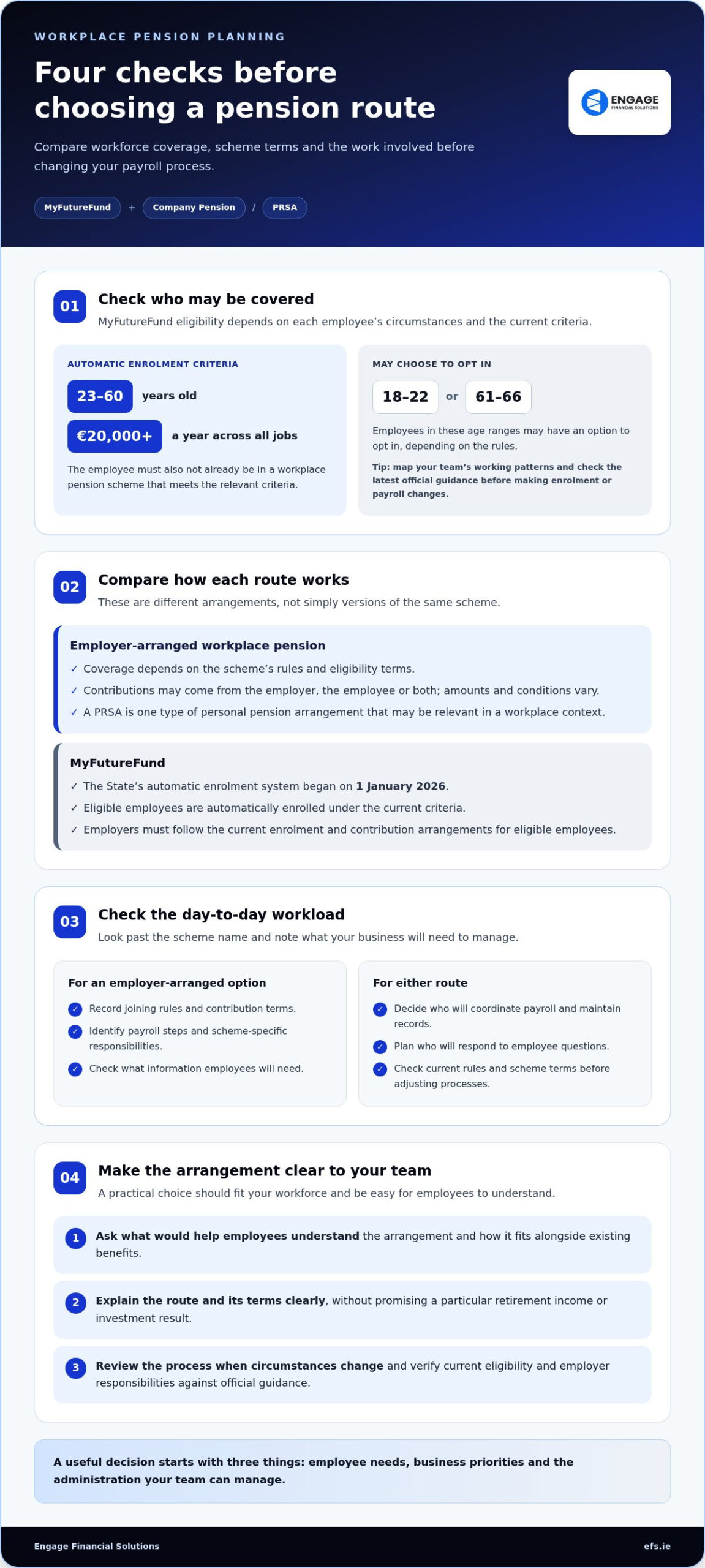
These routes aren’t simply competing versions of the same scheme. A Company Pension is an employer-arranged workplace arrangement, while MyFutureFund is the State’s automatic enrolment system for eligible employees. Comparing how each works helps you consider workforce coverage, contribution arrangements and the practical work involved.
| Consideration | Employer-arranged workplace pension | MyFutureFund |
|---|---|---|
| Who it serves | Employees covered by the particular scheme and its rules. | Employees who meet the current automatic enrolment criteria and aren’t already in a workplace pension scheme that meets the relevant criteria. |
| Participation | Depends on the arrangement’s eligibility and enrolment terms. | Eligible employees are automatically enrolled; other employees may have an option to opt in, depending on the rules. |
| Employer involvement | May include arranging contributions, coordinating payroll and meeting scheme-specific responsibilities. | Requires employers to follow the current enrolment and contribution arrangements for eligible employees. |
How an employer-arranged workplace pension differs
With an employer-arranged workplace pension, your business establishes or adopts an arrangement for employees. Contributions may come from the employer, the employee or both, but the amounts and conditions vary by arrangement. A PRSA, or Personal Retirement Savings Account, is one type of personal pension arrangement that may be relevant in a workplace context. Scheme terms determine how participation and administration work.
Look beyond the scheme name. Compare joining rules, contribution structure, payroll steps and the information employees will need. A useful way to do this is to record how each option handles access, contribution processing and routine administration, then check the details against relevant official guidance and scheme terms.
Where MyFutureFund fits into the decision
MyFutureFund began on 1 January 2026. Under the current criteria, automatic enrolment applies to employees aged 23 to 60 earning at least €20,000 a year across all jobs who aren’t already in a workplace pension scheme that meets the relevant criteria. Employees aged 18 to 22 and 61 to 66 may choose to opt in. Check official guidance before acting, as eligibility and employer responsibilities depend on current rules and each employee’s circumstances.
An existing payroll pension arrangement may affect whether an employee is enrolled in MyFutureFund, but don’t assume every scheme meets the criteria to count as an alternative. Check the relevant standards and how they apply to your workforce. This is separate from choosing an option based on your objectives, employee needs and capacity to administer it.
As you compare routes, note which employees may be covered, what payroll processes each option involves and who will explain it to your team. Engage Financial Solutions provides tailored Company Pensions guidance to help you assess the options alongside your wider business financial planning.
How to choose a pension arrangement that fits your workforce
The right arrangement needs to fit your employees’ circumstances and your business’s ability to manage it. Start with the workforce you have, rather than an assumed “typical” employee. A team with varied roles, working patterns or existing pension arrangements may need different information and processes from a more uniform group. This gives you a practical basis for comparing options without assuming one route suits every employer.
As you work through setting up a pension scheme for employees, consider three things together: employee access, the contribution approach and the ongoing work needed to administer and explain the arrangement. A feature that looks attractive in isolation may be harder to manage if it creates payroll steps or communication needs your business hasn’t planned for.
Questions to ask before selecting a scheme
Start by building a clear picture of what already happens. Review payroll records and existing benefit information, then note which employee groups may need additional support. Avoid assuming who has a pension or understands their options.
- What retirement provision do employees currently receive through payroll, and are there differences between teams or roles?
- Which groups may need clearer information about joining, contributions or how their arrangement works?
- Who will coordinate pension information with payroll, keep relevant records and respond to routine employee questions?
- How might recruitment patterns, part-time work or staff changes affect the process over time?
For example, if employees work different hours or join throughout the year, map how your proposed process will handle those situations. This is a planning prompt, not a substitute for checking each person’s position against current requirements.
Compare practical responsibilities, not just the scheme label
A scheme’s name doesn’t tell you how much work it involves. For each option, list the recurring tasks and assign responsibility for them. Consider how information reaches employees, how payroll will reflect the arrangement and how changes in employment or pension circumstances will be handled. Exact responsibilities depend on the scheme and current rules, so verify them before deciding.
Use a simple comparison document with a row for each option and these prompts:
- Access: Which employees may participate, and what steps explain their position?
- Contributions: How are employee and employer contributions determined under the arrangement?
- Administration: What information must payroll process, and who will maintain the supporting records?
- Communication: How will you explain participation, contributions and where employees can find further information?
Record the assumptions behind your comparison, including workforce details, current pension provision and who will manage each task. Then check those assumptions against up-to-date official guidance before making a final choice or changing payroll processes. If the rules or scheme terms don’t match your notes, revisit the comparison. This helps you select an arrangement that is workable for your business and understandable for employees.
Setting up a pension scheme for employees: a practical sequence
A clear setup process takes you from comparing pension routes to putting a workable arrangement in place. Keep a written record as you go. It helps your business apply decisions consistently, coordinate responsibilities and give employees reliable information. Use the steps below as a practical framework, and check the current rules that apply to your chosen arrangement.
From initial review to implementation
Before changing payroll or enrolment processes, confirm how current requirements apply to your business and employees. Check MyFutureFund eligibility and employer responsibilities, as well as the terms of any employer-arranged scheme, against current official guidance. Once those details are clear, agree the approach and coordinate implementation with payroll.
- Review existing provision. Map current pension arrangements and how they relate to employees across different roles and working patterns. Note any information gaps, but don’t assume one process covers everyone.
- Set out your aims and capacity. Record what you want the arrangement to achieve for employees and the business. Consider the administration your team can manage, including payroll coordination, record-keeping and handling questions.
- Compare suitable routes. Assess options against employee access, contribution arrangements, administration and communication needs. Keep scheme terms and current requirements alongside your comparison so decisions reflect the arrangement, not just its label.
- Assign responsibilities. Write down who will manage each task, from supplying or processing relevant information to preparing employee communications. Make responsibilities clear across the employer, payroll process and chosen scheme administration.
- Check the process before changes. Verify current eligibility, contribution arrangements and employer responsibilities against official guidance. Confirm that payroll instructions match the chosen scheme and reflect each employee’s circumstances before making changes.
- Communicate and keep a record. Explain the arrangement to employees in straightforward language, then save the information shared and decisions made. Review communications if scheme terms or official rules change.
Help employees understand the arrangement
Keep communications practical and easy to follow. Explain what the scheme is, how participation works, what contributions mean for employees and which choices may be available under the arrangement. Avoid presenting general information as a guarantee or as advice tailored to each person’s circumstances.
Give employees a clear route for scheme-related questions, distinguishing between payroll queries and questions about scheme terms. Use a consistent contact point or process within your business, and make sure the people handling enquiries have the same current information. If rules or arrangements change, check official guidance, then update employee materials and payroll instructions together.
Thoughtful implementation connects your pension decision with your business’s wider financial planning. Engage Financial Solutions provides Company Pensions guidance to help you assess your requirements and plan an arrangement. Discuss your Company Pension requirements with the team.
Get tailored guidance for your employee pension decision
Choosing between workplace pension routes is only part of the decision. You also need to consider your workforce, your business priorities and the practical steps needed to put an arrangement in place. A measured approach helps you move from understanding the options to making a decision that reflects your circumstances, without assuming one scheme will suit every employer.
Engage Financial Solutions provides Retirement Solutions, including Company Pensions, alongside financial planning guidance for businesses. Tailored guidance can help you bring workforce needs, business priorities and practical administration into the same discussion. For wider context on planning for later life, our retirement planning guide can help you consider how pension decisions relate to broader financial goals.
When tailored pension guidance can help
Guidance can be useful if you’re weighing MyFutureFund against an employer-arranged option, reviewing an existing arrangement or working out how a scheme could fit your payroll processes. It can help you organise the key considerations, identify details that need to be checked against current rules and connect employee provision with your business circumstances. Recommendations should reflect your requirements and the relevant scheme terms, not a one-size-fits-all assumption.
Setting up a pension scheme for employees can involve decisions across different parts of your business. For example, an arrangement may need to work for employees with varied roles while remaining manageable for the people coordinating payroll and communications. Assessing those factors together can make your next steps clearer.
Prepare for a useful first conversation
You don’t need every detail resolved before exploring your options. A concise overview of your workforce and current pension arrangements is a useful starting point. Bring questions as well as facts, especially where you need clarity on administration or employee information.
- Workforce: Note the broad mix of roles and working patterns, and where employees may have different needs.
- Current provision: Summarise what pension arrangements are already in place through payroll, if any.
- Operations: List questions about payroll coordination, record-keeping and who will manage recurring tasks.
- Communication: Consider what employees will need to understand about participation, contributions and where to direct queries.
- Rules: Identify eligibility or responsibility points that need checking against current official guidance before implementation.
This preparation can make it easier to discuss the decision in a focused way and identify what needs attention next. Whether you’re reviewing an existing approach or considering Company Pensions for the first time, Engage Financial Solutions can provide guidance tailored to your circumstances. Discuss your business pension needs with the team.
Make your next pension decision with confidence
Your next step doesn’t have to be a final decision. Start by identifying the questions that matter most to your business, such as how employee needs fit with your wider plans and what your team can manage in practice. A focused conversation can help clarify those priorities before you decide how to proceed with setting up a pension scheme for employees.
Engage Financial Solutions provides Retirement Solutions, including Company Pensions, alongside financial guidance for businesses. The firm describes its team as certified experts with decades of experience, and its website displays 64 Google reviews. This support can help you consider your pension decision in the context of your broader financial plans, without assuming a particular arrangement is right for every workforce.
Bring your questions, a high-level picture of your current arrangements and any payroll or communication concerns. From there, you can explore the considerations most relevant to your circumstances and plan a practical next step.
Discuss your business pension needs with Engage Financial Solutions and take a considered step towards supporting your employees’ longer-term financial planning.
Frequently Asked Questions
How do I set up a pension scheme for my employees?
Begin by confirming your current workplace pension obligations and identifying the arrangements employees already have. Then compare suitable options against your workforce’s needs, your business objectives and the administration involved. Before changing payroll or enrolment, check current official guidance and the chosen scheme’s terms. If employees work different hours or join at different times, include those situations in your process plan so they’re not overlooked.
Does every employer need to provide a workplace pension?
Employers must meet applicable workplace pension requirements, but the steps depend on current rules and employees’ circumstances. MyFutureFund applies automatic enrolment criteria, while a qualifying alternative arrangement may affect an employee’s position. Don’t assume an existing pension automatically meets the relevant standards. Review official guidance for your situation, record the basis for your decision and revisit it when your workforce or pension arrangements change.
What is the difference between MyFutureFund and a company pension?
MyFutureFund is the State’s automatic enrolment retirement savings system for eligible employees. A Company Pension is arranged by an employer, with participation, contributions and administration shaped by its scheme terms. The practical difference for your business may include how employees are covered and which processes you need to manage. An employee already in a qualifying arrangement may have a different MyFutureFund position, so check the current criteria rather than relying on the scheme name alone.
Can employees have a workplace pension and a personal pension?
An employee may have both a workplace arrangement and a personal pension, such as a PRSA, but the details matter. The workplace scheme’s terms, the employee’s wider pension savings and current tax rules can affect how contributions are treated. Avoid making assumptions about an individual’s eligibility or tax position. If employees ask, direct them to the scheme information and encourage them to seek guidance on their personal circumstances before changing contributions.
How do I choose a pension scheme for my workforce?
Choose by comparing your employees’ needs with your business’s capacity to administer the arrangement. Consider whether staff have different working patterns, existing pension provision or varying information needs. Then assess employee access, contribution arrangements, payroll tasks and how questions will be handled. Map the employee journey from joining to a change in work circumstances, noting where your process needs clear instructions or a current-rule check.
What information should an employer give employees about a pension scheme?
Give employees clear information about the arrangement, how participation works, how contributions are handled and what choices may apply to them. Explain where to find scheme documents and whom to approach with questions about payroll or scheme terms. Use plain language and avoid promising a particular retirement outcome. Keep a copy of what you share, and update it if the scheme or relevant official guidance changes.
How does setting up a workplace pension affect payroll?
A workplace pension can require payroll to process pension-related information and contributions in line with the chosen arrangement. The exact tasks depend on the scheme and current requirements, so agree the process with whoever manages payroll before making changes. Check how the system will handle new starters, changes in working circumstances and corrections. Keep written instructions and a clear route for resolving discrepancies, then review the process when the arrangement changes.
Disclaimer
Engage Financial Services LTD T/A Engage Financial Solutions is regulated by the Central Bank of Ireland CRO 764570. Suite 2 First Floor, 14 -18 Main street, Blackrock, Co Dublin. A94 W0Y3