


A mortgage protection waiver of premium is a temporary pause in paying policy premiums, not a change to the cover itself. To qualify for the three-month payment waiver, you needed evidence that your mortgage lender had approved a payment break. When the waiver ended, you had to resume premium payments to keep your cover in place.
Mortgage Protection is designed to repay the outstanding mortgage if the insured person dies before the loan is cleared. It is not the same as cover for monthly repayments after job loss, so first understand what your policy does and does not cover.
If you are weighing up cover, a possible waiver or the cost, the details can be difficult to untangle. This article explains what Mortgage Protection covers, who may qualify for a waiver, how the three-month payment pause works and what can affect premiums, helping you consider your options with greater confidence.
Key Takeaways
- Understand what Mortgage Protection is designed to cover, and how it differs from insurance for missed monthly repayments.
- Learn what evidence may be needed to qualify for a temporary premium waiver, including the role of an approved mortgage payment break.
- See how the three-month waiver works and what happens to your cover when the pause ends.
- Identify the personal and policy details that can influence your premium, so you can better understand what shapes the cost.
- Explore how Income Protection may fit into a broader plan for managing your mortgage commitments if your income is affected.
What is mortgage protection insurance?
Mortgage Protection is life insurance intended to repay the outstanding home loan if an insured borrower dies before it is cleared. Section 126 of the Consumer Credit Act 1995 makes life cover a statutory requirement for most residential mortgages, according to the Irish Statute Book.
Waiver of premium
A waiver of premium pauses policy payments in specified circumstances while the protection cover remains in place. Stopping payments without an applicable waiver can put your cover at risk. A premium waiver is not the same as a mortgage payment break: one concerns insurance premiums, the other repayments to your lender.
A waiver does not pay your monthly mortgage instalments or clear the loan. It changes whether you must pay premiums during the stated period. Read the policy terms to understand what event can trigger a waiver, how long it lasts and when payments must restart.
Lender requirements and discretion
A lender requirement is the life cover needed to secure a residential mortgage, while a waiver is an exception to that requirement. Irish mortgage lenders list being over 50 years old as a circumstance in which a lender may waive the mortgage life-cover requirement. A waiver is not automatic, so age alone does not mean the lender must approve one.
A lender may request medical evidence, insurer refusals or other supporting documents. If a health condition or diagnosis prevents you from obtaining cover, written evidence of refusal from three insurers may be required. The lender’s decision affects whether the mortgage can proceed without the usual protection cover, so keep relevant documents together when seeking a waiver.
Mortgage protection premiums and payouts also raise a separate tax question. Section 126 concerns the life-cover requirement, not the tax treatment of premiums or benefits; don’t assume that a lender’s requirement means premiums qualify for tax relief. Consider the policy’s tax position separately from its role in securing the loan.
For example, suitable life insurance you already hold may sometimes be assigned to the lender instead of taking out a new policy. Assignment means the lender receives the policy benefit towards the outstanding mortgage if the insured person dies. The lender and insurer must be notified, and the existing cover needs to suit the loan.
A waiver of premium also differs from Income Protection. A waiver pauses eligible insurance premiums under the policy terms; Income Protection is separate cover intended to support you if illness or injury affects your ability to earn. Neither means that Mortgage Protection itself covers monthly repayments after job loss.
When buying a home, consider the mortgage amount and term alongside any existing life insurance, your health history and occupation. These details help clarify what the cover is intended to do and what evidence may support a waiver request. Keep the lender’s requirements separate from the insurance policy’s terms to understand how each affects your mortgage and protection.
Eligibility for the payment waiver
Eligibility depends on which waiver you mean. A temporary pause in policy premiums has different criteria from a lender waiving the requirement for mortgage life cover. Keeping those decisions separate helps you provide the right evidence and understand whether your Mortgage Protection continues.
For the three-month premium payment waiver, customers had to provide evidence that their mortgage lender had approved a mortgage payment break. That approval was the key eligibility evidence for this waiver. A missed payment, reduced income or serious illness alone does not establish that this specific condition has been met.
Gather the lender’s approval record before applying for the premium pause. Make sure it clearly relates to your mortgage payment break and that the names and account details match your policy records. Accurate evidence helps the insurer assess your request against the waiver’s terms, rather than treating general financial difficulty as proof of approval.
Do not confuse this with a lender’s decision to waive the life-cover requirement. That decision concerns whether the mortgage can proceed without the usual life insurance. A premium waiver concerns payments for an insurance policy. Evidence of a lender-approved payment break relates to the latter arrangement; evidence about an illness or diagnosis may relate to a separate life-cover application.
Exclusions and limits depend on the policy wording. A payment waiver should not be treated as cover for every missed premium or as a promise that the mortgage balance will be repaid. Read the conditions to understand what event qualifies, how long the pause lasts and when payments must resume.
Adding or removing a waiver after taking out Mortgage Protection is a policy change, not an automatic adjustment. It must be processed under the insurer’s change procedure and revised policy terms. Ask your adviser how a change affects your premium, eligibility and protection cover before agreeing to it.
If your application involves illness, serious illness or a previous decline, keep the relevant insurer correspondence together. A decline from one insurer does not necessarily mean every insurer will refuse cover, as underwriting guidelines differ. Your adviser can help organise accurate information about your diagnosis, occupation and income for an application or appeal.
Before proceeding, separate the documents into three groups: lender approval for a payment break, policy details for the premium waiver, and medical or insurer evidence for life-cover decisions. This makes it easier to identify which condition applies and what remains outstanding. For support reviewing your mortgage protection options, bring those records to the discussion.
Mortgage protection premiums and pricing factors
Your premium reflects the cover selected and the information assessed by the insurer. For a Mortgage Protection policy, key considerations include your age, the amount insured, the cover term, nicotine use and medical history. These factors help determine the price and whether the insurer will accept the application on standard terms.
Age affects pricing because the insurer assesses risk over the policy term. Someone applying at an older age may pay more than a younger person seeking similar cover. The term matters too: longer cover can cost more because the insurer is providing protection for longer. The amount insured also affects the premium, as it sets the potential benefit available to repay your mortgage.
Nicotine use can affect the rate an insurer applies. Insurers use their own definitions of smoker and non-smoker, so your application should accurately reflect how each question is worded. Do not assume occasional use is treated the same way under every policy. Read the insurer’s definition and answer consistently, including questions about particular products or patterns of use.
Medical history is another pricing factor. A pre-existing condition or a finding from medical evidence may lead to further underwriting requirements or a premium loading, an added amount on the standard premium. A serious illness may affect the assessment differently from a resolved condition. Insurers assess health information individually, and different underwriting guidelines can produce different decisions.
The structure of the cover matters too. Adding Critical Illness Insurance as an optional extra can increase the premium because it adds a separate benefit. Consider whether that extra meets a specific need, rather than choosing it simply because it appears alongside life cover. The amount insured and term should also reflect the mortgage you need to protect.
If the quoted premium is difficult to manage, ask whether the insurer will consider a lower amount of cover or a shorter period. Either change can affect how closely the policy matches your mortgage, so weigh the lower cost against the protection you would give up. For example, shortening the term may leave part of the mortgage period without cover.
Before submitting an application, prepare accurate details about your age, nicotine use, medical circumstances, mortgage amount and required term. This helps the insurer assess your information consistently and reduces avoidable follow-up. If a medical report or examination is requested, provide the information needed to complete that step promptly.
Compare premiums alongside each policy’s purpose, term and exclusions, not as standalone figures. A lower premium may reflect a smaller benefit, shorter cover or different terms. The useful comparison is whether each Mortgage Protection option suits your circumstances and can help repay the mortgage if the insured person dies.
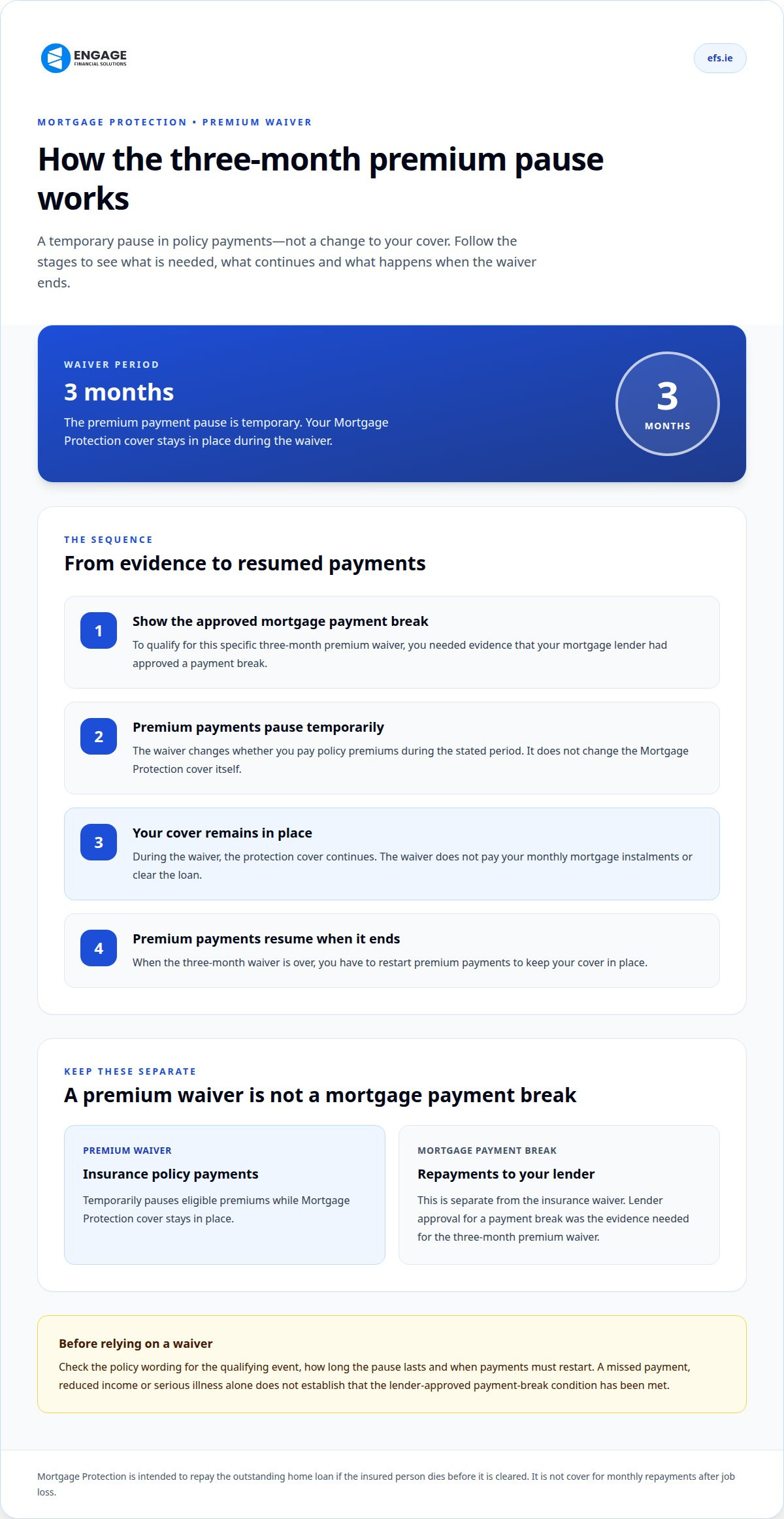
Three-month mortgage protection payment waiver
A three-month payment waiver concerns insurance premiums, not the amount owed on your home loan. Keep the insurer’s waiver terms separate from your mortgage repayment arrangements.
Waiting period before benefits begin
A waiting period is the time between meeting a qualifying condition and a waiver taking effect. The three months refer to the payment waiver period, not a stated waiting period before benefits begin. In your application, distinguish the period you are asking to pause premiums from any qualifying conditions in the policy wording.
Use the insurer’s terms to identify when the pause starts and ends. Include the lender’s approval of a mortgage payment break with your application, as that evidence was required for the three-month waiver.
Payments covered by the waiver
The waiver applies to eligible insurance premiums, not your mortgage repayments. You remain responsible for loan instalments under your mortgage arrangements; the waiver does not pay them or reduce the amount you owe.
For the three-month arrangement, customers needed evidence that their lender had approved a mortgage payment break. When the waiver ended, premium payments had to resume to keep the cover in place.
This distinction matters if your household budget is under pressure. A lender-approved break relates to loan repayments, while the waiver relates to the cost of maintaining insurance. One does not automatically replace the other. Review the approval document and policy terms together to see which payments each arrangement affects.
For example, if a lender approves a break from mortgage repayments, that approval is relevant evidence for the three-month premium waiver. It does not mean the insurer pays the mortgage instalments. The loan amount, repayments due and insurance premium remain separate figures in your financial plan.
Keep a record of the waiver start and end dates stated in the insurer’s decision. Before it ends, note when premium payments must restart and how the insurer expects them to be made. This helps prevent the assumption that a temporary pause continues automatically.
An adviser can help you distinguish a premium waiver from other protection benefits, including illness cover. These benefits serve different purposes: illness cover relates to an insured health event, while the payment waiver concerns premiums under its conditions. Read the relevant policy wording rather than treating “waiver” as assurance that mortgage repayments are covered.
If your application is refused, separate the reason for refusal from your lender’s decision on a mortgage payment break. The lender’s approval is relevant evidence for the waiver, but does not confirm that the insurer has accepted your application. Keep both decisions and their dates, then use the insurer’s stated terms to understand what happens next.
What is waiver of premium on Mortgage Protection insurance?
A Mortgage Protection waiver of premium is a policy feature that can pause eligible premiums when its conditions are met. It is intended to help keep the insurance cover in force for a specified period when you qualify, not to provide money towards your home loan.
That distinction shapes how to assess the feature. The waiver relates to the cost of the insurance contract; Mortgage Protection is intended to repay the outstanding mortgage if the insured person dies. A waiver does not replace that benefit, reduce the loan balance or make regular repayments on your behalf.
Think of the arrangement in three stages. First, the policy sets out the circumstances that may qualify and any evidence required. Next, the insurer assesses the application against those terms. If accepted, the waiver applies according to the policy conditions. Finally, premiums resume when the waiver period ends, so ongoing payments remain central to keeping the protection cover active.
A waiver is not a general promise to suspend payments whenever money is tight. The policy defines the qualifying event, evidence and process. For example, a lender-approved mortgage payment break was required as evidence for the three-month waiver discussed earlier. A change in income or an illness alone should not be treated as automatic qualification for that arrangement.
Before relying on the feature, read the policy schedule and wording together. The schedule identifies the cover you hold, while the wording explains the applicable conditions and restrictions. Look for the qualifying event, supporting documents, when the waiver can begin and what happens when it ends. These details help you plan for premiums to restart.
Consider how the waiver fits with the rest of your household finances. A mortgage payment break concerns payments to the lender; the insurance waiver concerns premiums to maintain the policy. If both arrangements are relevant, keep the lender’s and insurer’s decisions separate. This makes it easier to see which commitment is paused and which payments continue.
When reviewing a policy, note the waiver conditions beside the cover amount, term and premium. Then consider whether the cover still aligns with your mortgage and circumstances. If you’re arranging or reviewing Mortgage Protection cover, discuss how the policy’s waiver terms fit your needs before relying on them as part of your financial plan.
Engage Financial Solutions: Income Protection
Engage Financial Solutions can help you consider Mortgage Protection alongside Income Protection when planning for your home and household finances. Mortgage Protection addresses the mortgage if an insured person dies, while Income Protection is a separate part of planning for the effect of changes to your income. The right focus depends on the risk you want to address and how each option fits your wider financial commitments.
If you are reviewing cover after a mortgage payment break, comparing your protection needs with regular outgoings can help clarify your next steps. Engage Financial Solutions can discuss Mortgage Protection and Income Protection in the context of your circumstances, without treating a premium waiver as a substitute for either.
Contact Engage Financial Solutions to discuss your protection needs.
Make your next mortgage decision with confidence
As your mortgage plans change, make sure your protection decisions still fit your wider financial commitments. Whether you are buying your first home, purchasing a property to let or switching mortgages, consider how cover and household finances work together. A mortgage protection waiver of premium is one policy feature to assess, not a substitute for planning around your broader needs.
Engage Financial Solutions can help you explore First-time buyer mortgages, Buy-to-let mortgages and switching mortgages, alongside protection options relevant to your circumstances. Set out the decision you are facing and the outcome you want, then take the next step at a pace that feels right for you.
Contact Engage Financial Solutions to discuss your mortgage plans and move forward with greater clarity.
Frequently Asked Questions
How much do I pay?
You pay the premium set out in your policy schedule. Its amount reflects details such as your age, the amount insured, the cover term, nicotine use and medical history. For example, a policy covering a larger mortgage balance may have a different premium from one covering a smaller balance. Check your schedule for the amount and payment frequency that apply to your cover.
How much will it cost you?
The cost depends on your circumstances and the cover selected, including the amount insured, term, age, nicotine use, medical findings and any optional serious illness cover. There is no single cost that applies to every borrower. The price depends on your case and is provided after a quote request. To understand the quote, consider the premium alongside the cover amount and how long protection is needed.
What illnesses or circumstances can qualify for a premium waiver?
An illness does not automatically qualify you for a premium waiver; eligibility is determined by the policy’s stated conditions. For the three-month payment waiver, evidence that your mortgage lender had approved a payment break was required. Keep that approval with your policy documents. If illness or a diagnosis affects your ability to obtain life cover, that is separate from qualifying for a premium-payment waiver.
How long will an insurer waive Mortgage Protection premiums?
The payment waiver described here lasts three months. When it ends, premium payments must resume to keep the policy cover in place. Note the end date from the insurer’s decision and arrange for payments to restart rather than assuming the pause continues. The waiver concerns insurance premiums, so plan separately for any mortgage repayments due during the same period.
What exclusions and limitations apply to waiver of premium cover in Ireland?
The three-month premium waiver required evidence that the lender had approved a mortgage payment break; missed payments, reduced income or illness alone did not meet that condition. It does not cover every missed premium or pay mortgage instalments, and premiums must resume when the waiver ends. Other exclusions and limits depend on the policy terms.
Disclaimer
Engage Financial Services LTD T/A Engage Financial Solutions is regulated by the Central Bank of Ireland CRO 764570. Suite 2 First Floor, 14 -18 Main street, Blackrock, Co Dublin. A94 W0Y3