


The lowest headline tax rate does not automatically make an investment route the most tax-efficient. For Irish residents, tax-efficient investing depends on what you invest in, how long you hold it and whether you invest personally, through a company or in a pension.
It’s understandable to wonder whether ETFs are tax-efficient, particularly when their tax treatment differs from direct shares. This guide explains how ETF taxes and dividend withholding can affect returns, why pension contributions may offer valuable tax relief, and what company investing changes. Revenue says Irish pension contributions receive Income Tax relief at the contributor’s marginal rate, either 20% or 40%, subject to limits.
A company’s tax treatment is only part of the picture. Tax on investment income, access to your money and your longer-term plans all matter. The sections ahead compare personal and company routes, explain how pensions fit in and outline the considerations to weigh before deciding how to invest.
Key Takeaways
- Compare investing personally with investing through a company by looking beyond the headline tax rate to how and when you’ll access the money.
- Understand how fund and ETF tax treatment, including deemed disposal, can affect long-term returns.
- Allow for dividend withholding when estimating what you may receive from share investments.
- Consider pension contributions as part of your wider plan, weighing potential tax relief against the rules for accessing your savings.
- Bring your investment choices together with your retirement and protection needs to support your longer-term financial plans.
Should I invest through my company or personally?
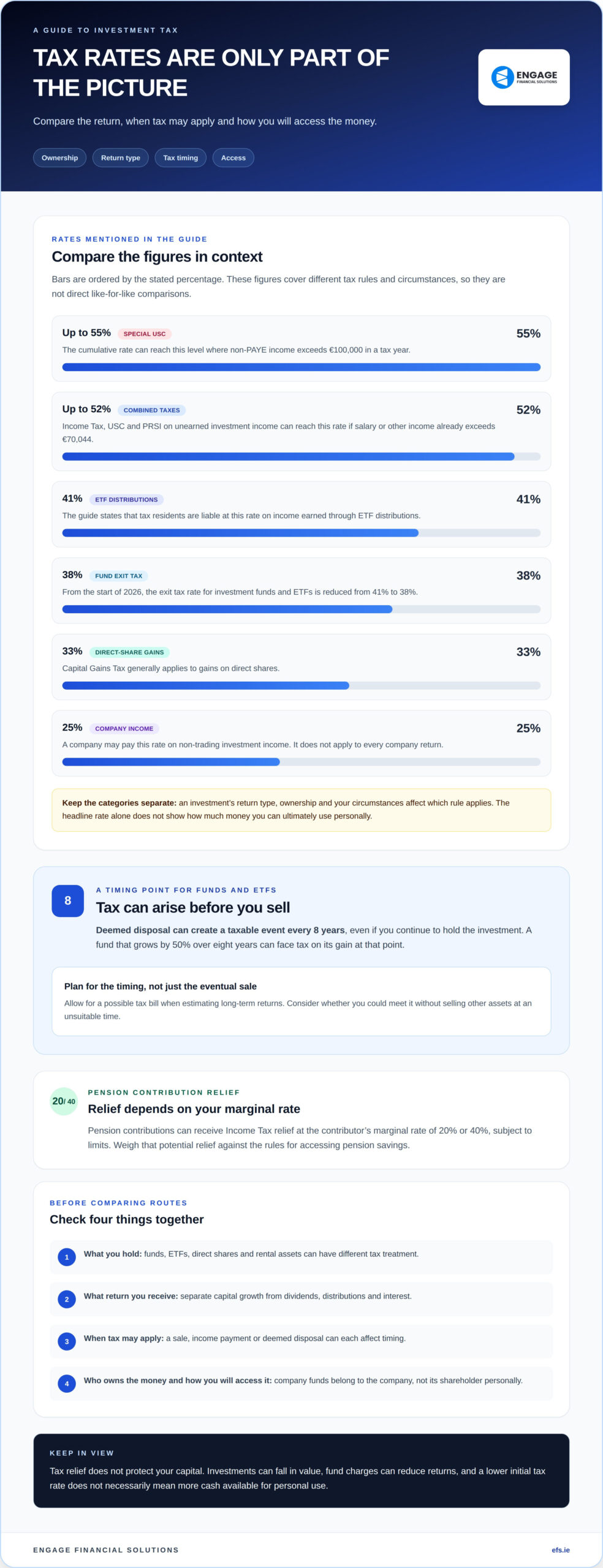
For tax efficient investing in the Irish market, compare ownership, return type and when you’ll need the money. A company may pay 25% tax on non-trading investment income, while personal investment income can face a higher combined rate. The headline rate alone won’t show how much wealth you can eventually use personally.
An individual’s combined Income Tax, USC and PRSI rate on unearned investment income can reach 52% if salary or other income already exceeds €70,044. A special USC rate can bring the cumulative rate as high as 55% where non-PAYE income exceeds €100,000 in a tax year. These rates concern investment income, not every gain or investor.
Company investing may suit you when profits can remain invested rather than being withdrawn for personal spending. The 25% rate applies to non-trading investment income, so don’t assume it applies to every company return. Separate interest, dividends and gains, then consider the company’s activity and asset type before comparing tax treatment.
Access matters too. Money held by a company belongs to the company, not its shareholder personally. If you may need funds for household spending, a home purchase or retirement, consider how withdrawing money could affect the overall result. A lower initial tax rate does not necessarily mean more cash is available to you personally.
For an individual, an annual €1,270 Capital Gains Tax exemption can apply to chargeable gains. Direct-share gains are generally taxed at 33%, while company investment income follows company rules. These aren’t directly comparable figures: return type, ownership and disposal timing all influence the outcome of tax efficient investing considered by residents of the Irish market.
Rental assets need their own comparison. Rental income is taxed at the investor’s Income Tax rate of 20% or 40%, and the combined rate can reach 52%. Repairs and loan interest are identified as allowable expenses that can reduce taxable rental income. Before buying property personally or through a company, consider rental income, deductible costs and access to eventual proceeds.
Withholding tax also affects dividend cash flow. Record the gross dividend and the tax withheld separately, whether you hold the investment personally or through a company. The amount deducted at source is not necessarily the final tax calculation.
For a practical comparison, list the investment, expected income, owner, tax during the investment period and access plan. Someone who needs income soon may value access differently from a company retaining profits for future investment. A financial adviser can help connect these decisions with your wider wealth and retirement plans.
Are Irish Tax Rules Holding Back Local Investors?
Investment funds, ETFs and direct shares can have different tax outcomes, even when they hold similar assets. The tax rate, timing of a disposal and type of return all matter when considering tax-efficient investing in the Irish market.
Taxation of funds and ETFs
Exit tax is the charge applied to certain investment fund gains or income, while deemed disposal taxes a holding before you sell it. From the start of 2026, the exit tax rate for investment funds and ETFs is 38%, reduced from 41%.
Deemed disposal means a taxable event can arise every 8 years, even if you keep the ETF. Gains may be taxable at that point, even if you have not sold the investment. For example, a fund that grows by 50% over eight years can face tax on its gain then. Include this potential bill when estimating long-term returns, rather than assuming tax waits until you sell.
Direct shares compared with funds
Direct shares are individual company holdings; a fund pools assets into one investment. For direct-share gains, the Capital Gains Tax rate is 33%, while investment funds fall under the fund tax regime.
These differences can affect both the amount and timing of tax. Selling a share may realise a capital gain, while an eight-year deemed disposal can trigger a tax event for a fund without a sale. Compare the investment structure and likely holding period, not just the companies or markets represented. Tax-efficient investing for Irish investors should account for both portfolio structure and tax timing.
Tax on dividends and interest
Shares, funds, dividends and interest do not all follow one tax rule. Direct-share gains may be subject to Capital Gains Tax at 33%; dividend income is taxed when received, while fund distributions and interest have their own treatment.
Irish tax residents are liable to tax at 41% on income earned through ETF distributions. Investment income from dividends and interest can also interact with Income Tax, USC and PRSI, depending on your circumstances. Separate expected capital growth from distributions when assessing returns, because receiving income and selling an asset can trigger different tax events.
Risks and costs of investing
Tax-efficient investing still involves market risk: an asset can fall in value, and tax relief does not protect your capital. Fund charges can reduce returns, while deemed disposal may create a tax bill before you sell or receive cash.
Before investing, compare the fund’s structure, charges, distribution policy and likely holding period. Then consider whether you could meet a tax bill at an eight-year disposal without selling other assets at an unsuitable time. A tailored review of your investment options can help bring tax treatment and investment aims into the same plan.
Dividend Withholding Tax
Dividend withholding affects the cash you receive, but it may not represent the full tax due on dividend income. When assessing returns and planning annual savings, distinguish the amount withheld from your final tax position.
Tax treatment of dividends
Dividends are payments made to shareholders from a company’s profits, and they can be taxable income for the recipient. Revenue says Irish resident companies must withhold Dividend Withholding Tax at 25% on distributions in the year they are made.
The amount deducted at source is not the same as the overall tax rate that may apply to you. Irish dividends may be subject to income tax and other applicable taxes, depending on your circumstances.
This distinction matters when comparing dividend-paying shares with investments focused on capital growth. Dividend income is taxed when received, while capital gains generally arise when you dispose of an asset. The annual Capital Gains Tax exemption applies to gains, not dividend income, so do not assume it shelters cash dividends. Estimate the net amount you may retain rather than judging an investment by its stated dividend alone.
Foreign withholding tax
Foreign withholding tax is deducted by an overseas company before it pays you a dividend. It reduces the cash reaching your account and can affect the value of holding shares from another country.
For dividends from US companies, withholding is 30% before payment. Filing a W-8BEN form with your broker can reduce that withholding to 15%. Keep the dividend statement and the amount withheld with your investment records.
Foreign withholding tax and Irish tax are separate parts of the calculation. Do not treat the overseas deduction as a complete account of your Irish tax position. Note the source country, gross dividend and tax deducted for each payment, then include these details when reviewing your annual income and investment returns.
For a practical comparison, record each dividend’s gross amount, withholding and net payment. This makes it easier to see how much income reaches you after deductions and to distinguish dividend income from gains on a sale. If dividends vary, use the actual payments rather than assuming a fixed annual amount.
Before choosing a dividend strategy, consider whether you need regular income or are investing for longer-term capital growth. A dividend can provide cash, but its tax treatment differs from that of a gain arising on disposal. Reviewing both outcomes can help you weigh potential savings against the timing and amount of tax deducted.
Pension contribution relief and withdrawals
A PRSA, occupational pension and personal pension can each offer tax advantages, but contribution rules and access differ. For tax-efficient investing, compare the relief available now with how pension savings are taxed when withdrawn.
A PRSA is a personal pension with tax-deductible contributions subject to age-related limits; an occupational pension is arranged through employment. Pension contributions can receive Income Tax relief at 20% or 40%, subject to age- and income-based annual limits. Outside pensions, dividends and interest remain subject to tax, while the €1,270 annual Capital Gains Tax exemption applies to gains, not investment income.
Pension contribution tax relief
Tax relief on pension contributions reduces the Income Tax you pay on eligible contributions, making each contribution more affordable after tax. Revenue says relief applies at your marginal, or highest, Income Tax rate, subject to limits. Employee contributions to occupational schemes do not receive relief from USC or PRSI, so the Income Tax saving does not reduce every payroll deduction.
For example, a contribution eligible for relief at 40% produces a larger Income Tax saving than one relieved at 20%. Your age and income determine the annual limit, so consider both before setting a contribution level. If you’re comparing a PRSA with a workplace scheme, include employer arrangements and the way contributions are handled.
Occupational pension contributions are tax-deductible, and Additional Voluntary Contributions can also qualify for relief within Revenue limits. These extra payments can build retirement savings alongside regular contributions. Distinguish your own contributions from employer contributions, then assess the applicable limits before deciding how much to add.
Tax-free pension growth
Tax-free pension growth means investments within a PRSA can grow without tax on investment growth while they remain invested. This can support compounding, where returns contribute to future growth. Shares and investment funds can both form part of a pension investment strategy, but their value can rise or fall.
Growth is not the same as tax-free access. Investment gains within a PRSA can grow tax-free, but withdrawals are subject to pension rules and tax treatment. The same distinction matters when comparing pension saving with an ordinary investment account: tax treatment during investment and tax due when accessing funds are separate questions.
At retirement, 25% of a pension can be taken tax-free on the way out. An Approved Retirement Fund can then provide an option for invested retirement savings, with its investments growing tax-free until accessed. Withdrawals from an ARF are taxed as income, so consider the timing and amount alongside other income.
Before choosing a contribution, compare the expected relief with your intended access date and retirement income needs. A PRSA, occupational pension and ARF serve different stages, from saving to drawing income. Keeping those stages distinct helps you plan contributions without overlooking how withdrawals may affect your future finances.
Company versus personal investing
The right ownership route depends on your tax position, investment income and when you need the money. A company may pay 25% tax on non-trading investment income, while personal investment income can face a higher combined rate. Compare the whole journey, including how company-held wealth may eventually reach you.
For an individual, the combined Income Tax, USC and PRSI rate on unearned investment income can reach 52% if salary or other income already exceeds €70,044. A special USC rate can bring the cumulative rate as high as 55% where non-PAYE income exceeds €100,000 in a tax year. These rates concern investment income, not every gain or every investor.
Company investing can look attractive when profits stay invested rather than being withdrawn for personal use. The 25% rate applies to non-trading investment income, so don’t assume it automatically applies to every company return. Separate interest, dividends and gains, then assess the company’s activity and the type of asset before comparing rates.
Access matters as much as the initial tax charge. Money held by a company belongs to the company, not its shareholder personally. If you need funds for household spending, a home purchase or retirement, consider how withdrawing money could affect the overall result. A lower initial tax rate may not mean more cash is available to you personally.
For an individual, an annual €1,270 Capital Gains Tax exemption can apply to chargeable gains. Direct-share gains are generally taxed at 33%, while company investment income is treated under company rules. This is not a like-for-like comparison: the return type, ownership and timing of disposal all influence the tax outcome.
Rental assets also need a separate comparison. Rental income is taxed at the investor’s Income Tax rate of 20% or 40%, and the combined rate can reach 52%. Repairs and loan interest are identified as allowable expenses that can reduce taxable rental income. Before buying property personally or through a company, model rental income, deductible costs and eventual access to proceeds.
Withholding tax is another cash-flow consideration for dividends. A company or individual may receive less than the declared dividend after tax is deducted at source, so record the gross payment and withholding separately. Compare the net cash received with the wider tax treatment rather than treating withholding as the final tax calculation.
A practical comparison should show the investment, expected income, ownership, tax during investment and personal access plan side by side. Someone needing income soon may value access differently from a company retaining profits for future investment. A financial adviser can help connect these decisions with your wider wealth and retirement plans.
For a tailored view of how personal and company investments fit your goals, review your investment approach as part of your wider financial plan.
Engage Financial Solutions
Engage Financial Solutions can help you consider investment decisions alongside your wider financial plan. This can be useful when comparing personal and company assets, planning for retirement or weighing future income needs against financial protection. Tax treatment is one part of the picture; your goals, access to funds and family commitments also shape your choices.
Through Financial Planning, you can consider long-term priorities alongside Company Pensions, Annuities, Mortgage Protection and Income Protection. The aim is to make each decision fit your circumstances, rather than view an investment choice in isolation.
If you’d like to discuss how your investment choices fit your wider plans, contact Engage Financial Solutions.
Make your next financial decision with purpose
Before making a change, write down what the investment is meant to support, when you may need access to it and who should own it. These aims give you a practical reference point as your circumstances evolve, whether you are building retirement savings, retaining money in a business or planning for family wealth.
It can also help to consider investments alongside major commitments. A home purchase, rental property or mortgage change may influence how much capital you can keep invested and for how long. Engage Financial Solutions offers Switching Mortgages, First-Time Buyer Mortgages and Buy-to-Let Mortgages, alongside Financial Planning, so you can consider these decisions within your wider plans.
For a considered next step, bring your investment questions and wider priorities together. Contact Engage Financial Solutions to discuss your plans and move forward with greater clarity.
Frequently Asked Questions
Are ETFs tax-efficient for Irish residents?
ETFs can offer diversified exposure, but their tax treatment may reduce returns compared with other investments. The fund’s structure, whether it distributes income and how long you hold it all matter. Before investing, read the fund’s tax information and estimate the effect of ongoing tax and deemed disposal. An ETF may suit your investment goals, but it is not automatically the most tax-efficient option.
Direct Shares vs Funds: Which Should You Use?
Choose direct shares if you want control over individual company holdings; consider a fund if you prefer exposure to a collection of assets in one investment. Tax treatment differs, so compare the type of return you expect, how often you may sell and the record-keeping involved. For example, someone seeking income from selected companies may weigh dividends differently from an investor focused on broad market exposure.
Is it worth paying a financial adviser for this?
A financial adviser may be useful if you are weighing several ownership routes, pension options or investment goals together. The value lies in understanding how each decision fits your circumstances, not simply choosing an investment by its headline tax rate. Before a discussion, note your goals, access needs and existing investments. Ask how the advice will address your overall plan, including retirement and financial protection.
Are investment tax rules due to change?
Whether the rules should change is a policy question, but investment decisions should be based on current treatment rather than possible future reforms. For example, distinguish the tax applying to a fund from the rules for direct shares and pension contributions. If a future change affects your plans, reassess your investment then; avoid delaying a decision solely because you expect tax rules to become more favourable.
What investment taxes apply to Irish residents, including Income Tax, CGT and exit tax?
Tax depends on the return and investment type. Dividends, interest and rental income can be subject to Income Tax, while a chargeable gain from direct shares is generally subject to Capital Gains Tax. Investment funds and ETFs have a separate exit-tax regime, including deemed disposal. Keep records of income received, assets sold and fund holdings, as each may have different reporting or payment implications.
What are the current Capital Gains Tax rate and annual exemption?
For chargeable gains from direct shares, the Capital Gains Tax rate is 33%, and an individual has an annual exemption of €1,270. The exemption applies to gains, not dividends or interest. For example, if you realise gains from more than one asset during the year, consider the combined gains when assessing the exemption. Keep disposal records so the figures can be calculated consistently.
How can pension contributions reduce tax, and what are the limits by age and income?
Eligible pension contributions can receive Income Tax relief at your marginal rate, which may be 20% or 40%. Revenue applies age- and income-based annual limits, so the amount eligible for relief depends on your circumstances. Revenue also states that employee contributions do not receive relief from USC or PRSI. Before increasing contributions, consider existing workplace payments and how much retirement saving you can maintain.
How does tax treatment differ for accumulating and distributing ETFs?
A distributing ETF pays investment income to you, while an accumulating ETF retains and reinvests that income within the fund. This affects when cash reaches your account, but does not by itself establish a different tax outcome. Consider the ETF’s structure and applicable fund rules, including deemed disposal. Decide whether you want regular cash flow or prefer returns to remain invested.
Disclaimer
Engage Financial Services LTD T/A Engage Financial Solutions is regulated by the Central Bank of Ireland CRO 764570. Suite 2 First Floor, 14 -18 Main street, Blackrock, Co Dublin. A94 W0Y3