


More investment choice does not automatically mean more tax relief. Non-Standard PRSA investments can include a wider range of assets than a Standard PRSA, while Standard PRSA charges are capped at 5% of contributions and 1% of the fund’s value a year. A Non-Standard PRSA is not subject to those standard statutory charge caps, so it’s important to understand the charges as well as the investment options.
It’s understandable to focus on the extra flexibility: the investments you choose can shape how your pension is managed over time. But the PRSA type, its charges and your tax-relief limits are separate parts of the decision. This guide explains how Standard and Non-Standard options compare, what a wider investment choice can involve, and how contribution tax relief works, so you can weigh the trade-offs with confidence.
Key Takeaways
- Compare contribution and annual fund charges together: a lower charge in one area may not mean lower costs overall.
- Standard PRSAs are limited to pooled funds, while Non-Standard PRSAs can provide a broader range of investments.
- Wider choice brings added responsibility: understand what an investment holds and how it fits your retirement plan.
- Choosing a Non-Standard PRSA does not itself increase your tax-relief limit; the applicable limit depends on factors such as your age and earnings.
- Use the comparison and decision guide to weigh flexibility, charges and investment suitability before choosing a PRSA.
Contribution charges and annual fund charges
Compare charges on contributions with charges on the fund itself. A Standard PRSA has statutory caps; a Non-Standard PRSA does not.
Contribution charges
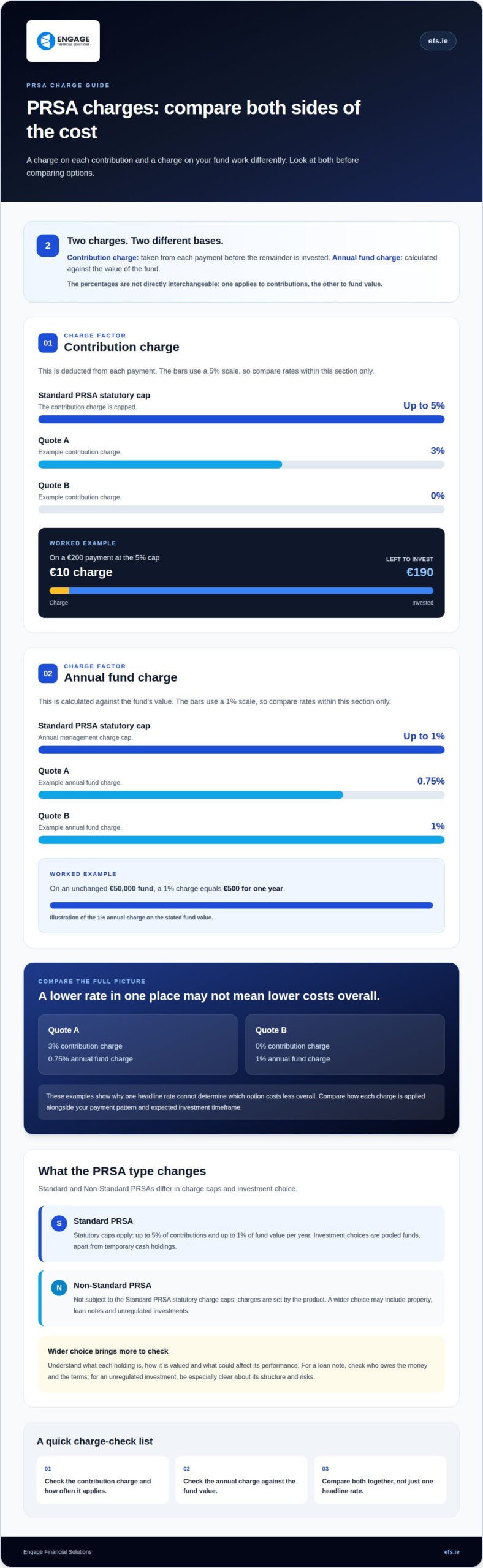
A contribution charge is deducted from each payment before the remainder is invested. For a Standard PRSA, the cap is 5% of contributions. On a €200 payment, that charge is €10, leaving €190 to invest. A Non-Standard PRSA has no equivalent standard statutory cap, so compare the actual rate and how often it applies.
Annual fund charges
An annual fund charge is calculated against the fund’s value, rather than each new payment. For a Standard PRSA, the annual management charge is capped at 1% of the fund’s value per year. On an unchanged €50,000 fund, a 1% charge equals €500 for one year. Non-Standard PRSA charges aren’t subject to that standard statutory cap.
Look at both charges together, as a lower contribution charge can sit alongside a higher annual charge. For example, Quote A has a 3% contribution charge and a 0.75% annual fund charge. Quote B has a 0% contribution charge and a 1% annual fund charge. These examples show why one headline rate cannot determine which option costs less overall.
How are Non-Standard PRSA investments valued and reported? PRSA assets are held off the provider’s balance sheet in an individual Unit Trust identifiable for you, and their value reflects the underlying investments. You should receive investment performance reports every 6 months and a statement of reasonable projection every year, showing estimated retirement benefits based on assumptions.
| Option | Contribution charge | Annual fund charge | Statutory cap |
|---|---|---|---|
| Standard PRSA | Up to 5% of contributions | Up to 1% of fund value per year | Both charges have stated caps |
| Non-Standard PRSA | Set by the product’s charges | Set by the product’s charges | Not subject to Standard PRSA charge caps |
Compare the combined effect of both charges against your payment pattern and expected investment timeframe, then check how each charge is applied.
Investment options and pooled funds
A Standard PRSA is restricted to pooled funds, apart from temporary cash holdings. A Non-Standard PRSA can offer a wider choice, including property, loan notes and unregulated investments.
How pooled funds work
A pooled fund combines money from many investors into a shared portfolio. A fund manager invests that pool according to the fund’s stated approach, so you choose between funds rather than selecting every holding yourself.
For example, a pooled fund might hold shares in several companies. Your exposure then comes from the portfolio as a whole, rather than from one company alone. Read the fund description to understand its assets, investment approach and risks before deciding whether it fits your retirement plan.
Standard PRSA investment choices are limited to pooled funds, apart from temporary cash holdings. That provides a defined framework, but it doesn’t mean every pooled fund has the same holdings or risk level. Compare the underlying assets, not just the fund’s label.
ETFs and index-tracking funds
An exchange-traded fund (ETF) is a fund traded on an exchange. An index-tracking fund aims to follow a particular market index rather than select investments to outperform it. These terms describe different features: “ETF” describes how a fund is traded, while “index-tracking” describes its investment approach.
Before considering either type within a PRSA, identify the specific fund and its holdings. Check which index it follows, which markets it covers, and whether it concentrates on particular companies or sectors. An index fund can still rise or fall with the assets it tracks; the label alone doesn’t tell you its level of risk.
Don’t assume every PRSA offers the same ETF or index fund choices. Focus on the investment options available under the arrangement and how each supports your intended asset mix.
Wider choices in a Non-Standard PRSA
A Non-Standard PRSA can include investments beyond pooled funds, such as property, loan notes and unregulated investments. That range may offer flexibility, but it also means you need to understand what each holding is, how it is valued and what could affect its performance.
For a property investment, consider the asset itself and how its value may change. For a loan note, understand who owes the money and the terms involved. With an unregulated investment, be especially clear about its structure and risks. Predicted performance is uncertain, so treat promises of better returns cautiously.
To compare options, write down each fund or asset, its role in your portfolio, and the risks you understand. Then consider whether the mix suits your retirement objectives. If you’re reviewing how pension choices fit your wider investment planning, take that broader picture into account too.
Comparing standard and non-standard PRSAs
The main differences are investment choice, charge limits and how much responsibility you take for understanding your holdings. Your PRSA category does not, by itself, increase the tax relief available on contributions.
| Criteria | Standard PRSA | Non-Standard PRSA |
|---|---|---|
| Investment options | Pooled funds, except temporary cash holdings | Wider choice, potentially including property, loan notes and unregulated investments |
| Charge limits | Statutory caps apply to contribution and annual fund charges | Not subject to the Standard PRSA statutory charge caps |
| Investment understanding | Choose between pooled funds and their stated approaches | Understand the structure and risks of each chosen asset |
| Contribution tax relief | Subject to limits based on relevant factors, including age and earnings | The PRSA category does not itself raise those limits |
A Standard PRSA may suit someone who prefers a fund-based framework. A pooled fund combines money from investors into a shared portfolio, so you select from available funds rather than building every holding yourself. The fund’s underlying assets still matter: two funds can have different exposures and risks, even within the same PRSA.
A Non-Standard PRSA allows a broader range of investments, but flexibility brings more decisions. Property, loan notes and unregulated investments can have different features, valuation methods and risks. Before selecting one, identify what it holds, how it is valued, what could affect its performance and how it fits with the rest of your retirement savings.
Charges also need a like-for-like comparison. Standard PRSA statutory caps set limits on contribution and annual fund charges. Those caps do not apply to Non-Standard PRSAs, so examine the actual charges and how they affect your fund over time. A low charge in one area does not automatically make an arrangement less costly overall.
Tax relief follows a separate test. The applicable contribution limit depends on factors such as your age and net relevant earnings, rather than whether you select a Standard or Non-Standard PRSA. For context, the earnings limit used for contribution tax-relief purposes was €115,000 for 2023. Choosing a wider investment menu does not create a higher relief allowance.
Use this sequence to compare the options:
- Decide whether pooled funds meet your preferred level of choice.
- List any wider assets you want and explain their role in your plan.
- Compare all charges, not just one headline rate.
- Assess contribution tax relief separately from investment selection.
The best fit is the PRSA whose charges, investment structure and risks you can understand and manage over your retirement timeframe.
Investment choice and regulation
Non-Standard PRSA assets can carry investment risks and liquidity limits: property may take time to sell, while repayment of a loan note depends on its terms. Before investing, understand how each asset is valued, what could affect its value and how readily it can be converted into cash.
A wider investment choice doesn’t remove the need for careful diversification. If a portfolio is concentrated in one property, borrower or unregulated investment, its value may depend heavily on that holding. Consider how each asset fits alongside the rest of your pension, rather than assessing it in isolation.
What regulation covers
Section 59AB of the Pensions Act 1990 sets out investment rules for occupational pension funds. That provision concerns occupational schemes; don’t assume its wording applies identically to every PRSA. The relevant question is how PRSA requirements apply to the provider and the assets offered within your contract.
The Pensions Authority has considered whether PRSA investment rules should place greater emphasis on regulated markets and diversification. Its consultation proposed requiring providers to ensure assets were invested predominantly in regulated markets and in a way that ensures diversification. It also sought views on collecting more detailed data about how contributors’ assets are invested.
The consultation response deadline was 5pm on 17 November 2025. Treat those points as proposals made through consultation, not as proof that the proposed requirements became law. For your decision, distinguish a consultation proposal from the rules that apply to your contract.
Assessing an investment’s risks
For each holding, establish what you own and what drives its value. A property investment has different considerations from a loan note or an unregulated asset. For a loan note, its terms and the borrower’s ability to repay matter. For property, consider how a sale might work and what influences the valuation.
Liquidity means how readily an investment can be sold or turned into cash. A listed fund may be easier to trade than a property holding, while a loan note may depend on its repayment terms. Don’t assume every asset can be sold quickly at its stated valuation. The timing and value of a sale can affect the flexibility of your overall pension plan.
Before choosing, use these steps to assess whether the investment is understandable and suitable:
- Describe the asset and how it could gain or lose value.
- Identify how its value is assessed and when it can be sold.
- Consider whether other holdings reduce or increase concentration.
- Read the contract terms for restrictions on transfers or access.
If you can’t explain how an asset works, pause before selecting it. A wider menu is useful only when you understand the risks, valuation and liquidity of the investments you choose.
Self-directed PRSA investment options
A self-directed Non-Standard PRSA can offer broader investment choices, but the contract sets the available options. Providers offering these arrangements differ, so compare the investment menu and terms rather than relying on a provider’s name alone.
Property, private equity and unlisted shares
A Non-Standard PRSA can invest in property, an example of an asset beyond the pooled-fund restriction that applies to a Standard PRSA. Private equity and unlisted shares are not interchangeable with property: they involve different ownership structures, valuation methods and risks. Whether a specific contract permits them depends on its investment terms, so identify the exact asset and the arrangement’s conditions before choosing.
For property, consider how its value is assessed and how it could be sold. For private equity or an unlisted shareholding, understand the company or fund structure and how investors realise value. These assets may be harder to value or sell than exchange-traded investments, which can affect the flexibility of your retirement portfolio.
Non-standard investment types
Non-standard investments are assets outside the pooled funds available under a Standard PRSA. Examples include property, loan notes and unregulated investments. Their features differ: property is a physical asset, a loan note represents lending under agreed terms, and an unregulated investment may have a less familiar structure.
A broader menu does not make every asset suitable for every saver. For each option, understand what it holds, what drives its value, how it can be sold and what could cause a loss. Predicted investment performance is uncertain, so be cautious about claims that a particular asset will deliver better returns.
Start by setting a clear purpose for each investment. Decide what role each holding should play in your pension, then consider how it fits alongside your other assets. A concentrated position in one property or company can expose your retirement savings to the fortunes of that single investment. Diversification means spreading investments across different assets, which helps avoid relying on one holding.
Next, read the PRSA terms for investment restrictions, valuation arrangements and any conditions affecting transfers. If you don’t understand how an asset works or how its value is established, it may not suit your plan. Focus on the underlying investment, not just the label “self-directed”.
A PRSA can be transferred to another provider without liquidating its assets. This can preserve investments during a move, but the receiving arrangement’s permitted assets and terms still matter. Check whether your chosen holdings can remain in place under the new contract, and understand any practical steps involved in the transfer.
To discuss how specific assets fit your wider retirement plan, talk through your investment choices.
Engage Financial Solutions: PRSA (Personal Retirement Savings Account)
Engage Financial Solutions can help you assess whether a PRSA fits your retirement plans and investment preferences. If you’re weighing broader investment choices against charges, risk and liquidity, consider how each option supports your wider financial picture. A clear comparison can help you make a more informed decision about the role of your pension.
You can also discuss how retirement planning connects with other financial priorities, such as protecting your income. Bring your questions about investment choices and the reasons behind them, so the discussion can focus on what matters to your circumstances. Contact Engage Financial Solutions to talk through your PRSA options.
Make your next pension decision with purpose
Your next step is to connect your pension choices with the future you’re building. Consider how your retirement plans sit alongside other priorities, whether you’re preparing for a first home, switching mortgages or considering a buy-to-let property. These decisions can influence the balance you want between long-term saving, accessible funds and investment risk.
Before making a change, write down what you want your pension to achieve and which investment decisions you feel comfortable managing. Use that starting point to discuss how Non-Standard PRSA investments could fit your wider financial plan, rather than treating the pension as a separate choice. A clear conversation can help turn complex options into a practical next step.
For support connecting your pension decisions with your broader financial goals, contact Engage Financial Solutions. Take the next step at a pace that feels right, with your longer-term plans in view.
Frequently Asked Questions
Does choosing a Non-Standard PRSA give me extra tax relief?
No. Choosing a Non-Standard PRSA doesn’t increase the contribution tax-relief limit. The limit depends on factors including your age and net relevant earnings, rather than your PRSA category or chosen assets. Keep tax relief separate from investment performance when comparing options. To plan contributions, consider your earnings, age and total pension contributions, then assess investment choices separately.
Does Non-Standard mean self-directed?
Not necessarily. “Non-Standard” describes a PRSA category with a potentially wider investment range, while “self-directed” usually refers to how investment decisions are made. A Non-Standard PRSA may offer more control over asset selection, but the contract and provider determine the available choices and process. Before choosing, establish who selects investments, who manages them afterwards and which decisions remain yours.
Does Standard mean lower risk?
No. “Standard” describes investment restrictions and charge caps, not a guaranteed risk level. A Standard PRSA can still hold funds exposed to market movements, and different pooled funds can have different assets and risk profiles. For example, a fund concentrated in shares behaves differently from one with a broader mix. Compare the holdings, investment approach and potential losses rather than treating the category as a risk rating.
Standard versus Non-Standard PRSA: which should I consider?
Consider a Standard PRSA if its pooled-fund choices suit your needs and you prefer that structure. A Non-Standard PRSA may be worth considering if you need access to particular assets and understand their risks, valuation and liquidity. For example, wanting exposure to a specific property may lead you to examine a wider investment menu. Decide by matching your objectives, knowledge and preferred level of involvement to the contract.
What investments can a PRSA hold?
A Standard PRSA is restricted to pooled funds, apart from temporary cash holdings. A Non-Standard PRSA can offer a wider range, including property, loan notes and unregulated investments. The actual selection depends on the arrangement’s terms, so a broad category doesn’t mean every asset is available in every contract. Identify the specific holding and its role before deciding whether it belongs in your retirement portfolio.
What rules apply to non-standard PRSA investments under the Central Bank?
The proposal discussed for PRSA investment oversight came from the Pensions Authority. It proposed that providers ensure assets were invested predominantly in regulated markets and diversified, and sought views on collecting more detailed investment data. A consultation proposal should not be confused with an enacted rule. For a specific PRSA, distinguish the applicable contract terms from policy proposals when assessing permitted holdings and investment oversight.
What fees and charges apply to Non-Standard PRSA investments?
There isn’t one universal charge rate for every Non-Standard PRSA. Compare the contribution charge with the annual fund charge, then check how each applies to your payments and holdings. Ask for the charges to be shown in a consistent format so you can assess their combined effect, rather than focusing on one headline percentage. Also consider whether the charging structure suits regular contributions, one-off payments or both.
What tax treatment applies to non-standard investments held in a PRSA?
The investment category doesn’t create a separate contribution tax-relief allowance. PRSA retirement benefits have their own tax treatment: the factsheet states that the first €200,000 of a retirement lump sum is tax free, the next €300,000 is taxed at the standard rate of 20%, and any balance above the stated limit can face marginal income tax of up to 40%, as at January 2023. These figures concern the lump sum, not a promise about investment returns.
Disclaimer
Engage Financial Services LTD T/A Engage Financial Solutions is regulated by the Central Bank of Ireland CRO 764570. Suite 2 First Floor, 14 -18 Main street, Blackrock, Co Dublin. A94 W0Y3