

Your first portfolio decision isn’t a minimum balance; it’s when you’ll need the money. To understand how to build an investment portfolio, start with an amount you can set aside after covering everyday needs and building an emergency savings pot. A common guide is to keep cash equal to 3-6 months of living expenses for emergencies.
It’s natural to wonder whether you need a large lump sum to get started. The amount that makes sense depends on your goals, timeframe and comfort with investment risk. Investments can fall as well as rise in value, so your portfolio should reflect your circumstances, not simply copy someone else’s.
This guide explains how to decide what you can invest, balance shares and bonds, and choose funds that suit your plan. You’ll also learn how to read fund information, check whether your holdings still match your goals, and adjust your investments as the time you need the money approaches.
Key Takeaways
- Set a target allocation between shares and bonds that reflects your goals and how much short-term fluctuation you can tolerate.
- Use diversified funds to spread exposure across regions, sectors and types of investment, rather than relying on a small number of holdings.
- Read fund information for its risk rating, underlying holdings and charges so you can see what you’re investing in.
- Review your portfolio once or twice a year and rebalance if its mix has drifted from your intended allocation.
- As a financial goal gets closer, consider whether you should reduce exposure to investments that can fluctuate sharply.
How much money do you need to build an investment portfolio?
There’s no single amount that suits every investor. Start with what you can invest without disrupting essential spending. Match your asset allocation to your goal, timeframe and tolerance for fluctuations: a longer horizon may allow for more shares, while a nearer goal generally calls for less risk.
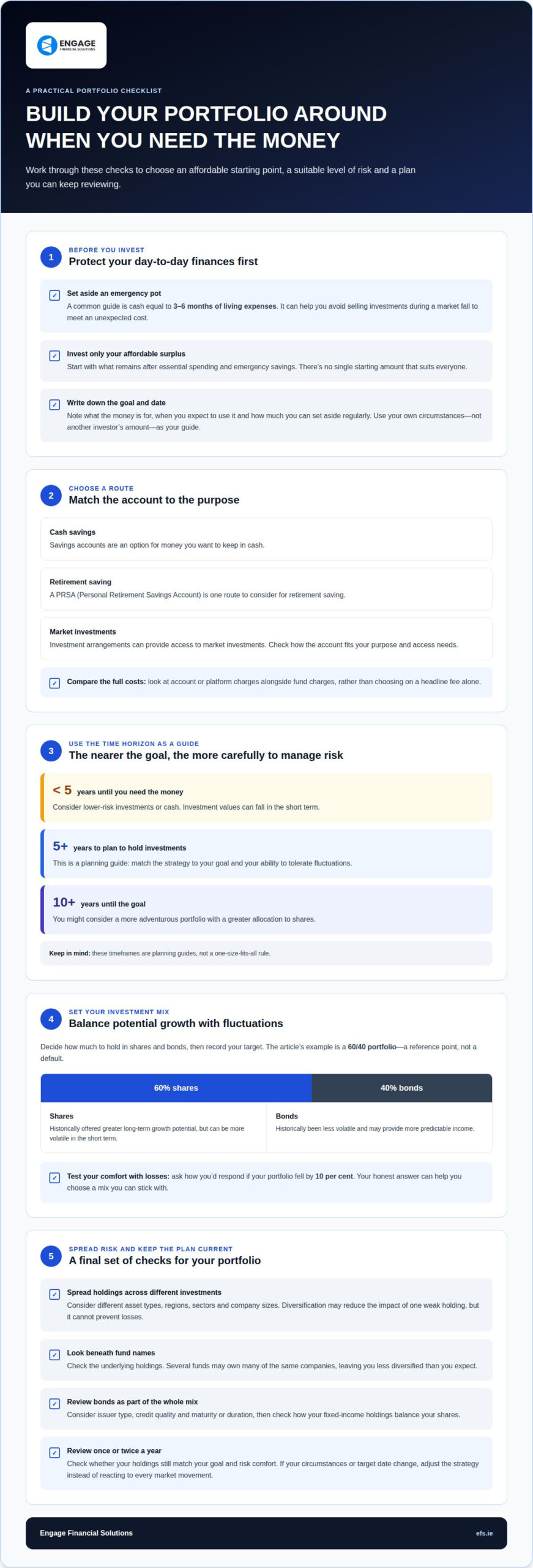
- Set a goal and protect your short-term finances. Write down what the money is for, when you expect to use it, and how much you can regularly set aside. Before investing, build an emergency savings pot covering 3-6 months of living expenses. This can help prevent you needing to sell investments during a market fall to cover unexpected costs. The amount to invest is the affordable surplus after essential expenses and emergency savings, not a target copied from another investor.
- Choose an account route for the goal. Options include savings accounts for cash, a PRSA (Personal Retirement Savings Account) for retirement saving, and investment arrangements for market investments. Platforms and account costs vary; compare any account or platform charges and fund charges together before choosing. Focus on how the account fits your purpose and access needs, rather than selecting a platform based on a headline fee alone.
- Match risk to the date you’ll need the money. Plan to hold investments for at least five years, because values can fall in the short term. If you’ll need the money within five years, consider lower-risk investments or cash instead. With a horizon of ten years or more, you might consider a more adventurous portfolio with a greater allocation to shares. These are planning guides, not a substitute for matching the strategy to your own goal.
- Assess your comfort with losses. Shares generally carry more risk than bonds, but offer greater growth potential. Ask yourself how you’d respond if your portfolio fell by 10 per cent: would you stay invested, or feel pressured to sell? Your honest response helps shape a risk level you can maintain. Potential returns usually come with risk, so don’t choose an allocation solely because it appears likely to grow faster.
- Spread investments and review the plan. Diversification means spreading investments across different assets, regions or sectors, so one weak holding has less influence on the whole portfolio. It can help lower volatility if one investment underperforms, though it can’t prevent losses. Review your holdings against your goal and risk appetite once or twice a year. If your circumstances or target date change, adjust the strategy rather than automatically copying another portfolio.
Strategic asset allocation across equity and fixed income
Choose a mix of cash, bonds and equities that reflects your goal, timeframe and risk tolerance. There’s no universal split: cash can support near-term needs, while the balance between shares and bonds affects potential growth and fluctuations.
-
Set an allocation across equity and fixed income
Decide how much of your portfolio to hold in shares and bonds, then record the target. A 60/40 portfolio, for example, assigns 60% to equities and 40% to bonds. Shares have historically offered greater long-term growth potential, but can be more volatile in the short term. Bonds have historically been less volatile and may provide more predictable income.
Treat that example as a reference, not a default. Check whether the mix suits your risk tolerance and purpose. A portfolio focused on preserving wealth may emphasise bonds; one with a longer growth horizon may hold more shares. Don’t set your allocation solely by age or copy another investor’s strategy.
-
Diversify across asset classes and sectors
Spread investments across asset classes, such as equities, bonds and, where suitable, commodities. Different assets can respond differently to changing market conditions, which may smooth some portfolio ups and downs. Diversification cannot remove investment risk or prevent losses. Account for cash needed for liquidity, but don’t treat it as a substitute for choosing an appropriate investment mix.
Within equities, spread holdings across sectors instead of relying heavily on one area, such as financials or resources. A broad mix can reduce the impact of a downturn in one sector. Check funds’ underlying holdings: several funds may own many of the same companies, giving you less diversification than their separate names suggest.
- Spread equity exposure across regions and company sizes. Include investments across different regions and businesses of different sizes, rather than concentrating on familiar local companies. International equity index funds can add overseas exposure. Check how much of your portfolio depends on one country or market, as a range of holdings can reduce concentration risk. Remember that international investments also bring currency movements into your portfolio’s results.
- Diversify bonds within their asset class. Consider how bond holdings vary by issuer type, credit quality and maturity or duration. Government and corporate bonds can have different characteristics, while maturity affects how a bond responds to changing interest rates. Review your fixed-income holdings alongside equities, not in isolation, so the combined allocation still reflects your intended balance of growth and stability.
Revisit your target mix when your goals or circumstances change, rather than reacting to every market movement. If you want help relating investment choices to your wider plans, explore your financial planning options.
Choosing investments such as index funds and ETFs
An ETF is a fund traded on an exchange, while an index fund aims to track a market index. Some ETFs are index funds. A mutual fund pools money from investors; an individual share gives you ownership in one company.
Tax treatment depends on the investment and account, so don’t assume ETFs, funds and individual shares are treated alike. Consider tax treatment and any reporting responsibilities before you invest.
- Start with the purpose of the money. For a college savings goal, identify when you may need the funds and how much flexibility you’ll want. Money needed on a fixed date has a different role from retirement savings that may remain invested for longer. A practical way to learn how to build an investment portfolio is to match each investment to its purpose, rather than selecting a fund because it recently performed well.
- Set the time horizon and growth objective. Retirement can involve a long investment period, and many people live for more than two decades after retiring. That can make it sensible to retain some shares in a retirement portfolio, depending on your income needs and appetite for risk. Consider how much growth you need and whether you could wait through a fall before withdrawing capital.
- Choose a fund structure that suits your approach. Index funds invest in a particular index and can provide exposure across asset classes. Ready-made investments combine several funds into one professionally managed portfolio. Compare each option’s holdings and objective, then look for overlap with investments you already own. A broad fund may make diversification simpler, while individual shares mean selecting and monitoring each company yourself.
- Check the fund’s strategy before investing. Read its objective, asset mix and underlying holdings to understand what may influence growth or losses. For example, a fund tracking a share-market index differs from one focused on bonds, even if both are ETFs. Check whether its regions, sectors and company sizes complement your existing investments. Include charges and the investment’s tax treatment in your comparison.
- Connect each choice to your wider plan. Record the goal, timeframe and reason for selecting each fund. For retirement saving, consider how a holding fits alongside your other retirement assets, rather than treating one investment as the whole plan. Understanding how to build an investment portfolio also means revisiting choices when circumstances change. Avoid adding funds just because their names sound different; their underlying holdings may overlap.
Reviewing fund fact sheets and holdings
Use each fund’s fact sheet to understand its risks, charges and investments. Then compare your actual holdings with your target allocation before deciding whether to make a change.
- Read the fund information before selecting an investment. Start with the fund’s objective and risk rating, which typically ranges from 1 to 7. Check what the fund holds, including its equity and bond exposure, regions and sectors. A fund’s name alone may not show whether it overlaps with another holding. For example, two funds with different labels could still invest in many of the same companies. Use the fact sheet to understand what each investment adds to your portfolio.
-
Check investment fees and their effect on returns
Compare the charges shown for each fund before you invest, and consider their effect over the full period you expect to hold it. A fund charging 2% annually instead of 0.2% annually can cost nearly 40% of potential returns over 30 years. That comparison shows why a seemingly small difference in charges deserves attention over a long investment horizon.
Consider each charge alongside the fund’s objective, holdings and risk rating, rather than choosing on cost alone. A lower charge doesn’t mean a fund’s exposure suits your plan. Compare charges across similar funds, and make sure you understand what the stated figure covers.
-
Set a portfolio review schedule
Set a regular time to review your portfolio, such as quarterly or every six months. Compare your holdings with your goal and target allocation, and look for changes in fund objectives, holdings, charges or risk ratings. A scheduled review helps you focus on material changes instead of reacting to daily movements in an exchange price.
Reviewing and rebalancing are related, but different, tasks. Investors are advised to check and rebalance portfolios once or twice a year to keep them aligned with their objectives. A review may identify a reason to act, but it doesn’t mean you need to trade every time you look.
- Rebalance when the allocation has drifted. Compare each asset class with its target weight. If shares have risen and now represent more of the portfolio, your exposure and volatility may exceed the level you originally intended. One approach is to rebalance annually or when an asset class moves more than 5% away from its target. Rebalancing means adjusting holdings towards the original mix, rather than chasing recent performance.
Before making a change, confirm that your original goal and risk tolerance still apply. If they do, use your target allocation as a guide. If your plans have changed, update the target first. This keeps decisions tied to your objectives rather than short-term market movements.
Adjusting investments as financial needs approach
As a goal gets closer, your portfolio’s purpose may shift from building wealth to supporting a planned withdrawal. Adjust gradually in line with when and why you’ll need the money, rather than making sudden changes in response to market movements.
- Work backwards from the spending date. Write down when you expect to use the money and whether you’ll need it all at once or in stages. For a planned lump-sum expense, a market fall just before withdrawal can have a different effect than for money used gradually. Use the withdrawal date to guide when you begin reducing exposure to investments that can fluctuate sharply.
- Move money needed soon towards cash. As withdrawals approach, consider moving the portion you’ll need into cash to help preserve its capital value. Keep the amount and timing linked to the actual spending plan, rather than shifting the whole portfolio automatically. For example, money set aside for an upcoming payment has a different purpose from investments you expect to keep invested for longer.
- Separate near-term and longer-term needs. Divide the plan into money needed soon and money intended to remain invested. This can help you avoid treating every holding as if it has the same deadline. If you expect to draw income over time in retirement, some investments may still have a longer role, while funds for nearer withdrawals need greater attention to potential short-term falls.
- Use age-based rules only as a starting point. One lifecycle approach subtracts your age from 100 to estimate the share allocated to stocks and funds. For example, at age 60, the calculation gives 40%. It’s a simple reference, not a complete strategy: it doesn’t account for your income needs, other assets, withdrawal schedule or appetite for risk. Adjust the result to fit those details.
- Review the plan when circumstances change. A change in retirement timing, expected income or spending needs can alter how much growth you need and how much volatility you can accept. Check whether the portfolio still supports each planned withdrawal, and increase or reduce exposure deliberately. Avoid becoming overly active in response to short-term price changes; prefer decisions tied to a clear objective and timeframe.
If an approaching goal is changing your investment decisions, plan your next investment steps with your wider financial picture in mind.
Engage Financial Solutions: Investments
Engage Financial Solutions can help you consider investments as part of your wider financial plan. This can be useful when your goals, income needs or expected withdrawals are changing, or when you want to review how your portfolio fits alongside other financial priorities. Discussing your objectives and comfort with investment risk can help shape decisions around the future you’re planning for.
If you’re ready to discuss your investment plans, contact Engage Financial Solutions.
Make your next investment decision with purpose
Your portfolio can evolve as your priorities change, so give future decisions a clear reference point. Write a short investment plan recording what you want your money to support, the decisions you’ve made and the circumstances that would prompt a review. This can help you avoid changing direction on impulse and keep later choices connected to your wider financial picture.
If you’re considering how to build an investment portfolio around your goals, bring your plan into a conversation about next steps. Discussing investment choices alongside your broader financial plans can help bring the pieces together, whether you’re investing for a future goal or planning for retirement.
Contact Engage Financial Solutions to discuss your investment plans. A considered next step can help you move forward with greater clarity.
Frequently Asked Questions
What is diversification?
Diversification means holding different types of investments so your results don’t depend on one company or market. For example, a portfolio could combine shares from different industries with bonds from different issuers. When reviewing your holdings, look beyond the number of funds: several may own the same large companies. Compare their underlying investments to see whether each holding provides genuinely different exposure.
What is risk?
Investment risk is the possibility that an investment’s value or income will change, including falling below the amount you invested. The level and type of risk vary. An individual company share depends heavily on that business, while a bond carries risks linked to its issuer and terms. Consider whether you could withstand a fall without selling at an unsuitable time, and match that comfort to your financial goal.
How often should you rebalance a portfolio?
Review your portfolio regularly and rebalance when its mix has moved away from your intended allocation. A practical schedule is once or twice a year, with extra attention after a major change to your goals or circumstances. Before trading, consider whether the difference is meaningful and whether your original target still suits you. Rebalancing restores your plan; it isn’t a response to every market movement.
What are ready-made investments?
Ready-made investments combine several funds into one portfolio managed as a single investment. They can suit investors who want a selected mix without choosing every fund themselves. Before investing, read the stated objective and check the underlying holdings, risk level and charges. Make sure the approach fits your needs rather than assuming a ready-made option automatically suits your circumstances.
What are the different types of assets?
Assets are broad categories that investments belong to. Common examples include cash, shares, bonds, property and commodities. Shares represent ownership in a company; bonds are investments issued by governments or businesses; cash is generally held for access and stability. Each category behaves differently, so consider its role in your plan rather than choosing it solely because its value has recently risen.
What are the steps to build an investment portfolio?
Start by writing down your goal and when you’ll need the money. Then decide how much risk you can accept, choose an allocation across suitable asset types, and select investments that provide the exposure you want. Review their holdings and charges before investing. Record your intended mix and the reason for each choice, so you can assess future decisions against a clear plan.
How should you diversify a portfolio across asset classes, regions, and sectors?
Spread investments across asset types, geographic markets and business sectors, then check what each fund actually holds. Several funds may still rely heavily on the same region or industry if their investments overlap. Look for concentration in a particular market, sector, issuer or company size. Diversification can reduce reliance on one area, but it cannot prevent losses.
How often should you rebalance an investment portfolio?
Set a consistent review date, such as an annual or six-monthly check, and compare your current allocation with your targets. Rebalance if a holding has drifted enough to alter the portfolio’s intended balance, rather than trading simply because prices moved. Consider whether a life change has affected your goal or timeframe. If so, revise your target first, then decide whether to adjust your holdings.
Disclaimer
Engage Financial Services LTD T/A Engage Financial Solutions is regulated by the Central Bank of Ireland CRO 764570. Suite 2 First Floor, 14 -18 Main street, Blackrock, Co Dublin. A94 W0Y3