

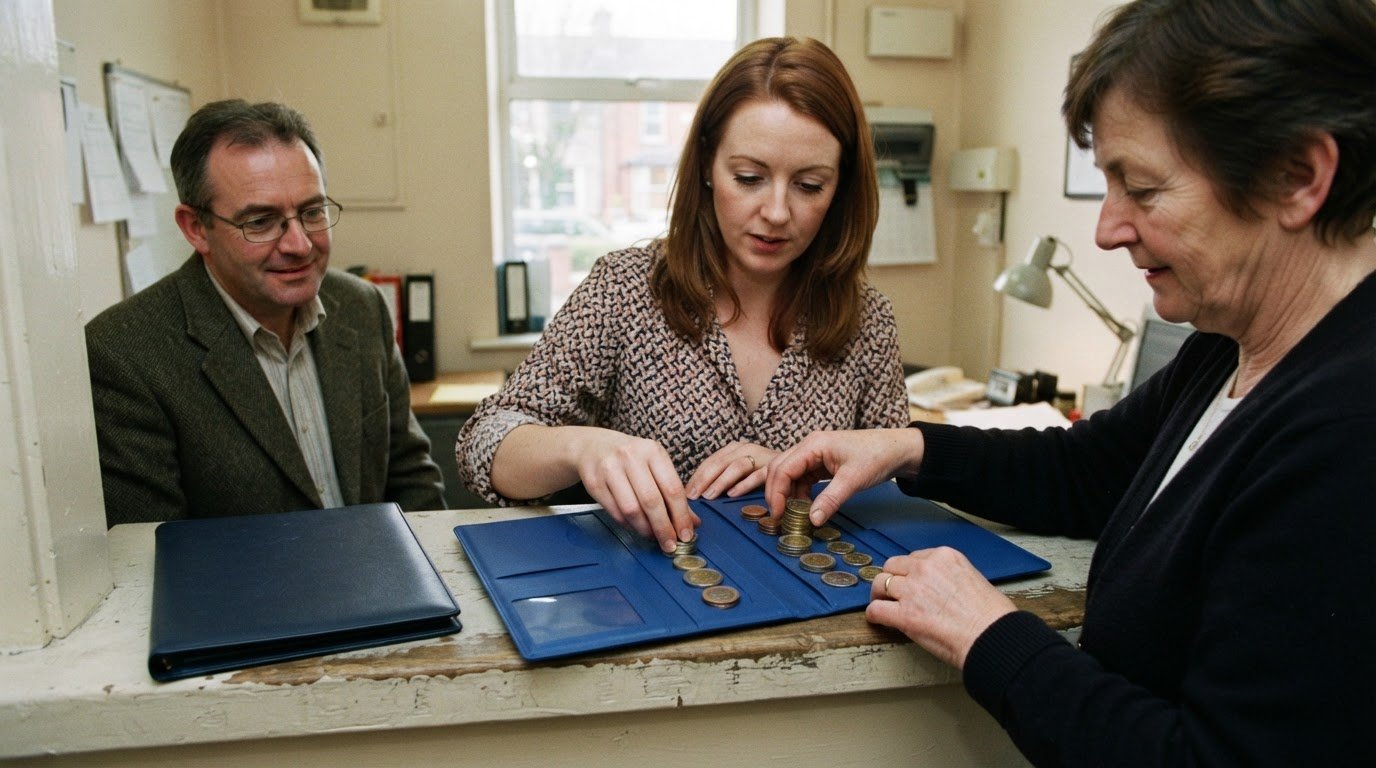
Having an occupational pension doesn’t automatically make a PRSA irrelevant. Managing your PRSA contributions alongside a workplace scheme helps you see how your savings fit together. Remember that age-related tax relief limits apply across your pension contributions, not separately to each account.
It’s understandable to want a clear view of how much you can contribute, what charges may apply and how employer payments are treated. This guide explains what a Personal Retirement Savings Account (PRSA) is, how contribution limits vary by age, the charges on a Standard PRSA and the tax relief available on personal and employer contributions.
You’ll also learn how a PRSA can work alongside an occupational pension, and why it may be useful to consider both when reviewing your retirement savings. Whether you’re building on a workplace pension or deciding where to direct further contributions, understanding the rules can help you plan more confidently.
Key Takeaways
- See how personal and employer payments can affect the tax treatment of your retirement savings.
- Use your age and earnings to understand how much of your contributions may qualify for tax relief.
- Learn which charges to look for when reviewing a Standard PRSA, and how they can affect your fund.
- Explore how a PRSA may complement an occupational pension, rather than replace it.
- Understand how tailored PRSA guidance can help you bring your pension decisions into a clearer plan.
Does an employer get tax relief on any contributions they make to an employee’s PRSA?
Yes. An employer can contribute to an employee’s PRSA and receive corporation tax relief on those contributions. For the business, company PRSA contributions are an allowable expense in the year they are paid, with no upper limit. This differs from personal tax relief: an employer payment is not a contribution for which the employee claims personal relief.
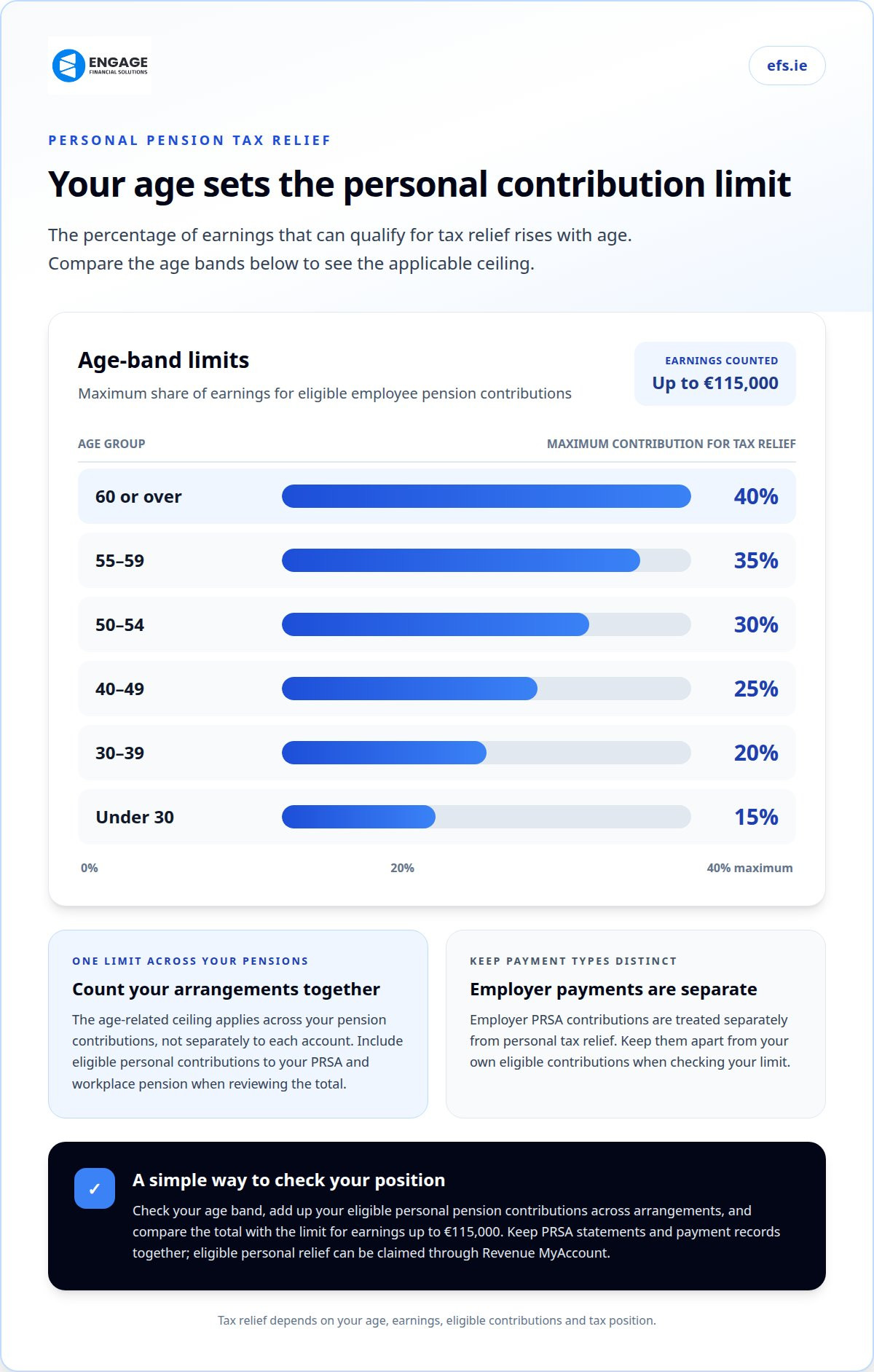
For personal contributions, tax relief reduces the income tax due on eligible pension payments. It doesn’t mean every contribution is tax-free, or that the full amount comes back to you. Revenue states that tax relief on employee pension contributions is limited to 15% of earnings for people under 30, rising to 40% for those aged 60 or over.
The age-related limits rise in stages. The maximum is 20% for ages 30-39, 25% for ages 40-49, 30% for ages 50-54 and 35% for ages 55-59. From age 60, the limit is 40%. These percentages apply to earnings up to €115,000, and the limits cover pension contributions across your arrangements, not just a PRSA.
To claim relief on eligible personal PRSA contributions, use Revenue MyAccount and enter the details for the relevant tax year. Keep your PRSA statements and payment records together so the amounts you enter match the contributions made. Relief depends on your age, earnings, eligible contributions and tax position. Employer contributions are treated separately from your own claim.
When choosing a PRSA contribution and investment strategy, start with an amount you can sustain alongside your current commitments. Then consider your age-related tax relief limit and retirement goals. Review the fund’s investment approach and charges before deciding, as both affect how your retirement savings may build over time.
You can increase, reduce or stop PRSA contributions at any time without a charge or penalty, according to The Pensions Authority. If you pause payments, record the date and amount of your last contribution, then revisit your plan when your income or commitments change.
You can transfer an occupational pension to a PRSA; a certificate of comparison is exempted when the transfer value is under €10,000. Before deciding, compare the transfer value and the benefits being moved, rather than treating a transfer as a new contribution eligible for relief.
If you change jobs, you can take your PRSA account with you, so you don’t have to cash it in when you change employer. Retirement and moving abroad can involve different access and tax considerations. Don’t assume either event automatically makes your fund available.
For example, an employee may make personal PRSA payments while also receiving employer contributions. Keep the amounts separate when reviewing annual pension contributions: personal tax relief limits apply to the employee’s eligible payments, while employer contributions receive separate corporation tax treatment.
Employer PRSA contributions
Yes, an employer can contribute to your PRSA. Employer contributions have no upper limit based on salary, service, retained benefits or marital status. The limits on tax relief for your personal contributions do not set a maximum employer payment.
Employer Contributions and Tax Treatment
An employer PRSA contribution is paid by your employer into your retirement account. It can build your retirement fund without coming from your take-home pay, so it’s useful to distinguish it from your own deductions.
Employer contributions are allowed as a business expense in the year paid, with no upper limit. The Finance Act 2022 removed the benefit-in-kind charge on employer PRSA contributions. This means the payment is not treated as a taxable employment benefit for you under that charge. The employer’s corporation tax treatment and your personal contribution relief are separate matters.
Because there is no maximum tied to salary or service, an employer can decide the contribution amount without those restrictions. This does not change the age-related limits on tax relief for your personal pension contributions. Keep employer payments separate from your own when reviewing annual contributions and relief.
Payroll Deductions and Payment Deadlines
Payroll deductions come out of your pay and are passed to your PRSA provider by your employer. Separating your deduction from the employer’s payment helps you track what has reached your retirement account.
An employer must send deducted employee contributions and its own PRSA payments to the provider within 21 days after the end of the month in which contributions were deducted. For example, payments deducted in a month must be forwarded within that deadline after the month ends. This timing matters because the payroll date and the date the provider receives money are not necessarily the same.
When reviewing your payslip and PRSA statement, compare the employee deduction with the amount credited, then identify any employer payment separately. If the amounts or payment periods don’t match, raise the specific discrepancy with payroll. Keep the relevant payslip and account statement together as a clear record of deductions and credited contributions.
For a director who is also an employee, the same distinction applies: identify payments made personally and those made by the company. Employer contributions have no maximum based on salary, service, retained benefits or marital status, while personal contributions eligible for tax relief remain subject to age-related limits. Keeping them separate helps you avoid treating every payment as eligible for personal relief.
Employers can choose a contribution arrangement that fits their payroll process, while employees benefit from seeing the amount and timing clearly. Review the PRSA statement alongside payslips, especially after a change to payroll deductions. For support with the wider pension picture, explore pension planning guidance.
Age-related contribution limits
Age-related percentages set the maximum share of earnings that may qualify for pension tax relief. They limit tax-relievable contributions; they are not a fixed amount everyone must pay into a Personal Retirement Savings Account.
Your age determines the applicable percentage for the tax year. The limits are:
- Up to age 29: 15% of net relevant earnings.
- Ages 30-39: 20% of net relevant earnings.
- Ages 40-49: 25% of net relevant earnings.
- Ages 50-54: 30% of net relevant earnings.
- Ages 55-59: 35% of net relevant earnings.
- Age 60 or older: 40% of net relevant earnings.
Revenue describes the overall range as 15% of earnings for people under 30, rising to 40% for those aged 60 or over. The percentage applies to earnings up to €115,000. For example, if your earnings exceed that cap, the excess does not increase the earnings figure used for this relief limit. Your age and eligible earnings therefore both affect the maximum tax-relievable contribution.
Professional athletes have a separate limit: 30% of earnings, regardless of age. That means the age bands above don’t determine the percentage for an athlete in this category. If you have relevant earnings from more than one source, distinguish eligible earnings from other income when working out the limit.
There’s no single minimum payment that every PRSA holder must make. These are maximum permitted minimums, not required contribution amounts. Check how your chosen payment frequency fits the provider’s stated minimum.
Contributing less than you intend may mean building less retirement savings than planned. Contributions above the applicable tax relief limit do not qualify for relief, so consider your earnings, age and other pension payments before setting a regular amount. A lump sum may also count towards the relevant limit. Paying into a retirement savings account does not create a separate relief allowance.
To make managing your PRSA contributions more straightforward, review your age band and eligible earnings annually, particularly after a birthday or salary change. Your contribution amount should also reflect what you can sustain alongside current commitments. A PRSA can generally accept contributions until your 75th birthday, giving you a further point to include when planning how long to contribute.
What are the charges for standard PRSAs?
A Standard PRSA has limits on two main charges: the amount taken from each contribution and the annual charge on your fund. These caps apply throughout the lifetime of a Standard PRSA contract. Knowing the difference helps you see how charges affect both the money invested now and your retirement fund over time.
The contribution charge is capped at 5% of each payment. The fund charge is capped at 1% of the fund value each year. These examples show the maximum permitted charges, not a promise that every provider charges the maximum.
When reviewing a Standard PRSA, keep its two charges separate:
- Contribution charge: up to 5% of each contribution paid.
- Fund charge: up to 1% of the fund value each year.
A charge on each contribution affects how much is invested straight away. An annual fund charge is calculated against the fund value, so the euro amount can change as the fund rises or falls. Consider both figures together rather than focusing on just one.
The standard fund threshold is currently €2,000,000. This figure is relevant when considering the Standard PRSA’s prescribed charging structure; it does not mean your fund will reach that value or determine your retirement income. Check the contract’s stated charges and how they apply to contributions and fund value, particularly if you are comparing a PRSA with an occupational pension scheme.
A Non-Standard PRSA has no maximum charge set. That doesn’t mean every Non-Standard PRSA costs more, but the caps described above don’t provide the same ceiling. Review the charges for the specific contract, including deductions from contributions and charges based on fund value.
Investment performance affects fund value, while charges reduce the amount retained in the account. As a practical step, note the contribution charge, annual fund charge and allocation rate together. This gives you a clearer view of how a pension may support future retirement savings or an annuity, without treating one headline percentage as the whole cost.
Making PRSA contributions alongside an occupational pension
A PRSA can sit alongside an occupational pension scheme, providing another way to build retirement savings. The key question is how each arrangement fits your overall plan, particularly if you already receive pension contributions through work.
You don’t have to use only the PRSA arranged by your employer. Employees can make direct contributions to another authorised PRSA provider, giving you a choice about where your personal contributions go while keeping the workplace scheme in place. The arrangements remain separate, so keep their statements and payment records distinct.
Tax relief is another reason to review both arrangements together. Age-related limits apply across your pension contributions, rather than giving each account a separate allowance. Before increasing a PRSA payment, add up your personal contributions to the occupational scheme and any other relevant pension payments. This shows how your total compares with the relief limit for your age and earnings.
Employer payments are different from your own contributions. An employer can contribute to an employee’s PRSA, but that payment should not be confused with a personal salary deduction when you review tax relief. Keep separate records of your payroll deductions, employer PRSA payments and contributions to the occupational scheme. This gives you a clearer picture of how each pension is funded.
Consider what you want an additional PRSA to do. It may provide a separate route for personal contributions or help you continue saving when your work situation changes. A PRSA can stay with you if you change jobs or take a career break, so it needn’t be tied to one employer. Whether you contribute regularly or at different times, keep track of the total.
Returns and charges also matter when you have more than one pension. Investment returns can rise or fall, and charges affect the amount that remains invested in each arrangement. Review your PRSA and occupational scheme statements together, noting each fund’s value, investment approach and charges. This can help you assess whether the arrangements still match your retirement plans.
A transfer is a separate decision from making new contributions. Moving benefits from an occupational scheme into a PRSA changes where existing pension savings are held; it isn’t simply a new contribution. Consider the benefits being transferred and how the receiving PRSA would fit alongside any pension benefits you keep.
For a joined-up view of workplace and personal pensions, discuss your pension arrangements as part of your broader retirement planning.
Engage Financial Solutions: PRSA (Personal Retirement Savings Account)
Engage Financial Solutions can help you consider a PRSA as part of your wider retirement planning. If you’re weighing contributions alongside an occupational pension, reviewing charges or working out how your savings fit your future plans, a conversation can help clarify the options for you.
A PRSA is one part of your longer-term financial picture. Your priorities may change as your career, income and retirement plans develop, so it’s useful to review how your pension arrangements work together. Engage Financial Solutions also offers Income Protection, Group Protection and Annuities, which may support different stages of your financial planning.
To discuss your PRSA and pension arrangements, contact Engage Financial Solutions.
Make your next pension decision with confidence
A useful next step is to connect your pension decisions with the future you want to support. Consider what financial flexibility in retirement means to you and how your savings fit alongside other priorities. This gives you a personal reference point, rather than prompting changes simply because a particular contribution amount seems customary.
Managing your PRSA contributions is an ongoing decision, not a one-off task. Revisit your priorities when your circumstances or plans change, and keep a clear record of your decisions. If you’re unsure how your PRSA fits into your wider financial plan, speak with Engage Financial Solutions to explore your options and decide what to consider next.
Arrange a conversation with Engage Financial Solutions about your pension planning. A considered plan can help you move towards the retirement you have in mind, one decision at a time.
Frequently Asked Questions
What is a PRSA?
A PRSA, or Personal Retirement Savings Account, is an individual pension arrangement for building retirement savings. You can take one out whether you’re employed or self-employed. The account can stay with you if you change jobs or take a career break, so it isn’t tied to one employer. Before deciding what role it should play, consider how it fits alongside any workplace pension.
How can I pay my contributions?
You can pay PRSA contributions monthly, quarterly, half-yearly or annually, or make a once-off lump-sum payment. Choose a pattern that fits your income and regular budget, then record payments made during the tax year. If your circumstances change, you can increase, reduce or pause contributions. Your provider may require notice before a payment change takes effect.
Does an employer have to contribute to PRSAs on behalf of their employees?
An employer can contribute, but providing access to a PRSA is different from paying contributions into it. An employer without an occupational pension scheme must provide access to at least one Standard PRSA. Employees who aren’t entitled to join a pension scheme within six months of service must also be given access to a PRSA. Access alone doesn’t mean the employer is paying contributions on an employee’s behalf.
How can you boost your pension?
You can increase your pension savings by raising your PRSA payments or adding a lump sum, while accounting for other pension contributions and your tax relief limit. For example, after a pay rise, you could review whether a higher regular payment fits your budget. Investment growth isn’t taxed during the PRSA term, although fund values can rise or fall with investment performance.
How do I keep up to date with how my PRSA pension is doing?
Use your provider’s statements to track contributions, fund value and investment performance. A PRSA holder should receive an account statement and investment performance report every six months. The annual statement of reasonable projection estimates retirement benefits using assumptions, so it is not a guaranteed outcome. Keep these documents together and review them periodically to see how your savings are progressing against your plans.
How do PRSAs work?
Your contributions go into a retirement account and are invested, so the fund value can rise or fall with investment returns. Investment growth isn’t taxed during the PRSA term. Benefits can normally be taken from age 60; access from age 50 may be possible if you retire from an employment. At retirement, you can consider the available options for using your accumulated fund.
How much will it cost?
Charges depend on whether you choose a Standard or Non-Standard PRSA and on the contract terms. A Standard PRSA has maximum charges for contributions and fund value; a Non-Standard PRSA has no maximum charge set. Read the charges together, including amounts deducted from contributions and any charge based on your fund, to understand their effect over time.
Is there a minimum amount that I must contribute to my PRSA?
There’s no single minimum contribution that applies to every PRSA. These are limits on the minimum a provider may require, not amounts every holder must pay. Check how the stated minimum works with your chosen payment frequency.
Disclaimer
Engage Financial Services LTD T/A Engage Financial Solutions is regulated by the Central Bank of Ireland CRO 764570. Suite 2 First Floor, 14 -18 Main street, Blackrock, Co Dublin. A94 W0Y3