


What if the answer to how much you need to retire at 60 isn’t one savings figure, but a plan for the income you’ll need at each stage? It’s understandable to want a clear target, especially when pension access rules vary and your savings may need to bridge the years before State Pension income begins.
Retiring at 60 is an income plan, not a single savings target. Your estimate depends on the lifestyle you want, household costs, pension arrangements and other resources. Looking at these together can give you a clearer picture than relying on a generic figure.
This guide explains how to estimate your retirement income target and consider how pensions, savings and investments could contribute. You’ll look at pension access, income timing and changing costs, then identify practical next steps to shape a plan around your circumstances, whether you’re approaching retirement or preparing well in advance.
Key Takeaways
- There’s no single savings figure that suits every household. Start with the lifestyle and spending you want your retirement income to support.
- Estimate your income gap by subtracting dependable income from planned spending, then identify which resources could help cover the difference.
- Compare pensions, PRSAs, ARFs, Annuities, Savings and Investments by their role and flexibility before deciding how they might fit into your plan.
- Test your estimate against changes in retirement timing, spending, inflation and investment performance to see where your plan may need more flexibility.
- Gather your pension statements, map when income may become available and compare different scenarios to set practical next steps.
Retiring at 60: Start With the Life You Want
There isn’t one retirement figure that suits every household. The amount you need depends on the life you want to lead, the commitments you’ll keep and the income you can rely on. A useful target combines the resources and dependable income needed to cover your planned spending. It isn’t simply a large pension balance.
Start with your own circumstances rather than a generic savings benchmark. Someone who has paid off their home and expects modest day-to-day costs may have different needs from someone still paying a mortgage, supporting family or hoping to travel regularly. Build an estimate around your choices, and review it as those choices change.
Keep the two sides of your estimate separate:
- Planned spending: what you expect to spend on essentials and the lifestyle you want.
- Income and resources: money you expect from pensions, Savings, Investments or other dependable sources to help meet that spending.
Retiring at 60 can mean a longer period without employment income. Your pension and other resources may need to support you before all expected retirement income is available. Treat any example as a planning illustration, not a promise. Pension access, State Pension eligibility and income depend on your circumstances and current rules, so verify the details before making decisions.
Separate essential spending from the lifestyle you would like
Build your estimate from actual spending. Review bank statements and regular bills across a representative period, then group costs such as housing, food, utilities, transport and ongoing commitments. Include expenses that don’t arrive monthly, such as annual insurance or home maintenance, so they aren’t left out just because they’re less frequent.
Next, add the choices that would make retirement feel like yours: travel, hobbies, meals out or helping family. Separate these from essentials, not because they matter less, but because it makes your estimate easier to adjust. If spending varies by season, use your records to capture the pattern rather than relying on a generic budget.
Why your retirement age changes the calculation
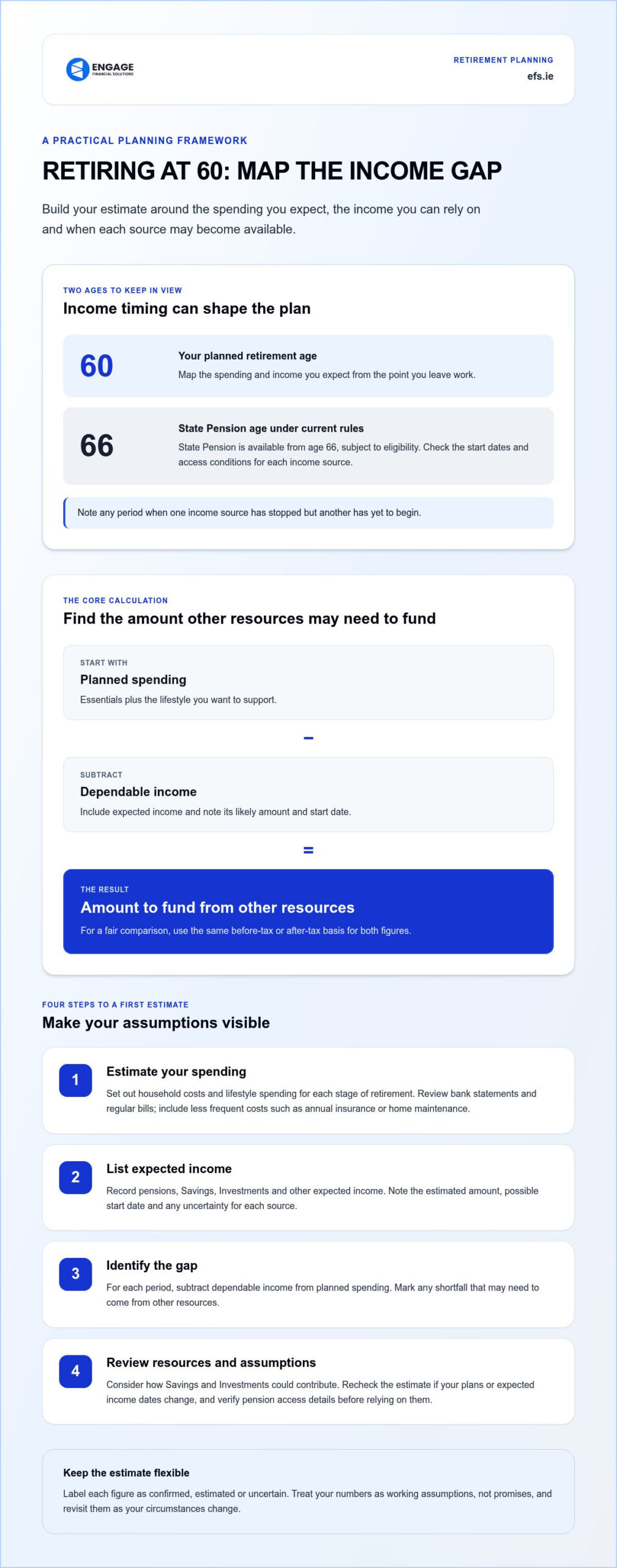
Leaving work at 60 changes when earnings stop and when pension or other income may begin. Under current rules, the State Pension is available from age 66, subject to eligibility. Other pension arrangements have their own access conditions. Map the expected start date of each income source against your planned spending, and account for any period when one source has stopped but another has yet to begin.
For each year, note what you expect to spend and which income sources may be available. Mark any shortfall that you’ll need to fund from other resources, and revisit the dates as you verify your pension information. When planning to retire at 60, the timing of income matters as much as the size of your pension pot.
Estimate your retirement income gap with a simple planning framework
A useful estimate doesn’t need to predict every detail of the future. It gives you a clear starting point: what you may spend, what income could be available and which resources might need to cover any difference. Treat the figures as working assumptions, not promises. The goal is to make choices and uncertainties visible so you can adjust your plan with care.
Use this sequence to build your first estimate:
- Estimate your spending. Set out expected household costs and lifestyle spending for each stage of retirement, rather than relying on one average figure.
- List expected income. Record pensions, Savings, Investments and any other income you expect, with the likely amount and start date for each.
- Identify the gap. For each period, subtract dependable income from planned spending. The result is the amount your other resources may need to fund.
- Review your resources and assumptions. Consider how Savings and Investments could contribute, then test how the estimate changes if your plans or expected income dates shift.
Planned spending minus dependable income equals the amount you need to fund from other resources. For a clear comparison, record whether each figure is before or after tax and use the same basis for spending and income. If you’re unsure, mark a figure for review rather than treating it as precise.
Build a personal spending estimate
Separate regular costs, such as food, utilities, transport and housing, from occasional or one-off expenses, such as replacing an appliance, carrying out home repairs or paying for a significant trip. This helps you avoid overlooking irregular costs or treating them as regular monthly commitments.
Look closely at housing. A mortgage or other housing cost may change by the time you stop working, but don’t assume it will disappear. Note what you currently pay, what you expect to continue paying and what could change. Record assumptions behind your estimate, including any planned move or home improvement, and revisit them when circumstances change.
List income and resources by when they may be available
Create a timeline rather than combining everything into one total. For each expected income source, note its estimated amount, possible start date and any uncertainty. Include relevant pension arrangements, Savings, Investments and other expected income. Pension access and benefit dates depend on the arrangement and your circumstances, so verify them using current information before relying on them in your plan.
Label figures as confirmed, estimated or uncertain. A statement may show a current balance, for example, but the future value of an Investment isn’t guaranteed. Avoid building your estimate around an assumed investment return. Instead, compare cautious, central and more favourable assumptions to see how each affects the amount you may need to draw from other resources.
Changing one assumption at a time can reveal what matters most. Try a later retirement date, higher spending or a different income start date, then record how the gap changes. A personalised retirement planning review can help bring those estimates together with your wider financial circumstances.
Compare pension and income options for the years after leaving work
Your retirement income may come from a combination of sources, each with a different purpose and set of conditions. A pension arrangement may help build retirement resources, while an Annuity or withdrawals from an ARF may provide income later. Savings and Investments can also play a part. No single option is right for everyone, so consider how each fits your income timeline, flexibility needs and wider circumstances.
| Option | Purpose and potential role | Flexibility and questions to explore |
|---|---|---|
| Pensions | Build retirement resources through a workplace or personal arrangement. | Access and income choices depend on the arrangement. Check its terms and the rules that apply to you. |
| PRSA | A Personal Retirement Savings Account is a way to save towards retirement. It may be one part of your overall pension resources. | Review its charges, investment choices, access conditions and how it could work alongside other pensions. |
| ARF | An Approved Retirement Fund can hold retirement funds and may provide income through withdrawals. | Withdrawals affect the amount left invested. Understand the relevant rules, tax treatment and potential impact over time. |
| Annuity | You exchange retirement funds for a regular income under agreed terms. Depending on the arrangement, it may provide a guaranteed income. | Consider the income terms and how they suit your need for certainty and flexibility. |
| Savings | Cash savings can provide a reserve or help meet planned spending. | Think about access, the account terms and how inflation could affect what your savings buy over time. |
| Investments | Invested resources may contribute to your retirement plan. | Values can rise or fall. Consider access, risk and how much uncertainty you can accommodate. |
Understand the role of pensions, PRSAs and ARFs
A pension is a broad term for an arrangement intended to build resources for retirement. A PRSA is a personal account for retirement saving, while an ARF is an option for holding retirement funds and drawing income from them. Their roles and available choices differ. Before relying on a particular access date, withdrawal approach or tax outcome, verify the arrangement’s terms and current authoritative guidance for your circumstances.
Consider annuities, savings and investments in context
An Annuity is designed to provide income under agreed terms, whereas Savings and Investments remain resources you draw on or manage. Depending on its terms, an income arrangement may offer greater certainty but less flexibility. Cash Savings can be accessible, while Investments can fluctuate in value. Compare these trade-offs as parts of one plan, rather than choosing based on a single feature.
Write down what each source might contribute, when it could be available and what remains uncertain. Access conditions and tax treatment can change the practical value of an option, so check current rules before acting. A retirement planning review can help connect pensions, Savings and Investments with your spending needs and wider financial circumstances.
Risks That Can Change Your Retirement Estimate
Your estimate is a planning tool, not a prediction. Spending can change, income may begin later than expected, and the value of Investments can rise or fall. Rather than trying to forecast every outcome, test how your plan responds to different circumstances. This can show which assumptions have the greatest effect and where more flexibility may help.
Stress-test your assumptions without relying on forecasts
Compare a cautious scenario, an expected scenario and a more flexible one. For example, consider what happens if regular household costs are higher than planned, or if you choose to spend more on travel or family support. You can also model retiring later. Earnings may continue for longer and the period before other income starts may be shorter, although the result depends on your circumstances.
Longevity is another planning consideration. Your retirement resources may need to last longer than you first expect, so avoid basing a plan on a fixed end date. Inflation can reduce the purchasing power of income over time, while investment uncertainty means returns can’t be treated as guaranteed. These are reasons to review your assumptions, not predictions of what will happen.
Change one assumption at a time and note how the income gap responds. Don’t rely on forecast percentages or assumed investment returns to make an uncertain outcome look certain. A simple comparison of scenarios can show whether your plan remains workable if spending, retirement timing or income changes.
Check pension timing and current rules
The terms of a pension scheme or arrangement can affect when benefits are accessible and what choices are available. State Pension eligibility and timing also need to be checked against current official guidance and your own contribution record. Don’t assume that a date or rule applying to someone else will apply to you. Record the source and date of each rule used in your estimate, then revisit it before making a decision.
Before reviewing your plan, gather the records that can help make your assumptions more precise:
- Recent statements for each pension, PRSA or ARF, along with scheme or provider information about access and available choices.
- Your latest Savings and Investment statements, noting balances separately from any assumed future value.
- Information about your State Pension record and any guidance you’ve used to estimate eligibility or timing.
- A household spending record, including regular bills, less frequent costs and planned changes to housing or other commitments.
- A timeline of expected income sources, with uncertain amounts or start dates clearly marked.
Keep these documents with your scenario notes. A personalised retirement planning review can help bring changing assumptions, pension details and other resources into one view, so you can identify practical adjustments without treating uncertain forecasts as guarantees.
Turn your estimate into a personal retirement plan
An estimate becomes more useful when it leads to clear decisions. You don’t need to settle every detail at once. Bring your information together, check when different income sources may become available and compare a few realistic scenarios. Then review the plan periodically, especially when your work, household spending or retirement priorities change.
Prepare for a focused retirement planning review
Gather recent pension statements, details of your household spending and the information you have about each scheme. Add Savings and Investment statements, along with notes on income dates or rules you still need to verify. Having the documents together makes it easier to see how the pieces fit, rather than judging each pension or resource on its own.
Write down your preferred retirement date and the lifestyle you hope to fund. Include priorities such as travel, hobbies, family support or keeping a financial reserve. These details help distinguish what matters most from what could be adjusted if your estimate shows a shortfall. A retirement planning review can help connect your income choices with those wider goals.
Choose practical next steps with support
Engage Financial Solutions provides personalised retirement planning guidance to help you consider your options in the context of your circumstances. An adviser can help assess pensions, PRSAs, ARFs, Annuities, Savings and Investments together, taking account of their potential roles, access conditions and how they relate to your planned spending. The aim is to help you understand your choices and identify practical steps, not to promise a particular outcome.
Before a review, prepare a short list of questions. You might ask which income dates need verification, which assumptions have the greatest effect on your estimate, or how a change to your retirement date could alter the plan. After reviewing your options, note the agreed actions, who will take them and when you’ll revisit the estimate. This gives you a straightforward way to keep the plan current without starting from scratch each time.
Your next step might be updating a pension record, checking an income date or comparing spending scenarios. A tailored review can bring these details together and help you decide what to do next, whether you’re close to leaving work or planning further ahead. Discuss your retirement planning options and take a considered step towards a plan shaped around your needs.
Make your next retirement decision with confidence
Your retirement plan doesn’t need to be perfect before you act. It needs to be clear enough to guide your next decision, whether that means checking a pension detail, adjusting a savings habit or reconsidering your preferred retirement date. Keep a note of what you know, what still needs to be verified and when you’ll review it again. That simple record can turn uncertainty about how much you need to retire at 60 into a more manageable series of steps.
Personalised guidance can help you weigh different choices in light of your priorities and circumstances. Engage Financial Solutions provides retirement planning advice. A discussion can help you consider your options and identify practical next steps, without assuming that one approach suits everyone or guaranteeing a particular result.
Discuss your retirement planning options and take the next step towards a retirement plan that feels considered, personal and achievable.
Frequently Asked Questions
How much money do I need to retire at 60?
There’s no universal amount. Your target depends on household costs, income sources and how long your resources may need to last. Begin with a monthly spending estimate, including irregular costs such as home repairs, then compare it with income you expect to receive. For example, if a regular bill will continue after you stop work, include it rather than assuming your costs will fall. Treat the result as an estimate to review, not a guaranteed figure.
Can I retire at 60 and receive the State Pension?
Stopping work at 60 doesn’t automatically mean State Pension income will start then. Eligibility and timing depend on current rules and your individual circumstances, so check authoritative guidance and your own record before relying on a payment in your budget. If you’re considering leaving work soon, write down the expected start date and the source of that information. Verify both again before making a decision that would be difficult to reverse.
Can I access my pension at 60?
Possibly, but access depends on your pension type, scheme terms and personal circumstances. A workplace arrangement may have different conditions from a personal pension, so don’t assume they can both be used at the same time. Read the latest scheme documents and clarify any terms you don’t understand. Before planning withdrawals, check the current access rules and consider how taking benefits could affect your other retirement choices.
How do I calculate the retirement income I need?
Estimate regular and occasional spending, then list income you expect from pensions and other sources. Compare them to see how much of your budget remains to be met from Savings or Investments. For example, include annual costs alongside monthly bills so your estimate reflects the full year. Keep uncertain income separate from confirmed amounts, and test how your plan changes if costs rise or an income source starts later than expected.
Is retiring at 60 realistic if I still have a mortgage?
It may be possible, but ongoing mortgage payments need to be included in your retirement budget. Check your current repayment schedule and note whether payments are expected to continue after your planned retirement date. Also account for other housing costs, such as maintenance, rather than focusing on the mortgage alone. Compare this full budget with your expected income and resources, then consider whether a different retirement date would make the plan more manageable.
What should I do if my pension savings may not be enough?
First, check that you’ve included all relevant pensions and other resources, and that your spending estimate reflects your actual commitments. Then compare alternatives, such as working for longer, adjusting discretionary spending or changing the timing of a planned expense. Don’t make a rushed decision based on one projection. A personalised review can help you understand the trade-offs between these choices and identify practical next steps that fit your circumstances.
Should I choose an ARF or an annuity when I retire?
Neither option is best for everyone; they offer different ways to plan for retirement income. An ARF allows retirement funds to remain invested and be drawn on, whilst an Annuity provides income under agreed terms. Consider how much flexibility you want, how you feel about investment fluctuations and what income certainty matters to you. Review the relevant scheme conditions and tax rules with current guidance before deciding which approach, if either, suits your plan.
Disclaimer
Engage Financial Services LTD T/A Engage Financial Solutions is regulated by the Central Bank of Ireland CRO 764570. Suite 2 First Floor, 14 -18 Main street, Blackrock, Co Dublin. A94 W0Y3