


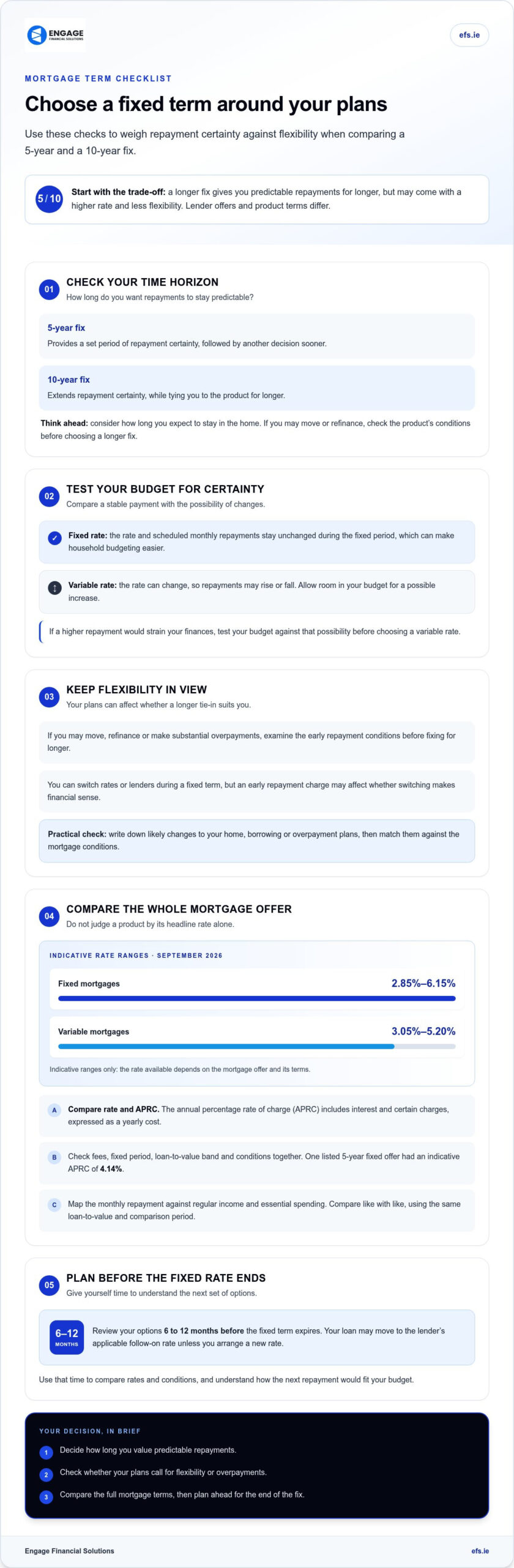
A 10-year fix isn’t automatically the safer choice: it can provide longer repayment certainty, but longer fixed terms typically have higher rates and can cost more. If you’re deciding whether to fix your mortgage for five or ten years, consider how long you want predictable repayments and how much flexibility matters to you. The right fit depends on your budget and plans.
It’s understandable to want predictable repayments, especially when your household budget has little room for surprises. A fixed rate keeps your rate unchanged during the fixed period, while variable-rate repayments may fluctuate. That certainty has to be weighed against the flexibility you may give up by fixing for longer.
This guide explains how fixed and variable rates differ, what happens when a fixed rate ends, and how to compare a 5-year and 10-year term against your plans. If you’re still weighing whether to fix for five or ten years, you’ll also see how your budget, likely time in the home and plans for overpayments can shape your decision.
Key Takeaways
- Compare the repayment certainty of a fixed rate with the flexibility of a variable rate before choosing a term.
- Weigh a 5-year fix against a 10-year fix by considering how long you want predictable repayments and whether your plans may change.
- Remember that fixed repayments stay unchanged during the fixed period, while variable repayments may fluctuate.
- Plan ahead for the end of your fixed rate and review your options 6 to 12 months before the term expires.
- Look beyond the headline rate: your budget, plans for overpayments and the terms of the mortgage all matter.
What happens when my fixed rate ends?
Irish lenders price 5-year and 10-year fixed mortgages according to funding costs, market conditions and the product’s terms. A longer fix may carry a higher rate because the lender guarantees that rate for longer, but offers differ. Compare the rate, fees and conditions together, rather than assuming a 10-year option always costs more.
Fixed-rate terms in the Irish market typically range from 2 to 30 years, with 3–5 years the most popular choice. A 5-year fix gives you a set period of repayment certainty, followed by another decision sooner. A 10-year fix extends that certainty, but also ties you to the product for longer. Your available choices depend on the lender and mortgage product.
During a fixed term, your mortgage rate stays the same, so your scheduled monthly repayments remain unchanged. This can make household budgeting easier, even if market interest rates rise. A variable rate can change, so repayments may increase or decrease as the rate moves. The trade-off is straightforward: fixed rates prioritise certainty, while variable rates can offer more flexibility.
When your fixed rate ends, the existing rate period expires. Your loan may move to the lender’s applicable follow-on rate unless you arrange a new rate. Don’t leave that decision until the final weeks. Review your options and speak with an adviser 6 to 12 months before the fixed term ends. That gives you time to compare rates and understand any conditions before choosing your next step.
If you’re a first-time buyer, the deposit also shapes your mortgage decision. According to the Central Bank of Ireland, first-time buyers typically need a deposit of around 10% of the property price. Alongside saving that deposit, consider whether your budget could absorb a change in repayments after a fixed period. A rate that feels manageable today should also fit your household plans when the term finishes.
To choose between 5 and 10 years, start with your expected time in the home and your appetite for repayment changes. If you may move, refinance or make substantial overpayments, examine the mortgage’s early repayment conditions before fixing longer. If predictable repayments matter most, compare the longer term’s rate with the value of added certainty. Write down your priorities, then compare the full mortgage terms, not just the opening rate.
Illustrations can help put that choice in context.
More than 140,000 variable-rate, 240,000 tracker and around 200,000 fixed-rate mortgage holders in Ireland could save by switching and fixing. More than 80% of new mortgages taken out in Ireland are on fixed rates, while several years ago, around 80% of mortgages in Ireland were on variable rates. These figures give broader context when comparing options after a fixed period.
What Are Mortgage Rates Right Now?
Indicative fixed mortgage rates ranged from 2.85% to 6.15% in September 2026. Variable rates ranged from 3.05% to 5.20%, so the rate available to you depends on the mortgage offer and its terms. Compare the interest rate with the overall cost and consider how repayments would fit your budget if rates changed.
ECB changes and variable mortgages
A variable rate can change in response to market shifts influenced by European Central Bank (ECB) policy. That connection matters because a change to your lender’s variable rate can affect your monthly repayments, although the timing and size of changes depend on the lender. The ECB’s rates had risen by 4.0% in the preceding year, and financial markets expected rates to rise by at least 0.5% over the following 12 months. These figures show why variable-rate borrowers should allow room in their household budget for possible changes.
A fixed rate offers budget protection: your rate and scheduled repayments stay unchanged during the fixed period, even if market rates rise. The examples show how a higher interest rate can affect monthly outgoings; they aren’t quotes for a particular mortgage. If a rise would strain your budget, test your finances against a higher repayment before choosing a variable rate.
Rate ranges and annual percentage charges
The annual percentage rate of charge (APRC) expresses the yearly cost of a mortgage, including interest and certain charges, as a percentage. It can help you compare offers, but check that the mortgage terms and comparison period match. One listed 5-year fixed offer had an indicative APRC of 4.14%, illustrating why the headline interest rate alone doesn’t tell the whole story.
Rates vary across lenders and mortgage products, including those from Bank of Ireland. Loan-to-value, the proportion of a property’s value that you borrow, can affect which rate band applies. Compare the rate, APRC, fixed period and conditions side by side. A lower headline rate may not be the best fit if its terms don’t support your plans.
For a recent comparison, note the date, rate type and loan-to-value used for each offer. Then map the monthly repayment against your regular income and essential spending. If you’re considering a move from a variable rate, mortgage switching guidance can help you weigh the available options and budget impact.
Balancing repayment certainty against flexibility
A fixed rate gives you predictable repayments, while a variable rate can change. You can switch rates or lenders during a fixed term, but an early repayment charge may affect whether switching makes financial sense.
Repayment examples and certainty
Repayment certainty means knowing the scheduled amount due each month during a fixed period. Compare the payment difference with the value you place on stable budgeting.
The variable-rate example also shows why the choice involves more than today’s payment. These figures are examples, not forecasts. Use your own mortgage balance and remaining term to consider how a rate change could affect your budget.
Early repayment and break fees
An early repayment charge may apply if you repay or leave a fixed mortgage before its term ends. Under EU legislation, a bank can charge a borrower who breaks a fixed mortgage period only the difference between the rate when they fixed and the rate when they repay. Fixed-rate mortgages typically have an early repayment charge, while variable-rate mortgages rarely do. Check your mortgage conditions before deciding.
This matters if you might sell your home, switch lender or make substantial overpayments. If you expect to overpay within the next two to three years, weigh any breakage cost against the interest you could save. A shorter fixed term may also let you benefit sooner if interest rates fall, whereas a 10-year fix could leave you paying more interest than necessary.
Before choosing, write down the changes you might make during the fixed period, such as moving home, refinancing or paying off a lump sum. Then compare those plans with the mortgage’s early repayment conditions. If flexibility matters, find out how overpayments are treated and what happens if you repay the loan early. If predictable payments matter more, weigh that certainty against the possibility of paying a charge to change course.
There isn’t one right balance for every household. A borrower with steady plans and little need for overpayments may value a longer period of fixed payments. Someone expecting substantial financial changes may prefer a shorter commitment. Compare the monthly repayment, fixed term and consequences of leaving early, then choose the arrangement that best fits your budget and plans.
Comparing lenders and mortgage rates
There isn’t one fixed mortgage rate for every borrower. The rate offered can depend on the lender, loan-to-value band and product conditions, so compare options using the same loan amount and repayment term. This makes it easier to see whether a difference comes from the fixed period, your borrowing profile or another feature of the offer.
Indicative 5-year fixed mortgage rates listed in September 2026 included 3.45% and 3.75%. Listed 10-year fixed rates included 3.8%, 4.1% and 4.25%. These are examples from different offers, not a single rate available to every borrower. Compare the rate and product terms that apply to your circumstances, and note when each figure was published.
Loan-to-value (LTV) is the mortgage amount expressed as a proportion of the property’s value. A lower LTV can place a borrower in a different rate band. The lowest fixed rate listed in April 2026 was 3.0% for a four-year mortgage with an LTV of 60% or less. Other offers showed maximum LTVs of 80.0% or 90.0%, so identify the band that matches your borrowing before comparing rates.
For a fair comparison, record the date, fixed term, LTV and rate for each offer. A displayed comparison used an LTV of 71.4%, which may not match yours. Differences in loan size or property value can affect which rate applies, so compare the same borrowing scenario across lenders rather than relying on a headline figure.
A BER, or Building Energy Rating, describes a property’s energy performance. Some mortgage offers link rates to a property’s BER rating, so read the eligibility conditions carefully. Check the required rating and whether the rate applies for the full fixed period. Compare it with offers that don’t use a BER condition, if available to you.
Cashback can change the upfront value of an offer, but it doesn’t establish which mortgage costs less over time. Some listed mortgage offers included cashback of up to 3%. Compare this benefit alongside the interest rate, fixed period, repayment conditions and applicable charges. Consider how long you expect to keep the mortgage, as the overall value depends on the offer’s full terms.
To organise your comparison, create a table with one row per offer and columns for the 5-year rate, 10-year rate, LTV, BER conditions and cashback. Add each suitable option’s monthly repayment, then assess whether a longer fixed period’s repayment certainty is worth the rate difference. This keeps the decision centred on your borrowing and budget, not one headline offer.
Choosing a mortgage term based on personal circumstances and budget
Choose a fixed term by matching repayment certainty to your likely plans, not by looking at the rate alone. A 5-year fix gives you an earlier chance to reassess; a 10-year fix holds the rate for longer. Longer fixed terms typically have higher rates, so the added stability may cost more in the short term.
Start with your household budget. List essential spending and regular bills, then work out what remains for mortgage payments. Consider whether a change in income or expenses could make repayments harder to manage. If even a modest rise would put pressure on your finances, the predictability of a longer fixed term may matter more than the chance to switch sooner.
Your plans for the property matter too. If you expect to move or change your borrowing before the fixed term ends, a long commitment may be less convenient. For example, a household planning a move within the next few years should weigh that possibility against the mortgage’s early repayment conditions. A 5-year term may align better with nearer-term plans, though it still involves a fixed commitment.
Consider overpayments as part of your decision. If you expect a bonus, inheritance or other substantial payment within the next two to three years, check how the mortgage treats early repayments. A charge could reduce the saving you hoped to make. If you don’t expect major changes and value stable monthly payments, a longer fixed term may suit you better.
Interest rates can move in either direction. A shorter fixed term may let you benefit sooner if rates fall, whilst a 10-year fix could mean paying more interest than necessary. That possibility is balanced against protection from rises during the fixed term. The Central Bank does not determine which term suits your household; your budget and plans are the practical guide.
Use a simple comparison before choosing: note the 5-year and 10-year rates, monthly repayments, fixed-term end date and early repayment conditions. Then ask whether each payment leaves enough room for your normal spending and future plans. Compare the full mortgage terms, rather than deciding from the opening rate or a cashback offer alone.
There’s no single term that suits every borrower. Choose the longest fixed term that feels affordable and compatible with your plans, while recognising that it may cost more initially. If you’re weighing a new rate against your current mortgage, explore mortgage switching options as part of that comparison.
A useful final check is whether the commitment feels comfortable over its full length, rather than focusing only on the appeal of a fixed rate. If fixing for longer feels manageable and any possible additional short-term cost fits your budget, it may be suitable. If the cost makes the commitment uncomfortable, you don’t need to extend it just to keep the rate fixed for longer. Let your own comfort set the limit, bearing in mind that a longer fix may cost more in the short term.
Engage Financial Solutions: Switching mortgages
Engage Financial Solutions can help you consider switching mortgages when your current rate is ending or no longer fits your budget. It can help you weigh a 5-year fix against a 10-year term, taking account of repayment certainty, flexibility and your plans for the property.
Before exploring a switch, note your current rate, remaining mortgage term and any early repayment conditions. This gives you a practical starting point for comparing options and understanding how a different fixed period could affect your monthly repayments. If you’re a first-time buyer or considering a buy-to-let mortgage, the same careful comparison can help clarify which mortgage structure fits your circumstances.
To discuss your mortgage options, contact Engage Financial Solutions.
Make your next mortgage decision with confidence
Before choosing a fixed term, write down what you need your mortgage to support over the coming years. That might mean keeping repayments predictable, retaining flexibility for a future move or making room for changing household needs. If you’re still asking whether to fix for five or ten years, use those priorities to guide your comparison rather than letting one headline rate decide.
Engage Financial Solutions can help you explore switching mortgages, whether you’re a first-time buyer reviewing your options or considering a buy-to-let mortgage. Discuss how your plans and budget fit the available mortgage choices to move forward with a clearer view of the decision.
Contact Engage Financial Solutions to discuss your mortgage options, and take the next step at a pace that feels right for you.
Make your next mortgage decision with confidence
Before choosing a fixed term, write down what you need your mortgage to support over the coming years. That might mean keeping repayments predictable, retaining flexibility for a future move or making room for changing household needs. If you’re weighing a five-year fix against a ten-year fix, use those priorities to guide your comparison rather than letting one headline rate decide.
Engage Financial Solutions can help you explore switching mortgages, whether you’re a first-time buyer reviewing your options or considering a buy-to-let mortgage. Discuss how your plans and budget fit the available mortgage choices to move forward with a clearer view of the decision.
Contact Engage Financial Solutions to discuss your mortgage options, and take the next step at a pace that feels right for you.
Disclaimer
Engage Financial Services LTD T/A Engage Financial Solutions is regulated by the Central Bank of Ireland CRO 764570. Suite 2 First Floor, 14 -18 Main street, Blackrock, Co Dublin. A94 W0Y3