


Using a mortgage broker can give you access to mortgage options from multiple lenders, while applying directly to a bank limits your comparison to that bank’s products. In the Irish market, 4 in 10 home-buyer mortgages are arranged through brokers and intermediaries by value. The benefits of a mortgage broker can also include help with paperwork and follow-ups, but a broker doesn’t provide the loan or approve your application.
It’s understandable to wonder whether that extra support is worth it, particularly when fees, approval prospects and the time involved all matter. A bank may still suit you if you want to apply directly and its mortgage meets your needs.
This guide compares broker and bank applications, including lender choice, fees, support and direct applications. You’ll get a clearer sense of which route may fit your circumstances and what to consider before applying.
Key Takeaways
- Compare the range of lenders and mortgage options available through a broker with the products offered by your own bank.
- Before choosing a broker, ask how they compare options, manage paperwork and explain any fees or commission.
- Use a broker for guidance through the application process, but remember that the lender makes the approval decision.
- If you apply directly to a bank as well, keep track of each application and compare the full mortgage terms, not just headline offers.
- Review the costs and payment arrangements carefully so you can decide whether broker support suits your circumstances.
Pros and Cons of Using Mortgage Brokers: Save Time and Money, or Not?
A broker compares mortgage options from multiple lenders, while a bank offers its own products. The value of a broker depends on your circumstances, lenders’ criteria and the support you need during the application.
Broker comparisons across lenders
A broker acts as an intermediary between you and lenders, including banks and non-bank lenders. Unlike a lender or its loan officer, a broker doesn’t provide funds or approve applications. They can compare options using criteria such as interest rate, term, repayments and eligibility, then explain the trade-offs. One broker in the discussion estimated that explaining product and term choices can take around an hour.
For a useful comparison, ask which lenders were considered and why particular products suit your circumstances. Focus on the full terms, not just the interest rate or cashback figure.
Broker offers and direct lender offers
A broker’s comparison may include several lenders, whereas a direct application gives you that lender’s own offer. An estimate in the discussion suggested the most competitive lenders have a direct application channel in 80% of cases, so applying through a broker isn’t the only route to a competitive option.
Compare each offer using the same criteria: interest rate, term, repayment structure and cashback conditions. A headline incentive may look attractive, but it shouldn’t replace a like-for-like review of the mortgage terms.
Application paperwork and lender liaison
Mortgage applications involve paperwork about your income, savings, debts and property. A broker can manage much of the application, follow-up and paperwork, helping organise documents and respond to lender requests. You still need to provide accurate information and review anything submitted in your name.
To keep the process moving, gather the requested records in one place and respond to follow-up questions promptly. Ask the broker to explain which documents are outstanding and what each lender needs next.
Lenders available only through brokers
Some lenders work only through brokers, which means a direct application won’t reach them. A broker in the discussion estimated that about 20% of more complex cases may need access to lenders available only through brokers. That access can matter when your income or property plans don’t fit a straightforward application.
Ask whether any broker-only lender was considered and how its terms compare with direct offers. The explanation should link the lender’s criteria to your circumstances.
| Option | Lender choice | Comparison criteria | Paperwork and liaison | Broker-only access |
|---|---|---|---|---|
| Broker | Multiple lenders | Products compared across lenders | Can manage much of the process | May include broker-only lenders |
| Direct bank application | That bank’s products | Compare its offer with other quotes | You liaise with the bank | Doesn’t access broker-only lenders |
Choose by comparing the full terms and lender access with the level of support you want for paperwork and follow-ups.
What are the benefits of using a mortgage broker vs a bank?
A broker may suit you if you want help comparing lenders; a bank may suit you if you prefer to deal directly. In the Irish market, 4 in 10 home-buyer mortgages are arranged through brokers and intermediaries by value, so both routes are common choices.
Choosing a broker involves more than looking for a lower mortgage rate. Ask how they select lenders, explain product trade-offs and support your application. Mortgage brokers must act in borrowers’ best interests under the Consumer Protection Code, making clear explanations and transparent comparisons important.
Use these questions in an initial conversation:
- Which lenders will you compare, and what criteria will guide that shortlist?
- How do you assess mortgage rates alongside the term, repayments and other conditions?
- Will you handle lender follow-ups and paperwork on my behalf?
- How are you paid, and could that payment affect the options you present?
- What support do you provide if a lender declines my application?
Look for specific explanations, not promises of approval. A Qualified Financial Adviser (QFA) qualification meets the Central Bank’s Minimum Competency Code requirements for advising on and selling retail financial products.
To find a broker, look for someone authorised to provide mortgage advice who can explain their lender access. Then compare their proposed shortlist with a direct offer from your bank, such as Bank of Ireland. A broker’s range can help you compare lenders, while your bank can explain its own mortgage criteria and application steps. Compare the same details in each offer, including rates, term and conditions, rather than choosing on the monthly repayment alone.
Choose the route that matches the support you want. If your case is straightforward and your bank’s offer meets your needs, applying directly may feel simpler. If you want help weighing options across lenders, a broker can guide your comparison and application. Before discussing approval, write down your priorities so the conversation stays focused on your budget and plans.
If you’re considering a switch, first compare your current mortgage terms with the new offer, including any conditions attached to the rate. You can also discuss mortgage switching options as part of that decision. If you’ve already started with a broker but want to change, ask what work has been completed, whether any fee applies, and how your documents will transfer. Get the handover details in writing before beginning a second application, and keep copies of your submitted paperwork.
Keep a brief record of each lender considered, the offer details and your questions. If a complaint about a mortgage broker remains unresolved, borrowers can escalate it to the Financial Services and Pensions Ombudsman (FSPO). These steps help you make a considered choice, whether you use a broker, apply directly or switch between routes.
Can a broker guarantee mortgage approval?
No. A broker can help you prepare and compare options, but the lender decides whether to approve your application. The lender assesses your income, outgoings, deposit, credit history and property details against its criteria. A broker can explain how your circumstances may affect the application, but cannot promise approval or a particular loan amount.
For many buyers, the process begins with an Approval in Principle (AIP). It is free and usually valid for six or 12 months. Treat it as an initial indication, not a final mortgage offer: the lender still needs to assess your full application and property. Ask your broker what information the AIP uses, what could change the result, and when to update your details.
First-time buyers can use a broker to understand how lending limits affect their budget. Irish mortgage lending is subject to Central Bank rules on loan-to-value (LTV), the loan compared with the property value, and loan-to-income (LTI), the loan compared with income. The standard maximum loan is 3.5 times salary, or 4 times salary for a first-time buyer. A broker may help borrowers seeking an exception, but the lender makes that decision.
If your circumstances are less straightforward, prepare a clear summary before comparing lenders. For example, note variable income, probationary employment, existing debts or plans to buy with another borrower. A broker can help explain these details to lenders and identify the relevant criteria. This support can make your application clearer, but it won’t change the lender’s assessment.
Property investors should be ready to discuss rental plans, income and the property they’re considering. A broker can help compare buy-to-let options and explain the repayments, term and any charges shown in each offer. If you’re remortgaging, gather your current mortgage details and compare the new rate and remaining term with your existing arrangement. This gives the lender relevant information from the outset.
If you’re unfamiliar with mortgages, ask for each stage to be explained in plain language, from AIP through application to drawdown, when the loan funds are released. Request a written summary of the proposed loan, repayment structure and outstanding steps. Check that the figures match your application and ask about anything you don’t understand before proceeding.
- Share accurate income, debt and deposit details at the start.
- Tell the broker about changes to your circumstances during the application.
- Keep your AIP date in view and refresh it when it expires.
- Compare the full mortgage terms, not just the initial approval indication.
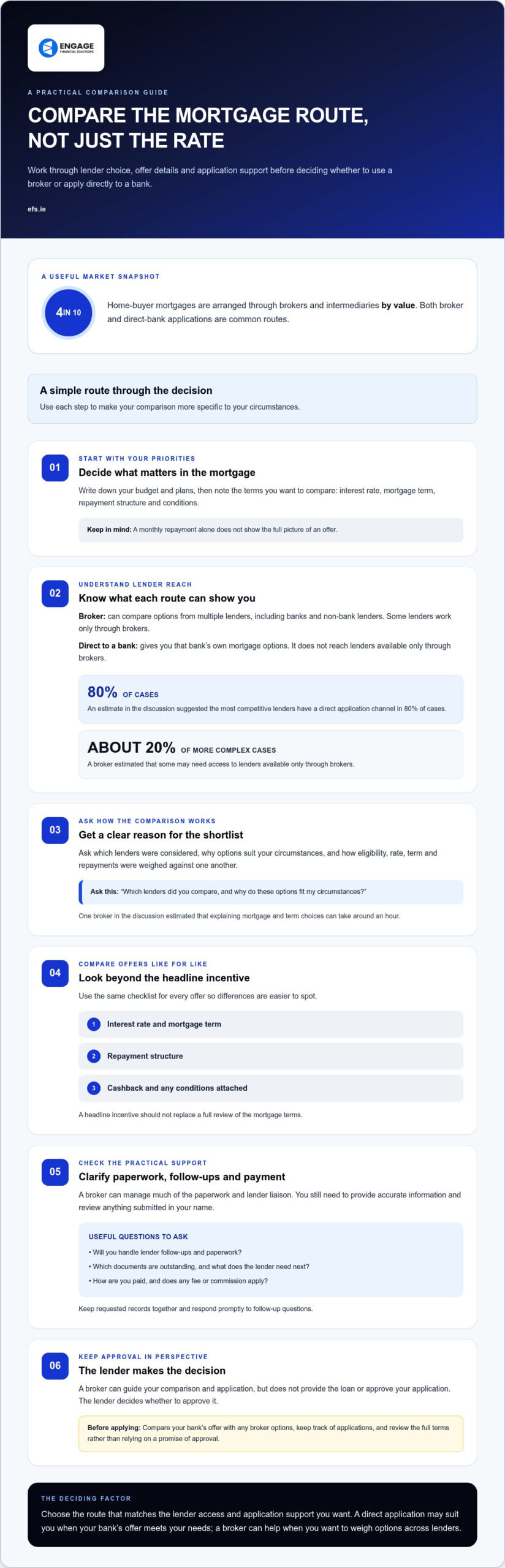
Using a broker alongside direct bank applications
You can speak with a broker and apply directly to a bank, but keep both routes organised. Decide what you want to compare before sending applications or documents.
Help with complex applications
A broker can help match a complex application with lenders whose criteria fit your circumstances. This may be useful if you’re self-employed, have variable income or are applying with another borrower. The broker can explain how income, existing credit commitments and the property affect a lender’s assessment, then identify the evidence your application needs.
For example, prepare clear records of your income and regular outgoings before discussing options. If you’re seeking an exception to standard borrowing limits, a broker can explain the route and help present your application. The lender still assesses the evidence and makes the decision.
Mortgage expertise and guidance
A broker can guide you through choices such as the interest rate, repayment structure and mortgage term. This differs from applying directly, where the bank explains its own products and criteria. Ask the broker to show how each option affects your repayments and what conditions apply, rather than focusing on a single headline rate.
You can use that guidance alongside a direct conversation with your bank. Keep a comparison note with the lender, rate, term, conditions and next step for each option. A broker in the discussion said lenders pay 1% commission on drawdown, so include disclosed payment arrangements in your comparison.
Application preparation and paperwork
Before starting both routes, create a folder for the records each lender requests. Keep details consistent across applications, including your income, employment status, debts and deposit. A broker can organise paperwork and liaise with lenders; with a direct application, you handle communication with the bank yourself.
Tell the broker which banks you’ve approached and the stage each application has reached. This helps avoid conflicting information and makes follow-ups easier to track. Don’t submit different figures to different lenders, and update each application if your circumstances change.
Use a simple sequence to coordinate both routes:
- Set your priorities, including repayment comfort, rate type and flexibility.
- Ask the broker which lenders and products they will compare.
- Record any direct bank offer using the same criteria.
- Review the full terms and paperwork before deciding how to proceed.
Applying through both channels can broaden your comparison, but it also means tracking more correspondence and deadlines. Keep an up-to-date record of lender requests, documents sent and decisions received. Choose the route that gives you the information and support you need to make a considered mortgage decision.
Broker fees and commission arrangements
Before choosing a mortgage broker, establish how they’re paid and what you may pay directly. Compare the written fee terms with the support offered and your financial circumstances.
Broker fees
Some brokers charge borrowers a fee, while others receive commission from a lender after a new mortgage completes. Some arrangements combine both. Ask for a written explanation of any borrower charge, when it’s payable and what work it covers. This lets you compare the cost of broker support rather than assuming all brokers are paid in the same way.
Mortgage brokers must disclose how they’re paid and any conflicts of interest. Ask whether the broker receives commission from each lender they recommend and how this affects the options presented. If you shop around, compare the payment explanation alongside the mortgage terms. A lower direct fee doesn’t, by itself, show which option best suits your circumstances.
Commission arrangements
A lender may pay a broker commission when your mortgage completes. This differs from a direct borrower fee because the lender, rather than you, pays the broker. Ask when commission is earned, whether it varies between lenders and whether the broker receives other payments. Clear answers help you understand the financial relationship behind a recommendation.
Some lenders may claw back commission if you switch away from that lender within 3 years. This can matter if you’re considering an early mortgage switch. Ask whether a clawback clause applies, what event triggers it and whether it could affect you. Get the explanation in writing, then include it when weighing a new offer against your current mortgage.
Use these steps before agreeing to broker support:
- Request a written breakdown of any direct charge and the service it covers.
- Ask which lenders pay commission and when that payment is made.
- Clarify whether a commission clawback could apply if you switch lenders.
- Compare the broker’s payment terms with the mortgage’s rate, conditions and overall fit.
For example, if a broker receives lender commission but charges you no direct fee, that doesn’t mean the arrangement costs the lender nothing. Your key task is to understand who pays, what could influence the recommendation and whether a borrower charge applies. These details help you assess the arrangement on its merits, rather than treating commission alone as proof of bias.
Keep the broker’s written payment explanation with your mortgage documents. If the explanation changes during the application, ask for an updated version before proceeding. You can also consider how the mortgage decision fits your wider financial planning, especially if repayments affect other goals. A clear record makes it easier to review the arrangement later.
Engage Financial Solutions: Switching mortgages
Engage Financial Solutions can help you consider switching mortgages if you want to review your current arrangement against other options. Gather your current mortgage details and any offer you’ve received, then compare the rate, term and conditions before deciding whether a switch fits your plans.
If you’re buying your first home or considering a property investment, the team also advises on First-time Buyer Mortgages and Buy-to-Let Mortgages. Bring a clear picture of your income, commitments and goals so the discussion can focus on your circumstances and next steps.
For a considered review of your mortgage options, visit Engage Financial Solutions.
Choose a mortgage route that fits your next move
The benefits of a mortgage broker matter most when their guidance helps you make a decision that fits your plans, not simply complete an application. Before taking the next step, write down what you need from the mortgage, what repayment feels manageable and which terms matter most to you.
Use those priorities to guide a focused discussion. Engage Financial Solutions offers Switching mortgages, First-time Buyer Mortgages and Buy-to-Let Mortgages for people at different points in their property plans. A clear outline of your goals can keep the conversation practical, whether you’re reviewing an existing mortgage, buying your first home or considering a rental property.
Take your time to compare the information you have and decide what support would make the process easier. If you’re ready to explore your options, contact Engage Financial Solutions. A thoughtful next step can help you move towards a mortgage decision with greater clarity and confidence.
Frequently Asked Questions
Is it cheaper to get a mortgage through a broker?
Not necessarily. The overall cost depends on the broker’s payment arrangement and the mortgage terms. Some brokers receive lender commission, while others charge borrowers directly or use both arrangements. Compare any broker charge with the interest rate, repayment conditions and other costs in the mortgage offer. Ask for payment details in writing so you can assess the full arrangement, not just whether a separate fee appears.
Can brokers get you a better rate than banks?
A broker may find a rate that suits your circumstances, but can’t promise one lower than your bank’s. Rates and eligibility depend on factors such as the mortgage amount, deposit, income and lender criteria. Compare a broker’s offer with your bank’s using the same loan amount and term. Include conditions attached to introductory rates, as these can affect whether an offer suits your plans.
How do you check if a broker is authorised by the Central Bank?
Use the Central Bank’s register of regulated firms to check a broker’s authorisation. Search using the firm’s exact legal name, then confirm the record covers mortgage advice or arranging. If you’re dealing with an individual adviser, ask which authorised firm they represent and compare that name with the register. Keep the details with your mortgage paperwork for future reference.
What’s the difference between a mortgage broker and a lender?
A mortgage broker arranges or advises on mortgage options; a lender provides the funds and decides whether to approve your application. For example, a broker may present options from several banks, while a bank assesses your application and issues its own mortgage offer. The broker’s recommendation isn’t an approval. Read the lender’s formal offer carefully, as it sets out the terms you would accept.
What are the main benefits of using a mortgage broker for a home loan?
The benefits of a mortgage broker can include comparing options across lenders and receiving guidance tailored to your circumstances. That can be useful if you’re buying with someone else, have variable income or want help understanding mortgage terminology. Before proceeding, ask which lenders the broker can consider and how they’ll explain the differences. A focused discussion can help you understand your options beyond a single offer.
How does a mortgage broker compare mortgage rates and deals across Irish lenders?
A broker reviews available lender options against your borrowing needs, eligibility and preferred repayment structure. Ask for a side-by-side comparison showing the rate, term, repayment type and conditions for each suitable option. The Central Bank requires mortgage brokers to provide a European Standardised Information Sheet (ESIS), which outlines loan details. Use it to examine the key terms before making a decision.
Do mortgage brokers have access to exclusive mortgage products?
Some lenders only accept applications through brokers, so you can’t apply directly to those lenders. Ask whether the comparison includes broker-only lenders and why any option might suit your circumstances. Broker access doesn’t mean every product is suitable or that a broker can approve the loan. Compare the terms with direct offers available to you before deciding.
How much do mortgage brokers charge in the Irish mortgage market, and who pays their fees?
There isn’t one fee arrangement for every broker. A lender may pay commission after a mortgage completes, a broker may charge you directly, or both may apply. Ask for a written breakdown of any borrower charge, what it covers, when it’s payable and whether lender commission is also received. Include any early repayment or switching conditions in your comparison before agreeing to proceed.
Disclaimer
Engage Financial Services LTD T/A Engage Financial Solutions is regulated by the Central Bank of Ireland CRO 764570. Suite 2 First Floor, 14 -18 Main street, Blackrock, Co Dublin. A94 W0Y3