


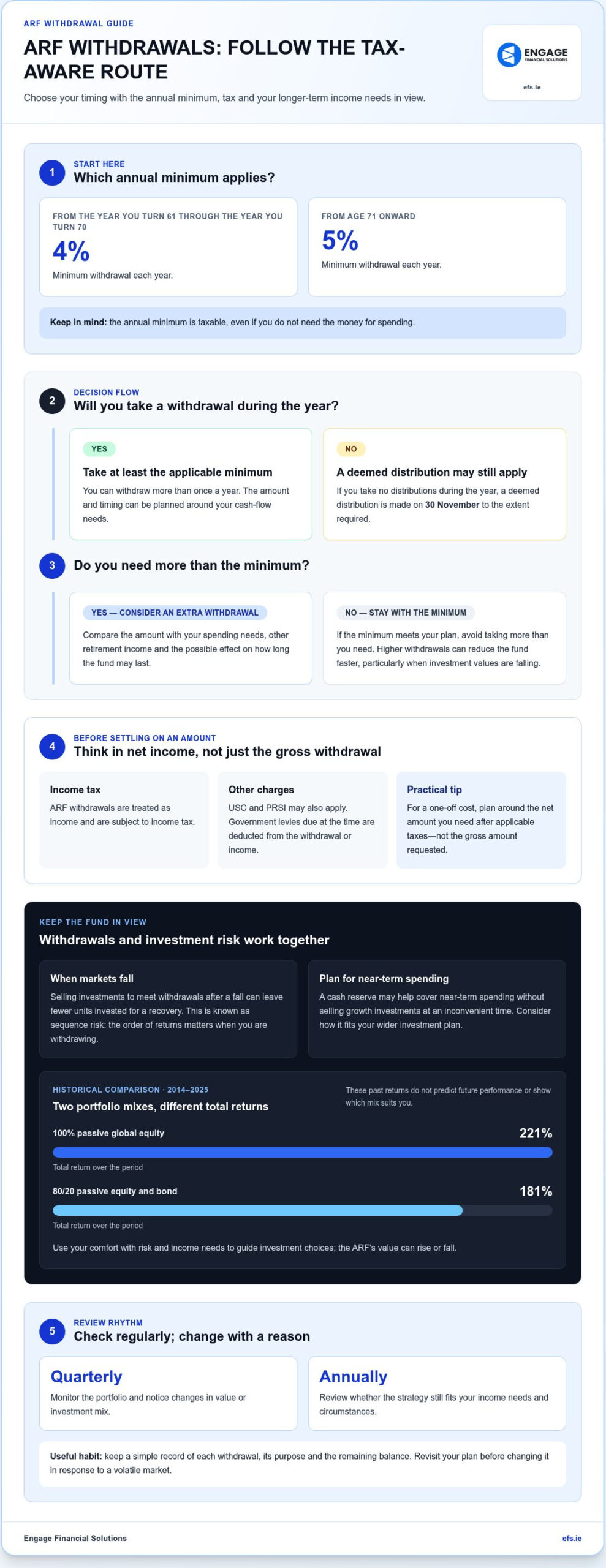
You can withdraw from an ARF more than once a year, but you must take at least the required minimum each year. When managing an ARF portfolio, remember that the minimum is 4% per year from the year you turn 61 until the year you turn 70, rising to 5% per year from age 71. Withdrawals are treated as income for tax purposes, so the amount you take and when you take it can affect both your cash flow and your tax bill.
It’s understandable to want flexibility over when retirement income reaches your account while protecting a fund that may need to support you for years. This guide explains how withdrawal frequency, tax and eligibility shape your choices, and how investment risk can affect your ARF’s value.
You’ll also learn why regular portfolio reviews matter and how to think about withdrawals alongside your wider retirement income. Whether you’re setting up an ARF or reviewing one you already hold, understanding these moving parts can help you make steadier, more informed decisions.
Key Takeaways
- Plan withdrawal timing around your cash-flow needs, while ensuring you meet the annual minimum.
- Include tax in your withdrawal plan: ARF withdrawals are treated as income, which affects what you receive after tax.
- Match your investments to your risk tolerance and income needs, and remember that an ARF’s value can fall as well as rise.
- Build a review routine by monitoring your portfolio quarterly and reviewing it annually, including whether its investment mix still suits you.
- Before setting up an ARF, understand the eligibility criteria and how your other retirement income fits into the picture.
Investment risk and the possibility of depleting an ARF
To move pension funds into an ARF, first establish which pension benefits are eligible for transfer and decide how much to move. Then arrange the transfer into your chosen fund. Your investment choices and withdrawals matter because the ARF remains invested, and its value can rise or fall.
Tailoring an investment strategy
A tailored strategy matches your ARF investments to your income needs in retirement, time horizon and comfort with risk. Choose a fund type and investment risk level suited to your circumstances. Depending on your goals and risk tolerance, options may include shares, bonds and property. Consider how much income you need, what other assets you hold and how a market fall could affect planned withdrawals.
Behavioural aspects of retirement investing
Behavioural investing describes how emotions and habits influence decisions, particularly when markets rise or fall. A sudden decline may prompt you to sell, while strong recent returns can tempt you to take more risk. Either response can disrupt a long-term strategy. Write down why you chose a fund and withdrawal level, then revisit your plan before making changes during a volatile period.
Withdrawal timing can affect how long an ARF lasts. If you sell investments after a market fall to meet income needs, fewer units remain invested for a recovery. This is known as sequence risk: the order of returns matters when you’re withdrawing. A cash reserve may help cover near-term spending without selling growth investments at an inconvenient time. Decide how it fits into your wider investment plan.
ARF investment returns accumulate tax-free while they remain in the fund, but this doesn’t remove investment risk. The fund can hold assets with different potential returns and levels of fluctuation. Exchange-rate movements can also affect investments held in other currencies. Past performance isn’t a reliable guide to future performance, so compare a fund’s risks and purpose rather than relying on previous results alone.
Selected Irish ARF investment comparisons show how different portfolios can perform over the same period. From 2014 to 2025, a 100% passive global equity portfolio returned 221% in total, while an 80/20 passive equity and bond portfolio returned 181%. These historical figures don’t predict future returns or establish which mix suits you. Your risk tolerance and income needs should guide the choice.
When managing an ARF portfolio, weigh withdrawals against your investment mix, market movements and retirement income from other sources. Consider whether a lump sum or regular payments suit your plans, and discuss the impact before making a significant change. This keeps decisions connected to your wider retirement strategy, rather than to a single market update or recent return.
Tax on ARF withdrawals
You can choose when to take income, but an ARF has a minimum taxable withdrawal each year. The amount you keep depends on the tax that applies to your withdrawal.
Tax treatment of withdrawals
Tax treatment determines how an ARF withdrawal is assessed after it leaves the fund. In Ireland, withdrawals are treated as income and are subject to income tax; USC and PRSI may also apply. Government levies due at the time are deducted from the withdrawal or income, so the gross amount requested may not be the amount you receive.
ARF growth is tax-free while it remains in the fund, but withdrawals are taxed differently. Include the tax impact when estimating income for bills, regular spending or a larger planned expense. For example, if you plan to withdraw money for a one-off cost, consider the net amount you need after applicable taxes, rather than planning around the gross withdrawal alone.
The annual minimum is taxable, even if you don’t need the money for spending. The required rate is 4% per year from the year you turn 61 until the year you turn 70, then 5% per year from age 71 onward. If you take no distributions during the year, a deemed distribution is made on 30 November to the extent required. This means leaving the fund untouched doesn’t necessarily avoid a taxable withdrawal.
Withdrawals and fund depletion
Flexible withdrawals let you match ARF income to your retirement spending, while the annual minimum sets a baseline. Taking more than you need can reduce the fund faster, particularly when investment values are falling. Before changing your payment amount, compare it with other income, including any guaranteed pension income, and distinguish essential spending from optional costs.
Review your withdrawal level when your circumstances change, such as when another income source begins or a major expense ends. Moving between funds doesn’t remove the need to plan withdrawals or account for tax. Keep a simple record of the amount taken, its purpose and the remaining balance. This can help you spot whether spending is rising faster than planned.
If you’re coordinating ARF income with other retirement needs, retirement planning can help bring those decisions together. Set your expected annual spending beside the minimum withdrawal, then consider how any additional income affects the fund’s longer-term role.
Portfolio monitoring and rebalancing
Monitor your ARF quarterly and review its strategy annually. Regular checks help you spot changes in the investment mix, income needs and personal circumstances before deciding whether to adjust the portfolio.
Monitoring an ARF portfolio
Monitoring means checking how your investments are performing and whether they still fit your retirement plans. A quarterly check can help you notice a sharp change in a fund’s value or allocation, while an annual review gives you time to assess the wider plan. Use each review to compare the fund’s purpose with your expected withdrawals, other savings and any annuity income.
Start each quarterly check with the current fund value, recent statements and planned withdrawals. Then compare the investment mix with your intended strategy. If one fund in a two-fund portfolio has grown more than the other, it may now make up a larger share of your savings than planned. Record what changed and why to distinguish a genuine change in circumstances from a short-term market move.
At your annual review, consider whether your retirement income needs or plans have changed. A new annuity, a change in spending or a different expected retirement date could affect how much growth you need from the ARF. Review the purpose of each holding, not just its latest return. This makes it easier to decide whether the portfolio still supports your income plan.
Portfolio rebalancing
Rebalancing means adjusting investments to bring the portfolio back towards its intended mix. In a two-fund portfolio, growth in one fund may leave it larger than planned compared with the other. Rebalancing can restore your chosen balance and help keep investment risk aligned with your strategy and time horizon.
Use your annual review to decide whether rebalancing is appropriate; don’t trade simply because one fund had a strong quarter. First, compare the current mix with your intended allocation. Then consider whether withdrawals or changed circumstances explain the difference. Finally, decide whether to redirect future contributions or sell part of a holding. These steps help tie the decision to your plan.
For example, one holding in a two-fund ARF may have grown faster than the other. Review whether the resulting mix still matches your chosen risk level, rather than assuming recent growth will continue. Check how a proposed change would affect planned income and the remaining holdings. Note your decision at each annual review, so you have a clear reference point for the next comparison.
Approved retirement funds (ARFs)
An ARF gives you continued control over pension money invested after retirement. That flexibility brings choices about investments, withdrawals and how the fund fits with your other income.
Understanding an ARF
An Approved Retirement Fund is a personal fund that receives all or part of your pension for investment after retirement. The capital remains invested, and you can choose investments and draw income from it, subject to the applicable withdrawal rules.
ARFs were introduced in 1999, and Finance Act 2011 extended the ability to establish one to members of defined contribution occupational pension schemes. Unlike an annuity, which provides retirement income guaranteed by an insurance company in return for a premium, an ARF remains invested. That means returns can vary, and the fund’s value can rise or fall.
You may hold more than one ARF, and funds can be transferred between providers. Before transferring, compare how each fund supports your income needs and investment preferences. Consider whether splitting pension capital across accounts would make your retirement arrangements easier to oversee, rather than assuming more accounts automatically mean better outcomes.
Who can invest in an ARF
An ARF is available to eligible pension holders who meet the relevant residency and income conditions. These criteria determine whether pension benefits can be invested in an ARF or accessed through another retirement option.
You must have a pension and be resident in the state to qualify. You must also have guaranteed income of at least €12,700 per year. Assess that income alongside your expected ARF withdrawals, so you can see how the fund would fit with your other retirement resources. A 5% proprietary director in an occupational pension scheme may transfer pension funds to an ARF.
AMRFs are no longer available; legislation enacted in 2021 removed them. This matters if older information refers to retaining money in an AMRF, as it describes an arrangement that has since ended.
Large ARF holdings have a separate imputed distribution rule. Combined ARF assets over €2 million are subject to an annual imputed distribution rate of 6%; for an ARF worth more than €2 million, the initial imputed distribution rate is 6% from age 61. An imputed distribution is treated as a withdrawal for tax purposes, even when you haven’t taken that amount as cash. Factor the rule into your income and tax planning, especially if you hold multiple ARFs.
The practical takeaway is to establish your eligibility and guaranteed income first. Then compare the ARF’s investment control with the certainty an annuity provides. This gives you a clearer basis for deciding how pension capital could support your retirement.
What is an ARF and who can invest?
An Approved Retirement Fund (ARF) lets an eligible retiree invest some or all of their pension after retirement. The pension capital remains invested, rather than being converted in full into a fixed income arrangement. You can draw income from the fund and choose investments, while its value changes with investment performance and withdrawals.
Eligibility depends on your pension and circumstances. You must have a pension and be resident in the state, and you need guaranteed income of at least €12,700 per year. Include any qualifying guaranteed income in your retirement income picture, then compare it with your expected spending and planned ARF withdrawals. This helps show whether the fund is a suitable part of your wider plan.
The pension scheme you belong to can affect when benefits become accessible. Funds in a group pension scheme from previous employment can generally be accessed from age 50. Pension plans funded during self-employment can generally be accessed from age 60. Occupational pension schemes often set age 65 as retirement age, subject to scheme rules. These are access points, not a single age rule for every ARF.
Scheme type also matters. Finance Act 2011 extended the ability to establish an ARF to members of defined contribution occupational pension schemes. A 5% proprietary director in an occupational pension scheme may transfer pension funds to an ARF. Start by identifying your pension type and its scheme rules, then establish which benefits can be used for retirement options.
Next, compare an ARF’s investment control and flexible withdrawals with an annuity’s guaranteed income. An ARF remains invested, so its value can rise or fall. An annuity provides retirement income guaranteed by an insurance company in return for a premium. Consider how much certainty you want, whether other income covers essential spending and how comfortable you are with investment fluctuations.
You can hold more than one ARF, and funds may be transferred between providers. Before transferring, list each fund’s purpose, investment mix and role in your income plan. This can help you avoid unnecessary complexity and understand how your retirement assets fit together. An ARF isn’t the only way to arrange retirement benefits, so compare the available options with your income needs and comfort with risk.
To bring pension options and future income needs into one plan, explore ARF retirement planning. Having your pension type, scheme rules and expected income to hand can make the next discussion more focused.
Engage Financial Solutions: Income Protection
Engage Financial Solutions can help you consider how Income Protection fits alongside your retirement plans. If illness or injury affects your ability to earn, protecting your income may help you avoid relying on ARF withdrawals for everyday costs. The right approach depends on your circumstances and how your wider financial arrangements fit together.
As you review your retirement income, consider how savings, pension benefits and protection could work together. Engage Financial Solutions also offers Annuities, which may be relevant if you’re comparing flexible ARF withdrawals with a more predictable retirement income. These options serve different needs, so consider what you want your income to do and how much flexibility matters to you.
If you’d like to discuss your retirement and income protection needs, contact Engage Financial Solutions.
Make your next retirement decision with confidence
Your next step is to turn your ARF decisions into a plan that reflects the life you want your retirement income to support. When managing an ARF portfolio, consider how it fits alongside your other financial priorities rather than treating each decision in isolation. A conversation about your goals can help identify which questions need attention first.
Engage Financial Solutions also offers Switching Mortgages, First-time Buyer Mortgages and Buy-to-Let Mortgages for people whose property plans form part of their wider financial picture. These are separate from ARF management, but may matter as your circumstances change.
For guidance on your retirement planning, contact Engage Financial Solutions and take a considered next step towards your future.
Frequently Asked Questions
How often can I withdraw from an ARF?
You can take flexible income from an ARF, with the required minimum withdrawn each year. You might arrange regular payments to match household bills, then plan an additional withdrawal for a larger expense. For perspective, one illustrated scenario modelled a €1 million ARF with gross annual withdrawals of 5% of its actual value, paid monthly. Your payment schedule should fit your cash-flow needs and the fund’s longer-term purpose.
What are the disadvantages of an ARF?
An ARF keeps your pension invested, so its value can fall as well as rise, and withdrawals reduce the remaining capital. You also need to manage investment choices and account for tax on income taken. Charges can reduce investment returns over time. For example, if a portfolio falls while you continue withdrawing, less remains invested to participate in a later recovery. This is why income decisions and investment risk are closely linked.
What happens to my ARF after I die?
What happens depends on who inherits the ARF. A spouse or civil partner can receive it in an ARF in their own name; a spouse pays income tax on later withdrawals, not on receiving the fund. A child under 21 pays no income tax on an inherited ARF, though Capital Acquisitions Tax may apply. A child over 21 is subject to tax at 30%. Other beneficiaries may face income tax and Capital Acquisitions Tax. If you or your beneficiaries need dedicated guidance on navigating estate transfers and inherited wealth, Her Financial Planning offers specialised support to help individuals manage significant life and financial transitions.
Who is eligible for an ARF?
You need to have a pension, be resident in the state and have guaranteed income of at least €12,700 per year to qualify. The pension scheme and your role can also affect the available route. For example, a 5% proprietary director in an occupational pension scheme may transfer pension funds to an ARF. Gather your pension details and guaranteed-income information before comparing retirement options.
Can I cash in my ARF?
You can withdraw money from an ARF, including more than the annual minimum, but withdrawals are treated as income and may be subject to income tax, USC and PRSI. A large withdrawal could reduce both the amount left invested and the amount available after tax. Before taking a substantial sum, set out the expense it will cover, the net amount you need and how the withdrawal affects your remaining retirement income.
How does an ARF work?
An ARF holds pension money that remains invested after retirement, and you can draw income from it over time. Investment growth is tax-free while it stays in the fund; withdrawals are treated as income. You choose investments to suit your goals and comfort with risk. For example, you might use ARF income for planned spending while coordinating it with other retirement income and preserving capital for later years.
How long might my ARF last, if I want my withdrawals to increase with inflation?
It depends on investment returns, withdrawals and charges. In one illustration, a €1 million ARF established at age 65, with a projected 5% net annual return and income rising by 1.5% annually, had an estimated €338,439 remaining at age 85. This is a specific scenario, not a lifespan rule. Use your intended withdrawal increases and investment assumptions to understand how changing them affects the projected balance.
If I already have an ARF that I’m not happy with, can I switch providers?
ARF funds may be transferred between providers, and you can hold more than one ARF. A transfer can take place after any early exit charges have elapsed. Before moving, compare the new fund’s investment choices, ongoing charges and how it supports your planned withdrawals. Also consider whether transferring one ARF or consolidating several would make your retirement arrangements easier to oversee.
Disclaimer
Engage Financial Services LTD T/A Engage Financial Solutions is regulated by the Central Bank of Ireland CRO 764570. Suite 2 First Floor, 14 -18 Main street, Blackrock, Co Dublin. A94 W0Y3