


A 5 x mortgage may be possible through an exception, but borrowing six times your income isn’t the standard limit. According to the Central Bank, first-time buyers can generally borrow up to four times their gross annual income, while second-time buyers can generally borrow up to 3.5 times their income. Some borrowers may qualify for an exception, so the amount you could borrow depends on more than a salary multiple.
It’s natural to focus on how much a lender might offer, especially when you’re working out which homes could fit your budget. But both the amount you can borrow and the repayments you can comfortably manage matter.
This guide explains how income multiples work, when exceptions may allow you to borrow above the usual limits, and how your deposit, lender affordability checks, interest rates and credit profile can affect the outcome. You’ll also learn how to assess borrowing against your wider budget, so you can plan your next move with greater clarity.
Key Takeaways
- Use the applicable income limit as a starting point, not a promise of the amount a lender will approve.
- Assess how your deposit affects the size of the loan you need and the property budget you can manage.
- Prepare a clear picture of your income, regular outgoings and credit history before comparing borrowing options.
- Consider how a change in interest rates could affect repayments and the amount a lender sees as affordable.
- If you’re reviewing your current mortgage or planning a purchase, understand which type of mortgage support fits your next step.
Deposit size and loan-to-value
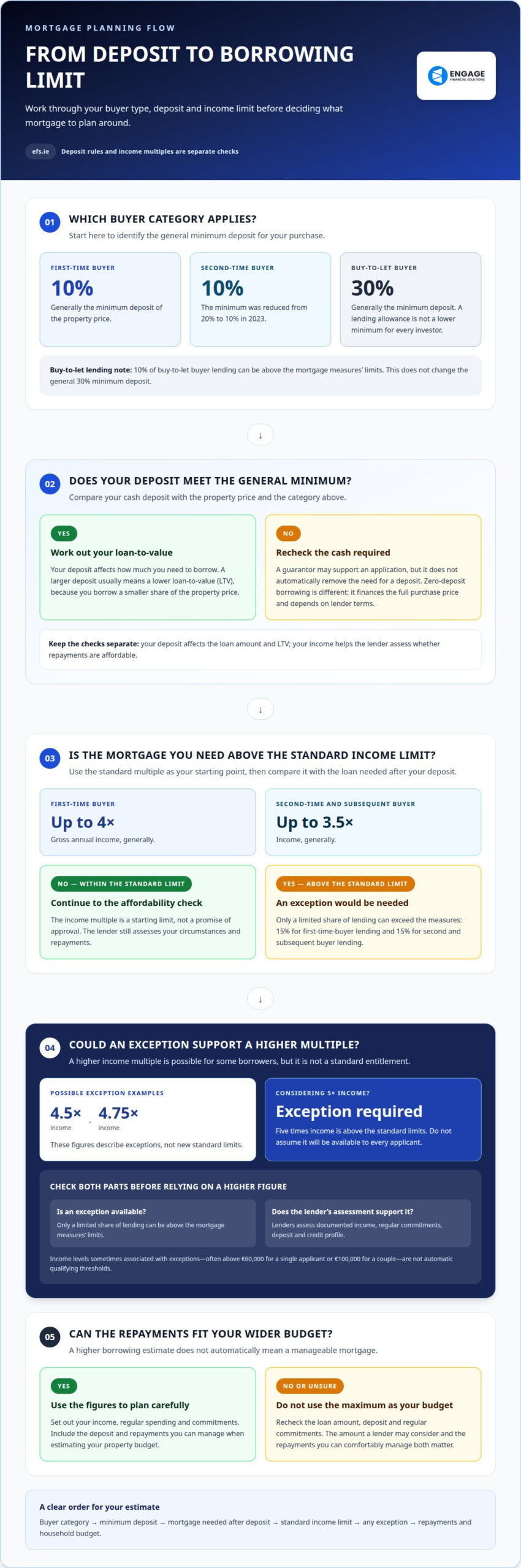
For a first-time buyer, the minimum deposit is generally 10% of the property price. A mortgage based on five times your income doesn’t change that deposit requirement.
Your deposit determines how much of the purchase price you need to borrow. Loan-to-value, often shortened to LTV, compares the mortgage amount with the property’s value. A larger deposit usually means a lower LTV because you’re borrowing a smaller share of the price. When planning a purchase, calculate your deposit as a percentage first, then compare the mortgage you need with your income and budget.
Deposit rules differ by buyer type. Buy-to-let buyers generally need a minimum deposit of 30%. The Central Bank states that 10% of buy-to-let buyer lending can be above the mortgage measures’ limits. That lending allowance is not the same as a lower minimum deposit for every investor. Second-time buyers’ minimum deposit requirement was reduced from 20% to 10% in 2023. Check which buyer category applies to your purchase before estimating how much cash you need.
Income and deposit are assessed together, but answer different questions. Your income helps a lender assess whether repayments are affordable, while your deposit affects the amount you need to borrow and the LTV. As you prepare your application, organise evidence of your earnings and the source of your deposit. Clear records show how the figures fit together, whether your deposit comes from savings or another source.
A guarantor arrangement involves another person supporting a mortgage application. It may help address a gap between your circumstances and a lender’s requirements, but it doesn’t automatically remove the need for a deposit. Zero-deposit borrowing means financing the full purchase price without contributing a cash deposit. These arrangements depend on the lender’s terms and the support available, so don’t assume a guarantor and a zero-deposit mortgage are interchangeable.
Use this simple check before applying:
- Identify whether you’re buying as a first-time, second-time or buy-to-let buyer.
- Calculate the deposit against the property price and note the resulting LTV.
- Set out your income, regular commitments and deposit source clearly.
- Compare the mortgage amount needed with both your borrowing capacity and repayments you can manage.
This gives you a more realistic starting point than focusing on an income multiple alone. A stronger deposit may reduce the amount you need to borrow, while lenders will still assess your income and overall affordability.
Can You Borrow 5 Times Your Salary from a Mortgage Lender?
A 5 x mortgage means borrowing five times your gross annual income. In the Irish mortgage market, that amount is above the standard income limits, so it would require an exception. Exceptions exist, but only a limited share of lending can exceed the measures.
Standard loan-to-income limits
A loan-to-income limit sets the usual mortgage amount in relation to your income. According to the Central Bank, second-time buyers can generally borrow up to 3.5 times their income. First-time buyers have a separate standard limit, so your buyer status sets the starting calculation.
The limit applies to the loan, not the property price. For a joint application, consider the applicants’ combined eligible income. Calculate the standard amount for your category first, then compare it with the mortgage you need after your deposit. This reveals any gap before you make plans based on a higher multiple.
Higher loan-to-income mortgages
A higher loan-to-income mortgage is lending above the standard income multiple through an exception. According to the Central Bank, 15% of first-time-buyer lending and 15% of second and subsequent buyer lending can be above the mortgage measures’ limits.
Some Irish mortgage exceptions have allowed borrowing up to 4.75 times income, and some borrowers have received 4.5 times income. These figures describe possible exceptions, not a new standard limit. Treat five times income as an exception-based possibility, rather than assuming it will be available to every applicant.
Eligibility for higher income multiples
Eligibility depends on the lender’s assessment of your income and overall affordability, alongside whether an exception is available. Irish mortgage exceptions may be available to single applicants with incomes often above €60,000, or couples with incomes often above €100,000.
Those income levels are not automatic qualifying thresholds. Your documented earnings, regular commitments, deposit and credit profile all affect your application. Before relying on a higher multiple, organise evidence of your income and compare the repayments with your household budget. This helps you see whether a larger loan suits your plans as well as the lender’s assessment.
Borrowing examples
Examples show how the multiple changes the initial borrowing estimate. At five times income, the arithmetic gives €500,000, but that requires an exception rather than the standard calculation.
Use the standard multiple first, then compare it with any higher figure as you plan a purchase. A mortgage broker can help explain how lender criteria apply to your circumstances. Include your deposit and expected repayments in the calculation, so a larger borrowing estimate doesn’t become your budget by default.
UK lender eligibility and affordability checks
For a mortgage application in Ireland, lenders look beyond the amount you request. They assess whether your income can support repayments alongside your regular spending and financial commitments. Understanding the evidence they consider helps you prepare a clearer application and set a property budget that reflects your circumstances.
Affordability checks
An affordability check examines the income and outgoings relevant to your ability to make mortgage repayments. It matters because two applicants with similar earnings may have different amounts left after their commitments.
Before applying, gather details of regular loan payments, household costs and other financial commitments. Lenders also assess factors such as your income, job type, age, credit history, deposit source and loan-to-value. Present a consistent picture of your finances, rather than relying on salary alone.
If your income varies, organise records that explain its pattern and reliability. For example, a self-employed applicant can prepare certified accounts showing business earnings. Clear supporting documents help a lender understand both the income available for repayments and the commitments that reduce it.
Repayment considerations
Repayment considerations are how mortgage payments could affect your budget over time. They matter because your initial payment is only one part of deciding whether the loan will remain manageable.
Irish mortgage lenders assess whether borrowers could afford repayments if interest rates rose by 2% above the current rate. Consider the same pressure in your household budget: identify which spending could adjust and which commitments would remain fixed. This gives you a practical view of how much room your finances have if payments increase.
Review the proposed repayment alongside the mortgage term and your other financial plans. A payment that looks manageable on paper may leave little flexibility for regular costs or changes in circumstances. Set a personal borrowing ceiling based on the payment you can sustain, rather than automatically aiming for the lender’s maximum.
Improving affordability
Improving affordability means strengthening the financial picture you present and choosing a loan that fits your budget. This matters because lenders assess both the amount you request and your capacity to repay it.
Before applying, list your regular commitments and consider whether you can responsibly reduce any of them. Avoid taking on new borrowing while preparing your application, as extra repayments reduce the funds available for a mortgage. Keep income documents and account records organised, especially if your earnings fluctuate or come from self-employment.
Compare your planned mortgage payment with your actual spending, including the rate-rise assessment. If the figures feel tight, consider a lower property budget or a larger deposit to reduce the amount borrowed. These steps help you set a realistic maximum and see how repayments fit with your wider financial plans.
How salary multiples determine potential borrowing
Lenders use eligible income and the applicable multiple to estimate a potential mortgage. They assess the type of income as well as salary, so your application figure may differ from your headline earnings.
Borrowing limits by buyer type
Buyer type matters because the standard income multiple differs for first-time and subsequent buyers. According to the Central Bank of Ireland, first-time buyers can generally borrow up to four times their gross annual income. For example, a single buyer earning €70,000 would reach €280,000 at that multiple. An exception allowing a higher amount is not the standard limit.
Use your own buyer category when estimating a property budget. A larger potential loan must also fit your deposit and the lender’s repayment assessment.
Income calculation for applications
Income calculation is the lender’s assessment of which earnings can support the requested mortgage. It matters because variable pay may not count in full. Some lenders may count 50% of average bonus income, while others may count 100% of guaranteed overtime.
When applying, separate your basic salary from bonuses, overtime and other variable earnings. Keep evidence showing how regular and guaranteed each part is. This helps you understand which income may count towards the calculation, rather than assuming every payment increases your borrowing capacity.
For a joint application, lenders combine eligible earnings before applying the relevant multiple. A couple with a combined income of €100,000 would reach €400,000 at four times income, before affordability checks. Compare that estimate with the mortgage needed after your deposit, not just the property’s asking price.
Age can affect the term a lender will consider and whether repayments remain affordable into retirement. The practical questions are how long the loan will run and what income will support payments later. If your planned term extends beyond your expected retirement, include likely retirement income in your personal budget and consider how repayments would fit.
Borrowing five times your salary can increase your purchasing budget, but it also means taking on a larger loan. That may leave less flexibility if household costs rise or your income changes. Compare repayments with your regular spending and future plans, rather than treating a competitive borrowing figure as a target.
Make your estimate more useful by calculating it twice: first using the standard multiple for your buyer category, then using only income you can clearly evidence. Record the difference. It shows how much your plans depend on variable earnings or an exception, and helps you set a more grounded maximum before viewing homes.
Interest rates and credit profile
Interest rates and your credit profile both shape how a lender assesses a mortgage application. A higher income multiple can increase the loan amount, but repayments still need to fit your finances. A borrowing limit is useful only if the resulting payments leave room for regular costs and changes to your budget.
Interest rates affect the amount you repay over the mortgage term. Irish mortgage lenders assess whether you could afford repayments if rates rose by 2% above the current rate. This stress test looks beyond the initial payment. Compare the possible increase with your income and existing commitments to understand how much flexibility your budget has.
The loan size, interest rate and repayment term work together. A larger loan means more interest is charged, while a rate change can alter the amount due. Compare repayment estimates for the mortgage options available to you and consider how they fit your spending plans. Leave room in your budget for everyday costs and other financial priorities.
Your credit profile gives lenders information about how you have managed borrowing. Missed payments and outstanding debts may affect how an application is assessed. The Central Credit Register records details of loans of €500 or more. Before applying, review your borrowing commitments and make sure the figures in your budget accurately reflect them.
Before applying, list your current loans, credit agreements and regular payments. Check that the balances and payment details in your budget are accurate. Avoid taking on new borrowing while preparing your application, as extra commitments can reduce the income available for mortgage payments. If you’ve had difficulty keeping up with payments, factor that into your assessment of what you can manage.
A mortgage broker can help you understand how interest rates and lending limits affect the options available to you. Ask for repayment comparisons that show the effect of a rate rise, rather than considering only the initial payment. This gives you a clearer basis for comparing mortgage options with your household budget and future plans.
Before setting a property budget, write down your proposed repayment, regular commitments and the amount left for other costs. Then consider how that balance changes under the rate-rise assessment. If you’re reviewing a current loan or planning a purchase, discuss your mortgage options as part of your next steps.
Engage Financial Solutions: Switching mortgages
Engage Financial Solutions helps homeowners review their existing borrowing and future plans through its switching mortgage service. If your current rate or repayments prompt you to reassess, reviewing your mortgage alongside your budget can clarify what matters in a new arrangement.
Whether you’re comparing a switch or planning your first purchase, the right borrowing decision depends on more than an income multiple. Consider your deposit, eligible income, regular commitments and the repayments you could manage if rates changed. A clear view of these details can help you approach your next mortgage decision with greater confidence.
For a conversation about Switching mortgages, visit Engage Financial Solutions.
Make your next mortgage decision with confidence
A 5 x mortgage can look like a route to a larger property budget, but the useful next step is to turn that estimate into a plan that fits your life. Consider not only the home you hope to buy, but also the flexibility you want for future changes in work, household costs and longer-term goals.
Engage Financial Solutions can help you explore mortgage options suited to your circumstances, whether you’re a first-time buyer, a buy-to-let investor or reviewing your current arrangement. Its first-time buyer, buy-to-let and switching mortgage services address different stages and purposes. Start by identifying the decision you need to make and the repayments you can manage.
Gather your income and spending details, decide what monthly payment fits your budget, then talk through the next step. Contact Engage Financial Solutions to discuss your mortgage plans and move forward with a clearer sense of direction.
Frequently Asked Questions
Can I get 6 times my income for a mortgage?
Six times your income is not the standard borrowing limit under Irish mortgage rules. The Central Bank of Ireland sets standard income limits, with a limited share of lending permitted above them. The research figures describe Irish exceptions reaching up to 4.75 times income, while multiples of six relate to some UK lending. Keep those markets separate when assessing your options and property budget.
Which banks offer 5x salary?
There isn’t one bank that offers a five-times-income mortgage to every applicant. Lenders assess applications against their own affordability criteria, alongside the Central Bank of Ireland’s lending measures and permitted exceptions. Rather than relying on a bank name alone, prepare evidence of your income, regular commitments and deposit. Then compare the mortgage amount and repayments available to you through the application process.
How does it work?
A lender multiplies eligible income by an income multiple to estimate a potential loan, then assesses affordability separately. For example, a joint application uses the applicants’ combined eligible income. That figure isn’t a property budget by itself: your deposit, regular spending and repayments also affect what you can afford. Keep your income and commitments together when planning a purchase, so you can compare borrowing estimates with your budget.
Are the Rates for a Mortgage Based on 5 Times Salary More Expensive?
Not automatically. The income multiple describes the loan size relative to income, while the interest rate is a separate mortgage term. The rate and repayment offered depend on the product, lender assessment and details such as loan-to-value. Some specialist UK lenders charge higher rates when a borrower needs an income boost, but this is not a universal rule for Irish mortgages. Compare the total repayment cost, not just the multiple.
Can I get a 5x salary mortgage with credit issues?
Credit issues don’t automatically answer whether a higher borrowing multiple is possible; lenders assess your credit history alongside income, commitments and affordability. Start by listing current loans and repayment obligations, then make sure your application reflects them accurately. The Central Credit Register records details of loans of €500 or more. Reviewing your borrowing records and addressing missed or overdue payments gives you a clearer picture before applying. While mainstream banks focus heavily on debt records, alternative arrangements exist in other markets; for example, specialist private lenders like ahlhardmoney.com demonstrate how property equity can secure financing even when resolving complex credit or tax liabilities.
Can self-employed borrowers use a 5x income multiple?
Self-employed borrowers can apply for a mortgage, and lenders assess documented earnings rather than relying on a payslip alone. Irish lenders may accept two years of certified accounts when assessing self-employed applicants. Prepare accounts that clearly show trading income, along with records supporting the figures in your application. If income varies from year to year, explain the pattern and relevant business commitments so the lender can assess the sustainable income available for repayments.
Can you borrow five times your income for a mortgage under Irish rules?
It may be possible through an exception, but five times income isn’t the standard limit. The Central Bank of Ireland’s mortgage measures generally allow first-time buyers up to four times gross income, and second-time buyers up to 3.5 times income. A limited proportion of lending can exceed those measures. Treat a higher multiple as a possibility to assess, not the baseline for setting your house-hunting budget.
How much would monthly repayments be on a 5x mortgage?
Monthly repayments depend on the amount borrowed, the interest rate, the mortgage term and the repayment structure. An income multiple alone cannot give you a monthly figure. To estimate payments, use the proposed loan amount and rate with the intended term, then compare the result with your regular budget. Also consider whether payments would remain manageable if rates rose, as lenders assess affordability under a rate-rise scenario.
Disclaimer
Engage Financial Services LTD T/A Engage Financial Solutions is regulated by the Central Bank of Ireland CRO 764570. Suite 2 First Floor, 14 -18 Main street, Blackrock, Co Dublin. A94 W0Y3