


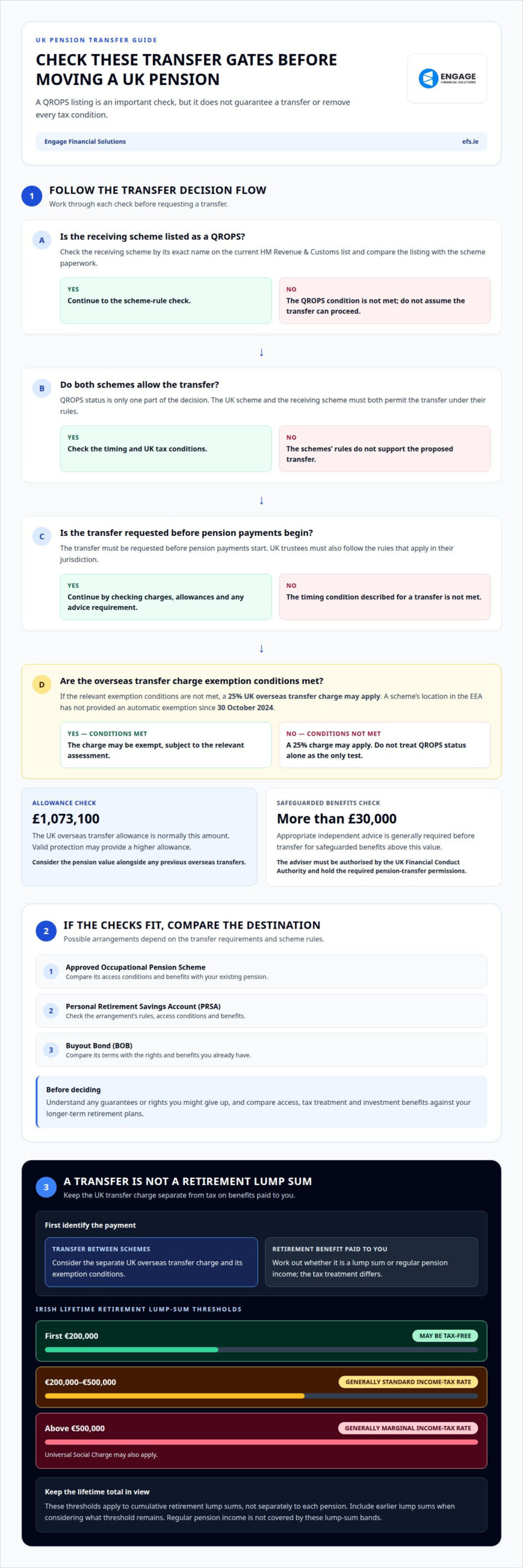
A UK private pension can be transferred to a scheme in the Irish market if the receiving scheme is listed as a Qualifying Recognised Overseas Pension Scheme (QROPS), according to HM Revenue & Customs. If the relevant exemption conditions aren’t met, a 25% UK overseas transfer charge may apply. It’s important to check the timing requirements before arranging a transfer.
It’s understandable to want a clearer picture of your pension options after moving, especially when tax rules and charges can affect your retirement income. Transferring a UK pension to Ireland after Brexit may be possible in some circumstances, but it is not automatically the right choice for every pension or retirement plan.
This article explains how QROPS eligibility works, how Irish tax applies to retirement lump sums, and which transfer costs and risks deserve attention. You’ll also see why it helps to compare withdrawal ages, tax treatment and investment benefits before deciding whether bringing a pension together supports your longer-term plans.
Key Takeaways
- Check whether the receiving pension arrangement is listed as a QROPS, as this can affect whether a UK transfer is accepted and taxed.
- Compare how retirement lump sums are taxed under the applicable rules before deciding when and how to take benefits.
- Consider your pension type and scheme rules, as these shape which transfer options may be available to you.
- Account for transfer charges and currency movements when assessing the value of moving pension savings.
- Weigh the practical benefits of bringing pension arrangements together against the tax, investment and access implications.
Can I transfer my UK pension to an Irish scheme?
Yes, you may be able to transfer a UK private pension to an Irish pension scheme if the receiving scheme meets the relevant QROPS requirements. The transfer also depends on the rules of both schemes and the UK overseas transfer tax conditions.
Recognised overseas pension schemes
A Qualifying Recognised Overseas Pension Scheme (QROPS) is an overseas pension scheme recognised for UK transfer purposes. HM Revenue & Customs says a UK private pension can be transferred when the receiving scheme is listed as a QROPS. “Qualified Recognised Overseas Pension Scheme” is sometimes used informally, but the formal term is “Qualifying”. Check the receiving scheme’s QROPS status before starting a transfer request.
Conditions before a transfer
QROPS status is one part of the decision, not a guarantee that a transfer will proceed. Both the UK scheme and the receiving scheme must allow the transfer under their rules. You must request the transfer before pension payments begin, and UK trustees must follow the rules that apply in their jurisdiction.
If the transfer requirements are met, possible destinations include an Approved Occupational Pension Scheme, a Personal Retirement Savings Account (PRSA) or a Buyout Bond (BOB). These arrangements have different rules, so compare their access conditions and benefits with those of your existing pension. Choose a destination that fits your retirement plans, not simply one with a familiar name.
For safeguarded benefits worth more than £30,000, appropriate independent advice is generally required before transfer. The adviser must be authorised by the UK Financial Conduct Authority and hold the required pension-transfer permissions. Safeguarded benefits can include guarantees, so understand which rights you might give up before instructing the transfer.
A proposed overseas transfer may also be assessed for tax by the scheme administrator and UK tax authorities. Keep the scheme details and transfer paperwork together, including the receiving scheme’s QROPS information. This gives the relevant parties the information they need to assess the proposed transfer and its tax treatment.
Overseas transfer charge and allowance
The overseas transfer charge is a UK tax that may apply when an overseas pension transfer doesn’t meet the relevant exemption conditions. For a scheme in the European Economic Area (EEA), its location alone hasn’t secured an automatic exemption since 30 October 2024. If exemption conditions aren’t met, a 25% charge may apply.
The UK overseas transfer allowance is normally £1,073,100, although valid protection may provide a higher allowance. Consider the value of the pension being transferred alongside any previous overseas transfers, because the allowance can affect the tax outcome. Assess the allowance and exemption conditions together, rather than treating QROPS status as the only test.
Irish retirement lump-sum tax
A pension transfer, a withdrawal and regular retirement income are different events, so don’t treat them as a single tax calculation. Under current Irish rules, the lifetime tax treatment of retirement lump sums depends on the total amount you receive over your lifetime.
The first €200,000 of lifetime retirement lump sums may be tax-free. The portion between €200,000 and €500,000 is generally taxed at the standard income-tax rate. Any amount above €500,000 is generally taxed at your marginal income-tax rate, with Universal Social Charge potentially also applying.
These thresholds apply to cumulative retirement lump sums, not to each pension separately. For example, if you take a lump sum from one arrangement and later take another, consider both when working out how much of the tax-free threshold remains. Keep records of previous lump sums before deciding how much to take from a UK pension.
A transfer itself is not the same as receiving a lump sum. The UK overseas transfer charge discussed in the previous section is a separate UK charge, while Irish lump-sum rules concern retirement benefits paid to you. The transfer’s tax treatment and the later tax treatment of withdrawals therefore need to be considered separately.
Tax on withdrawals depends on how you take your benefits and the rules that apply to the arrangement. A one-off retirement lump sum follows the lifetime thresholds above; regular pension income is not covered by those thresholds. Foreign State Pensions received by an Irish resident are generally taxed in the country where the recipient is resident.
For a UK private pension, distinguish a transfer into another arrangement from money paid to you as retirement income. The information here does not set out a specific Irish income-tax rate for every type of UK private pension payment, so don’t treat the lump-sum bands as a rate for all withdrawals. First identify whether a planned payment is a lump sum or ongoing income, then assess it under the rules for that payment type.
Before deciding on a withdrawal, gather records of earlier retirement lump sums and compare the amount you plan to take with the €200,000 and €500,000 lifetime thresholds. Also consider how much will remain invested for future income. That distinction helps you understand the tax consequences alongside the longer-term effect on retirement funds.
QROPS eligibility and UK pension types
A UK private pension can be transferred to Ireland if the receiving scheme is listed as a Qualifying Recognised Overseas Pension Scheme (QROPS), according to HM Revenue & Customs. Find the receiving scheme by its exact name on the current list and compare the details with the scheme paperwork.
Irish scheme eligibility for QROPS
QROPS eligibility depends on the receiving scheme meeting UK recognition requirements and appearing on the HM Revenue & Customs list. A scheme’s location or marketing description alone does not establish that status. Approved Occupational Pension Schemes, Personal Retirement Savings Accounts (PRSAs) and Buyout Bonds (BOBs) may be receiving arrangements, but each must meet the relevant QROPS test for a UK transfer.
This distinction matters because a pension arrangement does not automatically qualify as a QROPS. Check the specific arrangement, not just its general category. For example, don’t assume every PRSA or Buyout Bond can receive a UK transfer simply because another arrangement of the same type appears on the list.
UK private pensions that may be considered for transfer include defined benefit pensions, defined contribution pensions, Self-Invested Personal Pensions (SIPPs) and Small Self-Administered Schemes (SSASs). Their transfer terms and benefits differ, so identify your pension type before comparing it with a receiving scheme.
Checking the HMRC QROPS list
HM Revenue & Customs publishes the QROPS list of schemes that have notified it of their status. Search for the receiving scheme using its full name, then compare the listed details with the paperwork supplied for the proposed transfer. This helps distinguish an eligible named scheme from another arrangement offered by the same provider.
Use the exact scheme name rather than relying on a brand name or broad description. If a provider offers several pension arrangements, the listing for one does not establish that its other arrangements qualify. Keep a copy of the matching details with your transfer records so the scheme administrator can assess the intended destination against the application.
QROPS status does not mean every UK pension can be transferred automatically. Both the UK scheme and the receiving scheme must permit the transfer, and the UK State Pension cannot be transferred into a pension arrangement. QROPS are designed for private arrangements such as defined benefit and defined contribution pensions, SIPPs and SSASs, rather than State Pensions.
Separate eligibility from suitability. A listed receiving scheme may meet the QROPS condition, but you still need to compare what happens to your pension benefits after a transfer. Consider the scheme’s terms, access conditions and investment arrangements alongside your existing pension’s benefits. If you have a defined benefit pension, pay particular attention to guarantees that could be lost.
For a practical check, write down your UK pension type, the exact name of the proposed receiving scheme and its listing details. Compare these with the transfer paperwork and scheme rules. This gives you a clearer basis for understanding whether the arrangement is eligible and whether its terms fit your retirement plans.
Currency, charges and pension scams
A transfer can involve costs beyond the tax rules already discussed. Compare the amount being transferred, any charges and the effect of converting sterling into euros before assessing the value.
Currency considerations
Currency conversion changes how much sterling becomes euros at the exchange rate used for the transaction. If your UK pension is held in pounds but your future spending is in euros, exchange-rate movements can affect the value you receive after conversion.
Ask for a clear breakdown of the conversion method and any exchange margin included in the rate. Compare the sterling transfer value with the euro amount credited, using the same date and rate assumptions. This makes it easier to distinguish the conversion effect from pension charges.
Charges involved
Transfer charges are costs deducted or billed during the movement of pension funds. A 5% fee is described as a common cost, although the amount varies. The total depends on your pension type, its current value and the number of pensions being transferred.
For example, transferring several pensions may involve different charges for each arrangement, rather than one uniform cost. Request an itemised breakdown of any exit, administration or receiving-scheme charges that apply. Then compare the net amount expected to arrive with the value being transferred.
Keep tax separate from fees. A UK overseas transfer charge may apply if exemption conditions are not met, while scheme and transaction charges are separate costs. Review both before deciding, because a fee estimate alone does not show the full amount that may be deducted.
Pension scam risks
A pension scam can involve pressure to move savings into an arrangement that does not suit your needs. Treat unsolicited calls, messages promising unusually high returns or demands for an immediate decision as reasons to pause. A QROPS listing is relevant to transfer eligibility, but does not by itself show that an investment is suitable.
Before signing transfer paperwork, compare the proposed scheme name with the HM Revenue & Customs QROPS list. Read the investment details and charges, and make sure you understand how your money will be held after the transfer. Don’t rely only on a polished website or reassuring conversation.
Take time to compare any proposed benefits with the pension rights you would leave behind. If a salesperson says a transfer is urgent, ask for the explanation in writing and consider whether the pressure is distracting from the terms. A clear record of the offer, scheme and charges helps you assess the decision calmly.
Keep copies of pension statements, transfer forms and written cost estimates together. Check that the receiving arrangement’s name matches across the documents, and don’t sign forms with blank or unclear details. These practical checks can help you spot inconsistencies before your pension savings move.
Reasons to transfer a pension to an Irish scheme
A transfer may suit your plans if your retirement savings and future spending are centred in the same country. Whether it makes sense depends on your pension type, the benefits you would give up and how the receiving arrangement fits your retirement income needs.
One practical reason to consider a transfer is bringing several private pension arrangements under one plan. Fewer arrangements can make it easier to track investments, review charges and coordinate withdrawals. Before consolidating, compare each pension’s benefits and terms. A defined benefit pension, for example, may provide guarantees that a different arrangement does not offer.
Currency may also influence your decision. If your pension is held in sterling but your future spending is in euros, conversion can affect the amount available for those expenses. Compare the currencies used by the existing and receiving arrangements, and include conversion costs in your assessment. A transfer does not remove exchange-rate movements from future planning.
Access timing deserves attention too. The UK normal minimum pension age is currently 55 and is scheduled to increase to 57 from 6 April 2028. Compare that timetable with the receiving scheme’s access rules and your planned retirement date. A transfer that changes when you can draw benefits may not match your preferred timeline.
Tax planning is another reason to examine the wider picture, rather than focusing only on transfer-day treatment. The Irish Standard Fund Threshold is €2.2 million for 2026, with scheduled increases of €200,000 each year until it reaches €2.8 million in 2029. Consider how a transfer could fit alongside your other retirement savings and future benefits.
Think carefully before transferring if you may move countries again. The original tax treatment of a UK overseas pension transfer may be reconsidered if you move to another country within five years of the transfer. Your future residence plans can therefore matter as much as your current address. Include possible relocation in your decision rather than treating the transfer as a one-country choice.
A UK State Pension is different from a private pension: it cannot be transferred into an Irish pension arrangement. If you qualify, you can claim it after moving and choose payment to a UK or Irish bank account. Keep it separate from your private pension comparison, so you do not include a benefit that cannot be moved.
Before deciding, compare your current pension’s benefits, investment arrangements, access timing, currency exposure and tax position with the proposed receiving scheme. A transfer can support simpler oversight, but only if the new arrangement fits your retirement priorities. Review your retirement planning options as part of that comparison.
Engage Financial Solutions: Income Protection
Engage Financial Solutions can help you consider Income Protection as part of the wider financial plan supporting your retirement goals. If you’re reviewing pension arrangements while still earning, consider how your household would manage if illness or injury affected your ability to work. Income Protection addresses that concern separately from whether a UK pension transfer suits your circumstances.
A broader financial plan can help you consider expected retirement income alongside current commitments. This may be useful whether you’re preparing for retirement or balancing work, family responsibilities and longer-term financial security.
For a conversation about Income Protection and your financial plan, contact Engage Financial Solutions.
Make your next move with confidence
A pension decision is part of your wider financial picture. Before acting, consider how your retirement plans fit with your household goals, whether you’re protecting your income, planning a future home purchase or managing property investments. Engage Financial Solutions offers Switching Mortgages, First-time Buyer Mortgages and Buy-to-let Mortgages, which may be relevant to those wider plans.
Take time to shape a decision around the retirement lifestyle you want, rather than focusing on the transfer alone. A clear view of your priorities can help you decide what to explore next and how each financial choice fits together.
If you’d like to discuss your financial plans, contact Engage Financial Solutions. A considered next step can help you move towards a more secure financial future.
Frequently Asked Questions
Are there any other rules?
Yes. Both pension schemes must permit the transfer, and you must request it before pension payments begin. Safeguarded benefits worth more than £30,000 generally require independent advice from an appropriately authorised UK adviser. Also consider future moves: the original UK tax treatment may be reconsidered if you move country within five years of transferring. These conditions can affect whether the transfer proceeds and its tax outcome.
How could a transfer affect my retirement lump sum?
A transfer does not itself pay you a retirement lump sum, but it may change which scheme’s rules govern future benefits. Irish tax-free treatment applies across your lifetime, not as a fresh allowance for each pension. For example, lump sums received from an earlier arrangement can affect the tax-free allowance remaining when you later take benefits from a transferred pension.
How does the transfer work?
You request the transfer and provide details of your existing pension and proposed receiving scheme. The scheme administrator and UK tax authorities may assess the transfer for tax purposes, while trustees handle it under the rules that apply in their jurisdiction. Keep the scheme names, transfer paperwork and benefit statements together. Before submitting your request, compare the receiving scheme’s terms with the benefits you currently hold.
What is a QROPS?
A Qualifying Recognised Overseas Pension Scheme is an overseas pension scheme recognised for UK pension-transfer purposes. HM Revenue & Customs maintains a list of schemes that have notified it of their QROPS status. A listing relates to transfer eligibility, not whether the scheme’s investments or terms suit you. The UK State Pension is different and cannot be transferred into a QROPS.
What should I consider before transferring?
Compare the benefits you would give up with the receiving scheme’s access rules, investment arrangements and charges. If you have a defined benefit pension, identify any guarantees before deciding. Also consider the currency you expect to spend, your retirement timing and possible future moves abroad. A practical step is to place your latest pension statements side by side and note where the terms differ.
Can I transfer a UK pension to a local scheme after Brexit?
Yes, a UK private pension can be transferred if the receiving scheme is listed as a QROPS, according to HM Revenue & Customs. Both schemes’ rules must allow the transfer, and you must request it before pension payments begin. A UK State Pension cannot be transferred into a private pension arrangement, so keep it separate from workplace or personal pensions.
What are the current HMRC rules for transferring a UK pension to a local pension scheme?
HM Revenue & Customs says a UK private pension can be transferred to Ireland if the receiving scheme is listed as a Qualifying Recognised Overseas Pension Scheme (QROPS). An EEA location alone hasn’t automatically exempted a QROPS transfer from the overseas transfer charge since 30 October 2024. Scheme rules and applicable advice requirements also matter. Match the exact receiving scheme name against the list before submitting paperwork.
What UK tax charges apply when transferring a pension, including the overseas transfer charge?
A 25% overseas transfer charge may apply if the relevant exemption conditions aren’t met. The UK overseas transfer allowance is normally £1,073,100, although valid protection may provide a higher allowance. Since 30 October 2024, an EEA QROPS isn’t automatically exempt solely because it is based in the EEA. Consider the allowance and exemption conditions together when assessing a proposed transfer’s tax position.
Disclaimer
Engage Financial Services LTD T/A Engage Financial Solutions is regulated by the Central Bank of Ireland CRO 764570. Suite 2 First Floor, 14 -18 Main street, Blackrock, Co Dublin. A94 W0Y3