


To start a pension, first identify which type fits your work and circumstances: a workplace pension, Personal Retirement Savings Account (PRSA), personal pension or company pension. Then consider what you can contribute and how the plan could support your retirement income. Starting earlier gives your contributions more time to grow, although investment values can rise or fall.
Choosing between pension options can feel like a big decision. The right fit depends on factors such as whether you’re employed or self-employed, whether your employer contributes and how much flexibility you need.
This guide explains the main pension types, what to weigh when choosing a plan and how starting sooner can help you build towards greater financial security. It also covers contributions, tax relief and investment risk, giving you a clearer picture of your options and next steps.
Key Takeaways
- Identify whether a workplace pension, PRSA or personal pension best fits your employment situation and retirement goals.
- If you’re self-employed, explore how a personal pension can help you build retirement savings independently.
- Consider your contribution comfort, employer payments and investment risk when weighing up a plan.
- Starting earlier gives contributions more time to grow, making consistency a useful part of long-term planning.
- Explore how retirement planning and related financial protection can fit together as your circumstances change.
Why start a pension?
A pension can help build retirement income alongside the State Pension and other savings. Your contributions, any employer payments and tax relief can all affect the income available later.
Workplace and employer contributions
A workplace pension is arranged through your employer, with contributions potentially coming from both you and your employer. An employer contribution can add to the amount invested for your future, rather than relying on your payments alone. Check how your workplace plan sets contributions and whether your employer matches yours. For example, a matched contribution can increase the total paid into your pension.
Tax relief on pension contributions
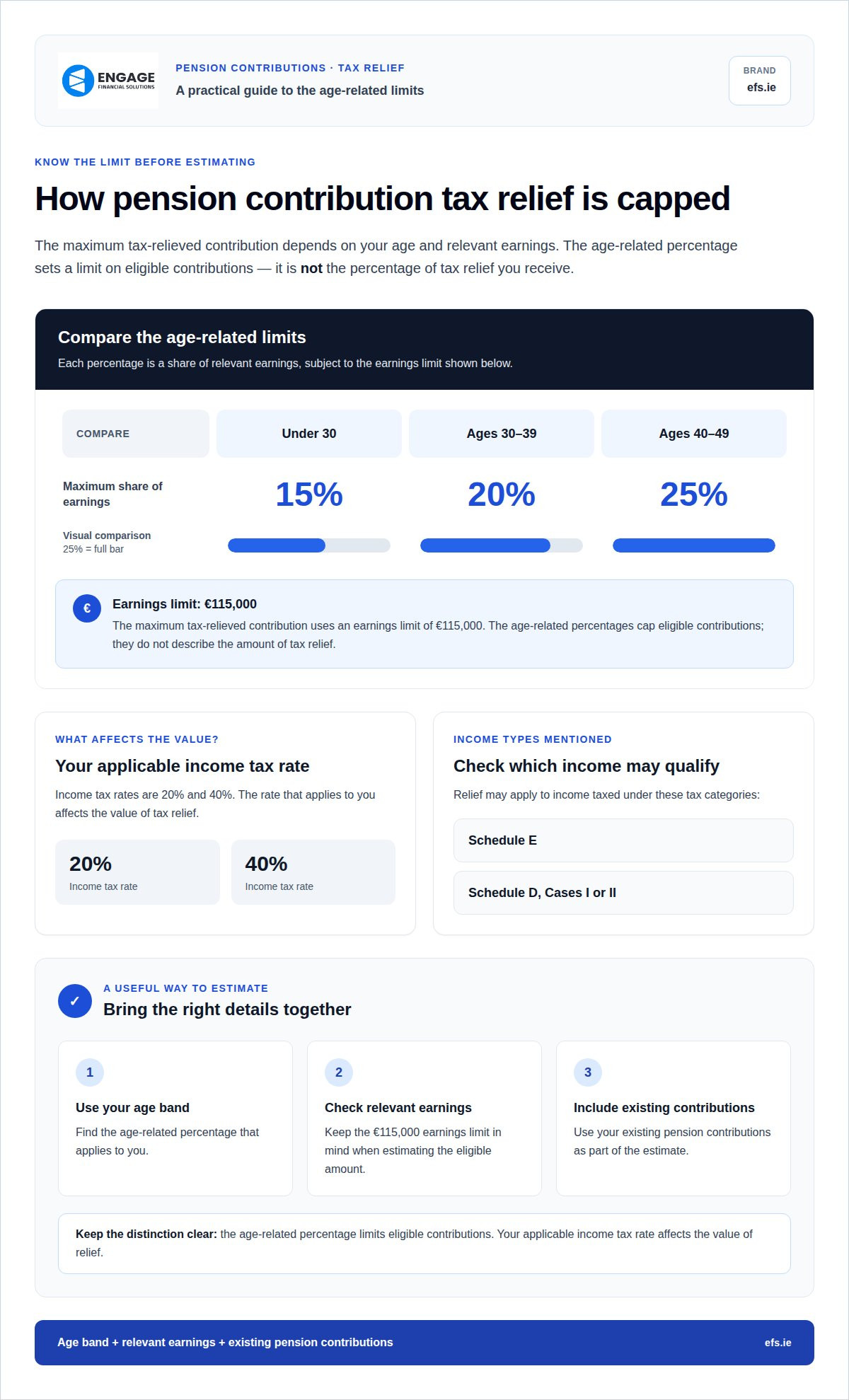
Tax relief reduces the tax due on eligible pension contributions, subject to limits based on age and earnings. The maximum tax-relieved contribution uses an earnings limit of €115,000. It is 15% of earnings for people under 30, 20% for ages 30-39, and 25% for ages 40-49. These percentages cap eligible contributions, not the amount of tax relief. Relief may apply to income taxed under Schedule E or Schedule D, cases I or II. As income tax rates are 20% and 40%, your applicable rate affects the value of relief. Use your age, relevant earnings and existing pension contributions to estimate the eligible amount.
Estimating contributions for a target retirement pension
Start with the retirement income you want, then estimate the contributions needed to work towards it. The Pensions Authority’s pension calculator estimates the contributions required to provide a target pension in retirement. Try different contribution amounts to see how changing your payments affects the estimate. Include workplace and personal contributions in your overall planning to assess your pension savings together. A calculator provides an estimate, not a guaranteed investment outcome.
Accessing pension savings and taxation
Access timing depends on the pension arrangement; the State Pension is a weekly payment for eligible people over 66. An RAC may pay up to 25% of its fund as a tax-free lump sum, subject to a €200,000 lifetime tax-free limit; according to the Revenue Commissioners, annuity payments and ARF distributions are taxable under Schedule E. Consider how a lump sum or regular income would support your retirement plans before choosing how to use pension savings.
Investment risks, job changes and contributions
Pension investments can fall as well as rise, and you may lose some or all of the money invested. Currency exchange changes can also affect value, while past performance is not a reliable guide to future performance. If you change jobs, review how your existing workplace pension fits with your new arrangements. If you stop contributing, payments into that pension pause. Revisit your retirement estimate and contribution plan when your circumstances change.
Personal pensions for self-employed people
If you’re self-employed, you can arrange a personal pension rather than relying on an employer’s workplace plan. The right structure depends on your work pattern, existing pension savings and how regularly you can contribute.
Starting a pension when self-employed
A personal pension lets you contribute towards retirement without an employer arranging the plan. A Personal Retirement Savings Account (PRSA) is another personal option. Compare how each fits your income pattern and future plans. Estimate what you can contribute during quieter and busier trading periods, then choose an amount you can maintain. A financial adviser can help assess the options in light of your circumstances.
Self-employed income can vary, so build flexibility into your contribution approach. For example, you might set a regular payment that suits your usual cash flow, then review it when your business income changes. Keep personal and business finances organised so pension contributions are visible alongside other commitments. Aim for a plan that supports retirement savings without making routine cash flow harder to manage.
Before setting up a plan, gather details of any existing pensions, your income pattern and your retirement goals. This information can help you decide whether a new PRSA or personal pension complements your existing savings. Consider contributions as part of your wider financial plan, rather than as an isolated payment. If you move from self-employment into a job, reassess your arrangement alongside any workplace pension.
Pension eligibility and auto-enrolment
Employees can generally start through a workplace pension arranged by their employer, whilst self-employed people can arrange personal pension savings. Auto-enrolment is designed as a workplace route for eligible employees, so it does not remove the need for self-employed people to consider their own plan. The Government planned to introduce an auto-enrolment system in the second half of 2024; employment status remains central to understanding which route applies.
If you’re an employee, find out how your employer’s pension works, including how your payments and any employer contributions are handled. Employer matching can increase the total going into a workplace plan, so understand the scheme’s contribution terms before deciding whether to make separate pension payments. A job change is a useful time to review how your existing savings fit with any new workplace arrangement.
For a self-employed person, a PRSA or personal pension provides a way to build retirement savings without an employer. An advisor can help you weigh contribution flexibility, existing arrangements and your longer-term plans. Pension planning support can help bring those decisions into focus.
Choosing a pension plan for your circumstances
Understanding how to start a pension in Ireland begins with matching a plan to your employment, income pattern, retirement aims and comfort with investment risk. A workplace pension, PRSA or personal pension may suit different circumstances. First identify how you earn, whether an employer contributes and what pension arrangements you already have. This gives you a practical basis for deciding which options to explore.
Next, map your existing arrangements. Note any workplace plan, personal pension or pension from previous employment. Consider how regularly you can make payments and whether your employer contributes. Someone in steady employment may start by examining the workplace plan. If your income changes from month to month, contribution flexibility may matter more in your decision.
Work back from the retirement income you want to plan for. Consider other expected income and savings alongside your pension. The Pensions Authority’s calculator estimates contributions towards a target pension. Try different payment amounts to see how they affect the estimate, then consider which level fits your budget and existing commitments.
Compare providers by reviewing their written charges and how these apply to payments or pension savings. Examine the investment options and understand the level of risk involved. A personal pension is managed by a life assurance or investment company. Ask for a clear explanation of the plan terms, charges and investment choices, then compare equivalent details rather than relying on brand recognition or past performance.
- Plan type: Match a workplace pension, PRSA or personal pension to your employment.
- Payments: Choose a contribution pattern that works with steady or variable income.
- Employer input: Include workplace contributions when assessing the total paid into your plan.
- Investments: Consider the investment approach and risk alongside your retirement time horizon.
- Charges: Review how fees apply to contributions and pension savings.
A financial adviser can help assess a plan in light of your circumstances. Bring details of existing pensions, income, intended payments and retirement aims to the discussion. For example, someone changing jobs may need to consider how an old workplace plan fits alongside a new arrangement. Clear information makes it easier to see the wider picture and identify relevant questions.
When deciding how to start a pension in Ireland, treat it as part of your wider financial plan, not an isolated product decision. Revisit it when you become self-employed, change jobs or adjust your savings priorities. A plan that suited your earlier income or responsibilities may need reviewing as your circumstances evolve. Keep your pension details together so future decisions can build on an accurate picture.
Reasons to start a pension early
Starting pension contributions earlier gives them more time to build towards retirement income. You can begin with an amount that fits your current budget, then review it as your income and priorities change. Regular payments have longer to accumulate investment returns than payments begun closer to retirement.
Investment growth can build on previous growth, a process often called compounding. Contributions invested over a longer period have more time to experience this effect. Returns are not predictable, but this helps explain why starting sooner can matter, even when your first payments are modest. A steady contribution habit may be more manageable than waiting until you can afford a larger payment.
Planning ahead also helps you avoid relying on one source of retirement income. In Ireland, 34% of workers have no pension coverage outside the State Pension. Among people without a pension, 57% expect the State Pension to be their main retirement income source. These figures underline why it’s useful to consider personal savings alongside State support, rather than leaving the decision until retirement approaches.
Demographic change adds another reason to plan for future income. The old-age dependency ratio is projected to reach 46% by 2050. This measure compares the older population with people of working age. It does not determine your personal pension outcome, but it provides context for thinking about how your own savings could contribute to retirement plans.
Starting early also gives you more opportunities to review contributions against changing costs and income. The European Central Bank’s target inflation rate for the euro area is 2% per annum. Inflation can affect what retirement income buys, so revisit your savings goals as prices and circumstances change. An annual review helps you check whether your planned contributions still match your intended lifestyle.
Tax relief may make eligible pension contributions more manageable by reducing their effective cost. Your income tax position and contribution limits affect the relief available. Treat tax relief as one part of the decision, not the sole reason to contribute. A practical first step is to set a regular payment that fits your budget, then review it when your income changes.
Early planning can also give you room to adapt. If your earnings rise, you could consider increasing payments; if your budget tightens, reassess what remains sustainable. This keeps pension contributions connected to real life, whether you’re building savings gradually or balancing several financial priorities. Record your contributions and review them alongside your other long-term plans.
Pension eligibility for workers
Employees and self-employed people can contribute to pension savings, but the available route depends on how they work. An employee may have access to a workplace arrangement, while someone working for themselves can consider a personal pension or PRSA. Start by identifying your employment status and the plan types relevant to it. Your status alone doesn’t determine how much tax relief applies.
If you’re employed, find out whether your employer offers a workplace pension and how to join. These plans may involve contributions from you and your employer, with payments linked to your salary. Employer matching may also apply under the plan’s terms. Include any employer contribution when assessing the total being paid into your pension.
Changing jobs doesn’t prevent you from contributing to a pension, but it can change your arrangements. A new employer may have a different workplace plan, while your existing pension remains part of your retirement picture. Gather details of previous arrangements and consider how they fit with any new payments. This helps you keep track of savings already built up as your employment changes.
Self-employed people can arrange personal pension savings without an employer setting up a workplace plan. A PRSA is one option to consider alongside a personal pension. If your income varies, consider a contribution approach that can accommodate changes in cash flow. A financial adviser can help assess the options in light of your employment, income and retirement aims.
Tax relief depends on the type of income you receive. It may be available on qualifying employment income or certain income from self-employment. The maximum earnings limit used to calculate tax-relieved contributions is €115,000. The maximum percentages are 15% of earnings under 30, 20% for ages 30-39, and 25% for ages 40-49. These are limits for calculating tax relief, not required contribution amounts.
To understand your position, identify your employment type, relevant income and existing pension contributions. Then consider the age-related limit that applies and whether a workplace plan or personal arrangement suits your circumstances. The Pensions Authority’s calculator estimates contributions towards a target retirement pension. It can help you explore contribution estimates alongside your employment arrangements.
Auto-enrolment is intended as a workplace pension route for eligible employees, rather than a personal pension arrangement for self-employed people. The Government planned to introduce the system in the second half of 2024. Distinguish workplace eligibility from your ability to arrange personal pension savings, and consider how any workplace plan fits your circumstances. For employer-based planning, explore Company Pensions as part of your wider retirement decisions.
Engage Financial Solutions
Engage Financial Solutions can help you consider how retirement decisions fit your wider financial circumstances. If you’re weighing future income against current financial responsibilities, its guidance can help bring the choices into focus. Depending on your needs, related considerations may include Income Protection, Group Protection or an Annuity as part of planning for financial security.
Whether you’re reviewing your next step or considering how retirement income may work later, a conversation can help you explore options relevant to your circumstances. Contact Engage Financial Solutions to discuss your situation.
Make your next step part of your wider plan
Give your pension decision a practical next step by connecting it with the life you want your finances to support. Consider how future retirement income sits alongside your current commitments, savings priorities and work plans. You might set a date to review your arrangements, note any unanswered questions and decide what information would help you move forward. A clear starting point can make a long-term decision easier to approach.
Engage Financial Solutions can help you consider pension choices through the wider lens of Retirement Planning and Financial Planning. This can be useful if you want to understand how retirement goals relate to other financial priorities, rather than viewing each decision in isolation. The conversation can focus on your circumstances and the areas you want to explore.
Contact Engage Financial Solutions to discuss your retirement planning and take a considered next step towards your future.
Frequently Asked Questions
What types of pensions are there?
The main options include the State Pension, workplace pensions, personal pensions and Personal Retirement Savings Accounts (PRSAs). A workplace or occupational pension is linked to employment, while personal pensions and PRSAs are arranged individually. Auto-enrolment is a workplace pension route. Options differ in how contributions are made and who arranges the plan, so start by identifying whether you’re employed or self-employed.
Who offers pensions?
Employers can arrange workplace pensions, while personal pensions are managed by life assurance or investment companies. Engage Financial Solutions provides retirement planning options, including PRSAs, personal pensions and company pensions. The provider and plan structure depend on whether you want an arrangement through employment or one you organise personally. If you’re reviewing an existing pension, gather its plan details to consider how it fits with your other retirement savings.
How do I start a personal pension?
Begin by setting out your retirement aims, income pattern and any pensions you already have. Then consider whether a personal pension or PRSA better suits your circumstances and decide what contribution level fits your budget. A financial adviser can help assess the options and explain investment choices. Keep a record of the plan details and review your contributions when your income or financial priorities change.
How do occupational pensions, personal pensions, PRSAs and auto-enrolment differ?
An occupational pension is arranged through an employer, while a personal pension or PRSA is set up individually. Auto-enrolment is a workplace route rather than a personal pension product. The practical distinction is who organises the arrangement and how contributions are handled. If you change jobs or become self-employed, review which arrangements apply to your new circumstances and how existing pension savings fit alongside them.
What are the pension contribution tax relief limits by age and income?
The maximum earnings limit used to calculate tax-relieved pension contributions is €115,000. The maximum contribution percentages are 15% of earnings for people under 30, 20% for ages 30-39 and 25% for ages 40-49. These figures are limits for calculating tax relief, not recommended contribution amounts. To estimate your own position, consider your age, relevant earnings and pension contributions together.
How much should I contribute to a pension?
Choose a contribution that supports your retirement goal without putting pressure on your current finances. The Pensions Authority’s pension calculator estimates contributions towards a target pension, so you can explore how different payment amounts affect the estimate. Include your existing pension arrangements in your planning and consider how income changes might affect regular payments. Review the amount as your budget and retirement aims evolve.
What steps and documents are needed to set up a PRSA or personal pension?
Prepare a clear picture of your income, retirement goals, existing pension arrangements and affordable contribution level. These details help shape a discussion about whether a PRSA or personal pension suits you. The provider’s application process will set out the information and documents required to open the plan. Before proceeding, read the plan terms, investment choices and charges, and keep copies of the documents you complete.
Disclaimer
Engage Financial Services LTD T/A Engage Financial Solutions is regulated by the Central Bank of Ireland CRO 764570. Suite 2 First Floor, 14 -18 Main street, Blackrock, Co Dublin. A94 W0Y3