


A pension can be tax-efficient while you’re saving, then taxable when you draw an income. If you’re wondering how pensions are taxed under Irish tax rules, the short answer is that eligible contributions may qualify for Income Tax relief, investment growth within a pension is generally exempt from Income Tax and Capital Gains Tax, and pension income is usually taxable.
It’s understandable if the rules feel less straightforward once different pension types and withdrawals are involved. Contributions receive Income Tax relief at the applicable rate, commonly 20% or 40%, but not USC or PRSI relief. In retirement, personal and occupational pension income is generally subject to Income Tax and USC, while Approved Retirement Fund withdrawals are also generally subject to these taxes and may be liable to PRSI depending on your circumstances.
This guide explains the tax treatment of pension contributions and income, ARF withdrawals, foreign pension lump sums and investment growth. It also outlines how the rules can differ between pension types, helping you understand the key considerations when planning for retirement or deciding how to draw your savings.
Key Takeaways
- Understand how pension income is generally taxed, and how Income Tax and USC can affect what you receive in retirement.
- See how contribution relief depends on your age and earnings, and what limits apply when working out eligible contributions.
- Learn why ARF withdrawals can have tax and imputed distribution implications, so you can factor them into your retirement income plans.
- Find out how the first €200,000 of qualifying retirement lump sums is generally treated, and why foreign pension lump sums may need separate consideration.
- Discover how investment growth within a pension is generally treated for Income Tax and Capital Gains Tax, and how that differs from withdrawals.
Are pensions taxable income?
In general, pension income is taxable, while eligible contributions may receive Income Tax relief. The amount payable depends on your income, available tax credits and the type of pension payment.
Personal and occupational pension income is generally liable to Income Tax and USC, with PAYE applying to pension income paid through that system. PAYE pension income uses the same Income Tax rates and bands as other PAYE income. The standard rate is 20% on the first €36,800 of income; income above the applicable band may be taxed at 40%. PRSI is normally not levied on pension income.
Relief on eligible pension contributions is given against Income Tax, not USC or PRSI. It is generally available to people whose income is taxed under Schedule E or Schedule D, Case I or II. The value of the relief depends on your Income Tax rate, so a contribution may reduce your taxable income without reducing every deduction from your pay.
Investment growth within a pension plan is exempt from Income Tax and Capital Gains Tax. This differs from investment income held outside a pension: if you are tax-resident in the relevant jurisdiction, income from abroad is generally taxable, and the income type and any applicable tax agreement matter.
Credits, bands and income tax exemption
Tax credits reduce the Income Tax due, while rate bands determine which Income Tax rate applies to each part of your income. From age 65, a person may qualify for an Age Tax Credit of €245 and an income tax exemption when income is below €18,000. A married couple may qualify for a €490 Age Tax Credit when one partner is 65 or older, and an exemption if combined income is below €36,000. These thresholds can change how much pension income remains taxable.
Tax systems differ between countries, so there is no single international rate comparison that applies to every pension. Key planning risks include overlooking your tax residence, assuming a foreign tax agreement automatically removes local tax, or claiming relief on ineligible contributions.
Declaring pension income and claiming relief
Declaring pension income means including taxable payments in the relevant Revenue reporting process. Claiming relief means recording eligible contributions so the Income Tax reduction can be assessed. Both steps matter if you receive income outside PAYE or want relief on personal contributions.
Foreign pension or investment income outside PAYE may require a self-assessment return, including Form 11, with tax generally due by 31 October; electronic filing generally extends the deadline to mid-November. Use Revenue’s online services to report the income and claim eligible contribution relief, and keep records of payments and contributions to support your return.
Foreign pension taxation depends on your tax residence and the pension’s origin. Foreign pension income received by a tax-resident person is generally chargeable to local Income Tax; section 18(2) of the Taxes Consolidation Act 1997 addresses foreign pension income under Schedule D Case III. Tax agreements may affect where occupational pensions are taxed, so establish whether one applies before treating overseas tax as your final liability.
Tax relief on pension contributions
Tax relief can reduce the Income Tax due on eligible pension contributions. The relief available depends on your age, qualifying earnings and applicable Income Tax rate.
Relief at marginal tax rates
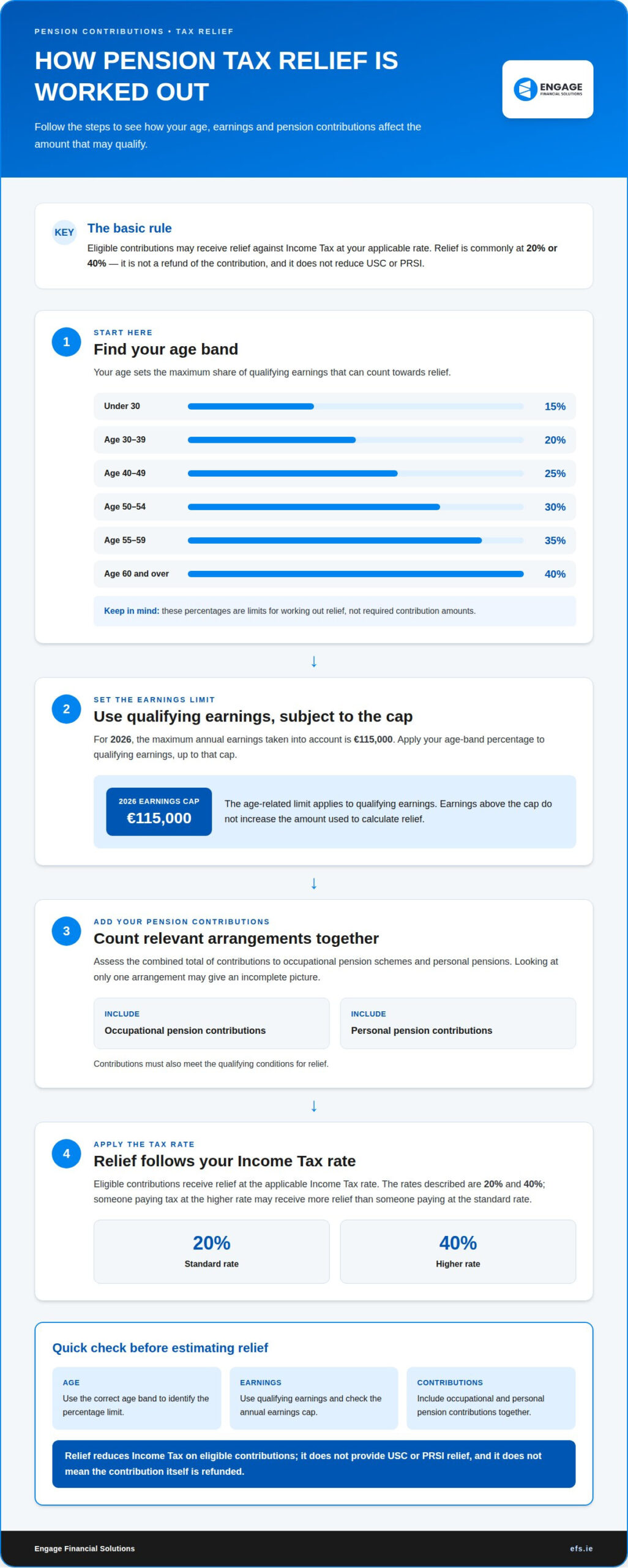
Marginal-rate relief means eligible contributions receive relief at the Income Tax rate applying to your income. This matters because a person paying tax at the higher rate may receive more relief than someone paying tax at the standard rate. The applicable Income Tax rates are 20% and 40%; relief does not mean the contribution itself is refunded.
Your age determines the maximum share of qualifying earnings that can count towards relief. The limits increase across these age bands:
- Under 30: 15% of qualifying earnings.
- Aged 30-39: 20% of qualifying earnings.
- Aged 40-49: 25% of qualifying earnings.
- Aged 50-54: 30% of qualifying earnings.
- Aged 55-59: 35% of qualifying earnings.
- Aged 60 and over: 40% of qualifying earnings.
For example, if you’re aged 40-49, the age-related ceiling is 25% of qualifying earnings. That percentage is a limit for calculating relief, not a required contribution. Your actual eligible amount can also be affected by other pension contributions and the earnings cap.
Relief is subject to the combined total of contributions to occupational pension schemes and personal pensions. Include both when assessing your annual position: looking at just one arrangement could give an incomplete picture. Contributions must also meet the qualifying conditions for relief; simply intending payments for retirement is not enough.
Annual and earnings-based relief limits
Annual and earnings-based limits cap the contributions that qualify for relief in a tax year. Contributions above the applicable limits do not increase the amount of earnings used to calculate pension tax relief.
For 2026, the maximum annual earnings taken into account is €115,000. The age-related percentage applies to qualifying earnings, subject to that cap. So, when estimating the maximum eligible contribution, consider your age band, your gross earnings and the combined contributions across relevant pension arrangements.
To assess your position, identify your age band and qualifying earnings, then include contributions to both occupational and personal pensions. The State Pension is separate from personal contribution relief. Do not count expected State Pension income as an additional contribution or as a way to raise the earnings limit.
Because these limits interact, a contribution plan should reflect your full pension picture rather than one payment in isolation. If you’re reviewing how pension saving fits your wider goals, a joined-up financial plan can help put the figures in context.
Approved Retirement Fund (ARF) withdrawals
Approved Retirement Fund (ARF) withdrawals are generally subject to Income Tax and USC, and may also attract PRSI. A separate imputed distribution rule can create a taxable amount even if you withdraw less.
Income tax on pension income
Income Tax applies to money withdrawn from an ARF, so each payment matters when planning your retirement budget. The taxable amount is treated as income and should be considered alongside your other income. This helps you estimate what remains available to spend, rather than assuming the full amount taken from your pension fund is spendable.
USC and PRSI in retirement
USC generally applies to ARF withdrawals, while PRSI depends on your circumstances. PRSI treatment of ARF and vested PRSA withdrawals depends on your circumstances. These deductions can affect the net payment, so include them when planning retirement income alongside Income Tax.
ARFs also have minimum distribution rules. If you’re aged 60 or older for the whole tax year, an annual imputed distribution is calculated using the applicable percentage of account assets. “Imputed” means the rules treat part of your fund as withdrawn, even if you haven’t taken that amount as cash. The resulting deemed distribution is relevant when working out tax due.
For an ARF worth €2 million or less, the imputed distribution rate is 4% for holders aged 60-70 for the whole tax year. The rate increases to 5% from age 70. For holders with ARF assets in excess of €2 million, the minimum annual withdrawal rate is 6%. Check which age and fund-value category applies before setting a withdrawal plan.
These rules do not mean you must spend the full amount treated as distributed. However, taking less cash than the imputed amount may not remove the tax implications. Include the required distribution in your yearly cash-flow plan, and distinguish the amount you actually receive from the amount used for tax calculations.
There can also be a PRSI record implication. An ARF withdrawal of at least €5,000 in the relevant year is stated to accrue 52 Class S PRSI contributions towards the contributory State Pension, where the qualifying conditions apply. This can make the withdrawal decision relevant to both current income and future pension entitlements.
Before choosing a withdrawal amount, consider your ARF value, age for the full tax year, other income and PRSI position together. Keep a record of payments made during the year and compare them with the applicable imputed distribution. This gives you a clearer view of the taxable amount and the cash available for regular spending.
Revenue’s position on foreign pension lump sums
A pension lump sum can be taxed differently from regular pension income. For a foreign payment, key questions include whether it qualifies as a retirement lump sum and how it fits with amounts taken from other pension arrangements.
Tax-free lump-sum thresholds
The lifetime tax-free threshold for qualifying retirement lump sums is €200,000. It matters because the threshold applies cumulatively, so lump sums from different pension arrangements can affect how much tax-free allowance remains.
After the first €200,000, the next €300,000 of cumulative qualifying retirement lump sums is generally taxed at the standard Income Tax rate of 20%. Qualifying amounts above €500,000 are taxed under PAYE at the higher Income Tax rate of 40%. These thresholds relate to the combined qualifying lump sums, not a separate allowance for each pension plan.
For example, taking €200,000 tax-free and the next €300,000 at 20% produces an effective tax rate of 12% across a €500,000 lump sum. This illustrates why the amount received and the rate applied to each portion are different figures. Before drawing funds, list any earlier qualifying lump sums alongside the proposed payment.
Tax on pension lump sums
Tax on a pension lump sum depends on whether it qualifies and the cumulative amount already received. This matters for foreign payments because you cannot assume they will be treated in the same way as a domestic pension payment.
Section 790AA TCA 1997 was introduced through the Finance Act 2006 to govern taxation of pension lump sums above a tax-free amount. Proposed rules would pool foreign pension lump sums taken from 1st January 2023 with lump sums from domestic pension arrangements since 1st January 2011. Treat that pooling proposal separately from the existing threshold calculation.
Section 781 TCA 1997 concerns people who commute their entire pension in one lump sum. It does not apply when the employment was carried on outside the country. Precedent 28, dated 30th July 1987, states that a tax-free lump sum commuting a foreign pension is not taxable when the individual moves here after retirement. This is a specific scenario, not a general exemption for every overseas payment.
To prepare for a foreign lump sum, gather details of the pension arrangement’s payment and a record of previous qualifying retirement lump sums. Then distinguish a full pension commutation from other payment types. This information helps clarify which threshold and tax treatment apply before you decide how to use the funds.
Tax treatment of pension investment growth
Tax treatment can differ between growth inside a pension, payments from a pension and money received as a lump sum. Keeping these categories separate helps you identify which rules apply at each stage.
Investment growth within a pension plan is exempt from Income Tax and Capital Gains Tax. In practice, growth can accumulate inside the plan without those taxes applying as it arises. This applies to investment growth held within the pension, not automatically to money withdrawn from it. Keep the distinction in mind when reviewing your pension statement or planning a future withdrawal.
Occupational pension payments are taxed under PAYE and are subject to USC. PAYE means tax is deducted through the payment system, rather than treating the pension as tax-free cash. Your net payment can therefore differ from the gross amount shown in scheme information. For planning, consider your occupational pension alongside other taxable income and the deductions applying to each payment.
Social welfare pensions are collected differently. A payment from the Department of Social Protection is liable to Income Tax, but tax is not deducted at source. It is not subject to USC or PRSI. This means no Income Tax is deducted from the payment itself, even though it remains relevant when calculating your overall tax position. Include it in your wider income picture rather than assuming it is tax-free.
Retirement lump sums also follow different rules from regular pension payments. Qualifying cumulative lump sums are generally tax-free up to €200,000 over a person’s lifetime. The next €300,000 is generally taxed at the standard rate, while qualifying amounts above €500,000 are taxed under PAYE at 40%. These limits apply across qualifying lump sums, so earlier payments matter when assessing a later one.
An inherited Approved Retirement Fund has its own tax treatment. An ARF inherited by a child over 21 is subject to Income Tax at a flat rate of 30%. This differs from the tax treatment of investment growth inside the pension: the growth exemption does not mean inherited funds are exempt from tax when passed on. If you’re considering how pension assets fit into your wider inheritance planning, include both the fund’s growth and its eventual transfer in your review.
As a practical step, separate your records into pension investment growth, regular occupational or social welfare payments, retirement lump sums and inherited ARF assets. For each category, note whether tax applies as the money grows, when it is paid or when it passes to a beneficiary. This breakdown helps you discuss the relevant figures with a financial adviser and plan around the correct tax point.
Engage Financial Solutions
Engage Financial Solutions can help you consider pension decisions alongside your wider financial plans. Whether you’re approaching retirement, reviewing income options or thinking about protecting your household, the right next step depends on how these choices fit your circumstances and future needs.
A financial planning conversation can help you organise the questions that matter, including how retirement income choices relate to your other plans. Engage Financial Solutions also offers Annuities, Income Protection, Group Protection and Mortgage Protection, which may be relevant at different stages of your financial life. The focus is financial planning, not tax filing.
To discuss how your pension choices fit your plans, contact Engage Financial Solutions.
Make your next pension decision with clarity
Your next step is to connect your pension choices with the life you want your retirement income to support. Before making a change, bring together your pension statements, expected income, planned withdrawals and any overseas pension details. A clear view of these moving parts can help you focus on the decision ahead rather than treating each account or payment in isolation.
It can also help to write down what you need your income to do, such as meet regular household costs, support a partner or preserve flexibility for later. Use those priorities to frame a conversation about your wider financial plan. If you’re unsure how a pension decision fits with your other goals, Engage Financial Solutions can provide financial planning support.
Contact Engage Financial Solutions to discuss your next step and move forward with greater confidence.
Frequently Asked Questions
How are pensions taxed?
Eligible pension contributions may receive Income Tax relief, and investment growth inside a pension is generally exempt from Income Tax and Capital Gains Tax. Pension payments and withdrawals can be taxable, depending on the payment type and your wider income. Regular pension payments and retirement lump sums follow different rules. Before making a withdrawal, consider how it fits with your other income and any earlier lump sums.
Is pension investment growth tax-free?
Investment growth held within a pension plan is generally exempt from Income Tax and Capital Gains Tax as it accrues. That does not mean every later payment is tax-free: tax rules can apply when money is drawn or paid as a lump sum. Keep growth inside the pension separate from income or gains on investments held outside it, which may receive different tax treatment.
What happens if you exceed a pension threshold?
Different thresholds have different consequences. Qualifying retirement lump sums above the lifetime tax-free threshold can be taxed at 20% or, above €500,000 cumulatively, at 40%. Separately, the Standard Fund Threshold is a limit on pension benefits. Benefits above the applicable threshold may face Chargeable Excess Tax, a tax on the excess, when taken. For 2026, the threshold is €2.2 million.
Why are pensions tax-efficient?
Pensions can be tax-efficient because eligible contributions receive Income Tax relief, while investment growth within the pension is generally exempt from Income Tax and Capital Gains Tax. Tax may still apply when you receive pension income or take benefits, so the timing and type of payment matter. Consider contributions, growth and withdrawals together to understand how their tax treatment affects your retirement plans.
What are the income tax rates, bands and credits for pensioners in 2026?
The standard Income Tax rate is 20% on the first €36,800 of income, and some income is taxed at 40%. A person aged 65 or older may qualify for an Age Tax Credit of €245 and an income tax exemption when income is below €18,000. Your applicable band and credits depend on your circumstances. Include other taxable income when estimating tax on pension payments.
Are State Pension payments taxable, and how is tax collected?
State Pension payments are liable to Income Tax, but the Department of Social Protection does not deduct tax before paying them. They are not subject to the Universal Social Charge (USC), a separate charge on income, or Pay Related Social Insurance (PRSI), which funds social insurance benefits. For someone taxed through PAYE, credits and tax bands can be adjusted to account for State Pension income.
How are occupational pensions, personal pensions and annuities taxed?
Occupational and personal pension income is generally liable to Income Tax and USC, the Universal Social Charge. PAYE, the system that deducts tax from pension payments, can apply. PRSI, or Pay Related Social Insurance, is normally not charged on pension income. Annuity payments are generally taxable and may also be subject to USC and PRSI where applicable. The payment type affects the deductions from your income.
How are foreign pensions taxed for tax residents, including treaty relief?
Foreign pension income is generally taxable if you are tax-resident here. A double taxation agreement is a treaty between countries that can affect which country taxes an occupational pension and help prevent the same income being taxed twice. Some foreign pensions may qualify for an exemption when legal conditions are met. The pension’s source, your tax residence and the relevant treaty all matter when assessing the tax due.
Disclaimer
Engage Financial Services LTD T/A Engage Financial Solutions is regulated by the Central Bank of Ireland CRO 764570. Suite 2 First Floor, 14 -18 Main street, Blackrock, Co Dublin. A94 W0Y3