
The tax-free amount isn’t the same for every pension. Taking a tax-free lump sum from a personal pension can generally mean taking up to 25% of its value, but Revenue sets a lifetime tax-free limit of €200,000 across retirement lump sums from all sources. Your pension type and any lump sums you’ve already taken both matter.
It’s understandable to want a clear figure before making a retirement decision, especially because taking cash can affect the income available to you later. Occupational schemes may calculate lump sums using factors such as salary and service, while amounts above your tax-free entitlement may be taxable.
This guide explains how your pension type and eligibility affect the amount available, how occupational schemes calculate lump sums, and what tax may apply to later withdrawals. You’ll see which details shape your options and how to consider a lump sum alongside your longer-term retirement income.
Key Takeaways
- Revenue sets a €200,000 lifetime tax-free limit across retirement lump sums from all sources, so account for any lump sums you’ve already taken.
- Your pension type affects the calculation: personal pensions may allow up to 25% of the fund, while occupational schemes can use salary and years of service.
- Check how your scheme’s rules and your circumstances affect when you can access your pension before making retirement plans.
- Plan how you’ll use the remaining funds, as later pension income and withdrawals may be subject to tax.
- Consider how a lump sum fits with the retirement income you’ll need over time, not just the cash available at the outset.
How to use your pension to get a tax-free lump sum?
Taking a tax-free lump sum from your pension starts with identifying your pension arrangement and its retirement rules. You can usually take a lump sum when your pension benefits become available, but access ages vary between pension types.
Tax-free lump-sum limits
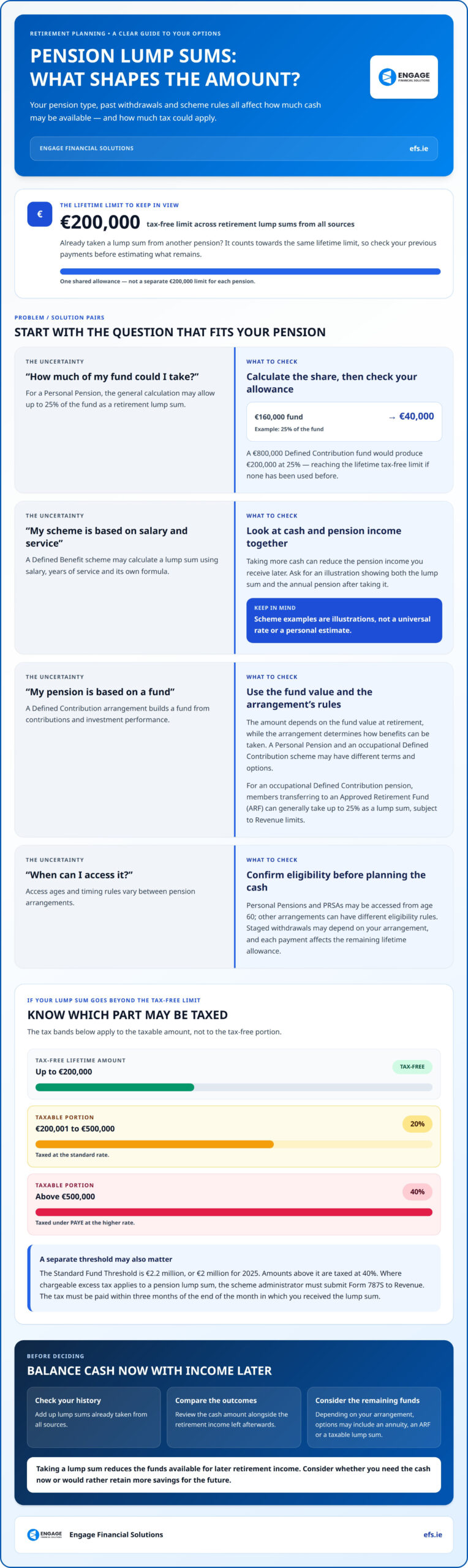
The tax-free limit sets the amount of retirement cash that can be received without income tax. According to Revenue, your lifetime tax-free entitlement is €200,000 across retirement lump sums from all sources. This matters if you have several pensions, because previous lump sums count towards the same overall limit. Taking a tax-free lump sum from a pension therefore means considering earlier payments, not just the value of the fund you’re accessing now.
For a personal pension, you can generally take 25% of the fund as a retirement lump sum. For example, a €160,000 fund could provide up to €40,000. A defined contribution fund of €800,000 would produce €200,000 at 25%, reaching the lifetime tax-free limit if you have not used it before. Use the fund value and any past payments to understand how much allowance remains.
Timing and staged withdrawals
A lump sum is generally taken when you access pension benefits at retirement. Personal pensions and PRSAs may be accessed from age 60, while other arrangements can have different eligibility rules. You can receive lump sums from multiple pensions, but their combined tax-free amounts count towards your lifetime limit. Staging withdrawals may depend on your arrangement, so consider how each payment affects your remaining allowance before setting a schedule.
Any retirement lump sum above €200,000 is not tax-free. The portion between €200,001 and €500,000 is taxed at the standard rate of 20%. Amounts above €500,000 are taxed under PAYE at the higher tax rate of 40%. These bands apply to the taxable amount, not the tax-free portion.
Excess-lump-sum tax can also arise when pension benefits exceed the Standard Fund Threshold. The threshold is €2.2 million, or €2 million for 2025, and amounts exceeding it are taxed at 40%. Where chargeable excess tax applies to a pension lump sum, the scheme administrator must submit Form 787S to Revenue. The tax must be paid within three months of the end of the month in which you received the lump sum.
Taking a tax-free lump sum from a pension reduces the funds available to support your later retirement income. Consider whether you need the cash now or would rather retain more savings to provide income in future. Depending on your arrangement, you may be able to use the remaining funds to buy an annuity, transfer them to an Approved Retirement Fund (ARF), or take a taxable lump sum. Compare how each option fits your plans before deciding.
Occupational pension lump sums based on final salary and years of service
Occupational schemes may calculate retirement lump sums differently from personal pensions. In a defined benefit scheme, the amount may depend on your salary and years of service, so the scheme’s formula and your employment history shape the outcome.
That calculation matters because taking more cash can reduce the pension income you receive later. A defined benefit pension provides income according to the scheme rules, rather than simply reflecting contributions and investment growth. Ask for an illustration showing both the lump sum and the annual pension after taking it.
Some scheme examples show how exchanging pension income for cash works. These figures illustrate a scheme calculation, not a universal rate.
The examples use assumptions from 2011, including tax rates for that year and annuity rates from October 2011. Treat these as illustrations of trade-offs, not current personal estimates.
A defined contribution occupational pension works differently: its value depends on contributions and investment performance. At retirement, members transferring to an Approved Retirement Fund (ARF) can generally take up to 25% of the fund as a lump sum, subject to Revenue limits. The amount available therefore reflects the fund value and any applicable limits, rather than a final-salary formula.
PRSA and executive pension arrangements also have their own rules and options. Compare the lump sum with the retirement income left afterwards, and include any pension benefits you have already taken. If serious illness is prompting an early decision, distinguish a pension retirement benefit from an insurance payment: this tax discussion concerns retirement lump sums.
For a clearer view of how scheme choices fit your personal retirement plans, explore retirement planning before settling on an option.
How pension type affects the lump sum calculation
Your pension type determines how the lump sum is calculated. A defined benefit scheme promises pension income according to its rules, while a defined contribution arrangement builds a fund from contributions and investment performance. This affects whether the calculation starts with a promised income or an accumulated balance.
For a defined benefit pension, the scheme’s formula sets the relationship between retirement income and any cash option. Salary, service and scheme terms can affect the calculation, so members with different work histories may receive different amounts. Consider the pension income before and after taking the lump sum alongside the cash figure.
A defined contribution pension is based on the fund value at retirement. Contributions and investment performance affect that value, while the arrangement’s rules determine how you can take the benefits. For example, a personal pension and an occupational defined contribution scheme may both use a fund-based calculation, but their terms and retirement options can differ. The pension label alone does not determine the final amount.
A PRSA is also fund-based, while an executive pension may follow the terms of its own arrangement. For each pension, identify the fund value or promised income, how the lump sum is calculated, and the income that would remain afterwards. If you have several arrangements, calculate each separately before considering their combined effect on your retirement savings.
Tax relief on contributions is a separate issue from the lump-sum calculation. Higher-rate taxpayers can receive up to 40% income tax relief on pension contributions, while standard-rate taxpayers can receive 20%. In 2025, the maximum annual earnings considered for this relief is €115,000. This relief can affect the cost of building pension savings, but it does not itself set the cash amount available at retirement.
To compare options, ask the same questions about each pension scheme:
- Is the benefit based on a fund balance or a promised income?
- Which salary, service, contribution or investment details feed into the calculation?
- What pension income remains if you take the cash option?
- How does the scheme treat the amount for tax, including any charge on taxable benefits?
These checks help distinguish a tax-free lump sum from taxable retirement income. They also show why no single percentage or calculation applies to every pension type. Use each scheme’s figures to weigh cash now against income for your retirement.
Pension types and eligibility
Access age depends on the pension arrangement, your employment status and its scheme rules. Personal pensions and PRSAs may generally be accessed from age 60, while some former-employer pensions have earlier access provisions. Eligibility to access benefits does not mean every payment is tax-free, so separate the access rules from the lump-sum calculation.
If you have a private-sector pension from a former employer, early access may generally be available from age 50. Occupational Defined Benefit, Defined Contribution and Executive pensions may also be accessed from age 50 without penalty. However, pension funds linked to a current employer cannot normally be accessed early. The key distinction is whether you have left the employment connected with that scheme.
Public service arrangements may have different rules for accessing pension benefits, so check the terms that apply to your scheme. By contrast, a PRSA or personal pension may generally become accessible from age 60. These rules make the type of pension fund and your connection to the employer important when planning personal retirement savings. Check which arrangement you hold before building a retirement date around early access.
Workplace auto-enrolment has its own access rule. The scheme launched in January 2026, and members cannot access its funds early; they must wait until age 66. This means an employee with an older workplace pension and an auto-enrolment account may face different access ages. Treat each account separately when planning when payments can begin.
Eligibility can also depend on the scheme’s normal retirement age and the circumstances in which you leave employment. Some arrangements allow access before their usual retirement date, while others require you to wait. Normal retirement age is not the same across all pension types. Your scheme documents and employment history help determine which access route applies.
Before deciding, note the following details for each pension:
- Whether it is a personal pension, PRSA, occupational scheme or public service pension.
- Whether it is linked to a current or former employer.
- The age at which benefits can be accessed and any relevant scheme retirement age.
- How access affects your planned income and any tax due on payments.
A financial adviser can help you consider how different access dates fit together, particularly if you hold several pensions. Also consider whether you need a lump sum immediately or can preserve more of your pension fund for later income. For larger funds, the Standard Fund Threshold is €2.2 million, with €2 million applying for 2025; this can affect tax treatment. Understanding the access rule first gives you a clearer basis for comparing retirement options.
Tax on pension withdrawals after the tax-free lump sum
Taking a tax-free lump sum doesn’t make the rest of your pension tax-free. Later pension income is subject to normal PAYE deductions, with USC and PRSI also applied where relevant. PAYE collects income tax from payments, so the amount paid into your bank account may be lower than your gross pension income.
Your scheme’s retirement options affect how you can receive the remaining savings. You may be able to use them to buy an annuity, transfer them to an Approved Retirement Fund (ARF), or take a taxable lump sum. An annuity provides pension income, while an ARF keeps funds invested and allows withdrawals. Each option affects the timing and form of your income differently.
With an ARF, withdrawals are taxable as income rather than treated as another tax-free lump sum. The stated minimum annual withdrawal is 4% from age 61 and 5% from age 71. These percentages describe minimum withdrawals, not guaranteed income or investment growth. Include the withdrawal alongside other taxable income when considering how much you may have available to spend.
A taxable lump-sum payment is different from regular pension income, but it can still create a tax bill. The remaining pension balance is subject to a 20% income tax rate up to €2 million. Amounts above the relevant limits can also bring chargeable excess tax into consideration. Keep the gross payment, tax deducted and amount received clear in your retirement records.
Before choosing whether to withdraw, retain or convert pension savings, compare the practical effect of each option:
- Annuity: turns retirement savings into pension income.
- ARF: leaves funds invested and lets you make taxable withdrawals.
- Taxable lump sum: gives access to cash, with tax deducted under the applicable rules.
If your pension is from a former employer, remember that scheme choices can affect how payments are arranged. A withdrawal may also interact with income from other sources, so consider your overall income rather than looking at one pension in isolation. A retirement income plan can help you match withdrawals to spending needs and preserve savings for later years.
For a clearer view of how retirement income choices fit together, explore retirement planning support before deciding how to withdraw your remaining funds.
Engage Financial Solutions
Engage Financial Solutions can help you consider how a pension lump sum fits into your wider retirement plans. If you’re weighing cash now against income later, Financial Planning can help you understand how that choice relates to your needs and other priorities. Annuities may also be relevant if you’re considering turning pension savings into retirement income.
Before deciding, gather details of your pension type, available options and any lump sums you have already taken. This gives you a clearer basis for weighing immediate cash against future income, without treating the lump sum as a decision in isolation.
If you’d like support considering your options, contact Engage Financial Solutions.
Make your next retirement decision with confidence
Before taking a tax-free lump sum from your pension, decide what you want the money to do. Write down its purpose, such as funding a planned expense or giving you more flexibility in retirement. Then consider how taking the lump sum fits with the income you expect to rely on and the financial commitments you want to protect.
A useful next step is to outline your expected spending and income sources, separating immediate plans from longer-term needs. This can help you identify questions to resolve before making an irreversible retirement decision. Financial Planning can help you connect the pension decision with your wider financial priorities, rather than considering the lump sum in isolation.
If you’re ready to talk through your next steps, contact Engage Financial Solutions. A considered plan can make it easier to move forward with clarity and confidence.
Frequently Asked Questions
What charges apply to lump-sum withdrawals?
In most cases, there are no direct charges for taking a pension lump sum. Tax is separate: part of the payment may be taxable if your total retirement lump sums exceed your tax-free entitlement. Before choosing an amount, ask for a breakdown of the gross lump sum, any tax deducted and the net payment. This helps you distinguish a scheme charge from tax withheld on a taxable amount.
How much of a pension can be taken as a tax-free lump sum?
For a personal pension, you can generally take 25% of the fund as a retirement lump sum, subject to Revenue limits. The tax-free entitlement across all sources has a lifetime cap, so unused allowance matters when calculating what remains available. For example, if you have already received tax-free lump sums, subtract those amounts from your remaining entitlement before relying on a new pension estimate.
What are the tax-free lump-sum limits and lifetime cap?
Revenue sets the lifetime tax-free entitlement at €200,000 across retirement lump sums from all sources. Retirement lump sums up to that cap are taxed at 0% income tax. The portion from €200,001 to €500,000 is taxed at 20%, while amounts above €500,000 are taxed under PAYE at 40%. Add lump sums from previous schemes when estimating how much of the cap remains.
How is the tax-free pension lump sum calculated?
The calculation depends on your pension arrangement. A personal pension calculation generally starts with the fund value and applies the relevant lump-sum percentage. An occupational defined benefit scheme may use salary and years of service instead, while a defined contribution scheme starts with the accumulated fund. To understand an estimate, identify the calculation method and whether previous lump sums reduce your remaining lifetime tax-free entitlement.
Which pension types allow a tax-free lump sum?
Most pension arrangements allow a retirement lump sum, subject to limits. Personal pensions, PRSAs and occupational schemes can provide one, although each arrangement’s rules affect the calculation. Members transferring eligible pension benefits to an Approved Retirement Fund may generally take a lump sum from the fund, subject to Revenue limits. Identify each pension type before combining estimates from several arrangements.
How is a pension lump sum taxed if it exceeds the tax-free limit?
The taxable portion depends on how much of your lifetime entitlement remains and the size of the payment. Amounts between €200,001 and €500,000 are taxed at 20%; the portion above €500,000 is taxed under PAYE at 40%. A separate charge can apply when benefits exceed the Standard Fund Threshold. Ask for the taxable and tax-free portions to be shown separately in your payment illustration.
How does taking a lump sum affect remaining pension income and tax?
Taking cash reduces the pension funds available to provide income later. You may be able to use the remaining benefits to buy an annuity, transfer them to an Approved Retirement Fund, or take a taxable lump sum. Pension income after the tax-free payment is subject to normal PAYE deductions, with USC and PRSI applied where relevant. Compare the income and tax treatment of each option before deciding how much cash to take.
What documents and steps are needed to claim a pension lump sum?
Start by requesting the retirement options and claim instructions for your specific pension. The scheme’s claim pack explains what information and documents are required, which can differ between arrangements. Review the proposed lump-sum amount, tax treatment and effect on remaining benefits, then complete and return the relevant claim forms as instructed. Keep copies of the final illustration and payment statement with your pension records.
Disclaimer
Engage Financial Services LTD T/A Engage Financial Solutions is regulated by the Central Bank of Ireland CRO 764570. Suite 2 First Floor, 14 -18 Main street, Blackrock, Co Dublin. A94 W0Y3