


What happens to your business if a fellow shareholder dies and their shares pass to their family? Co-Directors Insurance can provide funds to help the remaining shareholders buy those shares, supporting continuity of ownership. Here, Co-Directors Insurance is explained in practical terms, including how cover works alongside an agreement that sets out what happens to the shares.
It’s easy to assume that life cover alone settles the issue. In practice, the policy and agreement have different roles: the cover can provide money, while the agreement sets the terms for a purchase or sale. Without a clear plan, surviving shareholders may struggle to fund a buyout or find themselves sharing control with a new shareholder.
This guide explains what Co-Directors Insurance may cover, how buy/sell and double option agreements can shape a share transfer, and how personal cover differs from corporate cover. It also explains how this differs from Directors and Officers insurance, which addresses claims against directors rather than funding a share purchase. As a practical first step, consider how the agreement and cover would work together if a shareholder died or became seriously ill.
Key Takeaways
- Decide whether the priority is funding a share purchase or protecting the business from losing a key person’s skills and contribution.
- Pair cover with a buy/sell or double option agreement so the funding and the rules for transferring shares work together.
- Compare personal and corporate cover by looking at who owns the policy and how the proceeds can support a share purchase.
- Use the value of each shareholder’s stake to guide the level of cover, and revisit it as the business changes.
- Consider how the plan would work if a shareholder became seriously ill, as well as if they died.
What is Co-director Insurance?
Co-director Insurance is life insurance arranged on shareholders’ lives to help fund a share purchase after a death or serious illness. The aim is practical: surviving owners can have money available to buy shares, while the deceased shareholder’s estate can have a purchaser under an agreed plan. Put simply, Co-directors Insurance is cover focused on keeping ownership arrangements clear, not on claims about management decisions.
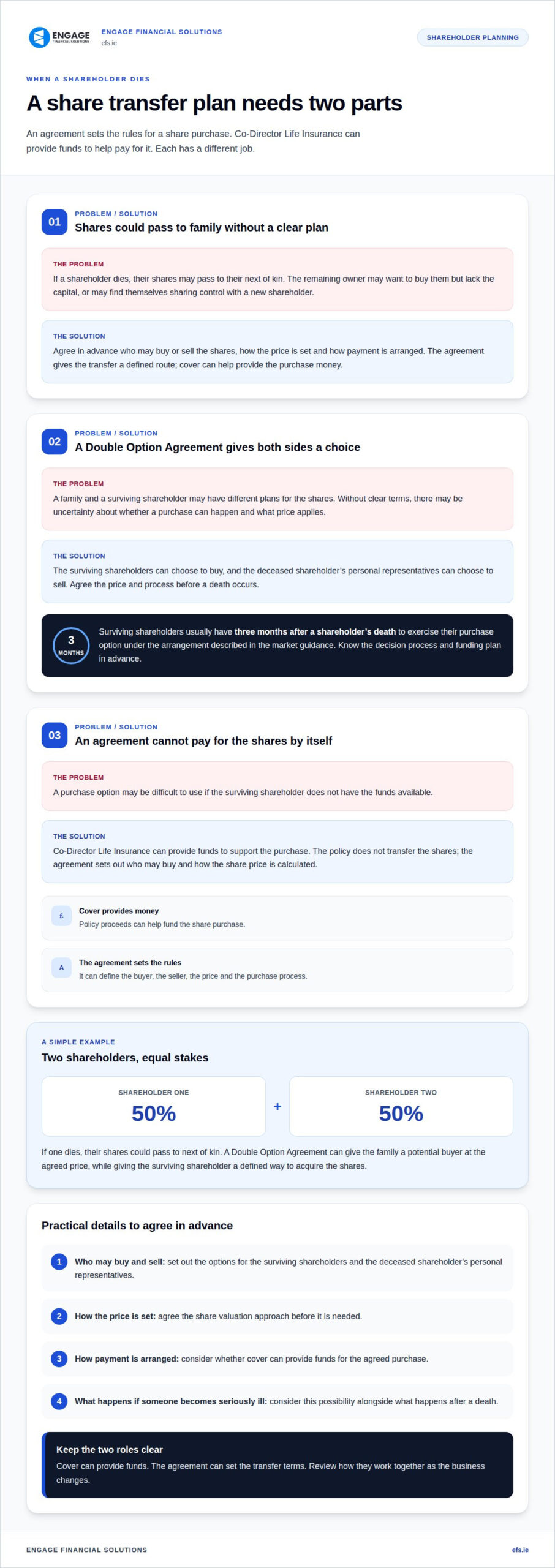
Consider a family company with two directors who each own half the shares. If one dies, their shares may pass to their next of kin, who then become shareholders. The other director might want to buy those shares but lack the capital. Cover can provide funds for the purchase, while an agreement sets out how the transfer should happen. This example makes the distinction clear: the policy can provide funds, while the agreement sets the transfer terms.
Key Person Insurance serves a different purpose. It protects the business against the financial impact of losing an employee whose skills, relationships or contribution support profit. A policy can pay a lump sum to the business if that key person dies or suffers a specified illness. Co-director cover, by contrast, focuses on the value and transfer of shares. A business could consider both if a shareholder is also essential to day-to-day operations.
Directors and Officers (D&O) Insurance addresses another risk: claims against directors or officers for alleged wrongful acts in running a business. It may cover defence costs, settlements and awards for covered claims, and can pay an insured person directly if the company cannot protect them from the loss. Side A cover relates to an individual’s loss that the company does not cover. D&O cover is not share-purchase funding, and it does not cover deliberately fraudulent or criminal actions.
Irish directors may face personal liability for negligence, default, breach of duty or breach of trust. The Companies Act 2014 also sets the legal framework for companies and directors. D&O cover may help with covered claims, but it does not remove a director’s duties or protect against every allegation. Review the policy wording alongside the company’s governance arrangements.
D&O Insurance differs from Professional Indemnity Insurance and Public Liability Insurance because each addresses a different type of claim. D&O concerns alleged wrongful acts in managing the company; professional indemnity concerns claims linked to professional services, while public liability concerns third-party injury or property damage. A business may need separate cover for these distinct risks.
To compare, buy or renew D&O Insurance, set out the company’s activities, directors’ roles, existing arrangements for covering directors’ losses and the claims history. Then compare policy limits, exclusions, excesses and whether cover responds on a claims-made basis, meaning the policy must be active when the claim is made. D&O cover for Irish companies is commonly written for a 12-month policy period on this basis.
D&O Insurance costs vary and are provided after a quote request. Premiums can be affected by the company’s activities, size, claims history, chosen cover limit and policy terms, so compare the protection provided rather than price alone.
There is no single cover limit that suits every company. Assess potential defence costs, the number and roles of directors, the company’s ability to cover directors’ losses, and the financial impact of a claim. These factors help establish a limit that reflects the company’s exposure.
After a claim or circumstance that could lead to one, record the relevant details and preserve related documents, emails and decisions. Notify the insurer using the policy’s reporting process, and follow its instructions before responding to allegations or agreeing to a settlement.
Double Option or Buy/Sell agreements
A buy/sell agreement sets out what happens to shares after a shareholder dies. It can give the remaining shareholders the right to buy, and the deceased shareholder’s next of kin a route to sell. The agreement can also state how the price is set and payment arranged. This matters because an estate may need to settle its affairs, while the remaining owners may want to retain control.
A Double Option Agreement uses matching options: the surviving shareholders can choose to buy, and the deceased shareholder’s personal representatives can choose to sell. The purchase price and process should be clear before a death occurs. Under the arrangement described in the market guidance, surviving shareholders usually have three months after a shareholder’s death to exercise their purchase option. This short window makes it important to understand the funding and decision process in advance.
For example, imagine a business with two equal shareholders. If one dies, their shares could pass to their next of kin, who may have different plans from the remaining owner. A Double Option Agreement can give the family a potential buyer at the agreed price, while giving the survivor a defined way to acquire the shares. Without available funds, however, the purchase option may be difficult to use.
That is where Co-Director Life Insurance can support the agreement. The policy proceeds can provide funds for the purchase, while the agreement determines who may buy and how the share price is calculated. Insurance and the legal agreement therefore have separate roles. Cover does not itself transfer shares, and an agreement does not itself provide money for payment.
Before putting arrangements in place, shareholders should agree on several practical details. These decisions can reduce uncertainty for the remaining owners and the estate:
- Who can buy: specify whether the option belongs to the remaining shareholders, the company, or both.
- How shares are valued: choose a clear valuation method that reflects the business and its shareholding.
- How payment is funded: connect the agreed purchase process with suitable cover and available funds.
- When the option applies: define the triggering event and the period for exercising the option.
- What happens if it is not used: explain the position of the shares and the estate if no purchase takes place.
Illness also deserves attention when shareholders plan for continuity. An agreement can describe what happens if a shareholder cannot continue in the business, but the trigger and any purchase terms need careful definition. A death-only arrangement may not address every situation the owners want to plan for. Set out the intended scenarios together, then ensure the insurance cover matches those terms.
For a company, the agreement with each director must comply with the Companies Act 2014. Keep the agreement, share records and policy details aligned as ownership or business value changes. Reviewing those documents together helps clarify the intended purchase and payment process. You can also review your wider financial arrangements as part of planning for business continuity.
Corporate Co-Director Insurance
A Corporate Co-Director Insurance policy is life cover taken out by a company on its directors’ lives. It can provide money to the company or remaining shareholders to purchase shares after a shareholder dies or becomes seriously ill. You may also see it called shareholder Protection Insurance. Its purpose is to support ownership continuity, rather than replace a director’s income or protect against management claims.
If one insured director dies, the policy proceeds can help fund the purchase of their shares. The remaining directors can then use the agreed share-transfer arrangements to guide what happens next.
The cover amount should reflect the value of the shareholder’s stake. Valuation is therefore an important part of the arrangement: a policy based on an old business valuation may no longer match the amount needed for a purchase. Review the share value and insurance policy together when ownership or the business changes. The agreement explains the purchase terms; the policy provides potential funding.
Corporate ownership can make the arrangement straightforward to coordinate through the business, but it also has important limits. The company pays the premiums, which are not admissible tax deductions. Proceeds from Corporate Co-Director Insurance are exempt from corporation tax. Any proceeds not used by surviving shareholders to buy the deceased shareholder’s shares are a taxable inheritance for Inheritance Tax purposes.
Before selecting corporate cover, map out how the money would move and who would use it. Work through the intended sequence alongside the company’s share-transfer documents and policy terms:
- Identify each shareholder whose life the company will insure.
- Set the cover amount using the value of that person’s shareholding.
- Match the policy proceeds to the intended purchase under the agreement.
- Decide how the company will address proceeds exceeding the amount required.
- Review the arrangement when the company’s value or share ownership changes.
Corporate cover is not the only way to arrange shareholder protection. With personal cover, shareholders arrange policies on one another’s lives or hold cover in trust; corporate cover is owned by the company. The choice affects who arranges the insurance and how proceeds are intended to support a purchase. Align ownership, policy terms and the agreement before relying on either structure.
Keep the business’s wider commitments in view. A share-purchase policy is separate from a pension arrangement and from person insurance designed to address the loss of an employee’s contribution. If a director is also central to revenue or operations, the company may need to consider those risks separately. A focused review of ownership, valuation and funding can help clarify what the corporate arrangement is designed to do. Explore your wider financial arrangements alongside that planning.
Keep the purpose of each policy distinct when reviewing the arrangement. Corporate D&O policies may operate on a first-come, first-served basis, so early legal costs can exhaust the policy limit. That warning concerns the D&O policy limit; it should not be mistaken for an estimate of the funds available for a share purchase. Check the policy terms against the intended use of the proceeds, and consider whether the company or surviving shareholders are meant to receive and use them.
Corporate Co-Director Insurance can provide funds to the company or its surviving shareholders to purchase the shares of a deceased or seriously ill shareholder; it is sometimes also called Shareholder Protection Insurance. Premiums may be tax-deductible in some cases, depending on jurisdiction and structure. However, premiums paid by the company for Corporate Co-Director Insurance are not admissible tax deductions. Keep both statements in view when assessing the tax treatment rather than assuming one applies in every structure. If a deceased director held more than 50% of a private company’s shares, losing control can become a concern. Include that possibility when considering how the share-transfer arrangements and intended purchase would work.
How Co-Director Insurance works
Start by deciding whose lives need cover and who should receive any policy proceeds. With a Life of Another policy, one shareholder takes out cover on another director’s life. With Own Life in Trust, a director takes out cover on their own life, and the policy is held in trust for its intended beneficiaries. These arrangements determine who owns or benefits from the cover, so match the structure to the company’s share-purchase plan.
Next, connect the policy to the shareholders’ agreement. The policy provides potential funds after a covered event; the agreement sets out the proposed share purchase. The shareholding indicates the interest that may need to be bought. If the policy proceeds are intended for a particular buyer, make sure the ownership and beneficiary arrangements support that purpose.
For example, imagine a company with three shareholder-directors, each holding a different proportion of the shares. The cover for each person can reflect the value of their own stake, rather than assume all shares are equal. If one director dies, the relevant policy may provide funds towards a purchase, while the agreement guides the transfer process. Both the amount and intended recipient of the proceeds matter.
If a shareholder dies, their shares normally pass to their next of kin, who may become shareholders. An agreement can give the other shareholders an option to acquire those shares. The family may then have a potential buyer, while the remaining owners have a defined route to consider retaining the existing ownership structure. The policy supports funding; it does not transfer shares by itself.
Serious illness can raise a separate question: should the plan allow a purchase if a shareholder cannot continue working? Cover responds only to the events included in its terms. If the plan includes serious illness, align the policy wording with the agreement’s trigger and purchase process. This helps avoid treating death cover as if it automatically provides illness cover.
Review these details together before relying on the arrangement:
- People insured: identify each shareholder whose life is covered.
- Policy structure: establish who owns the policy and who is intended to benefit.
- Covered events: distinguish death from any specified serious illness event.
- Purpose of proceeds: connect the intended payment with the proposed share purchase.
- Agreement terms: align the purchase option with the policy arrangements.
Revisit the arrangements whenever ownership changes or a shareholder joins or leaves. A new shareholding can change the value of each person’s stake and the funding needed for a purchase. Keep the company’s records, agreement and policy details aligned so the remaining shareholders understand the intended process if a director dies or suffers a serious illness.
Critical Illness Insurance can address specified illness cover, but it does not itself arrange a share transfer. If serious illness is part of your planning, explore Critical Illness Insurance as one element of your wider financial arrangements.
Engage Financial Solutions: Critical Illness Insurance
Engage Financial Solutions can help you consider Critical Illness Insurance as part of planning for the financial effects of serious illness. This cover addresses a different need from co-director insurance: it can form part of your personal financial arrangements, while share protection focuses on ownership and a potential share purchase.
If illness cover is part of your business continuity plan, consider how it fits alongside the agreement between shareholders and any cover arranged on directors’ lives. Engage Financial Solutions also offers Income Protection and Group Protection, which may be relevant to broader personal or workplace planning. A useful next step is to discuss your priorities and how they connect to your financial plan.
Contact Engage Financial Solutions to discuss your options.
Make your next decision with confidence
With co-directors insurance explained in context, you can make a clearer decision about how your business and personal finances fit together. Start by agreeing what you want to protect, then consider how that goal connects with ownership arrangements, family priorities and longer-term plans. A useful next step is to bring these priorities into one financial planning conversation, rather than treating each policy or business decision in isolation.
That wider view can also account for other milestones, whether you’re switching mortgages, buying your first home or considering a buy-to-let mortgage. Each decision has a different purpose, but all contribute to your financial picture. Engage Financial Solutions can help you consider the options that match your circumstances and priorities.
Contact Engage Financial Solutions to discuss your next step and move forward with a clearer plan.
Frequently Asked Questions
How does it work?
Shareholders arrange life cover on the directors whose shares may need to change hands. The policy structure determines who receives the proceeds, while the company’s agreement sets out the intended purchase terms. For example, if ownership changes after a director leaves, review the insured amounts and policy ownership against the new shareholdings. This helps keep the funding arrangement aligned with the business’s current ownership plan.
What happens in the event of the unforeseen death of a shareholding company director?
The deceased director’s shares normally pass to their next of kin, who may become shareholders. The remaining owners can then use the options set out in their agreement to consider a purchase. For example, surviving shareholders may need to coordinate their decisions before exercising an option. Clear roles and an agreed valuation method can help the family and business understand the intended route forward.
Who is covered?
Cover applies to the directors or shareholders whose lives are insured under the policy, not automatically to every employee. The arrangement may use Life of Another cover, where one person insures another, or Own Life in Trust. Check that each intended shareholder is named or otherwise covered by the policy terms, and ensure the ownership structure reflects who should receive proceeds if a claim arises.
Disclaimer
Engage Financial Services LTD T/A Engage Financial Solutions is regulated by the Central Bank of Ireland CRO 764570. Suite 2 First Floor, 14 -18 Main street, Blackrock, Co Dublin. A94 W0Y3