

What if the standard “four times your salary” rule is actually just the starting point for your home-buying journey? If you’re trying to calculate exactly how much can I borrow first time buyer Ireland, you aren’t alone. Buying your first home should be a time of optimism, yet it’s natural to feel anxious about whether your hard-earned bonuses or overtime will be fully recognised by a lender in the current 2026 market.
We’re here to provide the clarity and stability you need. In this guide, you’ll discover how Irish lending limits are calculated and how you can maximise your potential through exemptions and government supports. We’ll provide a straightforward breakdown of the Central Bank’s 4x income limit; explain how the 15% exemption allowance works; and outline how schemes like Help to Buy can help you reach your goal. By the end, you’ll have a clear roadmap to move forward with peace of mind.
Key Takeaways
- Understand the core Central Bank of Ireland regulations for 2026, including the standard four-times income multiplier and the 10% deposit requirement.
- Discover exactly how much can I borrow first time buyer Ireland by learning how lenders evaluate your total income, including variable elements like bonuses and overtime.
- Explore the criteria for securing a mortgage exemption, which may allow you to borrow beyond the standard limits under specific conditions.
- Learn how to demonstrate your “Proven Repayment Capacity” through savings and rent to satisfy lender stress tests and ensure your future financial stability.
- See how a professional broker can navigate a panel of lenders to find a flexible solution tailored to your specific career path and financial goals.
Understanding the Central Bank of Ireland’s Lending Rules for 2026
The Central Bank of Ireland maintains strict lending rules to ensure the financial system remains resilient and that you, as a borrower, are protected from over-extending your finances. These regulations serve as a vital safeguard against the type of instability experienced during the Irish property bubble, which left many households in a vulnerable position. By establishing firm boundaries on how much can I borrow first time buyer Ireland, the regulator fosters a sense of long-term security for the entire economy. These rules apply to everyone, though the way they’re calculated depends on your specific circumstances, such as whether you’re applying for a mortgage on your own or as part of a couple.
The 4x Gross Income Multiplier Explained
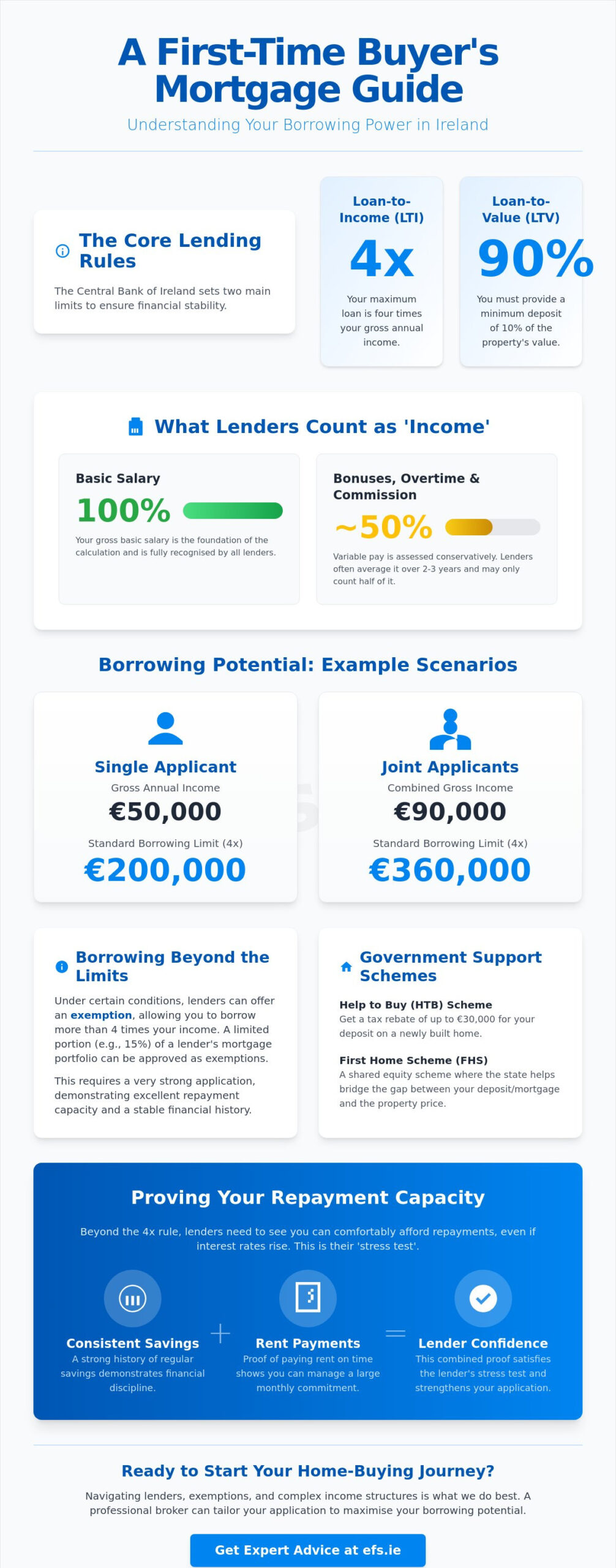
Your gross income is the total amount you earn in a year before any deductions like income tax, PRSI, or pension contributions are taken out. The Loan-to-Income (LTI) ratio is the relationship between your total mortgage debt and your annual earnings. For most first-time buyers in 2026, the maximum you can borrow is four times your gross annual income. If you’re a single applicant earning €50,000, your standard limit is €200,000. However, if you’re applying with a partner, lenders look at your combined household income. A couple with a joint income of €90,000 could potentially borrow up to €360,000. This multiplier provides a predictable baseline for your budget, giving you the confidence to start your property search with a clear figure in mind.
Loan-to-Value (LTV) and Your Deposit
Whilst your income sets the ceiling for your loan, the value of the property itself introduces another critical limit. You typically need to provide a 10% deposit, which allows you to borrow a maximum of 90% of the property’s market value. This is what’s known as the Loan-to-Value (LTV) ratio. For many, saving this 10% is the most challenging hurdle. When calculating how much can I borrow first time buyer Ireland, you should consider the Help to Buy scheme Ireland, which provides a tax rebate of up to €30,000 for newly built homes valued at €500,000 or less. You might also explore the First Home Scheme, a shared equity initiative where the state takes a stake in your property to bridge the gap between your mortgage and the purchase price. These government-backed tools are designed to make the path to your first home feel more accessible and tailored to your needs.
Defining ‘Income’: What Lenders Actually Count Towards Your Limit
Calculating your borrowing power starts with a clear understanding of what a lender considers “allowable income.” Whilst your gross basic salary forms the bedrock of the calculation, lenders in 2026 look closely at the quality and consistency of your earnings. When you begin to ask how much can I borrow first time buyer Ireland, it’s vital to recognise that not every Euro on your payslip is treated equally. The Central Bank of Ireland’s Lending Rules provide the framework, but individual banks have their own internal policies on how they weigh different income streams.
Basic salary is straightforward; lenders typically take 100% of this figure into account. However, if your earnings include overtime, shift allowances, or regular bonuses, a “Three-Year Rule” often applies. Lenders want to see that this variable pay is a stable feature of your career rather than a one-off spike. They’ll look for a consistent history of these payments over at least two to three years to ensure your mortgage remains affordable in the long term. Even alternative income, such as certain state benefits or the potential for tax-free earnings through the “rent-a-room” scheme, can sometimes be factored in, provided you can demonstrate a reliable track record.
Treatment of Bonuses and Commission
If a significant portion of your pay comes from performance-related bonuses or sales commissions, lenders tend to be more conservative. It is common for banks to count only 50% of your average variable pay towards the four-times multiplier. To present the strongest case, you should have your Employment Detail Summaries or P60s ready to prove your income history. If you’ve recently received a promotion, we can help you structure a “rising income” narrative. This helps the lender understand that your current higher salary is the new baseline for your future financial stability. If you’re navigating a complex pay structure, seeking advice on first-time buyer mortgages can help you maximise your recognised income.
Self-Employed and Contractor Income
For business owners and contractors, the path to approval requires a more meticulous approach to paperwork. Lenders generally require two to three years of certified accounts and Chapter 4 tax assessments to verify your earnings. Rather than looking at a single year, they typically average your “drawings” or “net profit” over that period to determine your borrowing limit. This methodical assessment ensures that your mortgage is built on a foundation of steady business performance. Whilst the documentation can feel extensive, a proactive approach to organising your accounts can make the transition from applicant to homeowner feel much more straightforward.
The Role of Exemptions: Borrowing Beyond the Standard 4x Limit
Whilst the four-times multiplier is the standard benchmark, it isn’t always the final word on your borrowing capacity. The Central Bank of Ireland’s Lending Rules allow for a degree of flexibility through what are known as exemptions or exceptions. These allow lenders to use their discretion to exceed the standard limits for applicants who demonstrate exceptional financial strength. In the 2026 market, these exemptions can potentially increase your borrowing power to 4.5 times or even 4.75 times your gross income in specific, high-quality cases. This flexibility is designed to recognise that every financial journey is unique, providing a tailored path for those with strong growth potential.
It’s vital to understand that lenders operate under a strict quota. Currently, banks are permitted to allocate only 15% of their total first-time buyer lending to these higher-limit mortgages each year. This makes the timing of your application particularly important, as this “exception capacity” can fluctuate throughout the financial quarters. When you are calculating how much can I borrow first time buyer Ireland, an exemption could be the key to bridging the gap between a standard approval and the purchase price of your ideal home. Securing one requires more than just a high salary; it demands a meticulous presentation of your overall financial health and future stability.
Who Qualifies for an Exception?
Lenders often adopt a “future-back” perspective when reviewing exemption requests, looking for career paths with high growth potential. Professionals in sectors such as technology, law, medicine, or engineering are often viewed favourably because their income trajectory is likely to rise significantly over the life of the loan. A clean credit history is a non-negotiable requirement for any exemption. Beyond your gross earnings, lenders focus heavily on your Net Disposable Income (NDI). This is the amount of money you have left each month after all essential living costs and existing debt repayments are met. A high NDI provides the lender with the confidence that you can comfortably manage a larger mortgage without financial friction.
How to Organise Your Application for an Exemption
Because exception capacity is limited, working with a professional broker is often the most efficient way to identify which lenders still have room in their quota. We can help you draft a compelling cover letter that highlights your career stability, consistent saving behaviour, and any recent promotions. This narrative moves your application beyond a simple algorithm, telling the story of your financial reliability. For a complete list of what you’ll need to prepare, you can refer to our First Time Buyer Mortgage Ireland pillar. Taking a proactive approach to your application ensures that you are positioned as a “high-quality” candidate, giving you the best possible chance of securing that extra borrowing power.
Beyond the Multiplier: How Lenders Stress Test Your Affordability
While the four-times multiplier provides a useful starting point, lenders in 2026 apply a much more granular lens to your daily financial habits. When determining how much can I borrow first time buyer Ireland, the bank’s primary concern shifts from your gross earnings to your actual disposable income. They need to be certain that your lifestyle can comfortably absorb a mortgage repayment alongside your existing obligations. This is why car loans, credit card balances, and even modern “Buy Now Pay Later” schemes can significantly reduce your borrowing ceiling. Each monthly outgoing is viewed as a potential friction point that could impact your future financial security.
Lenders also factor in a “Standard Cost of Living” figure based on your family size and number of dependants. This ensures that even after the mortgage is paid, you have enough remaining to maintain a reasonable quality of life. By looking at the big picture, banks aim to provide a loan that feels like a foundation for your future rather than a source of ongoing stress. This methodical approach helps safeguard your long-term interests and the stability of the wider housing market.
Proven Repayment Capacity (PRC)
The most effective way to demonstrate your readiness for a mortgage is through Proven Repayment Capacity. Lenders look for evidence that your current rent and monthly savings combined equal or exceed the projected mortgage repayment. A “Six-Month Rule” typically applies here; your bank statements must be flawless for the half-year preceding your application. You should avoid any “red flag” behaviour such as gambling transactions or frequent overdraft usage during this period. Consistent, organised saving habits show the lender that you have the discipline required to manage a long-term financial commitment with ease.
Stress Testing and Interest Rates
A stress test is a vital safeguard that ensures you can afford your home even if interest rates rise in the future. Lenders calculate your repayments at a rate that is typically 2% or 3% above the current market offer to see if you could still meet the costs. This process provides you with the peace of mind that comes from knowing your home is secure regardless of economic fluctuations. Choosing a fixed-rate mortgage can provide further stability in your long-term planning, protecting you from immediate rate changes. If you would like a personalised assessment of your borrowing potential, you can contact us to discuss first-time buyer mortgages and begin your application with clarity.
Securing Your First Home: How a Professional Broker Tailors Your Application
When you search for how much can I borrow first time buyer Ireland, you’ll often find rigid calculators that don’t account for your career trajectory or personal ambition. At Engage Financial Solutions, we move beyond the algorithm. We believe in telling your unique financial story to lenders. This ensures they see the stability and potential we see. Our personalised approach allows us to navigate a vast panel of lenders to find the one whose criteria best match your specific profession and lifestyle.
Your journey doesn’t end with a loan approval. We focus on safeguarding your future by integrating essential mortgage protection and life cover from the very start. This ensures that your new home remains a place of security and peace of mind for years to come. Our goal is to provide a seamless transition from your initial “approval in principle” to the moment you finally receive your keys, removing the stress that often accompanies complex financial transitions.
The Value of Independent Advice
Walking into your local bank branch limits your options to a single set of products. This can often restrict your borrowing capacity if that specific lender has a conservative view on your industry or income structure. A broker acts as your steady guide, tailoring your income presentation to meet the specific appetites of different banks. We understand which lenders are currently seeking certain types of applicants, which helps reduce friction and ensures your application is positioned for success. This expert stewardship means you don’t have to manage the complexities of the market alone.
Next Steps on Your Mortgage Journey
The first step towards a professional financial review is gathering your essential documents, such as your recent payslips and bank statements. Once you’re ready, booking a consultation will help you establish exactly how much can I borrow first time buyer Ireland based on the latest 2026 lending criteria. This isn’t just about a number; it’s about creating a holistic plan for your long-term financial health. We take the time to understand your aspirations, ensuring your mortgage fits perfectly into your broader life goals. Contact Engage Financial Solutions today for a personalised mortgage assessment and let us help you navigate the path to your first home with confidence.
Take the Next Step Toward Your First Home
Securing your first property is a significant milestone that deserves a clear and methodical approach. Whilst the Central Bank’s four-times income limit provides a steady baseline, your true borrowing potential often depends on the quality of your income and the availability of lender exemptions. By demonstrating a strong repayment capacity and preparing for future interest rate fluctuations through stress testing, you can move forward with the optimism that comes from long-term financial security.
Understanding exactly how much can I borrow first time buyer Ireland is the vital first step in your property search. As specialists in tailored first-time buyer solutions, we’re here to provide the expert stewardship you need to navigate the market with ease. We’re regulated by the Central Bank of Ireland and offer access to a comprehensive panel of Irish lenders to ensure your application is presented in the best possible light. Begin your seamless mortgage journey with an expert consultation at Engage Financial Solutions today. We look forward to helping you turn your homeownership aspirations into a straightforward and rewarding reality.
Frequently Asked Questions
Can I borrow 5 times my salary as a first-time buyer in Ireland?
Standard Central Bank rules generally cap borrowing at 4 times your gross annual income. Whilst lenders have a limited number of exemptions that allow for higher multipliers, these typically reach 4.5 or 4.75 times your salary. Borrowing 5 times your income is not a standard offering in the 2026 market. These limits are designed to protect your long-term financial stability and ensure your mortgage remains affordable even if your circumstances change.
How does a car loan affect how much I can borrow for a mortgage?
A car loan reduces your borrowing capacity by lowering your Net Disposable Income (NDI). Lenders subtract your monthly car loan repayment from the total amount they believe you can safely commit to a mortgage. Even a relatively small monthly payment can lead to a significant reduction in your final loan offer. If you’re planning to apply for a mortgage soon, clearing existing debts can often help you maximise your potential borrowing power.
Is my deposit included in the 4 times income limit?
No, your deposit is separate from the 4 times income limit. When calculating how much can I borrow first time buyer Ireland, the 4x rule applies only to the loan amount itself. Your deposit is added to this loan to reach the total purchase price of the property. For example, if you borrow €360,000 and have a €40,000 deposit, you can purchase a home valued at €400,000, provided you meet the 90% Loan-to-Value requirement.
Can I include my partner’s part-time income in our joint mortgage application?
Yes, you can include a partner’s part-time income as long as it is stable and fully documented. Lenders will look at the total combined gross household income to calculate your borrowing limit. You’ll need to provide payslips and Employment Detail Summaries to prove that the part-time earnings are consistent. This inclusive approach ensures that the total financial strength of your household is recognised, providing a more accurate reflection of your actual repayment capacity.
What happens to my borrowing limit if interest rates go up in 2026?
If interest rates rise, the “stress test” used by lenders becomes more stringent. Banks calculate your ability to afford repayments at a rate typically 2% or 3% higher than the current market offer. If rates go up, the monthly cost of this hypothetical stressed repayment also increases. This might lower the absolute amount a lender is willing to offer if your disposable income is tight, as they must ensure you remain protected against future financial friction.
How much can I borrow if I am self-employed or a freelancer?
Self-employed individuals can typically borrow 4 times their average annual earnings, though the assessment process is more detailed. Lenders generally average your net profit or drawings over the last two to three years to determine your stable income baseline. If you’re asking how much can I borrow first time buyer Ireland as a freelancer, having certified accounts and Chapter 4 tax assessments ready is the most effective way to ensure a seamless and professional review.
Do lenders count overtime and bonuses when calculating my mortgage limit?
Lenders do count overtime and bonuses, but they often apply a conservative discount to these variable earnings. It’s common for banks to factor in only 50% of your average variable pay, provided you can show a consistent two-year history. This cautious approach ensures that your mortgage remains sustainable even if your bonus or overtime hours fluctuate. Providing clear evidence of these payments through your P60s or payslips helps build a strong case for their inclusion.
Can I get a mortgage if I am currently using a “Buy Now Pay Later” service?
You can still secure a mortgage whilst using “Buy Now Pay Later” (BNPL) services, but they are treated as active credit obligations. Lenders see these transactions on your bank statements and include the repayments in your affordability stress test. Frequent use of BNPL can sometimes be viewed as a lack of financial discipline, which might impact an exemption request. It’s often best to clear these small debts and show clean statements for six months before your application.
Disclaimer
Engage Financial Services LTD T/A Engage Financial Solutions is regulated by the Central Bank of Ireland CRO 764570. Director David Moore. Suite 2 First Floor, 14 -18 Main street, Blackrock, Co Dublin A94 W0Y3