

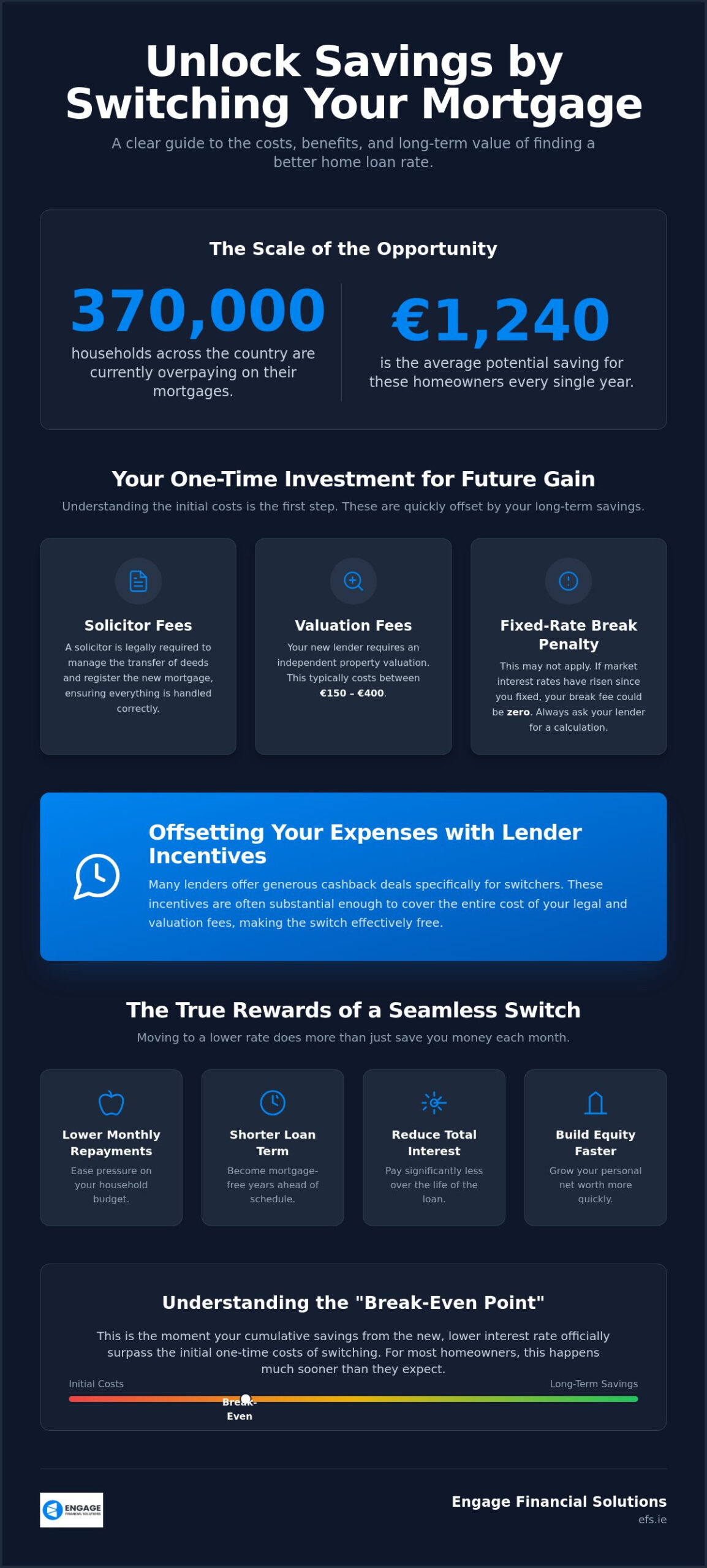
Did you know that roughly 370,000 mortgage holders across the country are currently overpaying on their home loans, with many missing out on average savings of €1,240 every single year? It’s a staggering figure, yet many homeowners hesitate to move because they’re worried about the costs of switching mortgage in the domestic market. Whether you’re feeling overwhelmed by the thought of solicitor fees or anxious about potential fixed-rate break penalties, it’s completely natural to wonder if the long-term gain is worth the initial effort.
We understand that the paperwork and hidden charges can feel like a significant hurdle. However, moving your mortgage doesn’t have to be a source of stress. In this guide, we’ll break down exactly what you’ll need to spend, from valuation fees to legal costs, and show you how to use lender incentives to offset these expenses. You’ll discover a clear path to a lower rate and a more secure financial future, ensuring your transition is as seamless and straightforward as possible.
Key Takeaways
- Understand how a lower interest rate reduces your total cost of credit, transforming a simple move into a strategic choice for long-term security.
- Get a clear breakdown of the essential costs of switching mortgage in the domestic market, from solicitor fees to property valuations, so you can plan with confidence.
- Discover how to leverage lender cashback offers to offset your expenses, which can often cover the full amount of your professional fees.
- Identify the key documents you’ll need to organise and how to manage the legal timeline for a seamless, stress-free transition between lenders.
- Learn how a dedicated advisor acts as a buffer between you and the complexity of lending, ensuring you stay focused on your future savings rather than the paperwork.
Understanding the Financial Mechanics of Moving Your Mortgage
When you look at your monthly bank statement, it’s easy to see your mortgage as a fixed, immovable expense. However, viewing your home loan through the lens of long-term financial security changes the narrative. Switching your mortgage isn’t just a change of provider; it’s a strategic tool designed to protect your wealth. By moving to a better rate, you aren’t just saving a few euros each month. You’re actively reducing the total amount of interest you’ll pay over the life of the loan, which keeps more money in your pocket for your future.
To grasp why this matters, you need to understand the Financial Mechanics of a Mortgage. Even a seemingly tiny difference in interest rates can have a massive impact on your total cost of credit. For instance, if you’re amongst the 150,000 borrowers in the domestic market who could save over €1,000 annually, that money isn’t just a “bonus.” It’s capital that could be used to pay down your loan faster or invest elsewhere. This is the “interest rate differential” in action; it’s the gap between what you’re currently paying and the best available rates in the local market.
Naturally, there are initial costs of switching mortgage terms that you need to consider. We often talk to clients about the “break-even point.” This is the moment when the amount you’ve saved on interest officially overtakes the money you spent on solicitor fees and valuations. For many homeowners, this happens much sooner than they expect. Once you pass that point, every cent saved is pure profit. Having professional stewardship from a partner like Engage Financial Solutions ensures you navigate these calculations with total clarity, acting as a buffer between you and the complexity of lender jargon.
Why Homeowners Choose to Move Lenders
Most people start the process for one of three reasons. First, they want to lower monthly repayments to ease pressure on the household budget. Second, some aim to reduce their overall loan term, allowing them to become debt-free years ahead of schedule. Finally, whether you’re consolidating debt or releasing equity for home improvements, moving lenders provides the flexibility to tailor your finances to your current life stage. It is about making sure your largest financial commitment remains aligned with your long-term goals.
The Long-Term Value of a Seamless Switch
The “interest-saving effect” is the cumulative reduction in your total debt obligation that occurs when you consistently pay less interest over a five-year period. By securing a lower rate, more of your monthly payment goes toward the principal balance rather than the bank’s profit. This leads to faster capital growth in your home, building your personal net worth whilst providing the psychological comfort of knowing you’re no longer overpaying on your largest debt. It’s about moving from a state of financial friction to one of calm, controlled progress.
Calculating the Essential Upfront Costs
Moving your mortgage requires a bit of upfront homework. Whilst the long-term benefits are clear, understanding the immediate costs of switching mortgage in our local market is the first step toward a successful transition. It’s helpful to view these expenses not as “fees,” but as a one-time investment to unlock thousands in future savings. Most homeowners find that these costs are quickly eclipsed by their reduced monthly repayments within the first year or two.
One common worry is the “Fixed Rate Break Fee.” You might assume that being on a fixed rate means you’re locked in until the term ends, but that isn’t always the case. These fees are calculated based on current interbank interest rates. If rates have risen since you fixed, your break fee could actually be zero. It’s always worth asking your current lender for a “breakage calculation” before making any assumptions. By gathering these figures early, you can build a precise five-year plan that shows exactly when your switch starts paying for itself.
Valuation Fees and Property Assessments
Your new lender needs to be certain that your home provides enough security for the loan. This requires an independent assessment from a professional on their approved panel. Typically, a standard residential valuation costs between €150 and €400. This is a vital step because a recent valuation might show your home has increased in value, potentially improving your Loan-to-Value (LTV) ratio and giving you access to even lower interest rates.
Legal Fees and Solicitor Professional Services
A solicitor is legally required to manage the transfer of the deeds and ensure the new mortgage is properly registered. When you look at the costs of switching mortgage for a domestic property, you’ll usually see a quote for “professional fees,” which typically range from €1,000 to €1,500 plus VAT. However, you also need to account for “outlays.” These are third-party costs your solicitor pays on your behalf, such as the €175 Land Registry fee, property search fees of around €61.50, and small charges for the Commissioner for Oaths. Finding a solicitor who specialises in mortgage transitions can often speed up the process significantly.
Insurance and Protection Adjustments
This is an area many homeowners overlook. When you move lenders, your Mortgage Protection policy must be updated or reassigned to your new provider. It’s the perfect time to review your cover. You might find that you can secure better terms for Income Protection or life insurance whilst you’re already organising your paperwork. Ensuring your protection remains seamless throughout the move provides the ultimate peace of mind. If you’re feeling unsure about the figures, you can explore your switching options to see how the total costs of switching mortgage compare to their potential interest savings in your specific situation.
Offsetting Your Expenses with Lender Incentives
One of the most encouraging aspects of the current market is that the initial costs of switching mortgage in our local lending environment are often entirely covered by the lenders themselves. Banks are competing harder than ever for your business, and they use cashback incentives as a powerful tool to attract new customers. For many homeowners, these incentives don’t just offset the legal and valuation fees discussed earlier; they often provide a surplus that can be used for home improvements or long-term savings.
When you begin comparing offers, you’ll generally find two types of incentives. Some lenders provide a fixed payment, often up to €3,000, which is ideal if you have a smaller mortgage balance. Others offer a percentage-based cashback, sometimes as high as 2% or 3% of the total loan amount. For a €300,000 mortgage, a 2% offer results in a €6,000 payment. This is why it’s so important to look at the “future-back” perspective; you’re not just moving to a better rate, you’re receiving a capital injection that effectively wipes out the friction of moving lenders.
Navigating these offers requires a steady guide to ensure you’re choosing the right fit for your lifestyle. A broker acts as your buffer here, helping you identify which lenders offer the most flexibility whilst managing the administrative burden on your behalf. They can help you weigh up whether a large upfront bonus is truly better than a slightly lower interest rate over the next five years.
To see how digital tools are streamlining this comparison process in other regions, you can visit paloo gmbh and discover how AI-driven platforms are helping borrowers compare hundreds of bank offers simultaneously.
How Cashback Offers Work in Practice
The timing of these payments is designed to be helpful. Most lenders will transfer the funds to your account within two to four weeks of the switch completing. This allows you to pay your solicitor and valuation fees directly from the incentive, rather than dipping into your personal savings. It creates a seamless transition where the bank effectively funds your move to a better deal, ensuring your household budget remains stable throughout the process.
Reading the Small Print on Incentives
Whilst these offers are attractive, you should be aware of “clawback” periods. If you decide to switch lenders again within a certain timeframe, typically three to five years, the bank may require you to pay back a portion of the incentive. Additionally, it’s vital to avoid the “Standard Variable Rate” trap. Some attractive-looking packages lead into higher variable rates once your initial fixed term ends. Always prioritise the long-term Annual Percentage Rate of Charge (APRC) to ensure the one-off payment doesn’t cost you more in interest over the coming decade.
Navigating the Legal and Valuation Requirements
The administrative side of moving your home loan is often where homeowners feel the most friction. It’s a process involving several moving parts, from your local solicitor to the new lender’s valuation panel. However, when you have a steady guide managing the dialogue between you and the bank, the costs of switching mortgage Ireland homeowners face become far more manageable. Your advisor acts as a proactive partner, meticulously reviewing your application before it reaches the underwriter to remove the guesswork from the process.
Maintaining a clean credit history during this period is essential for a successful outcome. Lenders will look closely at your recent financial behaviour, so it’s wise to avoid taking out new personal loans or credit cards whilst your application is in progress. Understanding the costs of switching mortgage Ireland lenders expect you to cover is only half the battle; the other half is proving your continued reliability as a borrower. This stability gives the new provider the confidence to offer you their most competitive rates.
A Step-by-Step Timeline for a Smooth Switch
The journey typically follows a methodical three-step progression. First, you’ll have an initial consultation to review the market and identify the best fit for your specific goals. Once a lender is chosen, you’ll secure an “Approval in Principle,” which acts as a green light to proceed. This is when you’ll book your property valuation. The final stage is the legal phase, where your solicitor requests your title deeds from your current bank. This part typically takes between six and eight weeks, largely depending on how quickly your existing lender releases those documents from their storage facility.
Common Pitfalls and How to Avoid Them
Even the most straightforward switch can be delayed by simple oversights. To keep your timeline on track, keep these common hurdles in mind:
- Incomplete Documentation: Lenders require six months of original bank statements and up-to-date salary certificates to verify your income. If a single page is missing or a digital statement is blurry, the process can stall for several weeks.
- New Credit Applications: Taking out a new loan or credit card whilst switching can alter your financial profile in the eyes of the bank. It is best to wait until the switch is complete before making other major financial commitments.
- Going Direct: Direct-to-bank applications often take longer because you lack a professional buffer to handle the back-and-forth communication. Brokers understand exactly what each lender needs to see, which prevents unnecessary delays.
If you’re ready to cut through the red tape, you can start your mortgage switch today with expert support to handle the heavy lifting on your behalf, ensuring the total costs of switching mortgage Ireland borrowers incur are kept to an absolute minimum.
Securing Your Financial Future with a Seamless Switch
The decision to move your mortgage is often clouded by a focus on the immediate price tag. However, when you look at the big picture, the costs of switching mortgage in the domestic market represent a strategic investment in your long-term wealth. You aren’t simply paying for a valuation or legal paperwork; you’re purchasing the right to pay less interest for years to come. This shift in perspective is what allows our clients to move from a feeling of financial stagnation to one of optimistic progress. It is about taking control of your largest debt and ensuring it works for you, rather than against you.
Whether you’re looking to free up cash for your children’s education or you simply want the peace of mind that comes with a lower monthly commitment, a tailored approach is essential. Your financial life isn’t just a set of numbers on a spreadsheet. It’s a reflection of your aspirations. By looking at how your mortgage fits into your overall lifestyle, including your pension and protection needs, we ensure that your new deal provides a foundation for stability rather than just a temporary fix. We see the switch as one part of a much larger journey toward lifelong financial health.
The Engage Financial Solutions Difference
Our role is to act as your steady guide through what can otherwise be a complex and friction-filled process. We understand that the local lending market is an intricate web of varying criteria and engagement fees. By managing the full stack of domestic lenders on your behalf, we remove the burden of the search. We don’t just find you a rate; we provide stewardship from the initial consultation until the moment your new lender completes the process. Our focus remains on your future security, ensuring that every transition is as straightforward and seamless as possible.
Your Next Steps Toward a Better Deal
Taking the first step toward significant savings doesn’t have to be overwhelming. It starts with a simple conversation to assess your current situation and identify where the greatest gains lie. To prepare for your initial discovery call, it’s helpful to have a recent mortgage statement and a rough idea of your home’s current value. This allows us to calculate your potential savings with precision, giving you a clear view of the road ahead. You don’t have to navigate these financial waters alone. With the right partner, the path to a more secure future is well within reach.
Organise your complimentary mortgage review today and discover exactly how much you could be saving by making a move that prioritises your long-term stability.
Take Control of Your Financial Future
Your mortgage is likely your largest financial commitment. It shouldn’t be a source of constant pressure. By viewing the costs of switching mortgage as a strategic investment rather than a simple fee, you can unlock significant long-term savings. Whether you use lender incentives to wipe out upfront expenses or secure a lower rate to build equity faster, the move toward stability is a logical step for any proactive homeowner.
We are here to ensure your transition is seamless. As a firm regulated by the Central Bank, Engage Financial Solutions provides expert guidance on the switching process with access to a comprehensive panel of domestic lenders. We handle the friction of the paperwork whilst you enjoy the peace of mind that comes with a tailored financial strategy. Book a consultation with our expert advisors today to start your journey toward lasting security. You’ve worked hard for your home; it’s time to make your mortgage work just as hard for you.
Frequently Asked Questions
How much does it typically cost to switch a mortgage in the current market?
You should budget for professional fees and outlays that typically total between €1,500 and €2,500. This figure includes solicitor professional services, property valuation, and statutory fees like Land Registry charges. Whilst these upfront costs of switching mortgage in the local market seem high, they are often offset by lender incentives. Having a clear breakdown allows you to plan your transition with confidence and long-term security in mind.
Is it possible to switch my mortgage if I am still in a fixed-rate period?
Yes, you can move lenders during a fixed term, but you may be liable for an early repayment charge or “break fee.” These fees are calculated based on current market interest rates. If rates have increased since you fixed your loan, your fee might be zero. It’s best to request a breakage calculation from your current bank to see if a switch makes financial sense for your long-term security.
Will I need to pay for a new valuation of my home when switching?
Your new lender will require a fresh, independent assessment of your property’s current market value. This ensures the loan amount is appropriate compared to the home’s worth. A standard valuation usually costs between €150 and €400. This step is beneficial because an updated valuation might reveal an improved Loan-to-Value (LTV) ratio, which could qualify you for even more competitive interest rates and better savings.
Do lenders still offer cashback to cover the legal fees for switchers?
Many lenders actively compete for your business by offering significant cashback incentives. These payments often range from a flat fee of €2,000 to €3,000, or a percentage of your loan amount, such as 2%. In many cases, this money is more than enough to cover your solicitor and valuation expenses. It effectively removes the initial financial friction of moving your home loan to a better deal for your future.
How long does the entire switching process usually take from start to finish?
You can typically expect the entire process to take between six and eight weeks to complete. The timeline depends on how quickly your current bank releases your title deeds and how efficiently your documentation is gathered. Working with an advisor helps streamline the application phase. Once your new lender issues a formal offer, your solicitor will manage the legal transfer to ensure a seamless and straightforward conclusion to the switch.
Can I switch my mortgage if I have a low outstanding balance on my loan?
Switching remains an option even with a lower balance, but you must weigh the savings against the professional fees involved. Some lenders have a minimum loan requirement, often starting around €40,000 or €50,000. If your balance is very low, the interest savings might not justify the effort. It is helpful to conduct a quick cost-benefit analysis to see if the reduction in interest outweighs the administrative expenses of moving.
Do I need to update my mortgage protection insurance when I move lenders?
You must ensure your Mortgage Protection policy is updated to reflect your new lender’s interest in the property. This is also the ideal time to review your cover to ensure it still meets your needs. You might find better value for income protection or life insurance whilst you’re already updating your paperwork. Maintaining continuous cover is essential to satisfy your new lender’s requirements and safeguard your financial future.
What happens to my deeds during the switching process?
Your title deeds are transferred from your current bank to your solicitor, who holds them whilst the new mortgage is being finalised. Once the switch completes and the new charge is registered with the Land Registry, the deeds are sent to your new lender for safekeeping. This legal exchange is handled entirely by professional services, acting as a buffer to ensure your property’s legal security remains intact throughout the entire transition.
Disclaimer
Engage Financial Services LTD T/A Engage Financial Solutions is regulated by the Central Bank of Ireland CRO 764570. Director David Moore. Suite 2 First Floor, 14 -18 Main street, Blackrock, Co Dublin A94 W0Y3