


Did you know that cancer accounted for more than 60% of all serious illness claims in 2025? It’s a sobering reality that highlights why a robust financial safety net is vital during your peak earning years. When a health crisis strikes, many people assume that state support will automatically bridge the gap, but the role of a CRITICAL ILLNESS BENEFIT is fundamentally different from social welfare. If you’ve ever felt overwhelmed by complex policy definitions or worried about how you’d manage the mortgage whilst recovering, you’re certainly not alone.
We understand that trying to distinguish between state ILLNESS BENEFIT and private CRITICAL ILLNESS BENEFIT can feel confusing. It’s natural to feel anxious about financial stability when you should be focusing on your health. This guide provides the clarity you need to move forward with confidence. You’ll learn how to navigate the latest PRSI changes, understand payout trends from leading domestic insurers, and discover how to tailor a solution that protects your family’s lifestyle. Whether you’re looking to secure your first home or protect an established career, we’ll help you build a future that’s both stable and secure.
Key Takeaways
- Learn to distinguish between weekly state support and a private CRITICAL ILLNESS BENEFIT to ensure your family remains financially stable during a health crisis.
- Understand how SPECIFIED ILLNESS COVER functions in the domestic market, including the importance of listed conditions and typical survival period requirements.
- Discover the key differences between a one-off tax-free payment and recurring monthly INCOME PROTECTION to decide which provides the best security for your lifestyle.
- Master the process of calculating your essential outgoings and evaluating employer-provided sick pay to identify any gaps in your current protection.
- Gain confidence in choosing the right level of cover by working with a steady guide who can navigate complex jargon and review the entire domestic market.
What exactly is a critical illness benefit?
Understanding the difference between state assistance and a private CRITICAL ILLNESS BENEFIT is the first step toward true financial security. When you’re facing a serious health diagnosis, the last thing you need is the friction of financial uncertainty. A CRITICAL ILLNESS BENEFIT serves as a buffer between you and the high costs of recovery, but it’s often confused with state-funded social welfare. Whilst both aim to provide a safety net, they function in fundamentally different ways. One provides a modest weekly income to keep you afloat, whereas the other delivers a significant, tax-free lump sum designed to clear debts or fund specialised care.
Building a robust safety net requires a clear-eyed look at how these two systems interact. For many workers, the state payment is the first line of defence, but it’s the private CRITICAL ILLNESS BENEFIT that provides the long-term stability needed to protect your home and your family’s standard of living. By integrating both, you create a seamless layer of protection that anticipates potential stresses before they occur.
The role of social welfare assistance
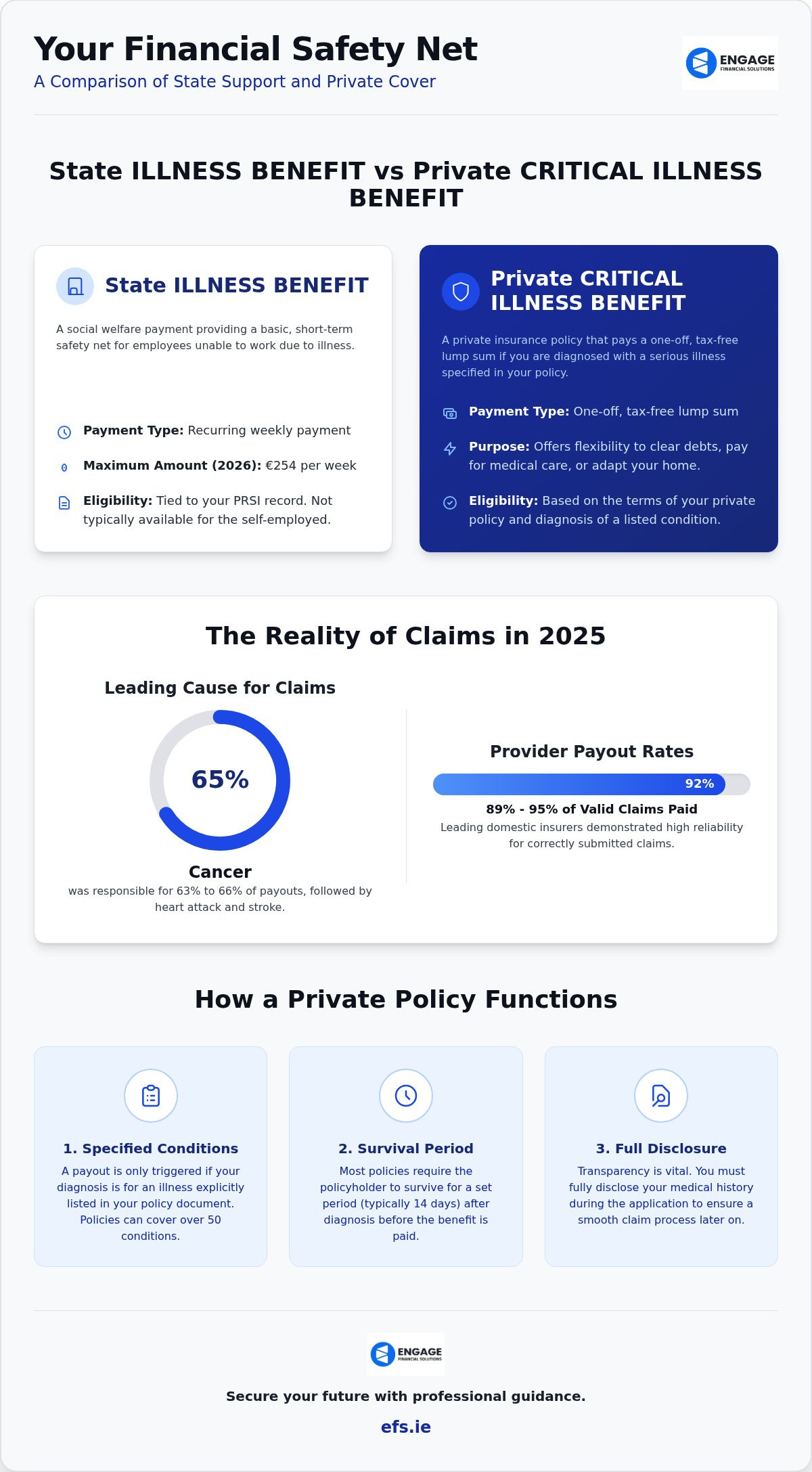
The state provides a basic level of support known as ILLNESS BENEFIT. This is a weekly payment for employees who are unable to work due to illness or injury. As of 2026, the maximum personal rate for this social insurance payment is €254 per week. Eligibility is strictly tied to your PRSI record; for instance, the employee rate for Class A PRSI is scheduled to increase to 4.35% in October 2026. Whilst this support is valuable, it’s a temporary measure intended for shorter-term recovery. It rarely covers a full mortgage payment or the long-term lifestyle adjustments required after a major health event. Furthermore, self-employed individuals are generally not eligible for this state payment, making private alternatives even more essential for their security.
Private protection and specified illness cover
Private protection, frequently referred to as SPECIFIED ILLNESS COVER, operates on a different scale. Unlike state support, this benefit is a one-time payment made upon the diagnosis of a condition explicitly listed in your policy. Critical illness insurance was originally designed to provide financial relief during the most challenging times, and that remains its primary purpose today. Because the payout is tax-free and independent of your ability to return to work, it offers unparalleled flexibility. You might use the funds to pay off your mortgage, cover private medical fees, or modify your home to suit new physical needs. Choosing between these options doesn’t have to be a source of stress. At Engage Financial Solutions, we act as your steady guide, ensuring you select a level of cover that mirrors your actual needs rather than just a generic policy.
How serious illness cover functions in the local market
Understanding how a CRITICAL ILLNESS BENEFIT functions in practice is essential for avoiding surprises during a claim. Unlike general health insurance, these policies are defined by a precise list of medical conditions. If a condition isn’t explicitly named in your policy document, it won’t trigger a payout. This specificity ensures that domestic providers can maintain high payout rates; many leading insurers reported paying between 89% and 95% of all valid claims in 2025. It’s a straightforward system designed to provide a lump sum when you need it most, provided you meet the specific medical criteria outlined by the provider.
One unique aspect of the domestic market is the survival period requirement. Most policies stipulate that the policyholder must survive for a set period, typically 14 days, following a diagnosis before the benefit is paid. Additionally, the success of your future claim depends heavily on the initial application. Full disclosure of your medical history is vital. Omitting details about your health or lifestyle can create friction later, so being transparent from the start is the best way to safeguard your future security. If you’re unsure how to navigate these requirements, our team can help you tailor a policy that provides the right balance of protection.
Commonly covered conditions and definitions
Whilst policies can cover over 50 different conditions, the vast majority of claims are linked to a few primary illnesses. In 2025, cancer remained the leading cause for claims amongst domestic providers, accounting for roughly 63% to 66% of all payouts. Heart attacks and strokes follow closely behind. It’s also common to see Permanent Total Disability (PTD) included in a SPECIFIED ILLNESS COVER policy. This specific benefit provides a payout if you’re permanently unable to work due to any illness or injury, even if it’s not on the main list. However, definitions of what constitutes a “serious” or “malignant” condition can vary between insurers, so it’s wise to review the fine print with a professional guide.
Policy structures: Standalone vs. Accelerated
When choosing your cover, you’ll need to decide between a standalone policy or an accelerated structure. A standalone CRITICAL ILLNESS BENEFIT exists as an independent pot of money. If you make a claim, it has no impact on your other insurances. In contrast, accelerated cover is usually an add-on to your LIFE COVER or MORTGAGE PROTECTION. In this scenario, a claim for a serious illness reduces the total amount of life insurance remaining. For example, if you have €200,000 in LIFE COVER and claim a €50,000 accelerated illness benefit, your remaining life protection drops to €150,000. Standalone cover is often preferred by single professionals seeking maximum personal security, whilst accelerated structures can be a cost-effective way for families to bundle their protection needs.
Comparing illness benefits with income protection
Choosing the right protection often involves weighing up two distinct financial tools: a CRITICAL ILLNESS BENEFIT and INCOME PROTECTION. Whilst they both offer security during a health crisis, they solve different problems. A CRITICAL ILLNESS BENEFIT delivers a one-off, tax-free lump sum upon the diagnosis of a specific condition. This provides an immediate injection of capital that can be life-changing during recovery. In contrast, INCOME PROTECTION provides a recurring monthly payment designed to replace a portion of your salary if you’re unable to work due to any illness or injury.
The tax treatment of these benefits is a key factor to consider. Under current Revenue rules, the payout from a serious illness policy is completely tax-free. INCOME PROTECTION functions differently; while you receive tax relief on your monthly premiums, the benefit itself is treated as income and is subject to PAYE, PRSI, and USC. Another major difference is the ‘deferred period’ associated with income replacement policies. This is a waiting period, typically between 4 and 52 weeks, that must pass before your claims payments start. Because of these differences, many of our clients choose to hold both policies simultaneously to create a comprehensive safety net.
When a lump sum is the better choice
A lump sum is often the superior option when you have significant, immediate capital requirements. If you have a large mortgage balance, receiving a CRITICAL ILLNESS BENEFIT allows you to clear or substantially reduce your debt, removing a massive monthly stressor. There are no restrictions on how you spend this money. Whether you need to fund private medical treatments, pay for specialised home modifications, or simply take a year off work without worrying about the bills, the flexibility of a lump sum is unmatched. It provides the financial freedom to make choices based on your health rather than your bank balance.
The long-term security of income replacement
While a lump sum handles big-ticket items, INCOME PROTECTION is built for the long haul. It focuses on maintaining your day-to-day lifestyle by covering utility bills, groceries, and childcare costs. The criteria for claiming are also broader; you don’t need a specific diagnosis from a list. Instead, you simply need to be ‘unable to work’ as defined by your policy. This makes it an excellent tool for safeguarding your earnings against a wider range of conditions, including mental health issues or back pain. For a deeper look at how this works, you can read our comprehensive guide to income protection. By combining these two forms of cover, you ensure that both your immediate and long-term financial needs are meticulously managed.
Assessing your requirements for financial protection
Determining the right level of cover is a deeply personal process that requires a clear view of your current financial landscape. Whether you’re a first-time buyer or an established professional, your needs will shift depending on your life stage. A CRITICAL ILLNESS BENEFIT isn’t just a generic insurance policy; it’s a tailored solution designed to fill the specific gaps in your existing protection. By taking a proactive approach today, you can ensure that a future health crisis doesn’t lead to a financial one.
Begin by auditing your current employer benefits. Whilst some domestic firms offer generous sick pay, many only provide the statutory minimum. You should also check if your workplace pension includes any form of SPECIFIED ILLNESS COVER. If these supports are absent or insufficient, you’re effectively self-insuring against a major life crisis. Next, calculate your non-negotiable monthly outgoings. Your mortgage, childcare costs, and utility bills don’t stop just because your income does. You must also consider the financial impact on a partner; if they had to reduce their hours or stop working to provide care, your household income could face a double hit that quickly exhausts your savings.
Integrating cover with your mortgage
For most homeowners, the mortgage is the largest monthly expense. It’s a common misconception that standard MORTGAGE PROTECTION is enough to secure your home. In reality, basic MORTGAGE PROTECTION only clears the remaining debt if a policyholder passes away. It offers no support if you’re diagnosed with a serious illness but survive. By adding a CRITICAL ILLNESS BENEFIT to your plan, you ensure that a lump sum is available to clear the mortgage or cover repayments whilst you recover. This provides the peace of mind that your home ownership status remains secure, regardless of your health. For more detail on this, see our homeowner’s guide to mortgage protection.
Lifestyle and dependency considerations
Beyond the obvious bills, serious illness often brings hidden costs that can quickly drain your bank balance. Whether it’s frequent travel to a specialist centre, hiring domestic help, or purchasing specialised medical equipment, these expenses add up. For self-employed individuals, the need for private protection is even more acute, as they lack access to employer-funded schemes. We recommend a simple stress test for your finances: ask yourself how long your current savings would realistically last if your income stopped for 12 months. If the answer causes anxiety, it’s time to act. Our team can help you assess your requirements and build a plan that removes the friction from your financial future.
Securing your future with professional guidance
Choosing a CRITICAL ILLNESS BENEFIT is one of the most important steps you can take for your long-term security, but the process shouldn’t be a source of stress. When you work with a professional consultancy, you gain access to a panel of leading domestic insurers rather than being limited to a single provider’s offerings. This market-wide perspective is vital; it ensures you don’t just find a policy, but the specific policy that fits your unique medical history and lifestyle. We focus on removing the friction from the application process, acting as a buffer between you and the complexities of the insurance world.
Our approach is methodical and logical. We start by assessing your current financial milestones and working backward to identify the exact level of cover required. Managing the medical underwriting process is a key part of our service. We handle the communication with insurers, ensuring that your health information is presented accurately and that any requests for further medical evidence are managed seamlessly. This proactive management often leads to smoother approvals and prevents the frustration of unexpected exclusions or premium increases.
The value of independent advice
The real advantage of independent guidance lies in the ability to decode the complex fine print that often hides within insurance documents. Definitions of what constitutes a “serious” condition can be dense, and exclusions can vary significantly amongst providers. We act as your single point of contact, providing a clear explanation of how your CRITICAL ILLNESS BENEFIT integrates with your other protections. If budget is a concern, we can often find creative ways to fund your cover. For example, switching mortgages is a straightforward way to reduce your monthly outgoings, potentially freeing up the necessary funds to secure your family’s future without increasing your overall spending.
Taking the first step toward peace of mind
We invite you to experience the clarity that comes from a personalised financial review. At Engage Financial Solutions, we offer a no-obligation consultation to help you navigate your options with confidence. Our “future-back” philosophy ensures that your protection plan isn’t just a standalone product, but a holistic part of your broader strategy for pensions and investments. It’s always best to act whilst you’re in good health, as this is when you can secure the most competitive rates and the most comprehensive terms. By taking this small step today, you’re safeguarding your stability and ensuring a seamless transition through any future health challenges.
Empowering your long-term financial security
Securing a CRITICAL ILLNESS BENEFIT is about more than just buying a policy; it’s about creating a seamless buffer between your family and the stresses of a health crisis. You now understand that whilst state support provides a basic safety net, it’s the private lump sum that offers the flexibility to clear a mortgage or fund specialised care. By distinguishing between these supports and assessing your specific requirements, you’ve already taken the first step toward lasting stability.
At Engage Financial Solutions, we act as your steady guide through the complexities of the domestic insurance market. As a Blackrock-based consultancy regulated by the Central Bank, we provide a comprehensive market review to ensure your protection is perfectly tailored to your lifestyle. We’re here to manage the medical underwriting and decode the fine print, leaving you with total peace of mind. Secure your family’s future with a tailored consultation at Engage Financial Solutions. Taking action whilst you’re healthy is the most effective way to safeguard your aspirations. We look forward to helping you build a future defined by confidence and optimism.
Frequently Asked Questions
Is a critical illness benefit the same as serious illness insurance?
Yes, these terms are used interchangeably within the domestic financial market. Whether you hear it referred to as SPECIFIED ILLNESS COVER, serious illness insurance, or a CRITICAL ILLNESS BENEFIT, the product remains the same. It’s a protection policy designed to pay out a tax-free lump sum if you are diagnosed with a specific medical condition listed in your policy document, providing vital financial stability during your recovery.
Do I have to pay tax on the lump sum received from an illness claim?
No, the lump sum you receive from a private CRITICAL ILLNESS BENEFIT claim is currently tax-free under Revenue rules. This is a major advantage compared to INCOME PROTECTION, where recurring monthly payments are subject to income tax and PRSI. Because the payout is treated as a one-off capital sum, you receive the full amount to clear your mortgage, fund medical treatments, or modify your home.
Can I get critical illness cover if I have a pre-existing condition?
You can often still obtain cover even with a pre-existing condition, although the insurer may apply specific terms to your policy. Depending on the nature of your health history, a provider might exclude that specific condition or apply a ‘premium loading’ to account for the increased risk. Full disclosure during the application is essential to ensure that your future security is robust and that any future claims are valid.
What happens to my policy if I never make a claim?
If your policy reaches the end of its term and you haven’t made a claim, the cover simply expires without a payout. These policies are designed as pure protection rather than savings or investment vehicles. However, some providers offer an optional ‘conversion’ benefit. This allows you to extend your cover or switch to a new policy in the future without providing fresh medical evidence, regardless of any changes in your health.
Is cancer always covered under a standard illness policy?
Cancer is covered in the vast majority of policies, but it must meet the specific definition of ‘malignancy’ outlined by your insurance provider. Whilst most invasive cancers trigger a full payout, some less advanced or non-invasive forms may only result in a partial payment. Since cancer accounted for roughly 63% to 66% of claims in 2025, it’s vital to review these definitions with a steady guide before you commit.
How much does a typical protection policy cost in the current market?
The cost of a CRITICAL ILLNESS BENEFIT isn’t a fixed figure; it’s tailored to your individual age, health status, and smoking behaviour. For example, a non-smoker in their 30s will typically secure much lower rates than someone in their 50s. Because premiums vary significantly between different domestic insurers, we recommend a market-wide review to find a flexible solution that fits comfortably within your monthly household budget.
Can I add serious illness cover to my existing mortgage protection?
Yes, you can frequently add SPECIFIED ILLNESS COVER to an existing MORTGAGE PROTECTION policy as either an ‘accelerated’ or ‘standalone’ benefit. Choosing the accelerated option is often more cost-effective as it shares the same pot of money as your life insurance. However, a standalone benefit provides a separate lump sum that doesn’t reduce your life cover, offering an extra layer of security for your family’s future aspirations.
What is the ‘survival period’ mentioned in most policy documents?
The survival period is a standard requirement that you must survive for a set timeframe, typically 14 days, following your diagnosis before the benefit is paid. This clause distinguishes the policy from life insurance. If a policyholder passes away within this short window, the illness claim won’t be paid, but a life insurance claim would usually be triggered instead. This is a common feature amongst all leading domestic insurance providers.
Disclaimer
Engage Financial Services LTD T/A Engage Financial Solutions is regulated by the Central Bank of Ireland CRO 764570. Director David Moore. Suite 2 First Floor, 14 -18 Main street, Blackrock, Co Dublin A94 W0Y3