
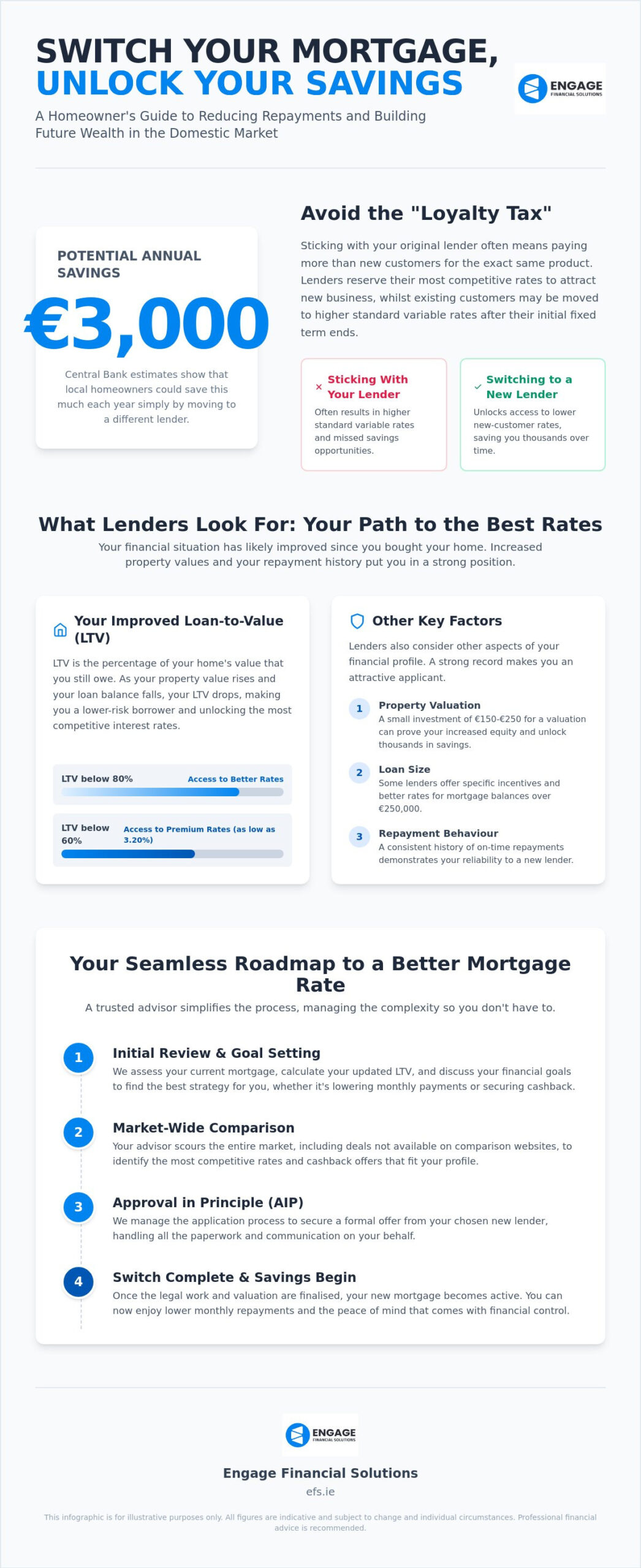
Did you know that the Central Bank estimates local homeowners could save as much as €3,000 every single year just by moving their loan to a different lender? It’s a staggering figure, yet many people stay with their current provider because they fear the process is too complex or costly. Whether you’re nearing the end of a fixed term or you’re currently on a variable rate, the prospect of lower monthly repayments through switching mortgages in the domestic market is closer than you might think.
We understand that high interest rates can weigh heavily on your household budget, and the thought of legal fees or endless forms can feel overwhelming. This guide is designed to provide you with the clarity and confidence needed to take control of your finances. You’ll discover how to navigate the current lending landscape to reduce your outgoings, secure a significant cashback lump sum, and establish long-term stability for your family.
We’ll explore the latest 2026 interest rates, break down the actual costs of moving your loan, and show you how a professional partner can make the entire transition feel seamless and straightforward.
Key Takeaways
- Understand why sticking with your original lender often results in a “loyalty tax” and how a lower rate can save you thousands over the coming decades.
- Discover how your home’s current market value influences your Loan-to-Value ratio, helping you qualify for the most attractive interest rates currently on offer.
- Evaluate whether a significant cashback lump sum or a lower long-term fixed rate provides the most value for your specific financial goals.
- Master a clear roadmap for switching mortgages in the local market, ensuring you move seamlessly from your initial review to a successful Approval in Principle.
- Learn how a trusted advisor can manage the paperwork and integrate your new loan into a wider plan for long-term security and peace of mind.
Why Switching Your Mortgage is a Vital Move for Your Financial Health
Many homeowners view their monthly repayment as a fixed reality. It’s easy to settle into a routine, paying the same amount year after year without questioning if there’s a better way to manage your debt. However, sticking with your original lender for too long often leads to what experts call a “loyalty tax.” This isn’t an official fee, but rather the hidden cost of missing out on the competitive rates that banks typically reserve for new customers. By staying put, you might be paying significantly more than a new borrower with the exact same financial profile.
When you consider what is a mortgage, it’s essentially a long-term strategy for home ownership. Even a seemingly small reduction in your interest rate can compound into tens of thousands of Euros in savings over a twenty-year term. This isn’t just about saving a small amount each month; it’s about reclaiming your future wealth. Those extra funds could bolster your pension, support your children’s education, or simply provide the disposable income you need to enjoy life today whilst maintaining a secure home base. When you begin the process of switching mortgages, you’re not just moving a loan; you’re realigning your largest debt to fund your future lifestyle.
Identifying the ‘Loyalty Tax’ on Your Current Rate
Lenders are constantly competing for new business, often launching sharp, attractive rates to lure in new applicants. Meanwhile, long-term customers are frequently moved onto standard variable rates once their initial fixed deal expires. If your financial situation has improved since you first signed your papers; perhaps through a salary increase or a rise in your property’s value; you’re likely in a much stronger position to negotiate. Moving from a generic rate to a bespoke fixed option is one of the most effective ways to safeguard your financial future.
The Emotional Dividend of Financial Security
There is a profound sense of optimism that comes from taking control of your largest monthly outgoing. Managing your household shouldn’t be a source of constant friction. A seamless transition to a better rate doesn’t just benefit your bank balance; it provides a sense of “calm competence” to your daily life. When you work with a professional partner like Engage Financial Solutions, we act as a buffer between you and the complex banking world. We identify opportunities that aren’t always visible on standard comparison sites, ensuring your transition is straightforward and stress-free. Taking this step allows you to stop worrying about rising costs and start looking forward to a more stable financial future.
The Core Factors That Determine Your Success in the National Market
Securing a better deal isn’t just about finding a lower number on a screen; it’s about understanding how your current financial position looks to a new lender. Since you first moved into your home, your circumstances have likely changed. With national home list prices rising by 3.7% year-on-year in early 2026, many families have gained significant equity without even realising it. This growth in value, combined with the capital you’ve already paid off, puts you in a much stronger bargaining position than when you were a first-time buyer.
Lenders in the domestic market are particularly interested in the size of the loan relative to the property’s worth. Whilst some lenders offer specific incentives for loans over €250,000, others focus on the stability of your long-term repayment behaviour. If you’re unsure where your current standing lies, our team at Engage Financial Solutions can help you evaluate your options and identify the most competitive rates available to you.
The Power of Your Improved Loan-to-Value Ratio
Your Loan-to-Value (LTV) ratio is the percentage of your home’s total market worth that you still owe to the bank, and it directly dictates the interest rate tiers you can access. When your LTV drops below key thresholds, such as 80% or 60%, you unlock the market’s most premium products. For instance, some lenders now offer fixed rates as low as 3.20% for those with an LTV of 60% or less.
To access these rates, a professional valuation is essential. In the current 2026 climate, these typically cost between €150 and €250. This small investment often pays for itself many times over by proving to a new lender that your “equity buffer” has grown, allowing them to offer you their most secure and low-interest options.
Assessing Your Financial Profile for a Smooth Move
New lenders want to see that you’re a reliable partner. Consistent repayment behaviour over the last twelve months is non-negotiable. They’ll look closely at your current accounts to ensure you aren’t overstretched, so managing other debts like car loans or credit cards before you apply can make a significant difference. It’s also vital to keep your debt-to-income ratio within a healthy range to ensure your application moves through the system without friction.
Organising your documentation early is the best way to ensure a seamless transition. You’ll generally need your last six months of bank statements, recent payslips, and your most recent Employment Detail Summary. Having these ready allows for a proactive approach, helping you meet the 10-business-day window that lenders now aim for when providing a decision on completed applications.
Calculating the Real Value: Fees, Cashback, and Long-Term Savings
When you sit down to calculate the potential savings from switching mortgages, it’s easy to get distracted by the headline figures. A lower interest rate is always the goal, but the true value of a move is found in the “total cost of credit” over the next five to ten years. This “future-back” perspective allows you to see past the immediate paperwork and understand how much wealth you’re actually retaining. In the domestic market, lenders are currently competing fiercely for your business, often using significant incentives to catch your eye.
The most common question we hear is whether a large cashback lump sum is better than a slightly lower interest rate. For many, a lump sum provides the liquidity needed to cover the costs of the move itself, whilst for others, the compounding effect of a lower rate offers better long-term security. Evaluating these options requires a clear-headed look at your family’s immediate needs versus your twenty-year financial plan. Taking a proactive approach to your debt means doing the maths today to ensure you aren’t paying a “loyalty tax” tomorrow.
Cashback Incentives vs. Low Interest Rates
Cashback offers can be incredibly tempting. Some lenders, such as Haven, provide a €5,000 flat cashback for switchers with loans over €250,000, whilst others like Bank of Ireland offer up to 3% of the total loan amount. These funds are often used to clear existing small debts or to fund home improvements. However, you must be careful not to fall into the trap of a high-interest product disguised by a generous headline. A lower rate, even by just 0.2%, can often save you far more than a €5,000 lump sum if you plan to stay with that lender for the full term of a five-year fixed deal.
Budgeting for the Transition
Budgeting for the transition is straightforward when you know what to expect. Solicitor fees for the conveyancing involved in a switch typically range from €1,000 to €1,500, including VAT. You’ll also need to account for a professional valuation, which generally costs between €150 and €250, and a Land Registry fee of €175 to register the new charge. Many lenders offer to cover these initial costs through cashback or specific “switcher packages” to remove the financial barrier of moving your loan. These incentives ensure that the process of switching mortgages in the national market remains accessible and cost-effective for the average homeowner.
Don’t let a fixed-rate break fee stop you from exploring your options. If you’re currently on a fixed rate, your bank may charge a fee for leaving early, but in a stable or falling rate environment, this fee is often €0. Always request a break-fee quote from your current provider first; you might find that the penalty is negligible compared to the thousands you could save by securing a more competitive rate elsewhere.
The Seamless Roadmap to Your New Mortgage Rate
The thought of paperwork often stops homeowners from pursuing a better deal. It’s a common fear, but the reality of switching mortgages Ireland in 2026 is far more efficient than it was even five years ago. By following a structured roadmap, you can move from a high-interest “loyalty tax” to a tailored rate that supports your long-term goals without the typical stress. The process generally takes between six and eight weeks, and with the right support, the “heavy lifting” is handled by professionals rather than falling on your shoulders.
Your journey begins with a comprehensive review of your current terms followed by a full scan of the domestic market. Once an attractive alternative is identified, the next milestone is securing an Approval in Principle. This confirms your borrowing capacity and gives you the green light to proceed with confidence. Under current Consumer Protection rules, lenders aim to provide a decision on your completed application within ten business days, making the initial phase faster and more transparent than ever before.
Simplifying the Documentation Maze
To ensure a “first-time right” application, you’ll need to gather a few essential files. Digital submission has revolutionised this part of the process, allowing you to upload documents securely from your own home. You should have the following ready:
- Your last three to six months of bank statements for all accounts.
- Recent payslips (usually the last three months) and your Employment Detail Summary.
- A recent statement showing your current mortgage balance and repayment history.
- Proof of identity and address, such as a valid passport and recent utility bill.
Having these files organised early prevents friction later on. A professional advisor can help you review these documents before submission to ensure everything meets the new lender’s specific criteria.
The Legal and Valuation Phase
Once you have a formal offer, the process enters the legal and valuation stage. You’ll need a solicitor to manage the title deeds and ensure the old loan is discharged correctly. Whilst you wait for the new lender to issue the final loan pack, a valuer will visit your home to confirm its current market worth. This is also the ideal time to ensure your mortgage protection is updated. Your policy must reflect your new lender’s interest and the remaining term of your loan to ensure your family remains fully safeguarded.
The final step is the seamless transition of funds between the banks, which your solicitor coordinates. After the switch is complete, it’s wise to look at the “big picture” of your financial health. With your monthly outgoings reduced, you might choose to redirect those savings into your pension or other investments to strengthen your future security. If you’re ready to see how much you could save, you can request a tailored market review today to start your journey.
Securing Your Future with a Trusted Financial Partner
Navigating the domestic lending landscape alone can feel like a daunting task. Whilst banks have their own internal teams, their primary goal is to sell you their specific products. A broker, however, prioritises your unique needs. By taking a “big picture” view of the entire national market, we identify opportunities that align with your long-term aspirations rather than just today’s balance. We act as a professional buffer between you and the complex banking world, managing the negotiations and technical details so you don’t have to.
This level of specialised support is equally valuable for those in the financial services industry; for instance, you can explore Project-Based and Retainer Consulting Fees to see how Versapien assists with risk management and digital transformation.
Taking a “future-back” perspective is essential for true financial health. Instead of merely looking at next month’s saving, we consider how a lower mortgage rate fits into your overall life plan. For many families, the hundreds of Euros saved each month become the foundation for robust retirement planning. By realigning your largest debt today, you’re effectively funding the lifestyle you want to enjoy decades from now. This proactive approach turns a simple administrative switch into a strategic move for lifelong security.
A Tailored Approach to Your Unique Goals
A one-size-fits-all rate from an online calculator rarely accounts for the nuances of your family life. Whether you’re planning to extend your home, support a child through university, or simply want the peace of mind that comes from a long-term fixed rate, your strategy should be personalised. We provide meticulous attention to detail, ensuring your application is positioned for success from the very first submission. Our team proactively manages the timeline, neutralising potential stresses before they occur to ensure your experience is seamless from start to finish.
Beyond the Mortgage: A Holistic Financial View
True stability comes from knowing every aspect of your financial life is working in harmony. Once you’ve successfully reduced your mortgage outgoings, you have a prime opportunity to bolster your family’s safety net. You might choose to redirect a portion of those savings into income protection, ensuring that your home and lifestyle are safeguarded against life’s unexpected turns. This holistic integration prevents your finances from feeling like a fragmented list of bills and transforms them into a coordinated engine for growth.
Taking the first step toward a more stable future doesn’t have to be stressful. You deserve a partner who is deeply invested in your individual needs and one step ahead of the market’s shifts. Contact our team at Engage Financial Solutions today to begin your journey toward a more secure and optimistic financial future.
Taking the First Step Toward Long-Term Financial Security
Taking control of your largest monthly debt is more than just a calculation; it’s a commitment to your family’s future stability. By understanding your improved Loan-to-Value ratio and looking past headline cashback offers to the total cost of credit, you can reclaim thousands of Euros that would otherwise be lost to a “loyalty tax.” Whether you’re aiming for lower monthly outgoings or a more secure fixed rate, the process of switching mortgages Ireland has never been more efficient or accessible.
Our team is regulated by the Central Bank and provides access to a wide panel of leading lenders to ensure you receive a truly tailored solution. We specialise in seamless transitions, acting as your steady guide through every legal and valuation hurdle. You don’t have to navigate these complexities alone. Book a consultation with our expert team to find your ideal rate and start your journey toward a more optimistic financial future today.
Frequently Asked Questions About Moving Your Loan
How much can I realistically save by switching my mortgage?
The Central Bank estimates that local homeowners could save up to €3,000 annually by moving to a more competitive rate. Your actual savings depend on your current interest rate, the remaining balance of your loan, and your Loan-to-Value ratio. By switching mortgages in the domestic market, you’re often able to reduce your monthly repayments significantly, which compounds into substantial wealth over the lifetime of the debt.
Is it possible to switch if I am currently on a fixed-rate term?
Yes, you can switch whilst on a fixed rate, but you should first check if an early breakage fee applies. In the current 2026 economic environment, these fees are often €0; however, it’s essential to request a specific quote from your current lender. Even if a small fee exists, the long-term savings from a lower interest rate often outweigh the initial cost of leaving your current deal early.
Do I need to hire a solicitor when moving to a new lender?
You’ll need a solicitor to handle the legal aspects of the transition, such as managing the title deeds and discharging the old loan. This is a mandatory step in the process to ensure the new lender’s charge is correctly registered with the Land Registry. Solicitor fees for this service typically range from €1,000 to €1,500, though many lenders offer cashback incentives to help cover these professional costs.
How long does the entire process typically take from start to finish?
The journey from your initial market review to the final drawdown of funds usually takes between six and eight weeks. This timeline includes the ten business days lenders aim for when reviewing a completed application and the subsequent valuation and legal phases. Having your documentation organised early is the most effective way to ensure a seamless and straightforward experience without unnecessary delays.
Will switching my mortgage affect my existing life insurance or protection policies?
Your existing life insurance remains valid, but you must update your mortgage protection policy to name your new lender as the interested party. This is a straightforward administrative task that ensures your family remains fully safeguarded under the new loan terms. It’s also an excellent opportunity to review your coverage and ensure it still aligns with your current financial needs and family aspirations.
What is the minimum amount of equity I need to be eligible for a switch?
Most lenders in the national market require you to have at least 10% equity in your home, meaning a maximum Loan-to-Value of 90%. However, the most competitive interest rates are reserved for those with an LTV of 80% or lower. If your home’s value has increased recently, you may find that you’ve unlocked premium tiers that offer significantly better value than your original loan.
Can I release equity for home improvements whilst I am switching my rate?
It’s often possible to release equity for home improvements during the switch, provided your income and LTV ratio support the additional borrowing. This allows you to consolidate the costs of your renovation into your new, lower interest rate. Many homeowners find this a proactive way to increase their property’s value whilst simultaneously reducing their overall monthly outgoings through a better mortgage deal.
What happens if my property has decreased in value since I first bought it?
If your property has decreased in value and you’re in negative equity, moving to a new lender is generally more challenging. Lenders typically require the property value to be higher than the outstanding loan amount to mitigate their risk. In this scenario, it’s often best to focus on paying down the capital until your LTV improves, at which point the full range of national switching mortgages options becomes available again.
Disclaimer
Engage Financial Services LTD T/A Engage Financial Solutions is regulated by the Central Bank of Ireland CRO 764570. Director David Moore. Suite 2 First Floor, 14 -18 Main street, Blackrock, Co Dublin A94 W0Y3