


If you were suddenly unable to work due to illness or injury, would your current savings be enough to keep your front door keys in your pocket? It’s completely natural to feel a sense of unease when considering how a loss of earnings might impact your family’s lifestyle or your ability to keep up with mortgage repayments. Many professionals find themselves confused by technical terms like “deferred periods” or the actual income protection insurance cost once tax relief is applied at the marginal rate of 20 or 40 per cent.
Whether you’re a company director or a salaried employee, you deserve to feel confident that your financial foundation is secure regardless of what the future holds. This guide will show you how to calculate the net cost of INCOME PROTECTION by leveraging available tax relief whilst staying within the 10 per cent limit set by Revenue. We will explore how to lower your premiums through a tailored policy structure without sacrificing the quality of your cover; providing you with a clear, actionable strategy for long term stability and peace of mind.
- Understand how your age and occupation influence your base premium and lock in long term security for your most valuable asset.
- Discover how to significantly reduce the net income protection insurance cost by claiming tax relief at your marginal rate of 20% or 40%.
- Explore how adjusting your deferred period can lower monthly premiums whilst ensuring your family remains fully protected during a recovery.
- Identify the vital differences between the recurring monthly support of INCOME PROTECTION and the lump sum provided by CRITICAL ILLNESS COVER.
- Gain clarity on how to move from generic online quotes to a personalised strategy that fits your specific financial milestones and career path.
Understanding the Factors Influencing INCOME PROTECTION Premiums
Your ability to earn an income is your most valuable financial asset. Over a career spanning several decades, your total earnings represent a significant sum that supports your home, your family, and your future. INCOME PROTECTION insurance serves as a dedicated safety net, stepping in to provide a recurring monthly salary if illness or injury keeps you away from your desk or workshop. When you begin exploring the income protection insurance cost, it’s vital to remember that these premiums are designed to foster stability and optimism, ensuring you never have to face a sudden loss of earnings alone.
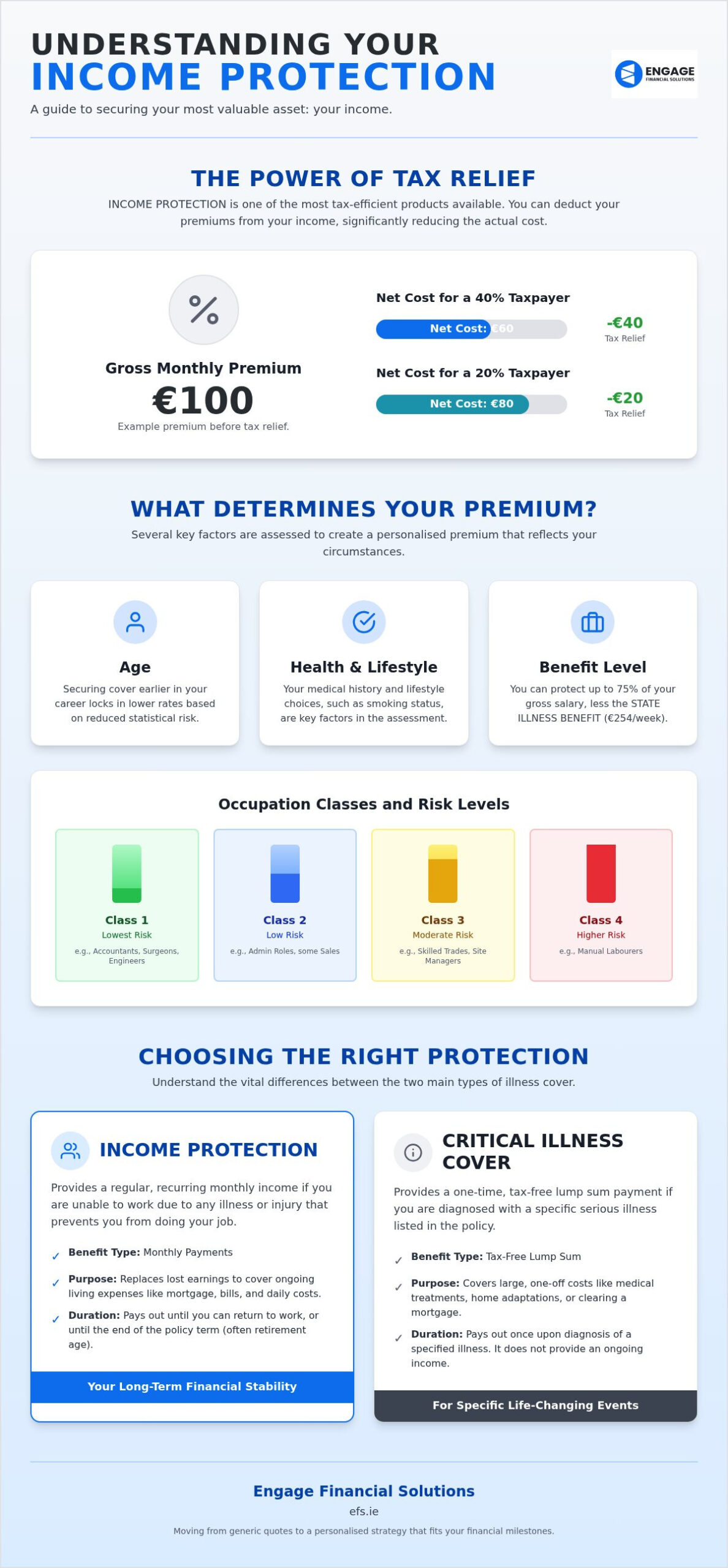
Age at entry is one of the most significant drivers of your premium structure. By securing cover earlier in your career, you lock in rates based on a lower statistical risk, which often results in more manageable long-term costs. Your health history and lifestyle choices also play a central role. For instance, smoking status significantly impacts the underwriter’s assessment because of the associated long-term health risks. These factors allow insurers to tailor a policy that reflects your personal circumstances whilst providing the peace of mind that comes from robust financial security.
The Role of Occupation Classes in Cost Calculation
Domestic insurers categorise every job into one of four standard classes to determine risk levels. Class 1 includes professional roles with minimal physical risk, such as surgeons, accountants, or engineers, who typically benefit from the lowest premium rates. Class 2 and 3 cover skilled trades or administrative roles that involve moderate physical activity or frequent travel. Class 4 is reserved for manual labourers or those working in higher-risk environments. It’s essential to describe your daily duties accurately; a project manager who spends most of their time on a construction site may be classified differently than one who works entirely from a home office.
Benefit Levels and Salary Percentages
The amount of cover you choose directly influences the monthly premium. Under current regulations, you can typically protect up to 75% of your gross annual salary. However, insurers must subtract the STATE ILLNESS BENEFIT, which currently stands at €254 per week as of January 2026, from this calculation. Opting for a lower benefit percentage, such as 50% or 60% of your earnings, can be an effective way to reduce your monthly costs. This strategic choice allows you to maintain a high level of protection whilst ensuring the premiums fit comfortably within your broader financial plan. Focusing on your desired end-state of security helps in choosing a benefit level that truly reflects your lifestyle requirements.
The Financial Logic of Tax Relief on Premium Costs
Securing your future shouldn’t feel like an uphill battle against your monthly budget. INCOME PROTECTION stands out as one of the most tax-efficient financial products available under current Revenue rules. Because the state recognises the importance of individuals safeguarding their own financial independence, you are permitted to deduct your premiums from your total income before tax is calculated. This unique arrangement effectively reduces the income protection insurance cost by a significant margin, allowing you to build a robust safety net with greater ease.
The beauty of this system lies in its simplicity. If you pay tax at the higher rate of 40 per cent, a monthly premium of €100 only costs you €60 in real terms. Even at the standard rate of 20 per cent, that same premium effectively costs just €80. Understanding these domestic income protection insurance rules helps transform a technical financial decision into a clear strategy for long term stability. It provides a sense of calm competence to know that your commitment to protecting your family is supported by significant tax savings.
Claiming Relief: PAYE vs Self-Employed
The method for claiming this relief depends on how you earn your living. For PAYE employees, relief is often granted through payroll via a “net pay arrangement,” meaning you feel the benefit in your take-home pay immediately. If your employer doesn’t offer this, you can simply claim it back at the end of the year through your tax return. For the self-employed or company directors, these costs are typically offset against your annual tax bill during the self-assessment process. Ensuring you maximise these allowances is a straightforward way to maintain a tailored protection strategy without unnecessary friction.
The Impact of Inflation Indexation
To truly look after your future self, your cover must grow alongside the cost of living. Adding inflation indexation to your policy ensures that your potential monthly benefit increases every year, safeguarding your purchasing power over a 20 or 30 year term. Whilst this adds a small amount to your initial premium, the “future-back” perspective reveals its true value. A benefit that seems generous today might feel restrictive in fifteen years; indexation ensures your security remains absolute. This proactive approach allows your policy to evolve seamlessly as your career progresses and your lifestyle requirements change.
Strategic Choices to Optimise Your Monthly Investment
Finding the right balance for your monthly budget doesn’t mean you have to settle for a generic, off-the-shelf policy. A truly effective strategy involves “tailored protection,” where every variable of your cover is adjusted to align with your specific lifestyle, career path, and financial obligations. Whilst many people focus solely on which provider to choose, the actual structure of your policy often has a greater impact on the long-term value you receive. Safeguarding your earnings requires a methodical approach that considers how your insurance works alongside other benefits you may already have, such as statutory sick pay or employer-led schemes.
By making informed decisions about how your cover is built, you can manage the income protection insurance cost Ireland without compromising the safety net your family relies on. This process is about removing friction and ensuring that, should you need to make a claim, the transition from your salary to your insurance benefit is as seamless as possible. It’s about creating a plan that looks forward, anticipating your needs before they arise so you can maintain your standard of living with absolute confidence.
Selecting the Right Deferred Period
The deferred period is the waiting time between the moment you are signed off work and the moment your policy begins to pay out. In the domestic market, you can typically choose periods of 4, 8, 13, 26, or even 52 weeks. There is a direct inverse relationship here: the longer you are willing to wait, the lower your monthly premium will be. To optimise your investment, you should align this period with your employer’s sick pay scheme. If your company pays your full salary for thirteen weeks, choosing a thirteen-week deferred period prevents you from paying for overlapping cover. This choice also encourages you to maintain a modest emergency fund to bridge any minor gaps, further refining your financial efficiency.
Guaranteed vs Reviewable Premium Models
When setting up your INCOME PROTECTION, you’ll need to decide between guaranteed and reviewable premiums. A guaranteed premium is fixed for the entire duration of the policy, providing absolute certainty about your future outgoings. In contrast, reviewable premiums may start lower but are subject to change by the insurer at specific intervals, often based on their overall claims experience or economic shifts. Whilst the initial income protection insurance cost Ireland might be higher for a guaranteed model, it offers superior stability. For those seeking long-term peace of mind, knowing your costs won’t spike unexpectedly allows for much more confident financial planning as you move toward your retirement goals.
Comparing INCOME PROTECTION with Other Safeguards
Building a resilient financial plan requires a holistic view of how different types of cover work together to protect your lifestyle. Whilst you might already have certain policies in place, it’s essential to understand that each serves a distinct purpose. Many people often confuse INCOME PROTECTION with CRITICAL ILLNESS COVER, also known as Serious Illness Cover. The fundamental difference lies in the payout structure: CRITICAL ILLNESS COVER provides a one-off lump sum upon the diagnosis of a specific condition, whereas INCOME PROTECTION provides a recurring monthly salary. This ongoing support is what truly replaces your earnings, making the income protection insurance cost Ireland a foundational investment in your long-term stability.
Homeowners will also be familiar with MORTGAGE PROTECTION, which is designed to pay off your remaining loan balance if you pass away. However, it doesn’t provide any assistance if you are simply unable to work due to a back injury or mental health struggle. By contrast, a well-structured INCOME PROTECTION policy ensures you can continue to meet your monthly repayments and daily expenses without depleting your savings. This level of security is the foundation of a comprehensive retirement plan, as it allows you to maintain your pension contributions even during a period of prolonged illness.
The Synergy of Combined Cover
For a young family, the most robust financial buffer often comes from a combination of monthly and lump-sum benefits. Consider a scenario where a parent is diagnosed with a condition that requires both expensive medical treatment and a year away from work. In this case, CRITICAL ILLNESS COVER provides the immediate cash needed for specialist consultations or home modifications, whilst INCOME PROTECTION ensures the mortgage is paid and the fridge stays full. This “Need-Solution-Benefit” progression allows you to focus entirely on recovery without the added stress of financial ruin. Aligning these products creates a seamless safety net that covers both immediate shocks and long-term requirements.
Group Protection vs Individual Policies
You may find that your employer already provides some level of GROUP PROTECTION as part of your benefits package. Whilst this is a valuable perk, it’s important to recognise the limitations of relying solely on a company scheme. Individual policies offer portability; if you change jobs or decide to go self-employed, your cover stays with you. Furthermore, an individual policy allows for personalised terms and a “guaranteed” premium structure that a generic group scheme cannot match. Relying on a company-led benefit can leave you vulnerable if the business decides to reduce its costs or if you choose to pursue a new career path. To ensure your safety net is truly tailored to your life, explore our personalised protection options to see how an individual policy can fill the gaps in your current cover.
Navigating the Path to a Personalised Quote
Moving from the research phase to taking concrete action should be a straightforward and empowering experience. For many first-time home buyers, the focus is often entirely on the immediate requirements of the mortgage process, such as securing a loan or arranging basic MORTGAGE PROTECTION. However, true long-term security involves looking at the bigger picture and ensuring your lifestyle remains protected if your salary suddenly stops. By taking a proactive approach now, you can arrange a safety net that evolves with your career and provides a sense of optimism for the decades ahead.
The process of obtaining a quote is designed to be stress-free and transparent. Rather than relying on generic online calculators that offer one-size-fits-all figures, a personalised assessment ensures that the income protection insurance cost Ireland is tailored specifically to your occupation, health profile, and financial goals. This methodical path allows you to understand exactly what you are paying for, removing the friction and confusion that often accompanies complex financial decisions.
What to Prepare for Your Assessment
To help your advisor find the most competitive terms, you should have a few key details ready for your initial conversation. You will need to provide your gross annual salary, your current employer’s sick pay terms, and a basic overview of your health history. Whether you are a permanent employee or a company director, this information allows a broker to search the domestic market and compare different providers on your behalf. Full disclosure at this stage is vital; it ensures that your policy is robust and that any future claim can be processed without unnecessary hurdles. This transparency is the foundation of a reliable partnership between you and your insurer.
The Peace of Mind of Professional Advice
At Engage Financial Solutions, we act as a steady guide and a professional buffer between you and the insurance companies. We understand the nuances of local regulations and the specific requirements of the Central Bank, ensuring your cover is always compliant and effective. By choosing a tailored approach over a standard quote, you benefit from a “future-back” perspective that aligns your cover with your actual lifestyle aspirations rather than just a percentage of your current wage. We invite you to take the first step toward a secure future by contacting our team for a personalised consultation. Together, we can build a financial foundation that looks after you and your family, no matter what transitions life may bring.
Securing Your Financial Future with Confidence
Protecting your lifestyle is about more than just numbers; it’s about the peace of mind that comes from knowing your family’s foundation is unshakable. By understanding how tax relief at your marginal rate can lower the income protection insurance cost Ireland, you transform a complex financial decision into a manageable and highly efficient strategy. Whether you’re aligning your deferred period with existing sick pay or choosing a guaranteed premium for lifelong certainty, every choice you make today builds a more optimistic tomorrow.
As specialists in seamless financial transitions, our team provides bespoke advice centred on your unique lifestyle goals. We are regulated by the Central Bank and act as your steady guide through the complexities of the domestic market. Don’t leave your most valuable asset to chance. Secure your future with a tailored INCOME PROTECTION assessment from our expert team and take the first step toward lasting stability. Your future self will thank you for the clarity and security you establish today.
Frequently Asked Questions
Is INCOME PROTECTION insurance worth the cost for most professionals?
INCOME PROTECTION is widely considered essential for any professional whose family relies on their monthly salary to meet mortgage repayments or lifestyle costs. Whilst everyone’s situation is unique, the benefit of having a guaranteed income during a long term illness far outweighs the monthly premium. It provides a foundation of stability that allows you to focus on recovery rather than financial survival.
How much does the average INCOME PROTECTION policy cost each month?
The income protection insurance cost Ireland depends on several personal factors including your age, smoking status, and occupation class. Because premiums qualify for tax relief at your marginal rate, the actual amount leaving your bank account is often much lower than the gross quote suggests. A tailored assessment is the best way to find a premium that fits your specific budget whilst maintaining robust cover.
Can I claim tax relief on my INCOME PROTECTION premiums if I am self-employed?
Yes, self-employed individuals and company directors can claim tax relief on their premiums just like PAYE employees. You can typically offset the cost of your INCOME PROTECTION against your income tax through the annual self-assessment process. This relief is available on premiums up to 10 per cent of your total income, making it a highly tax-efficient way to safeguard your business and personal earnings.
What happens to my premiums if I change my job or career path?
One of the primary advantages of an individual policy is its portability. If you change employers or move into a different career path, your cover remains in place without the need for a new application. It’s always a good idea to update your advisor on significant changes to your daily duties to ensure your occupation classification remains accurate and your protection stays seamless.
Is there a limit to how much INCOME PROTECTION cover I can buy?
Insurers generally limit cover to 75 per cent of your gross annual salary. This limit includes any other sources of disability income and is adjusted to account for the State Illness Benefit, which currently stands at €254 per week. This ensures that you have a strong incentive to return to work whilst still receiving enough support to maintain your home and family’s standard of living.
Does INCOME PROTECTION cover me if I am made redundant?
No, INCOME PROTECTION is specifically designed to replace your earnings if you are unable to work due to illness or injury. It does not provide cover for redundancy or voluntary unemployment. For those seeking protection against job loss, different types of general insurance may be more appropriate, though these are separate from the long term health-based protection discussed here.
How long will the policy pay out if I cannot return to work?
Your policy will continue to pay out for as long as you meet the definition of disability set out in your terms. This benefit can last for a few months or several years, continuing until you are well enough to return to your role or you reach your selected expiry age, such as 65 or 68. This long term commitment is why many consider it a vital pillar of their financial security.
Do I need to undergo a medical exam to get a quote?
Most applications begin with a straightforward health questionnaire rather than a physical examination. Depending on the level of cover you require or your specific medical history, an underwriter might request a report from your GP or a brief medical assessment. This process is handled with the utmost professionalism and is designed to ensure your policy is tailored accurately to your personal risk profile.
Disclaimer
Engage Financial Services LTD T/A Engage Financial Solutions is regulated by the Central Bank of Ireland CRO 764570. Director David Moore. Suite 2 First Floor, 14 -18 Main street, Blackrock, Co Dublin A94 W0Y3