


What if a “no” from your bank isn’t actually the end of your home-buying journey, but rather the most valuable diagnostic tool you’ve ever been given? It’s incredibly disheartening to receive a rejection, especially when you’ve worked hard to build a deposit and find a property that feels right. You might be left wondering about a mortgage application rejected what next, feeling frustrated by a lack of transparency from bank underwriters or confused by the data on your credit report. Whether you’re seeking FIRST-TIME BUYER MORTGAGES or looking at SWITCHING MORTGAGES, this setback doesn’t have to be permanent if you have the right plan.
We’re here to help you move from uncertainty to a position of strength. You’ll discover exactly how to identify the underlying causes of a declined MORTGAGE and the practical steps needed to secure an approval on your next attempt. We’ll guide you through interpreting your record on the Central Credit Register and show you how to demonstrate repayment capacity to a LENDER. This guide provides a concrete plan to improve your financial profile, whilst ensuring you have the tools to achieve a successful outcome within the next six to twelve months.
Key Takeaways
- Understand the difference between administrative errors and credit-related rejections by securing a formal Statement of Reasons from your LENDER.
- Navigate the uncertainty of a mortgage application rejected what next by implementing a six-month clean banking period to stabilise your financial profile.
- Prove your ability to manage debt by ensuring your monthly SAVINGS and rent payments match or exceed your proposed future MORTGAGE repayment.
- Explore how a MORTGAGE BROKER provides access to a broader panel of LENDERS, including those with more flexible criteria than traditional pillar banks.
- Discover why a refusal is often a temporary hurdle that can be overcome with a tailored financial plan and professional guidance.
Decoding the Reasons Behind a MORTGAGE Refusal
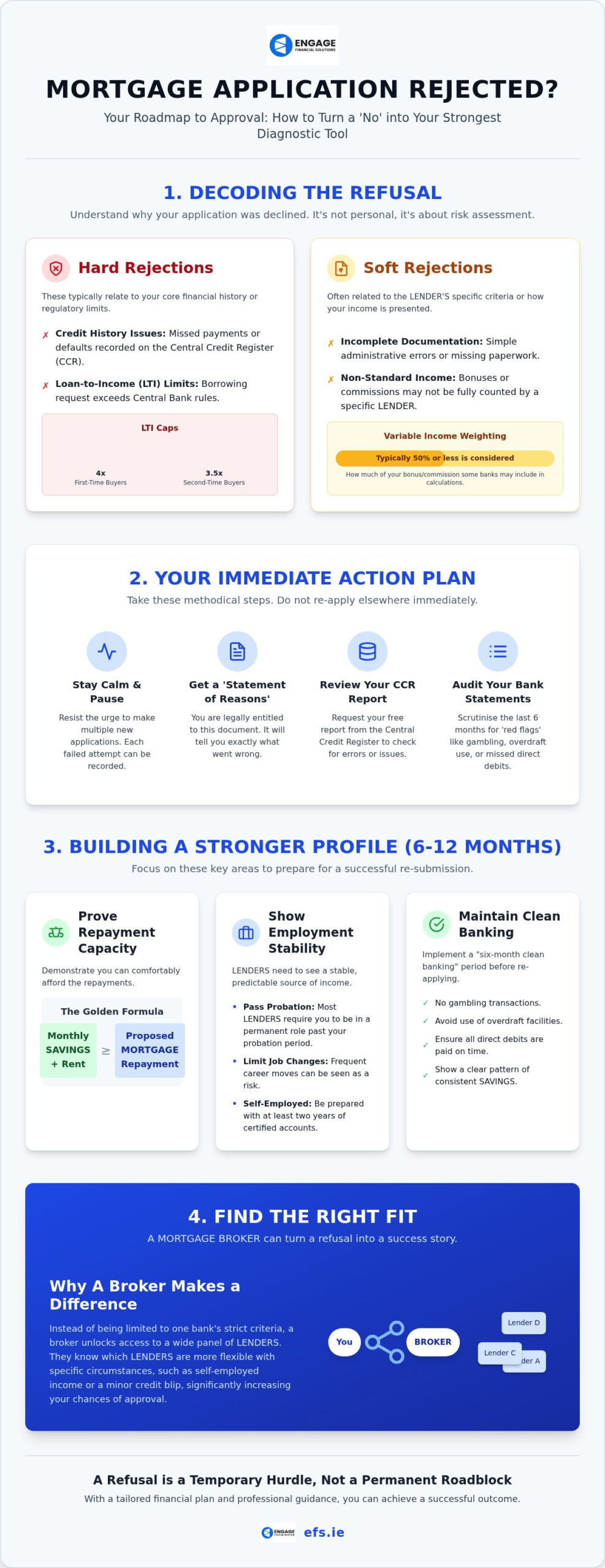
Underwriting is essentially an exercise in risk management. When a bank says “no,” they aren’t judging your character; they’re simply stating that your current profile doesn’t fit their specific risk appetite at this moment. Understanding why a mortgage application rejected what next starts with distinguishing between “hard” and “soft” rejections. A hard rejection typically stems from your credit history or failing to meet the Central Bank’s Loan-to-Income (LTI) limits. For instance, first-time buyers are generally capped at 4 times their gross annual income, whilst second-time buyers are restricted to 3.5 times. A soft rejection, however, might just mean your documentation was incomplete or your “non-standard” income, such as bonuses or commission, wasn’t weighted heavily enough to meet the LENDER’S criteria during the mortgage origination process.
LENDERS look for stability and predictability. If a significant portion of your earnings comes from fluctuating commissions or annual bonuses, some banks may only factor in a percentage of that income, typically 50% or less. This can lead to a shortfall in your maximum borrowing power compared to what you expected based on your gross salary. If you’ve found your mortgage application rejected what next steps involve reviewing how your specific LENDER treats these variables. You can find more tailored advice on presenting complex income by visiting Engage Financial Solutions to explore how different providers view your earnings.
The Role of the Central Credit Register (CCR)
The CCR is a centralised database that tracks every loan of €500 or more for a rolling five-year period. It doesn’t provide a “score,” but it gives LENDERS a transparent view of your financial behaviour. Even a single missed payment on a small PERSONAL LOAN or a utility bill can signal a lack of discipline to an underwriter. If you find yourself in this position, your first move should be requesting your free CCR report. If you spot errors, you have a legal right to have them corrected, which can immediately improve your standing for future FIRST-TIME BUYER MORTGAGES or even when SWITCHING MORTGAGES later in life.
Employment Stability and the Probation Hurdle
One of the most common reasons for a decline that often goes overlooked is the probation period. Most LENDERS require you to be in a permanent role and fully past your probation before they’ll consider your application. This can be frustrating if you’ve moved for a higher salary, but underwriters view the first six to twelve months of a new job as a period of heightened risk. Similarly, frequent job changes or significant career gaps can suggest instability. For self-employed applicants, the bar is often higher, usually requiring at least two years of certified accounts to prove that your income is sustainable for the long term. Demonstrating a steady, predictable career path is vital for providing the peace of mind that banks require to approve your loan.
Immediate Steps to Take Following a Declined Application
Receiving a refusal notice is a heavy emotional blow, but your immediate actions will determine how quickly you can recover. It’s vital that you stay calm and resist the urge to make multiple new applications with different banks immediately. Each failed attempt can leave a footprint on your record or lead to a cycle of refusals that further damages your profile. Instead, take a breath and treat this as a diagnostic phase. You’re legally entitled to a formal “Statement of Reasons” from your LENDER under the Consumer Protection Code. This document is your roadmap; it strips away the ambiguity and tells you exactly which part of your application failed to meet the required standard.
Once you have this feedback, it’s time to organise your financial documents for a thorough review. You need to look at your habits through the eyes of an underwriter. If you’re feeling overwhelmed by the technical feedback, consulting with a professional advisor can help you interpret the LENDER’S decision objectively and build a concrete plan for your next attempt. Understanding a mortgage application rejected what next Ireland requires a shift from emotional frustration to methodical analysis.
Conducting a Bank Statement Audit
Your bank statements tell a story that goes far beyond your balance. LENDERS scrutinise the last six months of transactions for “red flags” that suggest financial instability. Gambling transactions, even small ones, are often viewed unfavourably. Excessive use of an overdraft or missed direct debits are also major concerns. Pay close attention to “referral fees” on your account. These are charges applied when the bank has to decide whether to pay a transaction because you have insufficient funds. To a LENDER, these fees signal poor money management. You should also analyse your discretionary spending to ensure you’re prioritising your SAVINGS goals over non-essential costs.
Accessing Your Financial Data
The Central Credit Register (CCR) is the definitive record of credit agreements used by domestic LENDERS. To get a clear picture of your standing, you should request your free credit report directly from the CCR website. This process is straightforward and typically requires proof of identity and your PPS number. When you receive the report, check for any “associations” with third parties. If you once held a joint account or a loan with someone else, their credit behaviour could still be linked to your profile. Ensuring that your CCR report is accurate and free from associations that no longer apply is a crucial step in resolving a mortgage application rejected what next Ireland and preparing for a successful future submission.
Strengthening Your Financial Profile for a Future Submission
After you’ve identified the triggers behind your refusal, the focus shifts toward stewardship of your financial reputation. A successful recovery isn’t about finding a quick fix; it’s about demonstrating “calm competence” through a sustained period of fiscal discipline. You should aim for a “clean” banking period of at least six months before your next attempt. During this time, your bank statements must tell a story of stability and foresight. This includes the early consideration of your LIFE INSURANCE and MORTGAGE PROTECTION requirements, as having these quotes or policies in mind shows LENDERS you’ve considered the long-term security of the loan.
If you’re wondering about a mortgage application rejected what next Ireland, the answer often lies in removing friction from your profile. Prioritise the closure of short-term credit facilities, particularly “buy now, pay later” schemes. Whilst convenient for small purchases, these facilities suggest a reliance on credit for lifestyle costs, which can unnerve an underwriter. By streamlining your outgoings, you present yourself as a low-risk candidate ready for the responsibility of a long-term debt.
Managing Existing Debt and Credit Limits
Reducing your total available credit can significantly improve your borrowing power, even if those credit lines remain unused. LENDERS calculate your “debt-to-income” ratio based on your potential exposure. If you have a credit card with a €10,000 limit, an underwriter may factor in the repayments required if you were to max out that card tomorrow. Strategically clearing car loans or personal loans at least three to six months before applying can also free up your monthly “disposable income” figure, directly increasing the amount you’re eligible to borrow. This methodical approach ensures your financial profile is lean and optimised for approval.
Proving Consistent SAVINGS Habits
LENDERS look for a minimum six-month history of uninterrupted SAVINGS. This is the cornerstone of “proven repayment capacity,” which is the formula underwriters use to ensure you can afford the new monthly cost. They calculate this by combining your current monthly rent (verified by bank transfers) with your regular monthly SAVINGS. If your combined rent and SAVINGS equal €2,000, but your future MORTGAGE repayment is €2,100, a LENDER may still refuse the application on affordability grounds. Unlike monthly SAVINGS patterns, lump-sum gifts from family are treated as deposit boosters rather than proof of your ability to manage a monthly budget. Consistently putting away a fixed amount on the same day each month provides the empirical evidence LENDERS need to safeguard their investment and your future home.
Comparing LENDER Criteria and Finding the Right Fit
Discovering that your bank has declined your request can feel like a dead end, but it’s often just a sign that you haven’t found the right partner yet. If you are wondering about a mortgage application rejected what next Ireland, it’s important to recognise that a “no” from a major pillar bank does not mean a “no” from every domestic LENDER. Each institution operates with its own specific risk appetite and internal policies. Whilst one provider might be wary of certain employment sectors or “non-standard” income, another may have a more nuanced understanding of your career path and financial potential.
For those who already own a home, SWITCHING MORTGAGES can be a powerful strategy to consolidate your position or secure a more competitive rate, even if a previous top-up request was declined by your current provider. The key is to look beyond the high-street names and understand the full breadth of the market. To find out which LENDER best matches your unique profile, you can speak with our expert team today for a tailored assessment of your options.
Navigating Mainstream versus Non-Bank LENDERS
Traditional pillar banks often favour “standard” applications with predictable PAYE income and long-term service. If your circumstances are slightly more complex, you might find a more welcoming environment amongst non-bank LENDERS. These institutions often specialise in “case-by-case” underwriting, which is particularly beneficial for self-employed individuals or those with significant bonus and commission structures. Whilst their interest rates can sometimes be slightly higher than the most aggressive mainstream offers, the trade-off is a more flexible approach to documentation and a greater willingness to look at the big picture of your financial health. Choosing a LENDER that aligns with your specific life stage ensures a smoother journey towards approval.
Seeking Exceptions to Lending Limits
Even with strict domestic rules in place, LENDERS have a specific allowance to exceed standard Loan-to-Income (LTI) and Loan-to-Value (LTV) limits. For 2026, banks can approve up to 15% of their lending to first-time buyers and 15% to second-time buyers above the standard 4 times and 3.5 times income limits respectively. To become a prime candidate for these limited exceptions, you must demonstrate impeccable repayment capacity and a “clean” banking history. LENDERS typically reserve these exceptions for applicants with high disposable income, strong career progression, or significant SAVINGS beyond the required deposit. Positioning your application as a “low-risk exception” requires meticulous preparation and a clear narrative of your financial stability over the preceding months.
How a MORTGAGE BROKER Turns a Refusal into a Success
A MORTGAGE BROKER is far more than a mere intermediary; they act as your dedicated advocate in a complex financial market. When you’re faced with a mortgage application rejected what next Ireland, you need a partner who understands the intricate “rulebooks” of various LENDERS. They provide a vital buffer between your personal financial story and the bank’s underwriting department. By conducting a meticulous “pre-submission audit,” a professional advisor identifies potential friction points before a bank ever sees your file. This proactive approach allows you to fix issues in your banking behaviour or documentation, ensuring your next attempt is built on a foundation of stability and transparency.
Working with a specialist also grants you access to a much wider panel of LENDERS than you would find by walking into a local branch. Some of these providers don’t accept direct applications from the public, meaning a BROKER can open doors to products that are better suited to your specific life stage or income structure. This wider perspective is essential for moving past a refusal and securing your long-term FINANCIAL SECURITY.
The Strategic ‘Packaging’ of Your Application
Underwriters often make decisions based on raw data, but a BROKER adds the necessary context to that data. They “package” your application with a detailed cover letter that explains one-off financial anomalies, such as a temporary dip in SAVINGS due to a life event or a recent change in employment. This narrative can be the difference between a rejection and an approval, as it provides the clarity that automated systems often lack. Additionally, you benefit from a streamlined process where a single set of documents can be used to approach multiple LENDERS, saving you time and reducing the stress of repeated applications. For those earlier in their journey, reviewing this comprehensive guide for those buying their first home can provide further clarity on what LENDERS expect to see.
Long-Term Financial Planning Beyond the MORTGAGE
A successful home purchase is only one part of your broader financial journey. A professional advisor ensures that your new debt is safeguarded by arranging essential ancillaries like MORTGAGE PROTECTION and INCOME PROTECTION. These products provide peace of mind, ensuring that your home remains secure even if your circumstances change unexpectedly. Integrating your home-buying goal into a wider plan for LIFE INSURANCE and retirement ensures that you aren’t just buying a house, but building a stable future. This holistic approach removes the friction from complex transitions and replaces it with a sense of calm competence. To begin your recovery and secure a clear path forward, Contact Engage Financial Solutions for a tailored MORTGAGE consultation and expert guidance today.
Securing Your Path to Home Ownership
A refusal notice doesn’t have to be the end of your property aspirations. By treating your recent experience as a diagnostic phase, you’ve already taken the first step toward a successful outcome. Whether you are focusing on FIRST-TIME BUYER MORTGAGES or looking at SWITCHING MORTGAGES for a better rate, the path ahead requires methodical preparation and a commitment to “clean” banking habits. Addressing the question of a mortgage application rejected what next Ireland is about shifting from frustration to a proactive plan that proves your repayment capacity to potential LENDERS whilst you organise your finances for a future submission.
You don’t have to navigate this transition alone. Engage Financial Solutions is Regulated by the Central Bank and provides bespoke guidance for complex financial scenarios. We offer seamless application management from start to finish, ensuring your financial story is presented with clarity and precision. Book a professional MORTGAGE consultation with Engage Financial Solutions to turn your setback into a breakthrough. Your future home is still within reach, and with the right strategy, you’ll be ready to secure that approval with confidence.
Frequently Asked Questions
How long should I wait to re-apply for a MORTGAGE after a rejection?
You should generally wait at least six months before submitting a new application. This timeframe allows you to demonstrate a consistent period of “clean” banking and uninterrupted SAVINGS. LENDERS typically scrutinise your most recent six months of statements, so this window is vital for proving that any previous issues have been fully resolved and your financial behaviour has stabilised.
Does a declined MORTGAGE application affect my credit score on the Central Credit Register?
The Central Credit Register (CCR) does not record whether your application was approved or declined. However, it does record the “enquiry” made by the LENDER when they checked your file. Whilst a single enquiry is normal, making several in a short period can signal financial distress to underwriters. This is why it’s important to pause and seek advice when facing a mortgage application rejected what next Ireland scenario.
Can I apply to a different bank immediately after being refused?
It is unwise to apply to another LENDER immediately without first addressing the reason for your initial refusal. If the rejection was due to a policy issue common amongst domestic banks, you risk receiving another “no,” which further complicates your profile. It’s better to request a Statement of Reasons first to ensure your profile is fully optimised before approaching a different provider.
Why was my MORTGAGE rejected if I have a high income and a large deposit?
High income and a large deposit don’t guarantee approval if your “repayment capacity” or “account conduct” is poor. LENDERS look closely at your discretionary spending and how you manage your daily finances. If your bank statements show referral fees or erratic spending habits, an underwriter may still view the loan as a risk regardless of your salary level.
What are the most common ‘red flags’ on bank statements for domestic LENDERS?
The most frequent red flags include gambling transactions, consistent overdraft use, and missed direct debits. LENDERS also look for “referral fees,” which occur when a bank has to decide whether to honour a payment because you have insufficient funds. These indicators suggest a lack of financial discipline, which can derail an application even if you meet all other criteria.
Can a MORTGAGE BROKER help if I have a history of missed payments?
A MORTGAGE BROKER can be instrumental in explaining a history of missed payments by providing the necessary context to a LENDER. They act as your advocate, using a detailed cover letter to explain past financial anomalies. If you can show a subsequent period of stability, a BROKER knows which providers are more likely to take a holistic view of your profile.
How much SAVINGS do I need to prove I can afford MORTGAGE repayments?
Your combined monthly rent and SAVINGS should ideally exceed the “stressed” repayment of your future MORTGAGE. LENDERS apply a stress test, usually 2% above the current interest rate, to ensure you can cope with potential hikes. You need to prove this level of affordability consistently for at least six months to satisfy standard underwriting requirements.
Will a car loan or personal loan significantly reduce my borrowing capacity?
Any existing debt repayments will directly reduce the amount you are eligible to borrow. LENDERS deduct monthly car loan or personal loan instalments from your net disposable income before calculating your MORTGAGE limit. Clearing these debts a few months before your application can significantly boost your borrowing power and improve your overall financial standing.
Disclaimer
Engage Financial Services LTD T/A Engage Financial Solutions is regulated by the Central Bank of Ireland CRO 764570. Director David Moore. Suite 2 First Floor, 14 -18 Main street, Blackrock, Co Dublin A94 W0Y3