

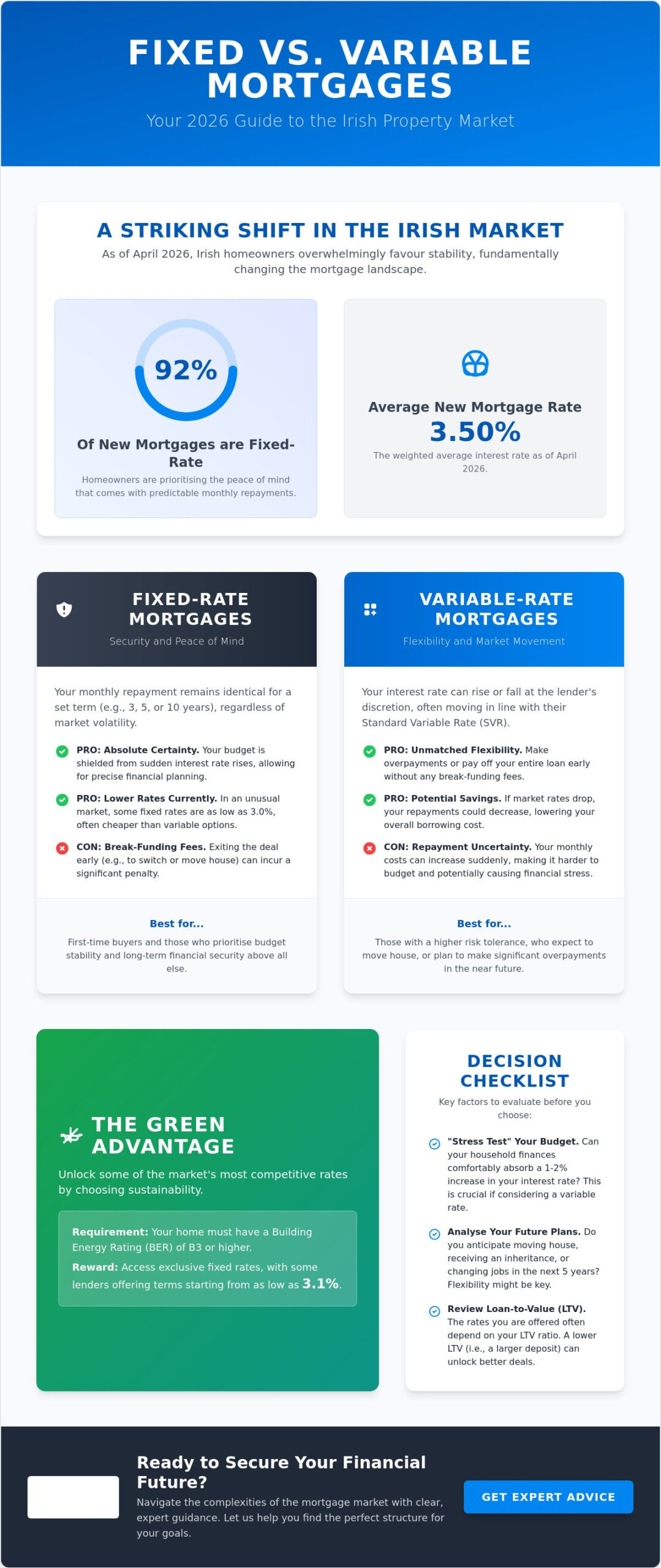
In a striking shift for the Irish property market, 92% of new mortgage agreements as of April 2026 are now fixed-rate. This marks a significant departure from historical trends, as homeowners increasingly prioritise the peace of mind that comes with predictable monthly repayments. Choosing between a fixed or variable mortgage ireland often feels like a high-stakes gamble; you might worry about being locked into a higher rate if the market drops, or conversely, feel anxious about the sudden spikes associated with variable terms.
We understand that your mortgage is more than just a loan; it’s the foundation of your long-term security and personal stability. Whether you’re a first-time buyer seeking a steady start or a homeowner looking to switch for a better deal, this guide will provide the clarity you need to move forward with confidence. We’ll explore the current 2026 market dynamics, where some fixed rates are sitting as low as 3.0%, and compare them against the flexibility of variable options. By the end of this comparison, you’ll have a clear understanding of which structure fits your risk profile and how to achieve a seamless transition to a mortgage that supports your lifestyle and future aspirations.
Key Takeaways
- Gain a clear understanding of the 2026 Irish mortgage market, where fixed rates currently provide a unique combination of lower interest and long-term stability.
- Discover how to evaluate whether a fixed or variable mortgage ireland best supports your financial goals and your need for monthly repayment certainty.
- Learn how to “stress test” your household budget against future rate movements to ensure your home remains a source of security rather than stress.
- Identify the strategic benefits of switching your mortgage to safeguard your future and potentially reduce your long-term interest costs.
- Navigate the complexities of break-funding fees and LTV-based rates with a clear, step-by-step framework designed for a seamless transition.
Understanding the Irish Mortgage Landscape in 2026
The Irish mortgage market has undergone a fundamental transformation. Deciding on a fixed or variable mortgage ireland is no longer just about picking a number; it’s about defining your financial rhythm for the years ahead. As of April 2026, the weighted average interest rate on new mortgages stands at 3.50%. We are currently witnessing an unusual market dynamic where fixed rates are frequently more affordable than variable options, a reversal of historical norms that has shifted how borrowers approach their home loans.
Before diving into specific rates, it helps to revisit the foundational concept of what is a mortgage, essentially a secured loan where the interest rate type dictates your long-term cost of borrowing. We view this choice through the lens of mortgage stewardship. This means treating your loan as a dynamic financial tool rather than a static debt. Lenders determine these rates by balancing signals from the European Central Bank (ECB) with their own internal funding costs and competitive pressures, creating a landscape that rewards proactive management.
Fixed Rates: Locking in Your Future
A fixed rate acts as a shield for your household budget. Whether you choose a three, five, or ten-year term, your monthly repayment remains identical regardless of market volatility. This predictability is the primary reason why 92% of new mortgage agreements in early 2026 opted for fixed terms. The psychological benefit of “repayment certainty” cannot be overstated, as it allows you to plan your future with absolute clarity. Whilst you are protected from sudden interest rate hikes, you must accept that you won’t automatically benefit if market rates drop during your term. Choosing a fixed or variable mortgage ireland requires weighing this guaranteed stability against the potential for future savings.
Variable Rates: Staying Fluid with the Market
Variable rates offer a different kind of freedom by staying fluid with the market. These rates can rise or fall at the lender’s discretion, often moving in tandem with the lender’s Standard Variable Rate (SVR). While they lack the ironclad certainty of a fixed term, they provide the most flexibility for those who value agility. If you intend to make significant overpayments, pay off your loan early, or expect to move house in the near future, a variable rate allows you to do so without the worry of break-funding fees. This path is often chosen by those with a higher risk tolerance who prefer to remain unattached to a specific rate for a long duration. At Engage Financial Solutions, we help you navigate these choices to ensure your mortgage aligns perfectly with your personal financial journey.
The Case for Fixed Mortgage Rates: Security and Peace of Mind
The surge in fixed-rate adoption is no accident. With 92% of new agreements in April 2026 opting for this path, it’s clear that Irish homeowners value stability. This choice protects you from inflationary shocks that could otherwise send variable repayments soaring. When you look at a CCPC mortgage comparison, the gap between fixed and variable options is often the first thing people notice. In the current climate, fixing your rate isn’t just about the interest; it’s about safeguarding your lifestyle against the unknown.
One essential detail to understand is the break-funding fee. This is the cost you might incur if you decide to exit your fixed deal before the term ends. It’s calculated based on the difference between the rate you’re on and current market rates. While it sounds complex, it’s simply the bank’s way of recouping the cost of the funds they set aside for you. If you plan to move house or switch lenders mid-term, this fee is a critical factor to weigh up. Despite this, the trend for long-term fixing is growing, with more borrowers looking at 10-year terms to anchor their financial future. If you’ve ever wondered am I paying too much for my mortgage Ireland, reviewing your current rate against today’s competitive fixed options is an essential first step.
Green Fixed Rates: The 2026 Advantage
If your home has a Building Energy Rating (BER) of B3 or higher, you can access some of the most competitive rates in the market. Banks like Bank of Ireland are offering qualifying energy-efficient homes rates starting from 3.1% on four-year terms. These “Green” products have become a cornerstone of the Irish market, rewarding sustainability with lower monthly costs. Before you decide on a fixed or variable mortgage ireland, check your BER rating; it could be the key to unlocking significant long-term savings. We recommend you review your switching options to see if your property qualifies for these preferential terms.
Short-term vs Long-term Fixing
Choosing the right duration depends entirely on your life stage. A 3-year fix offers flexibility sooner, making it ideal if you expect your circumstances to change or your income to rise. Conversely, a 10-year fix provides a decade of absolute security, shielding you from any market turbulence. This is often the preferred choice for families who want to lock in their biggest monthly outgoing. A break fee is a critical consideration for those planning to move house. By matching the term to your personal timeline, you ensure your mortgage remains a support rather than a constraint.
Exploring Variable and Tracker Rates: Flexibility and Market Movement
While fixed rates provide a fortress of certainty, variable rates offer a different kind of financial agility. Choosing a fixed or variable mortgage ireland involves balancing the desire for a steady budget against the need for total control over your loan’s lifecycle. Variable rates aren’t a single product but a spectrum of options, including standard variable rates and the now rarer tracker mortgages. A tracker follows the European Central Bank (ECB) base rate plus a fixed margin, ensuring you benefit immediately if the central bank reduces costs. As of mid-2026, the weighted average interest rate on new agreements is 3.50%, making the comparison between these paths more nuanced than ever.
The hallmark of the variable path is the “freedom factor.” Unlike fixed terms, variable mortgages generally allow you to switch lenders or pay off lump sums without facing break-funding fees. This allows you to be proactive with your financial stewardship. However, this flexibility comes with a trade-off. If market rates rise by 1% or 2%, your monthly repayment increases automatically. We recommend that clients “stress test” their household budget to ensure they can comfortably manage these potential fluctuations before committing to a variable deal. It’s about finding the balance that lets you sleep soundly at night whilst keeping your options open.
LTV Variable Rates: Rewarding Your Equity
Many lenders in Ireland now offer tiered variable rates based on your Loan-to-Value (LTV) ratio. As you pay down your mortgage and your home’s value potentially increases, your LTV improves. This “equity gain” can move you into a lower interest band, rewarding your financial progress with reduced monthly costs. For instance, specific flexible mortgage products in the current market offer variable rates as low as 3.12% for those with an LTV of 80% or below. This is significantly more competitive than the standard variable rates of 4.70% seen elsewhere. Regularly reviewing your property value ensures you aren’t paying more than necessary as your equity grows.
When Flexibility Outweighs Certainty
There are specific scenarios where a variable rate is the superior strategic choice. If you intend to sell your property in the next year or two, staying variable prevents you from being trapped by exit penalties. Additionally, variable rates allow for unlimited overpayments. This is a powerful tool for those receiving bonuses or commissions, as every extra Euro paid reduces the principal and the total interest charged over the loan’s life. To see the long-term impact of this strategy, explore our guide on Mortgage Overpayment Savings Ireland. By matching your rate type to your life plans, you ensure your mortgage remains a helpful tool rather than a constraint.
Fixed or Variable: A Decision Framework for Irish Homeowners
Choosing a fixed or variable mortgage ireland requires a methodical approach that looks past today’s headline rates. We believe a successful mortgage strategy rests on three primary pillars: cost, flexibility, and risk. Cost involves calculating the total interest you will pay over the specific term, not just the initial monthly repayment. Flexibility refers to your ability to make overpayments or exit the deal without friction. Risk is perhaps the most personal pillar; it measures your emotional and financial capacity to handle interest rate volatility. By evaluating these three areas, you can move away from guesswork and towards a decision rooted in your personal financial rhythm.
One strategy gaining traction in 2026 is the “split mortgage.” This allows you to hedge your bets by placing a portion of your loan on a fixed rate for security whilst keeping the remainder on a variable rate for flexibility. This hybrid approach offers a buffer against market shocks without completely sacrificing the ability to make unlimited overpayments. Regardless of the structure you choose, it’s vital to maintain a “switching mindset.” Your mortgage is a dynamic tool that should be reviewed every few years to ensure it still aligns with the current market and your long-term aspirations. If you are ready to explore your options, you can speak with a mortgage expert to begin your tailored assessment.
The Risk Tolerance Test
We often ask our clients a simple but revealing question: “If your mortgage rose by €200 a month, would your lifestyle be compromised?” If that figure causes immediate stress, you likely fall into the “Stability Seeker” category. These borrowers prioritise the peace of mind that comes from knowing exactly what leaves their bank account each month. Conversely, “Market Optimists” may be more comfortable with fluctuations, betting on their ability to absorb short-term rises in exchange for the potential of lower rates later. Professional guidance helps you quantify this risk by stress-testing your budget against various economic scenarios, ensuring your home remains a source of security.
Life Stages and Rate Choice
Your current life stage often dictates the best path forward. First-time buyers frequently opt for the security of a five-year fix. This allows them to find their feet and settle into the responsibilities of homeownership without the fear of rising costs. For those already on the property ladder, a rate change is often the perfect catalyst to facilitate Switching Mortgage Ireland for better terms. Meanwhile, investors might find that variable rates suit a buy-to-let strategy. The lack of exit fees allows them to sell or refinance properties quickly to maintain cash flow. Matching your mortgage type to your current life stage ensures your financial strategy supports your personal journey rather than hindering it.
Navigating Your Mortgage Switch with Expert Guidance
Deciding whether a fixed or variable mortgage ireland aligns with your goals is a deeply personal choice. There is no “one-size-fits-all” answer in the 2026 market; the right path depends on your income, your future plans, and your emotional response to market shifts. At Engage Financial Solutions, we act as your steady guide, transforming a complex financial transition into a straightforward and optimistic experience. Our role is to provide the calm competence you need to make an informed choice, ensuring you feel looked after throughout every stage of the journey.
A seamless transition requires more than just picking a low rate. It involves a holistic view of your financial health, from protecting your income to safeguarding your home with the right mortgage protection. We handle the heavy lifting, from lender negotiations to the meticulous management of paperwork, acting as the buffer between you and the complexities of the banking world. This partnership approach ensures that your decision today becomes the cornerstone of your long-term financial security and success.
Why Professional Advice Matters
Choosing a broker over a single high-street bank opens doors to a much wider panel of lenders. While a single bank can only offer its own products, we provide access to a diverse range of market options, including specialised “Green” rates and LTV-based variable deals. Our expertise allows us to navigate the “fine print” of fixed-rate contracts, specifically those break-funding fees discussed earlier, so you aren’t caught off guard by hidden costs. We also help you understand the practicalities of the move, such as Legal Fees for Switching Mortgage Ireland, to ensure that switching truly makes sense for your bottom line.
Your Next Steps to Mortgage Security
The first step toward a better deal is a proactive review of your current mortgage statement. Look at your current interest rate, the remaining term, and any potential exit fees. Once you have a clear picture of your starting point, an initial consultation with us can provide the clarity you’ve been seeking. We’ll listen to your needs, assess your risk profile, and present a tailored plan that prioritises your peace of mind. Contact Engage Financial Solutions today to find your perfect mortgage rate and take the first step toward a more secure financial future.
Securing Your Financial Future with Confidence
Your home is your most significant investment, and the structure of your borrowing defines your financial comfort for years to come. Whether you prioritise the ironclad certainty of a fixed term or the agile freedom of a variable rate, the key is ensuring your choice aligns with your specific financial rhythm. We have explored how current 2026 trends, such as the rise of green mortgages and competitive LTV-based variable options, provide unique opportunities to reduce costs whilst safeguarding your lifestyle. Choosing between a fixed or variable mortgage ireland is the first step toward a more stable and optimistic future.
As a firm regulated by the Central Bank of Ireland, we specialise in providing tailored financial guidance and expertise in seamless mortgage switching. We act as your steady guide, removing the friction from lender negotiations and managing the meticulous details on your behalf. Book a consultation with Engage Financial Solutions to secure your best mortgage rate today. We look forward to helping you move forward with clarity and absolute confidence in your long-term plans.
Frequently Asked Questions
Is it better to have a fixed or variable mortgage in Ireland right now?
The best choice depends on your personal need for certainty, but currently, fixed rates are providing exceptional value for the vast majority of Irish borrowers. With 92% of new agreements in early 2026 opting for fixed terms, most homeowners are prioritising the protection and lower interest costs these products offer. Whilst variable rates provide flexibility, the peace of mind found in a fixed repayment schedule remains the primary driver for household budgeting in the current climate.
Can I switch from a fixed rate to a variable rate before my term ends?
Yes, you can switch to a variable rate at any time, but you will likely incur a break-funding fee for exiting your fixed contract early. This fee is designed to compensate the lender for the loss of interest they expected to receive during the agreed term. It’s always wise to calculate whether the long-term flexibility of a new rate outweighs the immediate cost of the exit penalty before making a move.
What are the typical break fees for a fixed-rate mortgage in Ireland?
Break fees are not a set amount; they are calculated based on the cost to the lender of you ending the fixed term prematurely. The calculation involves the difference between the original interest rate you agreed upon and the current market rates at the time of your exit. If market rates have fallen since you fixed, the fee can be significant, whereas if rates have risen, the fee may be minimal or non-existent.
Do variable rates always go up when the ECB raises interest rates?
Not necessarily, as standard variable rates are set at the lender’s discretion, unlike tracker mortgages which follow the ECB base rate exactly. While many lenders do increase their variable rates following an ECB hike to cover their own funding costs, they aren’t legally required to do so. This discretion means that different lenders can have vastly different variable offerings, making it essential to compare the market regularly to ensure you aren’t overpaying.
What is a split mortgage and is it available in Ireland?
A split mortgage allows you to divide your loan into two parts, placing one portion on a fixed rate and the other on a variable rate, and it is widely available from Irish lenders. This hybrid approach is an excellent way to balance the fixed or variable mortgage ireland decision. It provides the security of predictable repayments on one portion whilst allowing you to make unlimited overpayments on the variable side.
How does my Loan-to-Value (LTV) ratio affect my choice of mortgage rate?
Your LTV ratio is a primary factor in determining the interest rates available to you, with lower ratios typically unlocking the most competitive deals. For instance, in the 2026 market, borrowers with an LTV of 60% or below can access fixed rates as low as 3.0%. As you pay down your mortgage and your equity grows, you may find that moving to a lower LTV band allows you to switch to a significantly better rate.
Will a variable rate mortgage allow me to pay off my loan faster?
A variable rate mortgage provides the flexibility to make unlimited overpayments, which can significantly shorten your loan term and reduce the total interest you pay. Unlike most fixed-rate contracts, which may limit overpayments to a small percentage or a set monthly amount, variable terms allow you to pay off large lump sums whenever you choose. This makes them a popular choice for those expecting bonuses or commissions who want to reduce their debt aggressively.
Are fixed rates higher than variable rates in the 2026 market?
In a reversal of historical trends, many fixed rates in 2026 are actually lower than the standard variable rates offered by major banks. Whilst standard variable rates from some providers reach up to 4.70%, qualifying fixed-rate products are available starting from 3.0%. This unusual dynamic has made choosing a fixed or variable mortgage ireland a strategic move for those looking to reduce their monthly outgoings whilst securing their financial future.
Disclaimer
Engage Financial Services LTD T/A Engage Financial Solutions is regulated by the Central Bank of Ireland CRO 764570. Director David Moore. Suite 2 First Floor, 14 -18 Main street, Blackrock, Co Dublin A94 W0Y3