


Moving a pension can make it easier to manage, but transferring a pension to another provider isn’t automatically the best choice. A pension transfer moves your benefits from one pension arrangement to another, and the available options depend on the type of pension you have.
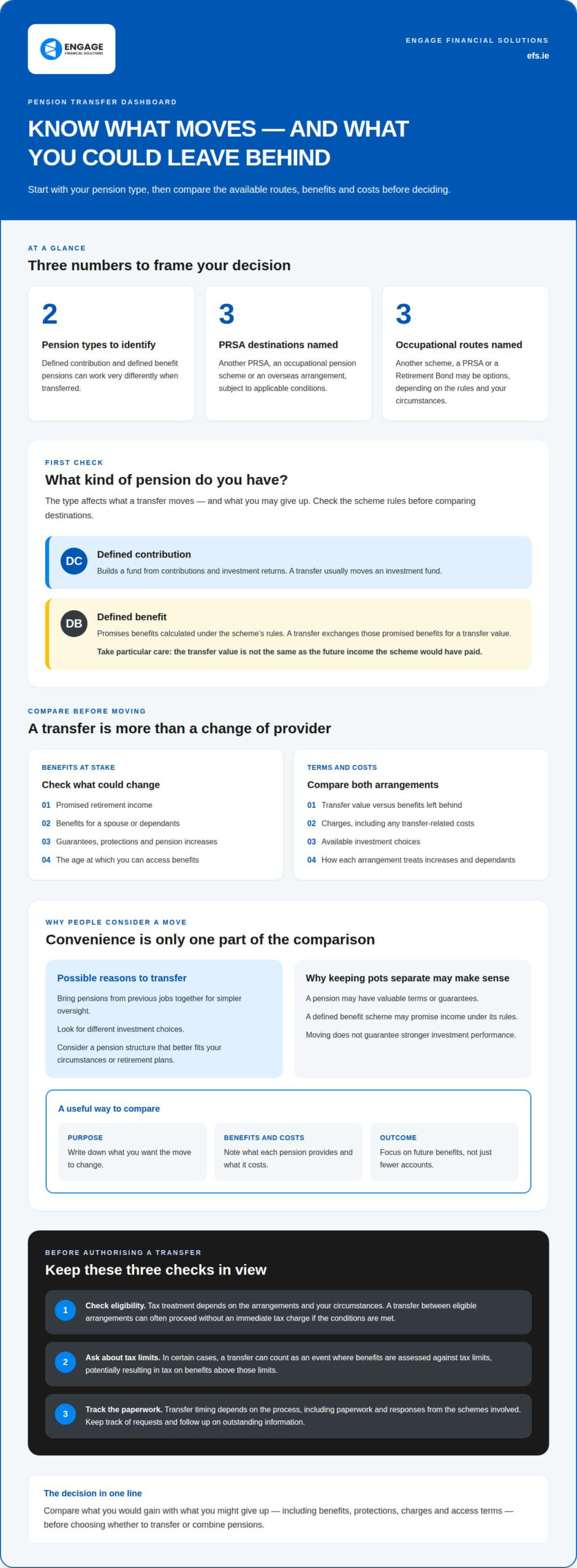
If you have a PRSA, for example, its benefits can be transferred to another PRSA, an occupational pension scheme or an overseas arrangement. With an occupational pension, options can include another scheme, a PRSA or a retirement bond. A defined benefit pension needs particular care because transferring may mean giving up a promised retirement income and benefits for a spouse or dependants.
If you’re considering transferring a pension to another provider, start by identifying the type of pension you have and what benefits a move could change. This guide explains the main transfer options, why people move or combine pensions, and what to weigh up before deciding. It also covers PRSA and personal pension transfers, helping you consider your next step with greater confidence.
Key Takeaways
- Identify whether your pension is defined contribution or defined benefit, as this affects what you may give up by transferring.
- Consider how a move could affect retirement income, dependant benefits, protections and any transfer charges.
- Before combining pensions, weigh simpler administration against differences in investment choices, charges and benefits.
- PRSA benefits can be transferred to another PRSA, an occupational pension scheme or an overseas arrangement, subject to applicable conditions.
- Occupational pension transfer options depend on the arrangements involved and your circumstances, so understand the rules before deciding.
What is a pension transfer?
A pension transfer moves benefits from one pension arrangement to another, subject to the rules of both arrangements. The implications depend on whether your pension is defined contribution or defined benefit, and on what you might give up by transferring.
Defined contribution and defined benefit transfers
A defined contribution pension builds a fund from contributions and investment returns. A defined benefit pension promises benefits calculated under the scheme’s rules. The distinction matters: a defined contribution transfer usually moves an investment fund, while a defined benefit transfer exchanges promised benefits for a transfer value. Depending on the scheme rules and your circumstances, occupational pension benefits may be transferred to another occupational scheme, a PRSA or a Retirement Bond. Identify your pension type before comparing destinations.
Guaranteed benefits and transfer risks
A defined benefit scheme may promise retirement income rather than provide a fund whose value depends on investment performance. Transferring can mean permanently giving up that promise, as well as benefits for a spouse or dependants. The transfer value is not the same as the future income the scheme would have paid. Deferred pension increases may also fall short of inflation. Compare the benefits you would retain with those available after transferring, including how each arrangement treats increases and dependant benefits.
Benefits, guarantees and charges to compare
Compare the transfer value with the benefits you would leave behind, then assess guarantees, dependant provisions, charges and investment choices. If you’re considering transferring a pension to another provider, include any protections and the age at which you can access benefits. A transfer may affect both. Check that the receiving arrangement suits your retirement plans instead of focusing only on consolidating accounts. How long does a pension transfer take? It depends on the process, including paperwork and responses from the schemes involved. Track requests and follow up on outstanding information.
Tax implications of transferring a pension
A transfer between eligible pension arrangements can often proceed without an immediate tax charge if the relevant conditions are met. However, tax treatment varies according to the arrangements and your circumstances. In certain cases, a transfer can count as an event where pension benefits are assessed against tax limits, potentially resulting in tax on benefits above those limits. Before transferring a pension to another provider, establish whether the destination is eligible and whether the move could affect protections or benefits. Understand the potential tax implications before authorising the transfer.
Reasons to consolidate or transfer pensions
Combining old pension pots can make them easier to oversee, but moving them may change your benefits and costs. The reason for each transfer matters as much as the convenience.
Reasons for consolidating old pension pots
Consolidation brings pensions from previous jobs together, making your retirement savings easier to oversee. If you’ve left several employers, for example, you may have separate statements, investment choices and scheme rules. One arrangement can make it simpler to see your overall position. Before deciding, compare each pension’s benefits, charges and investment options, not just the number of accounts.
Keeping pots separate can make sense if one has valuable terms or guarantees. An old defined benefit scheme, for instance, may promise income under its rules rather than simply hold an investment fund. List each pension and note what it provides, what it costs and whether benefits depend on your former employment. This gives you a clearer basis for deciding whether convenience outweighs what you might give up.
Reasons for transferring a pension
A transfer may suit you if your current arrangement no longer fits your retirement plans. You might want a different range of investment choices, simpler administration or a pension structure better suited to your circumstances. Transferring does not guarantee stronger investment performance. Compare the receiving arrangement’s charges and options with those of your existing scheme before deciding.
Changing jobs is another common reason to review a pension. Depending on the scheme rules and your circumstances, an occupational scheme may offer routes to another scheme, a PRSA or a Retirement Bond. Leaving employment does not generally allow you to cash out a preserved pension. Instead, consider whether to retain or transfer the benefits, taking account of guarantees, dependant benefits and access terms.
Use this practical comparison before deciding:
- Purpose: Write down whether you want easier administration, different investment choices or a change in retirement planning.
- Benefits: Identify any promised income, spouse or dependant benefits, and protections tied to each pension scheme.
- Costs: Compare charges in both arrangements, including any transfer-related costs that apply.
- Outcome: Consider how the proposed arrangement changes your future benefits, not only the number of accounts.
A regulated status is not, by itself, a reason to transfer; suitability depends on the benefits and terms being compared. If you’re weighing a move against your wider goals, retirement planning can help put the decision in context. A clear comparison lets you focus on what each pension means for your future.
Combining multiple pensions
Combining pensions means transferring benefits from separate arrangements into one destination. It can simplify administration, but the pensions must be suitable to combine. Your options depend on the type and rules of each arrangement and the benefits attached. A Retirement Annuity Contract, for example, can transfer to another Retirement Annuity Contract or a PRSA. This differs from keeping separate pots with separate administrators.
Start by making an inventory of your pension arrangements. Include current and former employer schemes, personal pensions and Retirement Annuity Contracts. For each, record its type, administrator, current value, charges and any special terms. This helps reveal important differences, such as a defined benefit pension that promises income rather than holding a transferable investment fund. A list also helps distinguish pensions that may be combined from benefits better retained separately.
Next, match each arrangement to a possible destination. Occupational pension benefits may be transferred to another occupational scheme, a PRSA, a Buy-Out Bond or Personal Retirement Bond with an insurance company, or an overseas pension arrangement. The receiving scheme’s rules matter too. A route available for one pension may not suit another, and some transfers require the entire benefit to move rather than allowing a partial transfer.
Combining several defined contribution pots may bring their investments and administration together. However, a larger combined balance does not automatically offer better value. Compare the receiving arrangement’s investment options and charges with those of each existing pension. Identify any guarantees or protections that could be lost. A defined benefit pension needs particular care because its promised income and dependant benefits may not transfer to the new arrangement.
Use this comparison to organise your review:
- Arrangement type: Mark each pension as occupational, PRSA or Retirement Annuity Contract.
- Destination: Record which receiving arrangement can accept each transfer under its rules.
- Benefits: Note guaranteed income, dependant benefits and any protections before considering a move.
- Costs and investments: Compare charges and investment choices across the existing and receiving arrangements.
- Administration: Identify the administrators involved and the documents needed to support each transfer.
Keep a separate record of pensions you decide not to combine, including your reason. This helps distinguish a deliberate choice to retain a valuable benefit from an overlooked account. The receiving arrangement must be suitable for the transfer, and its administrator needs enough information to process it. An organised comparison can clarify your retirement planning without treating every pension as interchangeable.
PRSA and personal pension plan transfers
A PRSA can be transferred to another pension arrangement, but the available destination depends on the pension type and your circumstances. This matters if you’re consolidating retirement savings, changing jobs or reviewing an older personal pension. Compare benefits and charges first, then consider how the proposed destination fits your retirement plans.
PRSA benefits can be transferred to another PRSA, an occupational pension scheme or an overseas arrangement. A transfer moves pension benefits, not cash for general spending. If you’re considering a different provider, compare your current PRSA’s charges, investment choices and asset mix with those of the receiving arrangement. Changing funds within your existing plan may be another way to adjust your investments without changing provider.
Timing matters. A transfer into a PRSA is not permitted after your normal retirement age if benefits have become payable under the scheme. This may affect you if you delay reviewing a pension until retirement benefits are due. Establish whether benefits have become payable before considering a PRSA as a destination.
Leaving an occupational scheme can also make a PRSA transfer relevant. Depending on your circumstances, transferring contributions to a PRSA may be an alternative to receiving a refund. Where you leave with less than two years’ qualifying service, a refund of your own contributions may be available or required. It is a refund of your contributions, not the entire pension fund, and is normally subject to 20% tax. Compare that outcome with preserving or transferring the benefits.
A personal pension arrangement, such as a Retirement Annuity Contract, has different transfer routes. Its benefits can be transferred to another Retirement Annuity Contract or to a PRSA. This may allow you to move personal pension benefits into a different arrangement, but compare the receiving plan’s terms carefully. Review charges, investment options and any guarantees before deciding.
For a transfer from an exempt approved occupational pension scheme to a PRSA, the employee’s entire benefit must be transferred. A partial or split transfer is not permitted. This matters if you hoped to move only part of the benefit while leaving the rest in the existing scheme. The receiving PRSA must accommodate the complete benefit being transferred.
Use a short comparison before making a decision:
- Identify the source: Separate PRSA, occupational scheme and Retirement Annuity Contract benefits.
- Confirm the route: Match each pension type to an eligible receiving arrangement.
- Compare terms: Review charges, investment choices, asset mix and guarantees.
- Check timing: Note whether benefits have become payable or retirement age has been reached.
This helps you assess whether a transfer supports your retirement savings without overlooking restrictions attached to your existing pension plan.
What are the rules for transferring an occupational pension?
Transfer rules depend on the pension scheme you’re leaving, the receiving arrangement and your circumstances. Occupational pension benefits may be transferred to another occupational scheme, a PRSA, a buy-out bond, a personal retirement bond with an insurance company or an overseas arrangement. These routes are not interchangeable, so first identify your scheme type and proposed destination.
Section 772(3D) of the Taxes Consolidation Act 1997 allows occupational pension benefits to move to a PRSA in specified circumstances. These include a change of employment or a scheme wind-up, provided benefits haven’t become payable. The section doesn’t create a general right to move every pension to a PRSA. Confirm which circumstance applies and whether benefits are already payable before considering that route.
A transfer from an exempt approved occupational pension scheme to a PRSA must cover the employee’s entire benefit. Partial or split transfers are not permitted. This matters if you planned to move only part of your pension while leaving the rest in the original scheme. Treat the whole benefit as the subject of the proposed transfer, then compare the receiving PRSA’s terms with those of the existing scheme.
Some transfer calculations also affect the benefits available from the receiving scheme. Where that scheme provides a lump sum of 3/80ths of final remuneration for each year of service in exchange for pension, transfer-related lump sums can’t exceed what the original scheme would have allowed. Where added years are purchased, the lump sum is limited to 3A/80 x F. Here, A means added years certified by the scheme actuary, and F means final remuneration in the receiving scheme.
Overseas transfers have separate conditions. A transfer from an occupational scheme to a scheme outside the EU may be made only to a country where you’re currently employed. A qualifying overseas transfer can proceed without prior Revenue approval, but the scheme administrator must submit a declaration to Revenue within 7 days. These requirements make the destination country and your employment status important parts of the transfer assessment.
Before proceeding, organise the decision around these points:
- Source scheme: Identify the occupational scheme and whether it is exempt approved.
- Destination: Confirm whether the proposed PRSA, occupational scheme or overseas arrangement fits the applicable route.
- Benefits: Establish whether benefits have become payable and whether the full benefit must transfer.
- Calculation: Review how service years, final remuneration or added years affect any receiving-scheme lump sum.
- Overseas process: For a qualifying transfer, account for the administrator’s Revenue declaration within 7 days.
If you’re assessing an occupational pension move, review your pension options in light of the scheme rules and your future retirement needs.
Engage Financial Solutions
Engage Financial Solutions can help you consider how a pension decision fits your wider financial plans. If you’re weighing a transfer, focus on the benefits you would leave behind, how the receiving arrangement fits your retirement goals, and how the decision affects your overall financial position.
Through Financial Planning, you can consider these questions alongside other priorities, whether you’re approaching retirement or reviewing your plans after a change in work. This broader perspective can help you make a considered decision rather than focusing only on account consolidation.
If you’d like to discuss your pension decision, contact Engage Financial Solutions.
Set your pension decision in context
Connect your pension choice with the future you want instead of treating it as an isolated account decision. Before transferring a pension to another provider, consider what you want your retirement income to support and how today’s choice fits your wider financial plans. This gives you a clear purpose for reviewing the options and a practical basis for deciding what to do next.
Engage Financial Solutions can help you consider your pension decision alongside other financial priorities. Its wider offerings include switching mortgages, first-time buyer mortgages and buy-to-let mortgages, which may be relevant as your housing or investment plans change. Discussing these goals together can help you see how different decisions relate to each other.
You don’t need to resolve every detail before taking a first step. Talk through your pension plans with Engage Financial Solutions and move forward with a clearer view of your options.
Frequently Asked Questions
What are the benefits of combining a number of pensions?
Combining pensions can make it easier to see how your retirement savings fit together. If you’ve changed jobs, for example, one overview can help you track which arrangements need attention and how they relate to your retirement income plans. It may also reduce the work involved in keeping separate records. The benefit is convenience and visibility, not an automatic improvement in investment results or pension value.
What happens to my retirement lump sum after a UK transfer?
A transfer from a UK pension can affect the lump-sum rights attached to that pension. You may lose the right to take a tax-free lump sum of more than 25% of your pension pot after transferring. The treatment depends on the transfer and receiving arrangement. Before agreeing to move a UK pension, compare the lump-sum options you have now with those available after the transfer.
What should I check before transferring?
Before transferring, identify your pension type and intended destination, then review the scheme’s latest statement and benefit information. Look for guarantees, dependant benefits, protections, access terms, investment choices and charges. Note whether contributions are still going into the existing arrangement. An old workplace pension with no current contributions, for example, may still have terms that matter at retirement. Keep these details together to compare your full position.
What’s in this guide?
This guide explains how transfers differ between defined contribution and defined benefit arrangements, and why someone might consider moving or combining pensions. It also covers transfer routes for PRSAs, personal pensions and occupational schemes, including relevant restrictions. Focus on your own circumstances: start with the pension type, then consider the destination, benefits and conditions that apply to that transfer.
Will I lose valuable benefits if I transfer?
Yes. Transferring can mean giving up valuable benefits. A defined benefit scheme, for instance, may provide a promised retirement income as well as benefits for a spouse or dependants. The transfer value will not necessarily replace those features. Some transfers can also affect protections or the age at which benefits become available. Identify every benefit attached to your current arrangement before deciding whether a new pension offers a suitable alternative.
Which types of pensions can be transferred?
Transfer options can include occupational pensions, PRSAs and RETIREMENT ANNUITY CONTRACTS, although each has different routes and conditions. Occupational benefits may move to another occupational scheme, a PRSA, a RETIREMENT BOND or an eligible overseas arrangement. PRSA benefits may have other destinations, including another PRSA or an occupational scheme. Your pension’s rules and circumstances determine which route applies, so begin by identifying the arrangement you hold.
Can I transfer a pension to a PRSA or personal pension?
In some circumstances, pension benefits can be transferred to a PRSA or personal pension arrangement. For example, benefits from a RETIREMENT ANNUITY CONTRACT can move to a PRSA, while occupational pension benefits may move to a PRSA under specified conditions. A personal pension route is not available for every scheme. Establish whether benefits have become payable and whether the proposed destination can accept that type of pension.
What documents and information are needed for a pension transfer?
Gather recent statements and details identifying your existing pension, such as the scheme or provider name and your membership or policy reference. You’ll also need information about the receiving arrangement and its administrator. The process may involve an application and a signed transfer instruction. Keep copies of correspondence and note outstanding requests so you can follow progress and respond if information is missing or needs clarification.
Disclaimer
Engage Financial Services LTD T/A Engage Financial Solutions is regulated by the Central Bank of Ireland CRO 764570. Suite 2 First Floor, 14 -18 Main street, Blackrock, Co Dublin. A94 W0Y3