
Greater control over pension investments also brings greater responsibility. A small self-administered scheme (SSAS) is an employer-established occupational pension scheme with a small membership, whose trustees have a role in investment decisions. It may suit a company director or senior employee, but it must follow the scheme rules and tax requirements.
It’s understandable to focus on the potential tax advantages. Personal contributions may qualify for tax relief, subject to age-related and earnings limits, while investment growth within a SSAS is exempt from income tax and capital gains tax under current Revenue rules. These benefits do not remove the need to understand the restrictions and ongoing administration.
This guide explains how a SSAS works, how contributions and investment returns are treated, and which investment limits, risks and costs to consider. Start by asking whether you want greater involvement in investment decisions and are comfortable with the responsibilities involved. This will help you assess whether this type of pension fits your wider retirement plan.
Key Takeaways
- Understand how a small self-administered pension scheme works and who it may suit before considering one.
- See how age and earnings limits shape personal contribution tax relief, and how investment growth may be treated.
- Learn why trustees must follow scheme rules and keep dealings with beneficiaries and connected parties at arm’s length.
- Weigh the investment flexibility against the scheme’s administration, governance and ongoing costs.
- Before transferring a defined benefit pension, consider what guaranteed income or dependant benefits you could be giving up.
Tax relief on contributions and investment returns
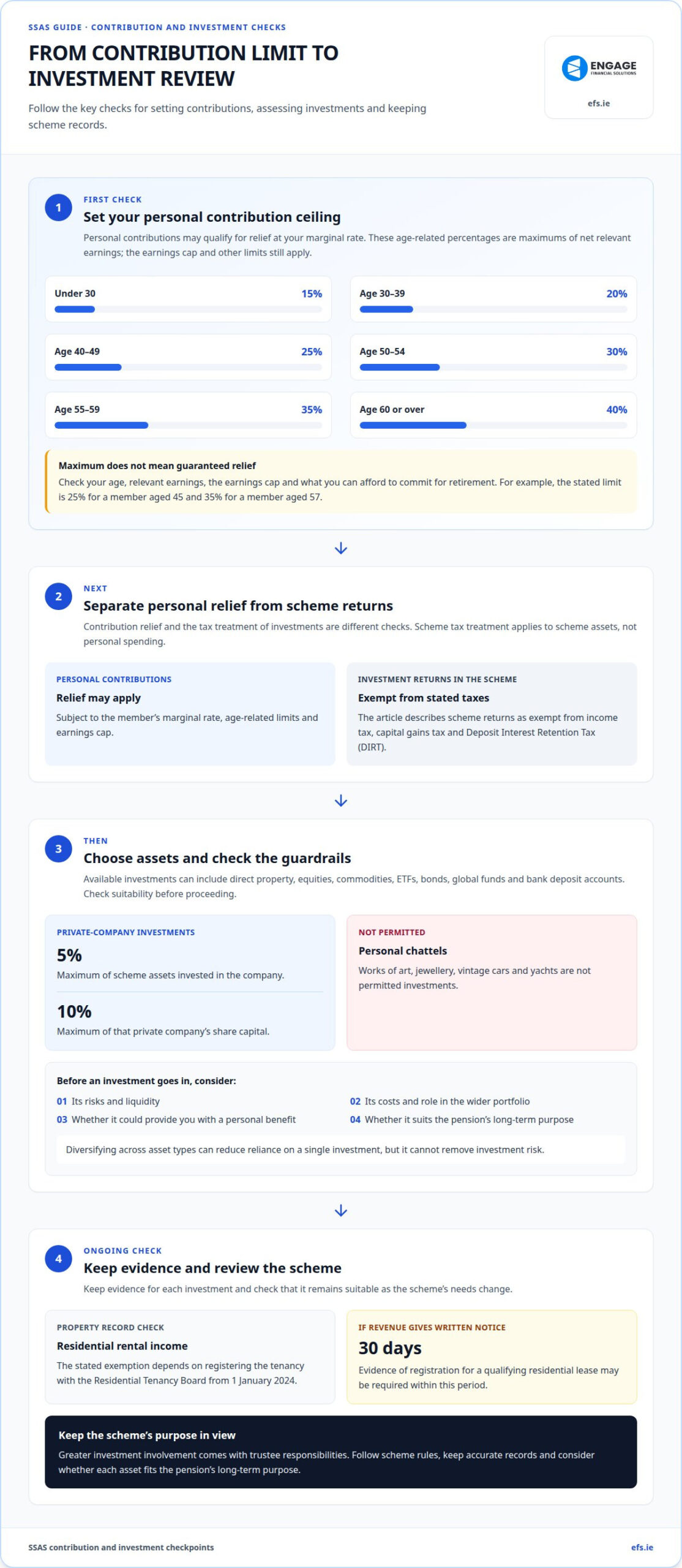
Tax treatment is one reason to consider a small self-administered pension, but relief has limits. Personal contributions may qualify for relief at your marginal rate, subject to age-related limits and the earnings cap. The maximum percentages of net relevant earnings are 15% for members under 30, 20% for ages 30-39, 25% for ages 40-49, 30% for ages 50-54, 35% for ages 55-59, and 40% for members aged 60 or over.
These are maximums, not a promise that every contribution receives relief at that rate. For example, a member aged 45 is subject to the 25% limit, while a member aged 57 is subject to the 35% limit. The applicable earnings cap also matters. Before setting a contribution level, consider your age, relevant earnings and the amount you can afford to commit for retirement.
Investment returns held within the scheme are described as exempt from income tax, capital gains tax and Deposit Interest Retention Tax (DIRT). This treatment applies to scheme assets, not personal spending. Investment choices still need careful due diligence: consider each asset’s risks, liquidity, costs and role in the wider portfolio. Diversifying across asset types can reduce reliance on a single investment, though it cannot remove investment risk.
Available investments can include direct property, equities, commodities, exchange-traded funds (ETFs), bonds, global funds and bank deposit accounts. Scheme assets may also include private-company investments, but limits apply: an investment cannot exceed 5% of scheme assets or 10% of the private company’s share capital. Assess both limits before proceeding, alongside the investment’s suitability for the pension’s long-term purpose.
- Personal chattels, including works of art, jewellery, vintage cars and yachts, are not permitted investments.
- Consider whether an investment could provide you with a personal benefit, as this may affect its suitability for the scheme.
- Residential property rental-income exemption depends on registering the tenancy with the Residential Tenancy Board from 1 January 2024.
Keep evidence for each investment and review whether it remains suitable as the scheme’s needs change. If Revenue gives written notice about a qualifying residential lease, it may require evidence of registration within 30 days. This makes accurate records and timely responses important parts of managing property assets.
What are the risks and penalties for non-compliance with scheme rules? Under section 779A of the Taxes Consolidation Act 1997, certain uses of scheme assets are treated as pension payments, and the amount is no longer regarded as a scheme asset. A personal-benefit investment can therefore affect how the transaction is treated for tax purposes.
What is a Small Self Administered Pension Scheme (SSAPS)?
A small self-administered scheme (SSAS) is an employer-established occupational pension arrangement held under trust. It has a small membership, and member trustees have a role in investment decisions. Its structure can offer more involvement than a personal pension, but also brings trustee responsibilities and scheme-specific requirements.
SSAS Definitions and Membership Thresholds
The terms SSAS and SSAPS refer to a small, self-administered occupational pension scheme established by an employer. An occupational pension scheme in the Irish market with fewer than 12 members will generally be regarded as small. A scheme with more members may still qualify if it primarily benefits a small group of directors, most of whom are 20% directors or connected persons.
A scheme may also be considered small where at least 65% of its investment value relates to benefits for 20% directors, their spouses, civil partners and dependants. A 20% director includes someone who owned or controlled more than 20% of voting rights in the employer or its parent company at any time in the previous three years. Typical members are company directors and senior employees, although a salaried employee may also be eligible.
What is a small self-administered scheme (SSAS) under Irish rules? It is an employer-established occupational pension scheme with a small membership, where trustees help decide how pension funds are invested. Each scheme requires Revenue approval before contributions or transfers can enter it. Unlike a personal pension arrangement, it is established by an employer, not an individual.
How does a SSAS in the Irish market compare with a PRSA, an occupational pension scheme and a UK SSAS? A PRSA is a personal pension arrangement, whereas a SSAS is established by an employer as an occupational scheme. A UK SSAS follows UK legal, tax and governance rules. Compare who establishes the arrangement, who makes investment decisions and which country’s rules apply.
Setting Up and Registering an SSAS
Setting up a small self-administered scheme involves establishing an employer-sponsored trust, appointing trustees and obtaining Revenue approval. The trustees include the individual beneficiary and a Revenue Approved Pensioneer Trustee. Approval is generally needed before contributions or transfers are made to the scheme.
To establish the arrangement, the employer sets up the trust and the trustees apply for Revenue approval. Tax approval and pension regulation are separate: approval for tax purposes does not replace any applicable regulatory obligations. Before proceeding, clarify the proposed membership, trustee roles and investment decision-making arrangements, so the structure reflects the scheme’s intended purpose.
Before choosing this structure, consider whether greater investment involvement and trustee duties suit your circumstances. Understanding how a small self-administered scheme differs from a PRSA can help you assess who will manage the pension and how it fits your retirement plan.
How much can I contribute to my SSAS?
There is no single annual contribution amount for every scheme. Personal tax relief depends on age and earnings, while employer funding also depends on the member’s pension position and scheme limits.
Personal and Employee Contributions
Personal contributions are payments made by a member, with tax relief subject to age-related limits and an earnings cap. The maximum percentages of net relevant earnings are 15% under age 30, 20% for ages 30-39, 25% for ages 40-49, 30% for ages 50-54, 35% for ages 55-59 and 40% from age 60.
These limits apply to the amount of earnings eligible for relief, not necessarily the amount you can physically pay. For example, a member aged 45 uses the 25% limit, but the earnings cap also affects the relief available. Before arranging a payment, calculate the member’s age band, relevant earnings and existing pension contributions together.
An employee’s own contributions may qualify for relief at their marginal rate, within the applicable age and earnings limits. Employer payments into a PRSA count towards the employee’s maximum allowable contribution based on age, so distinguish these from contributions to an occupational pension scheme. Trustees need clear records of who paid each contribution and which arrangement received it.
Employer Contributions and Funding Limits
An employer can contribute to an established occupational pension scheme, and these payments can usually be treated as an allowable business expense for Corporation Tax, subject to Revenue limits. There is no set annual SSAS contribution amount, but funding depends on factors including age, years of service, salary and existing pension benefits.
Revenue rules allow a company to fund a director’s pension pot towards income of up to two-thirds of final salary, based on actuarial assumptions. This is a funding measure, not a fixed contribution entitlement. The company’s accounts and the member’s pension benefits both matter when deciding an appropriate contribution.
A hypothetical director case study shows how several factors interact. The director is 45, earns €60,000 and plans to retire at 60. Their existing pension is valued at €53,000 and projected to reach €287,000 by retirement. The company has reserves above €500,000 and net profits of €100,000 per year.
In that example, the company could make a one-off special contribution of €399,000, then contribute €52,000 per year until the director reaches 60. The alternative illustrated is a contribution of €81,000 between the present and planned retirement. These are case-study figures, not standard contribution limits; the director’s salary, service and existing benefits shape the calculation.
Corporation Tax relief on an employer pension contribution may be spread over a maximum of five years. When considering a contribution, align its timing with company profits and cash flow, then assess the member’s overall pension funding and the scheme’s limits before trustees approve it.
Restrictions on dealings with beneficiaries and connected parties
A SSAS must be managed to provide retirement benefits, not used as a source of personal or business finance. This affects how trustees handle property, loans and other transactions involving members, their families or connected businesses.
A director may count as a 20% director where they, their spouse, children and connected persons together own at least 20% of the relevant company’s shares. Scheme investments must be made at arm’s length, meaning on commercial terms, without giving a beneficiary an immediate personal benefit. The scheme cannot buy property from, sell property to, or rent property from or to a beneficiary, their family or their business venture.
There are tax consequences too. Under section 779A of the Taxes Consolidation Act 1997, certain uses of occupational pension scheme assets are treated as pension payments, and the amount is no longer regarded as a scheme asset. The related rule for certain loans applies only to loans made after the passing of the Finance (No. 2) Act 2023. Trustees should therefore record the parties, purpose and terms of each transaction before approving it.
Retirement benefits can normally be accessed from age 60. One option is a lump sum of 25% of the fund, with the remainder transferred to an Approved Retirement Fund (ARF) or taken as taxable income. The first €200,000 of an individual’s retirement lump sums is tax free; amounts above that are taxable, with the next €300,000 taxed at 20%. Scheme benefits must be secured through an annuity from a life office or in accordance with section 772(3)(a) of the Taxes Consolidation Act 1997.
Some schemes may offer a retirement lump sum of 1.5 times final salary, but the option requires 20 years’ service with the employer. Shorter service may mean a lower multiple. Before benefits are paid, a final funding review must take place. Compare the available options against your expected retirement income, rather than focusing on the lump sum alone.
Flexibility can help tailor benefits to your circumstances, but trustee duties and limits on connected-party transactions restrict how the fund can be used. Transferring a defined benefit pension can also mean giving up guaranteed income or dependant benefits, so weigh these potential losses against the control offered by the new arrangement.
Death benefits need separate consideration. A SSAS may pay an estate a tax-free lump sum of up to four times salary, plus a refund of personal contributions. Review the scheme’s death-benefit provisions alongside your family’s needs, and ensure the trustees understand how benefits should be directed.
Flexibility, risk management and costs
A self-administered pension arrangement makes trustees responsible for operating the scheme and overseeing its investments. This flexibility can suit an occupational pension tailored to particular retirement needs, but it also requires sound records, regular reviews and careful governance.
Trustees remain responsible for ensuring investment decisions follow the scheme rules and applicable requirements. In practice, record each investment’s purpose and risks, and how it fits the fund’s overall balance. Review these records when circumstances change, such as a shift in retirement plans or the scheme’s assets. This helps keep decisions focused on members’ retirement benefits.
Administration is an ongoing commitment, not just a task at setup. Revenue expects actuarial reports at intervals no greater than three years, while annual accounts must be submitted within nine months of the year end. These records help monitor the scheme’s funding position and support its continued operation as an approved pension arrangement.
Governance requirements can also differ by scheme type and establishment date. Since 22 April 2026, additional governance and investment requirements apply to older one-member arrangements following the end of their temporary exemption. For a one-member arrangement established before the 2021 Regulations came into operation, the regulatory own-funds requirement applies after a 5-year postponement from those Regulations coming into operation. The scheme’s history therefore matters when assessing its obligations.
Costs can include setup, pensioneer trustee, administration, investment and professional fees. The overall fee range stated for these schemes is 1% to 4%, depending on the scheme, providers and investment strategy. Compare the charging method as well as the amount: percentage-based fees change with fund value, while fixed fees do not move in the same way.
Include these charges in your retirement projections. For example, model how ongoing fees affect the fund over time, rather than comparing investment returns alone. If you’re transferring a defined benefit pension, weigh any flexibility against the guaranteed income or dependant benefits you may give up. A final salary promise and an investment-based arrangement do not offer the same certainty.
Before deciding, list the scheme’s annual reporting dates, governance duties and expected charges, then consider whether you can manage them over the long term. For support with reviewing your pension arrangements, take the next step with a clear picture of your retirement goals and the responsibilities you’re prepared to take on.
Engage Financial Solutions
Engage Financial Solutions can help you consider pension decisions as part of your wider retirement income and financial protection plans. If you’re weighing a SSAS alongside other arrangements, consider how future income needs connect with protection during your working years and options at retirement. Depending on your circumstances, this may include Income Protection or an Annuity to support retirement income.
A useful next step is to write down your priorities, such as responsibility for investments, income security and support for dependants. This gives you a clearer basis for considering how different financial decisions fit together, rather than viewing the scheme in isolation.
Contact Engage Financial Solutions to discuss your financial planning questions.
Shape your next retirement decision
Choosing a pension structure is one part of planning for later life. Consider whether a small self-administered scheme (SSAS) under Irish rules fits your wider retirement plan, the income you may need and the financial responsibilities you’re comfortable taking on.
Before making changes, write down your priorities and any questions that remain. Consider how an Irish small self-administered scheme (SSAS) would fit alongside your other savings and commitments. A clear view of your goals can focus the next discussion and show which decisions need attention first.
Engage Financial Solutions can help you consider financial decisions in the context of your wider plans. Explore your next step with Engage Financial Solutions and move forward with a plan shaped around your priorities.
Frequently Asked Questions
What are the benefits of an SSAS?
A SSAS can give a company and its trustees greater involvement in investment decisions and access to a range of investment types. Investment growth within the scheme may receive favourable tax treatment, while employer contributions can usually qualify as a business expense for Corporation Tax, subject to Revenue limits. These advantages come with trustee duties, administration and investment risk. Consider whether the additional control fits your retirement goals and willingness to manage the arrangement.
Can an SSAPS invest in property?
Yes, a scheme may hold direct property, subject to its rules and applicable requirements. Property can bring rental income and diversification, but it also ties up pension assets and can be harder to sell than listed investments. For residential property, rental-income exemption depends on the tenancy being registered with the Residential Tenancy Board from 1 January 2024. Keep lease and registration records with the scheme’s investment documents.
Who can establish and join an SSAS?
An employer establishes a SSAS as an occupational pension scheme, typically for company directors or senior employees; a salaried employee may also be eligible. The scheme must receive Revenue approval before contributions or pension transfers can enter it. Trustees include the individual beneficiary and a Revenue Approved Pensioneer Trustee. Membership and who benefits can affect whether the scheme qualifies as small, so clarify the proposed membership before establishing the trust.
What are the Revenue rules and limits for contributions and tax relief?
Personal contribution relief depends on age and net relevant earnings, with the applicable earnings cap also affecting the amount eligible. The maximum ranges from 15% for members under 30 to 40% for members aged 60 or over, with age bands between those limits. Employer contributions are subject to Revenue funding limits and depend on factors such as salary, service and existing benefits. Keep personal and employer payments clearly recorded.
What investments can an SSAS hold, and which are prohibited?
Permitted options can include property, equities, commodities, ETFs, bonds, global funds and bank deposit accounts. Private-company investments are limited to 5% of scheme assets and 10% of that company’s share capital. Personal chattels, including jewellery, artworks, vintage cars and yachts, are prohibited. An investment must not give a beneficiary an immediate personal benefit. Before trustees approve an asset, record its purpose, valuation and place in the portfolio.
Can an SSAS buy commercial property or lend to its sponsoring employer?
A scheme can hold direct property, including commercial property, provided the investment follows scheme rules and applicable requirements. Lending to a sponsoring employer is a separate transaction, and should not be assumed to be permitted simply because the scheme can invest in property. Before proceeding, trustees must consider the loan’s terms, the scheme rules and any connected-party restrictions, and document the decision and its purpose in providing retirement benefits.
What are the setup, annual administration and investment costs?
Costs may include setup, pensioneer trustee, administration, investment and professional fees. Reported overall fee ranges are 1% to 4%, depending on the scheme, providers and investment strategy. Ask for a breakdown by fee type and compare how percentage-based charges change as the fund’s value moves.
How can members access retirement benefits, including lump sums and ARFs?
Benefits can normally be accessed from age 60, subject to scheme rules and applicable requirements. One described option is a lump sum of 25% of the fund, with the remainder placed in an Approved Retirement Fund or taken as taxable income. A final funding review must take place before benefits are paid. Consider how much income you need over time, not only the amount available as an initial lump sum.
Disclaimer
Engage Financial Services LTD T/A Engage Financial Solutions is regulated by the Central Bank of Ireland CRO 764570. Suite 2 First Floor, 14 -18 Main street, Blackrock, Co Dublin. A94 W0Y3