


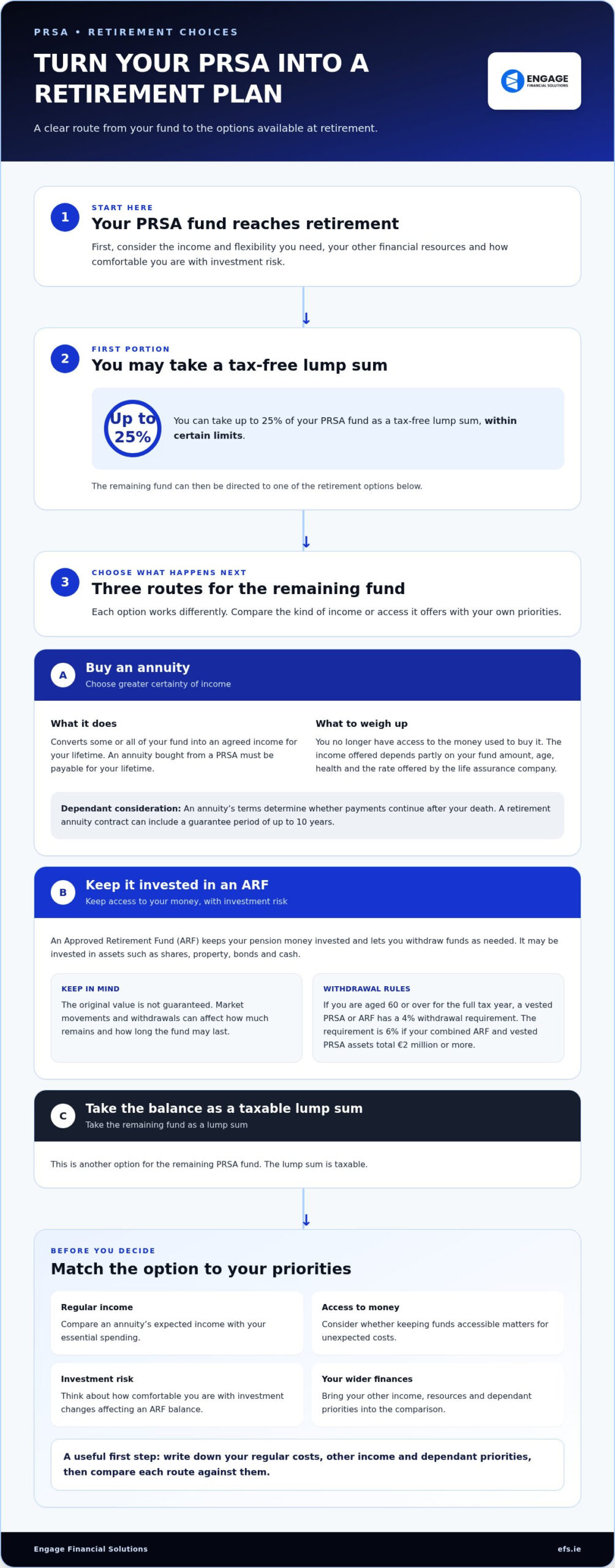
At retirement, you can take up to 25% of your PRSA fund as a tax-free lump sum, within certain limits. You can use the remaining fund to buy an annuity for a guaranteed income for life, keep it invested in an Approved Retirement Fund (ARF), or take it as a taxable lump sum. The right fit depends on the income and flexibility you need, your other resources and how you feel about investment risk.
It’s understandable to wonder why you need a pension when retirement can feel a long way off. A pension helps you build financial resources for when you’re no longer earning a salary, giving you more choice over how to meet your plans and everyday costs.
This guide explains the main options at retirement in Ireland, including how PRSAs work and the key differences between an annuity and an ARF. Whether you value regular income, continued investment or access to a lump sum, understanding the trade-offs can help you make a decision that supports your wider financial future.
Key Takeaways
- Compare an Annuity’s lifetime income and security with the flexibility, investment risk and withdrawal rules of an ARF.
- Before choosing a retirement lump sum, understand how the tax treatment changes across the available thresholds.
- Check how your workplace pension scheme calculates benefits and what options apply to your type of pension.
- A PRSA can offer different ways to access your savings at retirement; consider how each choice could support your income needs.
- Bring your pension funds, other assets and retirement priorities together before deciding how to take your benefits.
Annuities
An annuity converts some or all of a pension fund into regular income, usually for life. On death, payments depend on the pension arrangement and annuity terms. Key retirement risks include outliving invested savings or giving up access to money used to buy an annuity when exploring your options at retirement in Ireland.
Guaranteed lifetime income
An annuity pays an agreed income for the recipient’s lifetime, rather than making withdrawals dependent on investment performance. This can help cover regular costs throughout retirement, including if you live longer than expected. By contrast, a vested PRSA or ARF could run out during your lifetime. Compare the annuity income with essential spending before deciding how much of your pension fund to commit.
The income offered depends partly on your fund amount, age, health and the annuity rate offered by the life assurance company. For example, two people with the same pension balance may receive different incomes if their ages or health differ. Annuity income is taxed under PAYE. Include the expected after-tax income in your retirement budget, alongside other pension income and regular costs.
Annuity income for dependants
An annuity’s terms determine whether payments continue for a set period after the recipient’s death. A retirement annuity contract can include a guarantee period of up to 10 years. This may provide payments during that period if the recipient dies earlier. Consider whether supporting a dependant is a priority, and compare the effect of the guarantee period on the income offered.
Using the remaining pension fund to buy an annuity provides income for life, but you no longer have access to that fund. This trade-off matters if you want to retain money for unexpected costs or leave pension assets to others. Write down your income needs and dependant priorities before deciding whether lifetime income or access to capital matters more.
Retirement annuity contract options
Benefits from a retirement annuity contract can generally be taken from age 60 up to, but before, age 75. You can use some or all of the retirement fund to buy an annuity, or transfer it to another approved scheme that pays a pension. For contracts taken out after 6 April 1999, options also include transferring the fund to an ARF or taking it as a taxable lump sum.
Personal pension benefits can be deferred until age 75. If you’re weighing an annuity against another approved scheme, compare the income certainty, access to the fund and the needs of any dependants. Note the contract date and list the available choices before making a decision, because earlier contracts may have different transfer options.
An annuity purchased from a PRSA must be payable for the recipient’s lifetime. Its income can provide a predictable element within your overall pension income, while other retirement resources may meet different needs. Set out your expected regular expenses, other income and dependant priorities, then compare them with the annuity income and its terms.
Approved Retirement Funds (ARFs)
An Approved Retirement Fund keeps your pension money invested after retirement and lets you withdraw funds as needed. This offers flexibility, but investment performance and withdrawals affect how long the balance may last.
Investing in an ARF
An ARF invests your retirement fund in assets such as shares, property, bonds and cash. Its original value isn’t guaranteed, so market movements can reduce the balance as well as increase it. This matters if you rely on the fund for regular income: withdrawals and investment returns both affect what remains for later years.
A vested PRSA is a PRSA from which retirement benefits have been taken, and it can also remain invested. If you hold a vested PRSA or ARF and are aged 60 or over for the full tax year, you must withdraw 4%. Withdrawal requirements can vary depending on your circumstances. If you’re aged 60 or over for the full tax year and your combined ARF and vested PRSA assets total €2 million or more, you must withdraw 6%.
Before choosing this route, consider how much income you’ll need and how withdrawals could affect your future savings. For example, taking more than you need from an ARF may leave less invested for later retirement. Compare expected spending with other pension income, then consider a withdrawal approach that balances current needs with the fund’s longer-term purpose.
Approved Minimum Retirement Fund rules
An Approved Minimum Retirement Fund (AMRF) was previously required in some cases, but that requirement ended on 1 January 2022. Before that date, a personal pension holder with guaranteed annual pension income below €12,700 had to buy an AMRF. Existing AMRFs automatically became ARFs from 1 January 2022, so the former distinction no longer determines how those funds are treated.
This change matters if you have an older pension arrangement or an existing AMRF. Include it when listing all your retirement funds, because its current status affects your overall view of invested savings and withdrawals. You can then assess your ARF alongside any vested PRSA and other pension income, rather than treating an old AMRF as a separate current category.
Remaining ARF funds can pass to your estate when you die, but the tax treatment depends on who inherits them. A surviving spouse can receive a transfer without income tax or Capital Acquisitions Tax (CAT), although withdrawals by the spouse are subject to income tax. A child under 21 pays no income tax on inherited ARF funds, but CAT may apply depending on the total inherited. A child aged 21 or over pays income tax at 30%, with no CAT; other beneficiaries face income tax at their marginal rate and CAT.
To bring investment choices, withdrawals and estate considerations together, retirement planning support can help you assess how an ARF fits your wider finances.
Occupational defined contribution and defined benefit pensions
Occupational pensions come through work, but the retirement income depends on the scheme’s design. Your access age and lump-sum choices also depend on the pension type and scheme rules.
Occupational pension retirement options
An occupational scheme may provide a lump sum and ongoing pension income, with the calculation depending on its rules. A defined contribution pension reflects contributions and investment performance, while a defined benefit scheme provides benefits based on its scheme formula. For an occupational scheme, the tax-free lump sum may be 25% of the fund balance or up to 1.5 times final salary.
Compare the lump sum with the regular income you may receive, rather than treating the cash amount as the only benefit. For example, a larger lump sum can leave less of the pension fund available to provide future income. Check the scheme’s normal retirement age and benefit calculation, then consider how the choice fits with your other pension income.
Pension types and access ages
Access ages vary by pension type. Personal pension benefits can generally be taken from age 60, while company pension benefits can generally be taken from age 60. In certain circumstances, a company pension may be available from age 50; occupational schemes generally pay benefits at their normal retirement age, usually between 60 and 70.
A PRSA holder who is fully retired from all employments can access benefits from age 50. Other PRSA holders can generally access them from age 60, and may continue contributing until age 75. A Personal Retirement Bond holds pension benefits from a previous arrangement. Check its terms alongside your current scheme, as access and retirement choices can differ.
An ARF keeps money invested for withdrawals, an annuity provides income for life, and an occupational pension lump sum gives access to cash. Each serves a different purpose: compare income security, investment exposure and immediate spending needs before choosing.
Applying for or deferring a pension
To access a private pension, start with the relevant scheme or pension provider and identify the benefits available under its rules. To claim a State Pension, apply through the relevant public service. Keep your pension records together, including contribution history and scheme details, so you can organise each application according to its requirements.
The State Pension (Contributory) pensionable age is 66, and at least 520 qualifying full-rate paid PRSI contributions are generally needed. Its rate depends on contribution history, not earnings. The State Pension (Non-Contributory) has separate eligibility and rate rules, so assess it separately from the contribution-based pension when planning retirement income.
You can defer personal pension benefits until age 75. Company pension members may continue working and contributing until age 70; the flexible State Pension (Contributory) pensionable age was introduced in January 2024. Deferring a pension and continuing work are separate decisions, so compare expected income, contributions and retirement timing before making plans.
Taxable lump sums
A retirement lump sum can be tax-free, taxed at a set rate or taxed as income. The amount you take and any previous pension lump sums affect how much remains available to provide retirement income.
Tax treatment of retirement lump sums
In Ireland, a pension holder may take a tax-free retirement lump sum of up to €200,000, subject to Revenue rules. The next €300,000 of a pension lump sum is taxed at 20%, while an amount above €500,000 is taxed as income under PAYE. These thresholds make it useful to consider the tax treatment before arranging a withdrawal.
For example, if you take a lump sum above the tax-free threshold, the portion within the next €300,000 band is taxed at 20%. Any portion above €500,000 is taxed under PAYE as income. Keep a record of previous pension lump sums, since the tax-free limit applies to pension lump sums rather than each separate decision in isolation.
A lump sum can provide cash for a planned expense, but taking more now leaves less pension money to provide future income. Before deciding, set out the amount you need for immediate spending and compare it with the retirement income you may give up. Tax relief on pension contributions and tax treatment at retirement are separate parts of the decision.
Tax on pension withdrawals and ARF income
Annuity income is taxed under PAYE. ARF withdrawals are subject to minimum withdrawal rules: 4% for a holder aged 60 or over for the full tax year, 5% from age 70, and 6% where a person aged 60 or over has combined ARF and vested PRSA assets of €2 million or more.
These required withdrawals affect the amount taken from your invested retirement fund, so include them when estimating the income available each year. The percentages are based on age and, for the 6% rule, combined fund value. Keep your ARF and vested PRSA balances together when assessing whether that threshold applies.
After taking a tax-free lump sum, you may be able to use the remaining pension fund to buy an annuity, transfer it to an ARF or take it as a taxable lump sum. Each route affects your access to money and the income it can provide. Compare the tax treatment alongside your expected spending, other pension income and the amount you want to retain for later years.
For a practical decision, list the lump sum you need, the tax bands that may apply and the income required from the remaining fund. This gives you a clearer basis for arranging withdrawals and comparing the retirement options available under your pension plan.
Personal Retirement Savings Accounts (PRSAs)
A Personal Retirement Savings Account (PRSA) builds personal retirement savings through contributions invested for later use. Its flexibility can help if you change jobs, adjust your contributions or want to continue saving beyond a particular employer’s pension plan.
You can increase or decrease PRSA contributions and take the account with you when changing jobs. This portability means your savings can continue in one account instead of being tied to each employer. Review your contribution level when your salary or household costs change, then consider how much you can keep setting aside for retirement.
Access depends on your circumstances. An employee fully retired from all employments can take PRSA benefits from age 50. Other PRSA holders can generally access benefits from age 60. You can continue working and contributing until age 75, helping you maintain personal retirement savings if you remain in employment.
At retirement, you can take up to 25% of your PRSA fund as a tax-free lump sum, within certain limits. The remaining fund can be used for other retirement choices, including an Annuity or an ARF. Compare the cash you want now with the income or invested balance you may need later, rather than viewing the lump sum in isolation.
Contribution tax relief can also affect the cost of saving. The relief rate is 20% for standard-rate taxpayers and 40% for higher-rate taxpayers. For example, a €200 contribution costs a standard-rate taxpayer €160 after tax relief, or a higher-rate taxpayer €120. Use your own expected contributions and tax rate when considering how regular saving fits your budget.
Employer contributions have a separate consideration. From 1 January 2025, employer PRSA contributions above 100% of an employee’s salary can result in a benefit-in-kind charge. If your employer contributes to your PRSA, include both your salary and the employer contribution when reviewing the arrangement.
Death before retirement also affects how PRSA savings are treated. If a personal pension holder dies before retiring, the funds form part of their estate, and Capital Acquisitions Tax may apply. Keep your spouse and other intended beneficiaries in mind when reviewing your wider estate plans.
To make your PRSA choices practical, note your access age, contribution level, employer payments and preferred use of the fund. Explore PRSA retirement planning to consider how your account may fit your longer-term income needs.
Engage Financial Solutions: Income Protection
Engage Financial Solutions offers Income Protection, which may be relevant while you’re working and building retirement savings. It’s distinct from an annuity or an ARF: it concerns protecting earned income, rather than choosing how to use pension benefits at retirement.
If illness affects your ability to work, a gap in earnings could disrupt household plans and pension contributions. Consider how your income, regular commitments and retirement timeline fit together. Income Protection may form part of that wider plan, while your pension choices address how you’ll fund retirement.
If you’re reviewing how to safeguard income alongside your future pension, contact Engage Financial Solutions to discuss your circumstances.
Turn your retirement plans into a clear next step
Your next move is to turn pension choices into a plan that reflects the life you want. Start by writing down the income you expect, the commitments you want to meet and the flexibility you value. Then consider how each pension decision fits alongside your wider finances, including savings, investments and plans for your family.
This personal picture can help you compare the retirement choices available under Irish pension rules, weighing security, access to funds and future priorities without treating each decision in isolation. Use it to identify what matters most to you and where you’d value guidance. A structured conversation can help you organise your questions and identify which parts of your plan need attention.
Engage Financial Solutions offers Retirement Planning to help you consider your pension choices in the context of your broader financial goals. If you’re ready to explore the retirement choices that fit your priorities, take the next step with Engage Financial Solutions and move towards the future you want.
Frequently Asked Questions
Why do I need a pension?
A pension helps you build income for a time when you may no longer earn a salary. It can supplement the State Pension and give you more control over how you fund everyday costs in retirement. Starting contributions earlier gives savings more time to accumulate, while increasing them when your salary rises can help you work towards your goals. Begin by reviewing your existing pension arrangements and current contributions.
What are the benefits?
A pension can provide a source of retirement income, while eligible contributions can receive tax relief. Workplace arrangements may also include employer contributions, and some company schemes match employee contributions. The value and benefits depend on the arrangement and investment performance. To understand what your pension may provide, review your latest statement, note your own and your employer’s contributions, and consider how these fit your expected retirement spending.
Executive pension or employer-funded PRSA?
These arrangements differ in how they are set up and administered, so compare the employer’s contribution, your own contribution options, investment approach and access terms. Access to an executive pension from age 50 isn’t automatic for every director or executive. From 1 January 2025, employer PRSA contributions above 100% of an employee’s salary can result in a benefit-in-kind charge. Ask for a clear comparison based on your role and remuneration.
How do I get started?
Start by gathering your pension statements, employment details and a rough estimate of your retirement income needs. If you’re employed, find out whether your workplace has a pension arrangement and whether your employer contributes. If you’re self-employed or changing jobs, review personal pension and PRSA routes. Then decide what regular contribution fits your budget and revisit it when your salary or circumstances change.
What are the main types of pensions?
The main arrangements include the State Pension, workplace occupational pensions, personal pensions and PRSAs. Workplace pensions may be defined contribution, where the fund depends on contributions and investment performance, or defined benefit, where benefits follow the scheme’s formula. A PRSA is a personal retirement savings account, while a Retirement Bond can hold benefits from a previous pension arrangement. Identify each arrangement you hold before planning your retirement income.
What pension options are available at retirement?
Your retirement choices depend on your pension arrangement and its rules. Options may include taking a retirement lump sum and using the balance for an annuity, an ARF or a taxable lump sum. These routes differ in access to funds, income certainty and investment exposure. To compare them, write down your regular income needs, planned one-off expenses and preference for retaining an invested fund.
When can you claim the State Pension (Contributory), and how much is it?
The amount you receive depends on your PRSI record, so review your contribution history when estimating your State Pension income. The rate depends on your PRSI record. PRSI means Pay Related Social Insurance, the contributions used to assess entitlement to this pension. The maximum rate differs for claims made at later ages, so review your contribution history when estimating your State Pension income.
What options are available for an occupational pension at retirement?
Occupational pension choices form part of the retirement options available under Irish pension rules, with the scheme setting the benefits. The calculation and retirement age differ between defined contribution and defined benefit arrangements. Read your scheme’s benefit statement to understand its normal retirement age, how any lump sum is calculated and what income may follow. Compare those figures with your other pension resources before choosing.
Disclaimer
Engage Financial Services LTD T/A Engage Financial Solutions is regulated by the Central Bank of Ireland CRO 764570. Suite 2 First Floor, 14 -18 Main street, Blackrock, Co Dublin. A94 W0Y3