


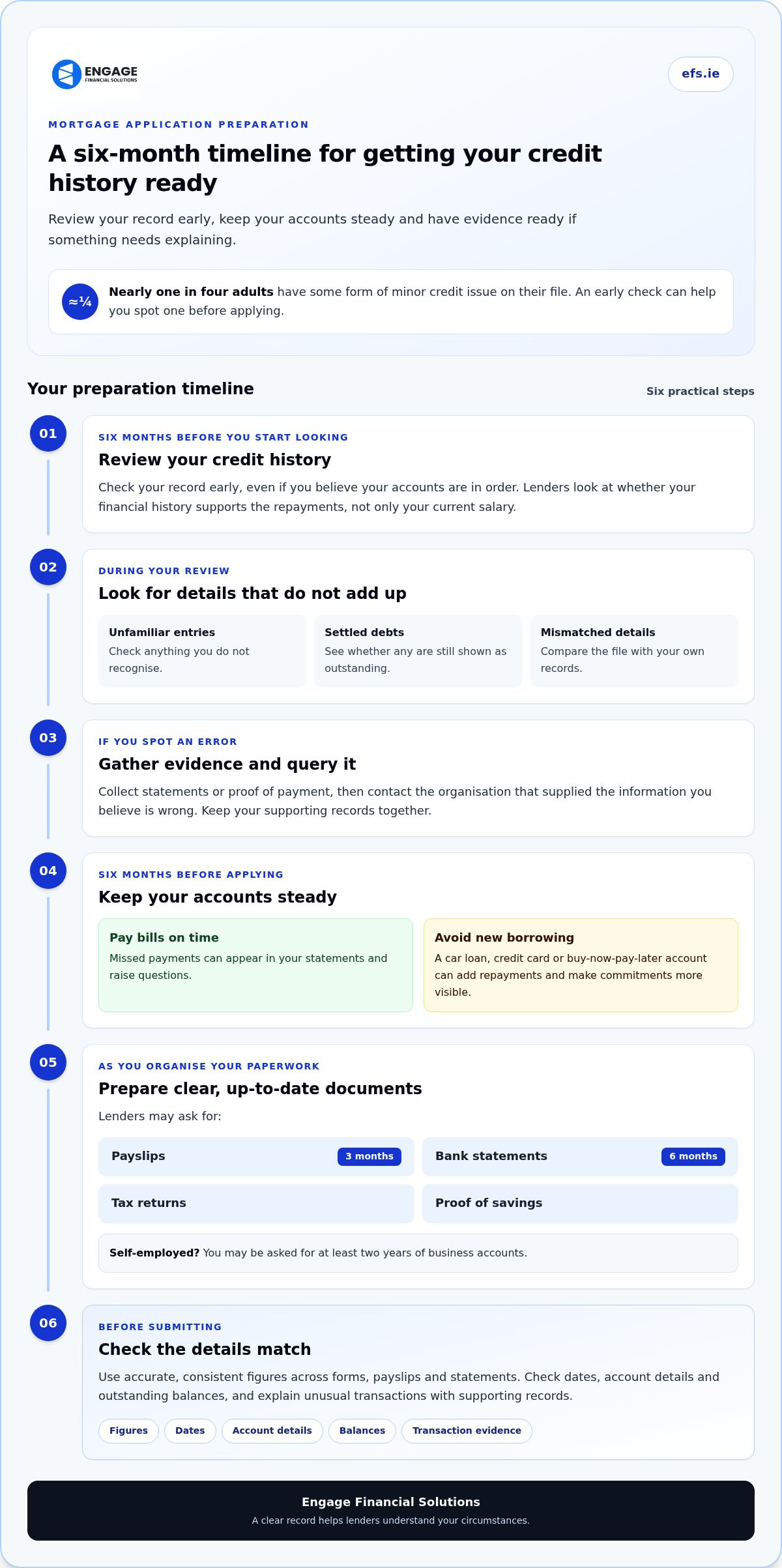
Common mortgage application mistakes in Ireland often begin before you apply: overlooking your credit history, missing bill payments or taking on new debt. Check your credit history six months before you start looking for a mortgage, and avoid missed payments and new borrowing in the six months before you apply.
It’s easy to focus on your deposit and income, but lenders also look at how consistently you manage your money and whether your circumstances support the repayments. Changes to your job, debts or spending can raise questions, so preparing early can help you present a clearer picture.
This guide explains how employment changes, existing debts, major life events and everyday account habits can affect your application. You’ll also find practical steps for organising your savings and paperwork, so you can address potential issues before they complicate your plans to buy a home.
Key Takeaways
- Review your credit history early and avoid new borrowing or missed bill payments while preparing your application.
- Keep your employment and income details steady during the application, and explain any unavoidable changes clearly.
- List your regular debt repayments alongside everyday costs to understand how they may affect what you can afford to borrow.
- Consider how planned life changes could affect your future repayments, and build those costs into your budget.
- Keep your bank statements, savings records and deposit paperwork organised so you can explain significant transactions.
1. What are the most common mortgage application mistakes to avoid?
Common mistakes include applying without checking your credit report, taking on new credit and overlooking past arrears. Lenders assess whether your financial record supports the repayments, not just your current salary. A missed bill payment can appear in your statements and raise concerns. Check your credit history six months before you start looking for a mortgage.
Nearly one in four Irish adults have some form of minor credit issue on their file. An early review is useful, even if you believe your accounts are in order. Look for unfamiliar entries, settled debts still shown as outstanding, or details that don’t match your records. Gather statements or payment evidence, then contact the organisation that supplied any information you believe is wrong.
Past arrears, defaults or a low credit score can contribute to a mortgage rejection. A lender considers the pattern and context of your credit history, including missed payments and whether any issues were resolved. Avoid new credit for at least six months before applying. A car loan, credit card or buy-now-pay-later account can add repayments and make your existing commitments more visible.
What documents do Irish lenders require for a mortgage application? Lenders may request three months of payslips, six months of bank statements, tax returns and proof of savings. Self-employed applicants may be asked for at least two years of business accounts, so prepare clear, up-to-date copies.
What deposit and loan-to-value rules apply to first-time buyers and home movers? According to the Central Bank, a borrower buying a primary residence generally needs a deposit of at least 10% under the loan-to-value limit. Home movers should check the deposit required for their circumstances and work it into their budget.
How do Irish lenders assess income, probation periods, overtime and bonuses? They review income evidence and its reliability alongside your regular commitments. Permanent employment, time in your line of work, probation status and the consistency of variable pay can all affect how clearly your documents support the income stated in your application.
How can applicants avoid errors in a mortgage application and supporting documents? Use the same accurate figures across forms, payslips and statements, and check dates, account details and outstanding balances before submitting. Explain unusual transactions with supporting records. A clear application helps lenders compare your declared circumstances with the documents you provide.
Keep your accounts steady while preparing: pay bills on time, avoid new borrowing and review your credit report early. If you find an error, address it and keep the evidence. These steps help you deal with issues before lenders assess your creditworthiness and can make the application process more straightforward.
2. Employment stability and financial changes during an application
A change in employment can affect how lenders view your income and ability to keep up with payments. They generally prefer applicants who have worked in the same line of work for at least two years. A job move doesn’t automatically end your plans, but a new role, probation period or change in pay can make income harder to assess. Think carefully before changing jobs once you’ve started applying.
Where possible, keep your current role until the mortgage is drawn down. Lenders may ask for updated payslips or statements during the application process, so a new employer or salary could prompt further questions. If a move is necessary, tell your mortgage broker promptly. Share the reason for the change, your new contract and documents showing your salary and start date.
Promotions can also affect timing, even when they bring higher pay. One reported example involved a six-week delay after a borrower received a promotion and changed salary during the application. The lender needed to understand the updated income. If you expect a promotion, pay rise or change in working hours, raise it before accepting or implementing the change, then keep written evidence of the revised terms.
Applicants who are newly employed may need time to establish a stable record. Most banks want borrowers to have been in permanent employment for several months before applying. A probation period can therefore affect when your application is ready. Check your contract for its probation terms, note the expected end date and organise your employment documents before applying.
Self-employed applicants face a different evidence challenge: changing business income can make affordability harder to demonstrate. Keep business accounts, tax records and bank statements organised, and be ready to explain a fall or rise in earnings. Lenders may view frequent changes in income or employment as added uncertainty, so a clear record helps them distinguish what is consistent from what is temporary.
Before accepting a new role during the process, consider the whole timeline: application, approval and drawdown. If changing is unavoidable, tell your mortgage broker as soon as possible rather than waiting for a lender to notice different details in your documents. A broker can help you understand how the change may affect your application and what evidence to prepare. For guidance on your mortgage options, explore mortgage advice and support.
3. Existing debts and affordability calculations
A mortgage within the lender’s limit may still stretch your household budget. Lenders assess whether you can afford the repayments and whether the mortgage suits your circumstances. They consider your income alongside existing commitments, regular spending and available deposit. Start with your actual monthly outgoings, not an idealised budget, then identify payments that will continue after you buy.
According to the Central Bank, first-time buyers of a primary residence can borrow up to 4 times their gross annual income under the loan-to-income limit. Non-first-time buyers can borrow up to 3.5 times their gross annual income under the same limit, according to the Central Bank. These limits are ceilings, not a promise of approval: lenders also assess your debts and ability to meet repayments.
List every regular commitment before estimating what you can afford. Include personal loans, car finance, credit-card balances, overdrafts and childcare or other recurring expenses. A €200 monthly car payment can reduce borrowing capacity by roughly €40,000 to €50,000, depending on income. This example shows why a seemingly manageable payment can change the mortgage amount a lender considers affordable.
Build a realistic monthly budget using bank statements and bills. Include utilities, groceries, transport, insurance, property taxes, maintenance and potential repairs, alongside the mortgage repayment. Consider how your budget would cope with changes to interest rates or household costs, rather than assuming current spending will stay fixed. A broker can help you work through the figures and compare your requested amount with documented income and commitments.
What mistakes should applicants avoid when choosing a mortgage amount or term? Don’t borrow the maximum simply because a calculation suggests you could, and don’t choose a longer term without considering its total interest cost. A longer term can lower each repayment while increasing the time interest is charged. Lenders usually expect repayment by an age between 65 and 70, which can affect the term available.
Before applying, pay down debts where practical and avoid adding new monthly commitments. Don’t leave a credit-card balance or loan out of your figures: lenders can compare your declarations with your statements and credit history. If a debt will end soon, keep evidence of its balance and repayment schedule. Clear records help explain your position and support an accurate affordability assessment.
Use a cautious borrowing figure when planning your home search. Set aside money for ownership costs, then compare the proposed repayment with your take-home income and existing payments. If your budget only works when every month goes perfectly, lower your target amount and review the term. Careful preparation gives you a clearer basis for discussions with a lender or broker.
4. Life changes and future repayment ability
A mortgage is a long-term commitment, so consider how planned changes could affect your ability to repay. Buying a home may coincide with starting a family, caring for someone or changing your working hours. Each can alter household income or spending. Before applying, list likely changes and estimate how they could affect your budget and regular repayments.
Test the proposed repayment against your current finances before committing. Set aside a regular amount equal to, or at least 10% higher than, the future mortgage repayment. Keep a record of these payments in your savings account. This practical exercise shows whether the repayment fits alongside ordinary costs, and helps you build a buffer for changes in your circumstances.
For example, if you expect childcare costs or a move to part-time work, include both in your monthly budget. Don’t calculate affordability using only today’s income if a change is already planned. List essential spending, such as utilities, food and transport, then compare what remains with the expected mortgage payment. This gives you a more realistic view of your future finances.
Retirement timing matters too. Mortgage lenders usually expect a loan to be repaid by an age between 65 and 70, which can affect applicants seeking a long term. If your planned term extends towards retirement, map out how income may change after work ends. Consider whether the repayment remains manageable using expected retirement income, rather than relying only on your current salary.
A change in your relationship can also alter who contributes to the household budget. If you’re buying with another person, discuss how repayments would be managed if one income fell or household costs changed. Use a written budget to show each person’s income, commitments and contribution. This makes assumptions visible before you apply, rather than revealing a shortfall after you make an offer.
During the application process, tell your mortgage broker about a significant planned change, such as parental leave, reduced hours or retirement. A lender’s assessment depends on the income and commitments presented, so updated circumstances may affect its view of affordability. Keep relevant documents together, including revised employment terms or a household budget, to explain what has changed and how you’ll manage repayments.
Don’t treat approval as a reason to ignore new developments. Before drawdown, review your budget if your income, household or plans change, and avoid taking on commitments that could reduce the amount available for repayments. A clear record of expected costs and regular savings can help you judge whether the mortgage still fits your plans, not just your current circumstances.
5. Managing accounts and savings before applying
Your account history can show lenders how you manage money between paydays. Review your spending habits during the six to 12 months before applying, and identify recurring costs, missed payments or unexplained transfers. A monthly budget can show whether savings build consistently after household bills, rather than appearing through a one-off transfer shortly before your application.
Keep everyday spending and savings records clear. If you move money between accounts, retain transfer records so the funds aren’t mistaken for new income or unexplained savings. Check account names, balances and transaction dates against your application documents. If the same deposit appears in several accounts, note the transfers so its original source is easy to follow.
Gifted deposit money also needs a clear paper trail. Lenders may want to see that gifted funds have been in your account for three to six months. Keep evidence of when the money arrived and where it came from, along with relevant gift documentation. Don’t describe a gift as personal savings or move it between accounts without recording each transfer.
According to the Central Bank, a borrower buying a primary residence generally needs a deposit of at least 10% under the loan-to-value limit. Work out your target deposit against the purchase price, then track it separately from money reserved for everyday spending. If your savings are short of the target, review your progress before committing to a property search or spending funds earmarked for the deposit.
Credit-card use is another account habit to manage. Make payments on time and avoid relying on a card to cover routine costs while saving. Lenders can see balances and repayments in your financial records, so make sure your declared commitments match your account activity. If you’ve cleared a balance, keep evidence of the final payment and check that your records reflect it accurately.
Before applying, organise current payslips, tax returns, bank statements and proof of savings. Compare names, dates and figures across each document, then prepare an explanation for any large deposit, such as a gift or transfer from another account. Having the explanation and supporting paperwork ready can reduce follow-up questions and help the application proceed more smoothly.
Start with one practical step: review a recent statement and mark each regular payment, transfer and saving deposit. Repeat this across the months you’re preparing, then address any inconsistent pattern before applying. If you’re saving towards your first home, explore First-time Buyer Mortgage options as part of your planning.
Engage Financial Solutions: Switching mortgages
Engage Financial Solutions can help you consider switching your mortgage if your current deal no longer suits your circumstances. Reviewing your income, regular commitments and mortgage details can clarify what to consider before making a change. Gather recent mortgage and bank statements, along with details of changes to your employment or household budget, so you can discuss your position clearly.
If you’re preparing to buy your first home or considering a rental property, Engage Financial Solutions also offers first-time buyer and buy-to-let mortgages. The right next step depends on your plans and financial position, so organise your records and identify the questions you want answered.
To discuss your mortgage options, contact Engage Financial Solutions.
Take your next step with a clear plan
Buying a home is a major decision, and your application is one part of a wider financial plan. Before moving forward, write down what you need your mortgage to make possible: a manageable monthly budget, room for future plans or greater certainty about your next move. Use those priorities to guide conversations and keep decisions connected to the life you want to build.
If your plans change, revisit your priorities rather than relying on an old estimate or assumption. A focused conversation can help you understand which mortgage route fits your situation, whether you’re buying your first home, considering a rental property or reviewing an existing mortgage. Engage Financial Solutions can help you explore your options and decide what to consider next.
Take the next step at your own pace. Explore mortgage support and move towards your plans with greater clarity and confidence.
Frequently Asked Questions
What are the most common mortgage application mistakes in Ireland?
Common mortgage application mistakes in Ireland include leaving out financial commitments, submitting inconsistent details and failing to explain unusual transactions. For example, a form may list a different loan repayment from the amount shown in your bank records. Before applying, compare figures across your forms and documents, answer every question, and prepare a clear explanation for any transaction that could otherwise be misunderstood.
What counts as acceptable deposit proof?
Proof of deposit should show both the funds available and where they came from. Savings account records can demonstrate accumulated savings, while documents relating to a gift or asset sale can explain other sources. Keep a clear trail if you transfer money between accounts. A short written note, supported by relevant records, can help explain deposits that aren’t immediately obvious from your statements.
How do missed payments or credit history affect a mortgage application in Ireland?
Missed payments and past arrears can affect how lenders assess your credit history, especially if they suggest difficulty meeting commitments. If you spot an inaccurate entry, gather evidence such as a payment receipt or settlement confirmation and raise it with the organisation that supplied the information. Keep copies of your correspondence and supporting documents so you can explain the issue clearly during an assessment.
How do existing loans, credit cards and childcare costs affect mortgage affordability in Ireland?
Loan and credit-card repayments reduce the income available for housing costs, while childcare adds another regular expense. List each commitment beside your take-home income, using the amounts actually leaving your account. Don’t treat a credit card as cleared until you’ve repaid its balance. This fuller picture can help you set a borrowing target that leaves room for ordinary family spending.
Can gambling transactions or large unexplained bank deposits lead to a mortgage application being declined in Ireland?
Bank transactions may prompt questions about spending patterns or the source of funds, but an individual entry doesn’t explain your full financial position. Keep records for substantial deposits, including transfers between your own accounts, and describe regular gambling transactions accurately. Review your account history before applying so you can explain entries and show how your savings and repayment capacity fit together.
What are the most common reasons Irish banks decline mortgage applications, and how can applicants improve their chances?
Applications may be declined if your income doesn’t support the requested amount, your deposit is insufficient, debts affect affordability or documents conflict with the details provided. To reduce common mortgage application mistakes in Ireland, identify the specific issue before applying again. You might adjust the amount requested, build savings, repay a commitment or correct an inaccurate document, then prepare a consistent application supported by clear records.
Disclaimer
Engage Financial Services LTD T/A Engage Financial Solutions is regulated by the Central Bank of Ireland CRO 764570. Suite 2 First Floor, 14 -18 Main street, Blackrock, Co Dublin. A94 W0Y3