


What if your daily rate was viewed by lenders as a sign of professional strength rather than a complex hurdle to be cleared? For many independent professionals, the search for a CONTRACTOR MORTGAGE can feel like an unexpected battle against rigid systems that don’t quite understand the modern workforce. You might worry that a brief contract gap or a non-standard income structure will lead to an automatic rejection, leaving your homeownership dreams on hold.
It’s entirely natural to feel this way, but the reality of the 2026 lending landscape is far more optimistic than you might think. This guide provides you with a clear roadmap to MORTGAGE approval, helping you navigate the domestic market with clarity and confidence. We’ll examine how lenders currently calculate gross annual salary from daily rates, the impact of the 4 times Loan-to-Income limits for those entering the market for the first time, and how to find a partner who understands the professional lifestyle. Whether you operate through an umbrella company or a private limited firm, the path to a new home should be straightforward. By the end of this article, you’ll have a tailored strategy to maximise your borrowing capacity and secure your long-term stability with ease.
Key Takeaways
- Understand how lenders convert your daily rate into a gross annual salary, typically using a 46 or 48-week multiplier to determine your total borrowing capacity.
- Discover why a CONTRACTOR MORTGAGE is assessed through bespoke criteria that prioritise your professional experience and skills over traditional permanent employment.
- Learn how the current Loan-to-Income limits apply to a FIRST TIME BUYER MORTGAGE and what steps you can take to maximise your potential loan amount.
- Identify the importance of the ‘Mortgage Ready’ phase, where six months of consistent financial behaviour and repayment capacity are essential for a successful application.
- See how a specialised financial advisor acts as a vital buffer between you and the lender, ensuring a seamless transition and long-term stability in the domestic market.
Understanding the CONTRACTOR MORTGAGE Landscape
A CONTRACTOR MORTGAGE is essentially a standard property loan that is assessed through bespoke criteria designed specifically for professional freelancers. If you have ever asked, What is a mortgage?, you will know it is a long-term commitment secured against your property. For those working independently, the challenge has historically been the perception of risk. However, it is important to debunk the myth that being self-employed or on a fixed-term contract is a barrier to homeownership. In the current domestic market, lenders have become increasingly sophisticated, recognising that your specialised skills often provide a higher degree of financial security than a traditional permanent role.
The primary metric used by lenders today is “Sustainability,” which shifts the focus from your employment status to your professional reliability. Instead of demanding a permanent contract, underwriters now look at your history of renewals and the demand for your specific expertise. Whether you are an IT consultant, a medical professional, or an engineer, your ability to command a high daily rate is seen as a sign of professional strength. This shift allows you to approach the market with confidence, knowing that your income structure is viewed as a stable foundation for a long-term MORTGAGE.
The Shift in Lender Behaviour
Over the last decade, banks have significantly evolved how they assess non-PAYE income. The growth of the professional services sector has forced a change in national lending policies, moving away from rigid tick-box exercises toward a more holistic view. Lenders now appreciate that professional contractors often have “calm competence” in managing their finances, making them highly attractive borrowers. This modern approach ensures that your application is judged on its individual merits rather than outdated employment definitions, leading to much more favourable outcomes for independent professionals.
Defining Sustainability in Professional Contracting
Sustainability is the lender’s confidence in your future earning potential based on your past professional performance. To demonstrate this, you should focus on three pillars: a consistent contract history, high demand within your specific sector, and rigorous financial discipline. Underwriters want to see a career trajectory that suggests you will remain employable and high-earning for the duration of the MORTGAGE. By showcasing your professional journey rather than just your current project, you highlight the long-term stability that lenders prioritise, ensuring a more straightforward path to approval.
How Lenders Calculate Income for Professional Contractors
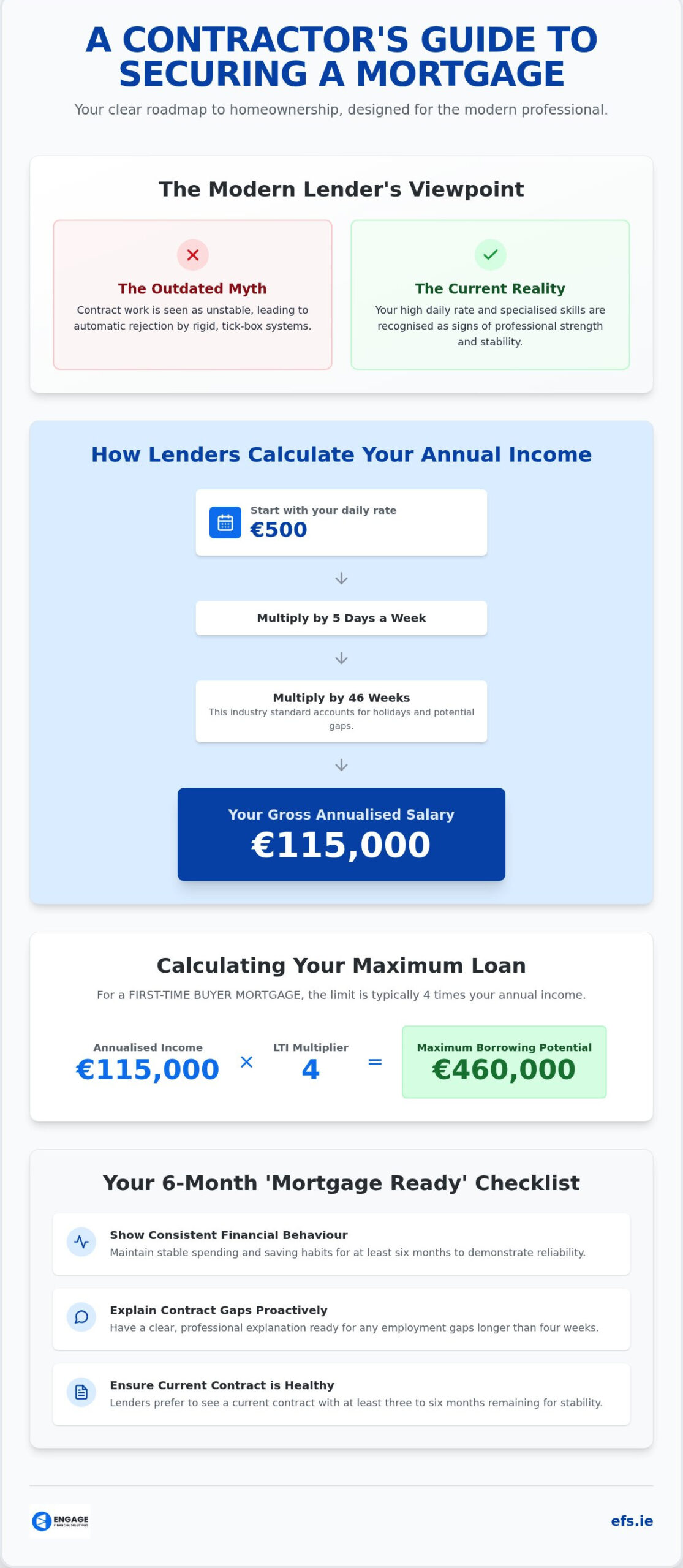
Understanding your borrowing capacity starts with the specific calculation method used by most specialist lenders. Instead of looking at your net drawings or base salary, underwriters typically annualise your contract value to reflect your true earning power. This is achieved by taking your current daily rate, multiplying it by five days, and then projecting that figure over a 46 or 48-week period. Using a 46-week multiplier is common in the domestic market as it provides a practical buffer for public holidays and annual leave, ensuring your CONTRACTOR MORTGAGE remains sustainable and realistic.
Whilst contract gaps are a reality of independent work, they don’t have to hinder your application if handled with transparency. Providing a brief, professional explanation for any gap longer than four weeks helps the underwriter see the consistent pattern of your career. Most lenders prefer to see a current contract with at least three to six months remaining to ensure the long-term stability of your MORTGAGE repayments. This proactive approach helps to neutralise potential stresses before they occur, allowing for a much more straightforward approval process when seeking a CONTRACTOR MORTGAGE.
When calculating these limits, lenders must follow the Central Bank mortgage rules which set the baseline for all domestic lending. These regulations ensure that your total loan remains proportionate to your annualised income. Whether you are applying for a FIRST-TIME BUYER MORTGAGE or a SWITCHING MORTGAGE, these rules provide the framework for a secure financial future and prevent over-extension.
Umbrella Company vs Private Limited Company
How you structure your business significantly impacts the documentation you’ll need to provide. If you operate through an umbrella company, you are technically a PAYE employee, which often simplifies the assessment. Lenders can view your payslips and P60s much like a traditional staff member, making the path to a CONTRACTOR MORTGAGE quite seamless. However, if you are the director of a private limited company, you’ll generally need to provide two years of certified accounts to verify the underlying health of your business and ensure your dividends are consistent.
Dealing with Variable Income and Bonuses
If your income includes overtime, bonuses, or fluctuating daily rates, consistency is your greatest asset. Lenders will often look at your Revenue Notices of Assessment to verify your declared earnings over a multi-year period, ensuring your tax affairs are fully up-to-date to avoid unnecessary friction. If you’re unsure how your specific income mix will be viewed by a lender, seeking professional FINANCIAL PLANNING can help you present your application in the best possible light, ensuring a smooth transition to your new home without the stress of unexpected delays.
Comparing Deposit Requirements and Borrowing Limits
Navigating the financial requirements for a CONTRACTOR MORTGAGE involves understanding the specific limits set by the national regulator. If you’re entering the property market for the first time, you can typically access a FIRST-TIME BUYER MORTGAGE with a borrowing limit of up to 4 times your gross annual income. This is a significant boost compared to the 3.5 times limit usually applied to those seeking a SWITCHING MORTGAGE or moving to a second home. Whilst these ratios provide a standard framework, lenders often have a limited number of exceptions or allowances. These can permit higher borrowing multiples for high-earning professionals, making it essential to present your application with meticulous detail to qualify for these flexible options.
Lending Rules for the National Market
The Central Bank’s macroprudential rules in 2026 remain a cornerstone of financial stability. For a professional contractor, gross income is defined by the annualised daily rate we discussed previously, rather than just the salary drawn from a company. However, your total borrowing capacity isn’t just about what you earn; it’s also about your existing commitments. Lenders will closely examine any outstanding loans or credit card balances to ensure your new repayments are manageable. Following a practical checklist for mortgage readiness can help you organise your documents and identify any potential friction points before you approach a lender.
Maximising Your Loan-to-Value (LTV) Ratio
Building a deposit whilst managing a contract-based income requires a balance of discipline and tax efficiency. Most first-time purchasers only need a 10% deposit, whereas subsequent buyers generally require 20%. If you’re considering a new-build property, the HELP TO BUY SCHEME can be an invaluable resource, offering a tax refund of up to €30,000 to assist with your down payment. For those facing a gap between their maximum loan and the property price, the FIRST HOME SCHEME can act as a bridge, providing equity support to make your purchase possible. By integrating these supports with your own savings, you can achieve a seamless transition into your new home with long-term security.
A Practical Checklist for MORTGAGE Readiness
Achieving a successful contractor mortgage Ireland application requires a period of meticulous preparation known as the ‘Mortgage Ready’ phase. This is a six-month window where your financial behaviour must be beyond reproach. Lenders aren’t just looking at your high daily rate; they’re assessing your Repayment Capacity. This means proving you can comfortably afford the monthly cost of your MORTGAGE plus a “stress test” through consistent savings or rent payments. By organising your bank statements to reflect a stable lifestyle, you remove friction from the underwriting process and project an image of calm competence.
During this critical period, it’s essential to avoid taking on new credit or making large, unexplained transfers between accounts. Underwriters look for a clean paper trail that demonstrates financial discipline. If you’re planning to use a gift for part of your deposit, ensure the funds are in your account well in advance. You’ll also need a formal ‘Gift Letter’ from the donor confirming the money is a non-repayable gift. Preparing these details early ensures a seamless transition when you finally submit your application.
The Six-Month Paper Trail
- Months 1-2: Review your credit reports and close any unused credit facilities or store cards. This simplifies your financial profile and ensures there are no surprises during the bank’s background checks.
- Months 3-4: Establish a consistent savings pattern. If your future MORTGAGE repayment will be higher than your current rent, save the difference every month to prove you can handle the increased commitment.
- Months 5-6: Gather your final application pack. This includes your latest certified accounts, six months of business and personal bank statements, and copies of your current and previous contracts.
Common Pitfalls to Avoid
Certain activities can cause immediate concern for a domestic lender. Frequent overdraft usage or online gambling transactions on your bank statements are significant red flags that suggest financial instability. You should also avoid changing your business structure, such as moving from a Sole Trader to a PRIVATE LIMITED COMPANY, in the middle of an application. This can reset the clock on the “trading history” requirements lenders need to see. If you’re unsure if your current financial habits meet the grade, you can speak with an advisor to audit your readiness before you apply.
By following this methodical timeline, you position yourself as a reliable borrower. Proactive management of your “paper trail” neutralises potential stresses before they occur, allowing you to move toward your new home with total confidence.
The Value of Personalised Financial Advice for Contractors
A specialist advisor acts as an essential buffer between your professional world and the bank’s underwriters. When you’re seeking a contractor mortgage Ireland, you need someone who can articulate your professional value beyond a simple payslip. Brokers who specialise in this field don’t just submit documents; they build a narrative of stability and success. They understand how to present your contract history to ensure the lender sees your skills as a long-term asset rather than a short-term risk. This partnership removes the friction of explaining your daily rate calculation repeatedly, allowing you to focus on your work whilst the technicalities are handled with calm competence.
Adopting a “Future-Back” perspective means looking at your home purchase as one part of a larger financial roadmap. It’s about starting with your long-term goal of security and working backward to the present. This includes integrating mandatory requirements like MORTGAGE PROTECTION into your plan from the outset. By viewing these products as tools for stability rather than just administrative hurdles, you safeguard your family’s future. A personalised approach ensures that your insurance and debt structures are aligned with your career trajectory, providing peace of mind as your professional life evolves.
Holistic Financial Security
Lenders often view contractors more favourably when they see a robust PRSA or COMPANY PENSION in place. These structures demonstrate that you’re proactive about your long-term financial health, which builds trust with underwriters. Beyond the mortgage, having a safety net through LIFE INSURANCE and CRITICAL ILLNESS COVER is vital when you are the primary earner. You can learn more about safeguarding your earnings with INCOME PROTECTION to ensure your home remains secure even if you’re unable to work. These layers of protection work together to create a foundation of stability that supports your lifestyle for years to come.
Next Steps with Engage Financial Solutions
Our team understands the nuances of the national lending market and acts as your steady guide through every stage of the process. We specialise in managing the unique requirements of a contractor mortgage Ireland, ensuring a seamless experience from your first consultation to the day you receive your keys. We take pride in being the buffer that protects you from the complexities of modern finance. If you already own a home and want to optimise your current loan, explore our comprehensive guide to SWITCHING MORTGAGES. We’re here to help you navigate your financial transitions with clarity and confidence.
Building Your Future with Confidence
Securing a home as an independent professional is no longer the uphill battle it once was. By focusing on the sustainability of your earnings and maintaining a meticulous six-month financial paper trail, you can navigate the domestic lending market with total clarity. Whether you are annualising your daily rate for a FIRST-TIME BUYER MORTGAGE or seeking a SWITCHING MORTGAGE for better long-term stability, the right preparation ensures a seamless transition to homeownership.
As specialists in the professional contractor market, our team provides the expert guidance needed to neutralise stress and manage the complexities of a contractor mortgage Ireland application. We are regulated by the Central Bank and pride ourselves on delivering tailored financial planning that looks at the big picture of your career and lifestyle. We act as your steady guide, ensuring every detail is managed with calm competence and professional care.
Secure your financial future and start your MORTGAGE journey with Engage Financial Solutions today. Your path to a new home is straightforward when you have a partner who truly understands your professional world.
Frequently Asked Questions
Can I get a CONTRACTOR MORTGAGE with only one year of accounts?
Yes, it’s possible to secure approval with just twelve months of trading history. Whilst many traditional banks prefer two years of certified accounts, specialist lenders often focus on your industry experience and the strength of your current contract. If you can demonstrate a consistent track record in your professional sector and have a contract with longevity, lenders may assess your application based on your annualised daily rate rather than long-term business accounts.
How do lenders calculate my maximum borrowing limit as a contractor?
Lenders typically determine your borrowing capacity by annualising your daily rate. They multiply your rate by five days and then by 46 or 48 weeks to account for potential holidays. Once this gross annual figure is established, standard Loan-to-Income ratios apply. Under current regulations, a FIRST-TIME BUYER MORTGAGE allows you to borrow up to 4 times your income, whilst those moving home or switching are generally limited to 3.5 times.
Does being under an UMBRELLA COMPANY make a MORTGAGE application easier?
Operating through an UMBRELLA COMPANY can often simplify the process because lenders treat you as a PAYE employee. This allows you to provide standard payslips and P60s, which is a much more straightforward process for bank underwriters than reviewing complex company accounts. It removes significant friction from the application, as your income is verified through traditional payroll documentation, making your transition to homeownership feel much more seamless.
Is a higher deposit required for professional contractors compared to PAYE staff?
No, the deposit requirements for contractors are identical to those for permanent employees. If you are applying for a FIRST-TIME BUYER MORTGAGE, you will need a minimum deposit of 10% of the property purchase price. For subsequent buyers or those moving house, the standard requirement is a 20% deposit. Being a contractor doesn’t change these rules, provided you can satisfy the lender that your income is stable and your professional skills are in high demand.
Will a gap between my contracts affect my MORTGAGE approval?
Brief gaps between contracts are generally acceptable provided they are explained proactively to the lender. Underwriters look for a consistent work history, but they understand that specialists may take time off between projects for training or travel. Gaps longer than four to six weeks may require a professional explanation to demonstrate your “Sustainability.” Showing a clear pattern of contract renewals or a high demand for your specific skill set helps neutralise any concerns about these intervals.
What is the 6-month ‘Mortgage Ready’ rule for bank statements?
The ‘Mortgage Ready’ rule is a six-month window where your bank statements must demonstrate perfect financial behaviour. Lenders scrutinise this period to verify your REPAYMENT CAPACITY, looking for consistent savings or rent payments that match your future loan costs. You should avoid any overdraft usage, large unexplained cash transfers, or online gambling transactions during this time. Maintaining a clean paper trail for these six months is vital for ensuring a straightforward path to approval.
Do I need to have a permanent contract to qualify for a MORTGAGE?
You don’t need a permanent employment contract to qualify for a MORTGAGE in the current market. Lenders have become far more sophisticated and now prioritise the “Sustainability” of your income over your employment status. As long as you have a strong history in your professional field and a current contract with at least three months remaining, you can prove you are a reliable borrower. Your specialised skills are often viewed as a sign of long-term financial security.
Can I use my daily rate to calculate my income for a loan?
Yes, using your daily rate is the primary method used by specialist lenders to calculate your borrowing power. This approach recognises the full value of your professional expertise by annualising your rate, typically over a 46-week period. This method often results in a higher borrowing limit than if the lender only looked at the salary or dividends you draw from a PRIVATE LIMITED COMPANY, as it reflects the true market value of your services.
Disclaimer
Engage Financial Services LTD T/A Engage Financial Solutions is regulated by the Central Bank of Ireland CRO 764570. Director David Moore. Suite 2 First Floor, 14 -18 Main street, Blackrock, Co Dublin A94 W0Y3