


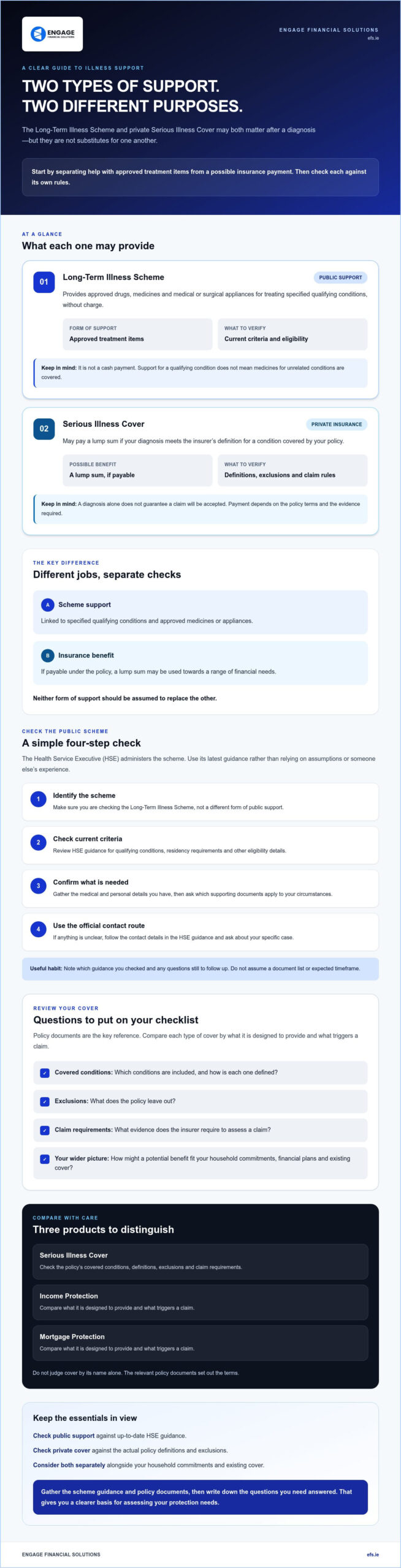
The Long-Term Illness Scheme and private serious illness cover in Ireland may both matter after a diagnosis, but they provide different kinds of support. The scheme helps with approved medicines and appliances for specific qualifying conditions. Private cover may pay a lump sum if your diagnosis meets the definition in your policy.
It’s understandable to wonder whether public support would be enough to protect your household finances. The answer depends on your circumstances, and the two forms of support shouldn’t be treated as substitutes. The scheme is focused on certain treatment costs, while private cover may provide money for a range of needs, subject to policy terms.
This article explains the differences, what to check about scheme eligibility and policy definitions, and how Serious Illness Cover compares with Income Protection. It also sets out practical questions to consider, from covered conditions and exclusions to how a potential payout might fit your wider financial plans.
Key Takeaways
- The Long-Term Illness Scheme and private Serious Illness Cover serve different purposes. Don’t assume one replaces the other.
- Check the latest Health Service Executive guidance for scheme criteria, covered support and application requirements before taking action.
- Compare Serious Illness Cover, Income Protection and Mortgage Protection by what each is designed to provide and what triggers a claim.
- Before considering serious illness cover Ireland, review policy definitions, exclusions and claim requirements alongside your household commitments and existing cover.
- Gather relevant scheme guidance and policy documents, then write down questions to help assess your protection needs.
Long-Term Illness Support and Serious Illness Cover: Why the Difference Matters
Public illness support and private insurance can sound similar, particularly when you’re trying to understand what may help after a diagnosis. Their purposes differ, so check each against the right source. Start by separating public scheme support from the terms of a private insurance policy.
The Long-Term Illness Scheme provides approved medicines and appliances for specified qualifying conditions, while private Serious Illness Cover may pay a lump sum if a diagnosis meets the policy’s terms.
What does the Long-Term Illness Scheme refer to?
Administered by the Health Service Executive (HSE), the Long-Term Illness Scheme provides approved drugs, medicines and medical or surgical appliances for treating listed conditions without charge. It isn’t a cash payment, and support for a qualifying condition doesn’t mean medicines for unrelated conditions are covered.
The scheme covers a defined list of conditions. Eligibility and support depend on current criteria, so check the HSE’s latest guidance for qualifying conditions, residency requirements and application details. Public scheme eligibility is separate from private insurance, so confirm each on its own terms.
What is private Serious Illness Cover?
Private Serious Illness Cover is an insurance product. It may provide a lump sum if you’re diagnosed with a condition covered by your policy and the diagnosis meets the insurer’s definition. Payment isn’t automatic: covered conditions, exclusions and claim requirements vary, so a diagnosis alone doesn’t guarantee a claim will be accepted.
For a neutral introduction to the general concept, see this overview of Critical Illness Insurance. Your policy documents are the key reference. Check the definition for each covered condition, any exclusions and what evidence the insurer requires to assess a claim. These details matter as much as the product name when comparing policies.
This distinction can help you consider how different types of support may fit your circumstances. Scheme support is tied to specified conditions and approved treatment items. A private insurance benefit, if payable under the policy terms, may be used towards a range of financial needs. Neither should be assumed to replace the other.
How the Long-Term Illness Scheme Works and What to Verify
If you’re considering applying, use current official guidance rather than relying on a diagnosis or someone else’s experience. The HSE administers the Long-Term Illness Scheme, and its guidance is the place to confirm the current criteria, support and application route.
Check scheme eligibility and available support against the latest official HSE guidance. This helps avoid assuming that a particular condition or personal circumstance automatically qualifies.
Who may qualify, and how can you check?
Start with the HSE’s current information about the scheme. Check whether your condition appears in the qualifying criteria and whether your circumstances meet the stated requirements. A diagnosis alone may not settle eligibility, so don’t infer that you qualify from the name or seriousness of an illness.
If anything is unclear, use the contact route in the HSE guidance to ask about your specific case. The HSE’s official website can help you find relevant scheme information and contact details. Confirm that you’re looking at guidance for the Long-Term Illness Scheme, rather than information about a different support scheme.
What information should you have ready?
Some preparation can make an enquiry easier. Before contacting the HSE, gather the medical and personal details you have to hand, then ask which documents are required for your circumstances. The HSE can confirm the applicable steps, so don’t rely on an assumed document list or expected timeframe.
Use this short process to keep your next steps clear:
- Identify the scheme. Make sure you’re checking the Long-Term Illness Scheme, not a different form of public support.
- Check current criteria. Review the HSE guidance for qualifying conditions and other eligibility requirements.
- Confirm documentation. Ask which medical or personal information and supporting documents apply to your case.
- Contact the official service. Follow the contact route provided by the HSE if you need clarification before applying.
Keep a note of the guidance you checked and any questions you still have. This makes it easier to follow up later. Don’t treat public scheme support as a cash payment or a replacement for private insurance: they have different purposes and terms.
If you’re also reviewing private protection, the Competition and Consumer Protection Commission’s guide to Serious illness insurance explains what to examine in policy terms. You can also consider how protection fits your wider plans with personalised financial guidance. Private cover does not change your eligibility for public support.
Serious Illness Cover, Income Protection and Mortgage Protection Compared
These forms of protection address different financial needs. A diagnosis, an inability to work and a mortgage commitment aren’t interchangeable circumstances. Compare each product’s purpose and claim conditions before deciding what may suit your household.
| Type of protection | Purpose | Potential trigger | Terms to check |
|---|---|---|---|
| Serious Illness Cover | May provide a lump sum that can be used for a range of financial needs. | A diagnosis that meets the policy’s definition of a covered condition. | Covered conditions, definitions, exclusions and claim evidence. |
| Income Protection | May provide an income if illness or injury prevents you from working. | Being unable to work, as defined by the policy. | How inability to work is assessed, exclusions, claim requirements and benefit terms. |
| Mortgage Protection | Designed to help repay a mortgage if the insured person dies, subject to policy terms. | Death during the policy term, subject to the policy’s conditions. | Who is covered, the mortgage-related cover, exclusions and claim requirements. |
How does Serious Illness Cover differ from Income Protection?
Serious Illness Cover is linked to a specified diagnosis. A claim depends on whether the condition and its severity meet the definition in the policy. A serious diagnosis alone doesn’t guarantee payment. If a claim is accepted, the policy may pay a lump sum.
Income Protection addresses a different need: lost earnings when illness or injury leaves you unable to work, subject to the policy terms. It isn’t another name for Serious Illness Cover. One focuses on qualifying diagnoses, while the other focuses on the ability to work and earn. Read the relevant Income Protection guide alongside your policy documents, and check how the policy defines inability to work and what conditions apply.
How does Mortgage Protection fit into the picture?
Mortgage Protection has a mortgage-related purpose and shouldn’t be treated as cover for general living costs. Its primary purpose is to help repay the mortgage following the insured person’s death, subject to the policy wording. Some policies may offer Serious Illness Cover as an optional addition, but check the documents rather than assuming it’s included.
The Mortgage Protection guide can help you understand the product’s role. Then compare it with any separate Serious Illness Cover you hold. Write down the financial need you want to address, then check each policy’s trigger, exclusions and claim requirements. This gives you a clearer basis for considering how protection fits your wider financial plans.
How to Check Whether Private Serious Illness Cover Fits Your Needs
Start with your financial priorities, not a target cover amount. The right questions depend on your household commitments, existing protection and the resources you could draw on if illness affected your plans. This checklist can help you identify what to examine, but it can’t determine whether an insurer will accept an application or what level of cover is suitable.
- List your commitments. Note regular household costs, borrowing and anyone who depends on your income.
- Gather existing policy details. Include any Serious Illness Cover, Income Protection and Mortgage Protection, along with workplace cover if you have it.
- Consider your priorities. Think about which financial pressures you’d want to address following a serious diagnosis and what other savings or resources may be available.
- Review changes in your circumstances. New dependants, a change in employment or additional borrowing may be reasons to reassess your arrangements.
Which policy details should you compare?
Look beyond the product name. Read the definition for each covered condition and check what a diagnosis must meet for a claim to qualify. Review exclusions, any waiting requirements and the evidence needed to support a claim where these are set out in the policy. If a term is unclear, ask the insurer or an adviser to explain it before making a decision.
Policy details can differ, so don’t assume two products cover an illness in the same way. Keep a note of your questions and the answers you receive, then compare the documents side by side. This makes it easier to understand what the wording means for your circumstances.
How should existing protection affect your decision?
Use your policy list to identify what each arrangement is designed to address, rather than treating one as a substitute for another. For example, Income Protection and Serious Illness Cover respond to different insured events, while Mortgage Protection has a mortgage-related purpose. Consider your household needs and other resources together before deciding whether there may be a gap to discuss.
Applications may involve underwriting, which is the insurer’s assessment of information such as your health and medical history. Answer questions accurately and ask how information you disclose may affect the application and policy terms. Acceptance isn’t guaranteed, and you shouldn’t assume a particular outcome.
A review doesn’t have to lead to a change. If you’d like to consider your protection alongside your wider financial plans, discuss your protection needs with Engage Financial Solutions.
Getting Clear Guidance on Long-Term Illness Support and Cover
Public support and private protection answer different questions. For the Long-Term Illness Scheme, confirm eligibility and available support through current HSE guidance. For private Serious Illness Cover, use the policy wording to understand which diagnoses may qualify and what conditions apply. Keeping those checks separate helps you build a clearer picture without expecting one form of support to replace another.
A few steps can help you prepare:
- Check the HSE’s current guidance about the scheme and note anything you need clarified.
- Gather policy documents for any existing Serious Illness Cover, Income Protection or Mortgage Protection.
- Write down questions about your household commitments, existing protection and priorities.
What questions can you ask an adviser?
Use a conversation to understand how a product relates to the financial risk you’re concerned about. You might ask:
- Which type of protection is designed to address this need, and why?
- How could the policy’s definitions, exclusions or claim requirements affect my circumstances?
- What information about my medical history is relevant to underwriting, the insurer’s assessment of an application?
- How would proposed cover fit alongside my existing policies, dependants and other financial commitments?
Ask for unfamiliar terms to be explained in plain language, and take time to read the relevant documents. An adviser can help you consider options, but the insurer’s policy terms determine whether a claim meets the requirements. No discussion can guarantee acceptance or a future claim outcome.
What is a sensible next step?
Separate scheme questions from insurance questions. Ask the HSE about current public scheme criteria, application steps and documents for your situation. Ask the relevant insurer or adviser to clarify private policy definitions, exclusions and application requirements. This keeps each answer tied to the source responsible for that information.
Engage Financial Solutions arranges Critical Illness Insurance and Income Protection and provides personalised financial guidance. If you’d like to review how protection could sit alongside your wider financial plans, you can discuss your protection needs. Take your questions and policy documents with you to help make the conversation useful.
Take a Clear Next Step Towards Financial Confidence
The key distinction is straightforward: the Long-Term Illness Scheme provides support under public scheme criteria, while private Serious Illness Cover depends on the definitions and conditions in your policy. They aren’t substitutes. Checking official scheme guidance and reviewing policy documents can help you understand what may apply to your circumstances.
If you’re considering serious illness cover Ireland, gather details of your existing protection, household commitments and questions about covered conditions, exclusions and claims. This gives you a practical foundation for a considered conversation, without assuming a particular policy or outcome is right for you.
Engage Financial Solutions arranges Critical Illness Insurance and Income Protection, with personalised financial guidance tailored to individual circumstances. To explore how protection could fit alongside your wider plans, discuss your protection needs.
Frequently Asked Questions
What is the difference between the Long-Term Illness Scheme and Serious Illness Cover?
The Long-Term Illness Scheme is public support, while Serious Illness Cover is a private insurance product. The scheme provides approved medicines, drugs and appliances for qualifying conditions, subject to current criteria. Private cover may pay a benefit if a diagnosis meets the policy’s definition and claim requirements. Check eligibility and support with the HSE, and read the policy wording for insurance terms. Neither automatically covers every diagnosis or financial need.
Who can qualify for the Long-Term Illness Scheme?
Qualification depends on the scheme’s current criteria, including whether the condition and your personal circumstances meet its requirements. Don’t assume that a diagnosis alone means you qualify. Check the latest HSE guidance or contact the relevant official service to clarify your situation and the application requirements. This is separate from an insurer’s assessment of an application, which may involve underwriting and policy definitions.
Does the Long-Term Illness Scheme pay a cash benefit?
No, the scheme’s stated support is not a cash payment. It provides approved medicines, drugs and medical or surgical appliances for qualifying conditions, subject to current scheme guidance. Check the HSE’s information for the latest details about what is covered. Private insurance works differently: any benefit depends on the policy wording, covered conditions and claim requirements, so verify those separately with the insurer.
What does Serious Illness Cover pay out for?
A claim may be paid if your diagnosis meets the definition of a condition covered by your policy and you satisfy its claim requirements. Not every serious illness qualifies, and a diagnosis alone doesn’t guarantee payment. Check your policy schedule and wording for covered conditions, exclusions and required evidence. If any terms are unclear, ask the insurer or adviser to explain how they apply before relying on the cover.
Can I have Serious Illness Cover and Income Protection at the same time?
These products address different potential financial needs and may be held together, subject to insurer availability and your circumstances. Serious Illness Cover relates to specified diagnoses that meet policy definitions. Income Protection is designed to provide an income if illness or injury prevents you from working, subject to its terms. Compare both products with your existing protection, and check definitions, exclusions and claim conditions before deciding whether either fits your needs.
How do I make a claim under Serious Illness Cover?
The claim process and evidence required depend on your insurer and policy. Check the policy’s claims section, then contact the insurer or adviser promptly to confirm the steps and documents that apply. A claim depends on the diagnosis meeting the policy definition and on satisfying all stated requirements. Don’t assume a decision timeframe or outcome. Ask the insurer what to expect and keep copies of relevant correspondence and documents.
Is private Serious Illness Cover the same as Mortgage Protection?
No, they are distinct insurance products with different purposes and policy terms. Mortgage Protection is designed for a mortgage-related need, while Serious Illness Cover depends on the conditions and definitions set out in its policy. Some policies may offer illness cover as an optional addition, but don’t assume it’s included. Review your existing documents and ask the insurer or adviser to clarify any overlap before making changes.
Disclaimer
Engage Financial Services LTD T/A Engage Financial Solutions is regulated by the Central Bank of Ireland CRO 764570. Suite 2 First Floor, 14 -18 Main street, Blackrock, Co Dublin. A94 W0Y3