


Could a past cancer diagnosis still leave room for Life Insurance? If you’re asking, “can I get life insurance with a history of cancer?”, the answer depends on your circumstances and the insurer’s assessment. A previous diagnosis doesn’t automatically mean you’ll be declined, but it’s understandable to feel unsure about applying, particularly if you’re concerned about exclusions, a postponement or a refusal.
This guide explains what may influence an insurer’s decision, including the type of cancer, treatment and time since treatment ended. You’ll also learn what medical information you may be asked to provide, why accurate disclosure matters and what outcomes are possible. If you’re applying for Mortgage Protection, a voluntary code may also be relevant in certain circumstances. Gathering details about your diagnosis and treatment can help you approach the application with greater confidence.
Whether you’re exploring cover for your family or arranging Mortgage Protection, an adviser can help you understand application questions and compare available options. The aim is to give you a clearer next step, without assuming the outcome in advance.
Key Takeaways
- If you’re asking “can I get Life Insurance with a history of cancer?”, remember that each application is assessed individually and an application doesn’t guarantee an offer.
- Prepare clear details about your diagnosis, treatment and current health, and answer each application question fully and truthfully.
- An insurer may offer cover, change the terms, postpone its decision or decline the application. Outcomes and processes can vary.
- Before applying, clarify the cover you need and review any offer carefully so you understand its terms.
- An intermediary can help you understand application questions and compare available options, but can’t guarantee an insurer’s decision.
Can you get Life Insurance after a history of cancer? What to know first
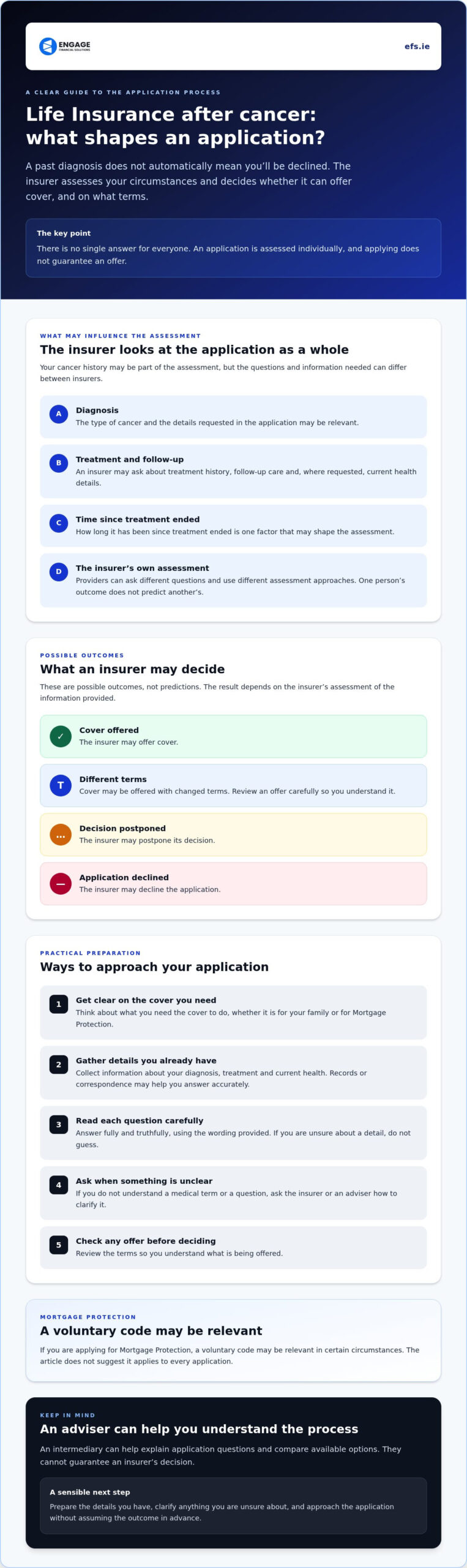
If you’re asking, “can I get life insurance with a history of cancer?”, there isn’t one answer for everyone. A past diagnosis alone can’t establish whether an insurer will offer cover. Each application is assessed on its own details, and the outcome depends on the information provided and the insurer’s assessment.
Sharing personal health information can feel unsettling, especially when you don’t know what decision will follow. Applying is one step in the process, not a guarantee of acceptance or a final offer. An insurer may need to assess your details before deciding whether to offer cover and, if so, on what terms. Read each question carefully and ask for clarification if you’re unsure how to answer.
Does a cancer history automatically mean an application will be declined?
No single diagnosis predicts the result on its own. Insurers consider the application as a whole, and their assessment criteria can differ. One person’s outcome may not indicate what another applicant will be offered, even when their circumstances seem similar. Don’t assume you’ll be accepted, declined or offered standard terms before an insurer has assessed your application.
If you’re uncertain whether applying makes sense, first clarify what you need the cover to do. An adviser can explain the application process and help you compare available options, but can’t determine or guarantee an insurer’s decision.
What does an insurer assess when you apply?
Life Insurance underwriting is the process an insurer uses to assess an application and decide whether to offer cover and, if so, on what terms. Your medical history and answers to health questions may be considered. Depending on the insurer and application, you may also be asked for further information or supporting medical evidence. Questions and requests can vary between providers.
Read each question carefully and answer fully and truthfully, using the wording provided. If you can’t remember a date or detail, avoid guessing. Note what you’re unsure about and ask the insurer or an adviser how to clarify it. This can help you provide accurate information and understand what the insurer needs to assess your application.
Why outcomes vary: “Life Insurance decisions after cancer can differ because insurers assess each application using the information provided and their own assessment process.”
To prepare, gather information you already have about your diagnosis and treatment, then check what the application asks for before submitting it. The next step is to understand the factors an insurer may consider without treating any one factor as a certain prediction of the result.
How cancer history can shape Life Insurance underwriting
After you submit an application, the insurer considers the information it has been given to decide whether it can offer Life Insurance and, if so, on what terms. Your cancer history may form part of that picture, but there’s no single checklist that applies to every provider. The questions asked and information needed can vary.
That’s why “can I get life insurance with a history of cancer” can’t be answered from a diagnosis alone. The details an insurer requests and how it assesses them depend on the application and provider. The examples below are areas to check against the actual application form, not a promise that every insurer will ask about them.
Which medical details might an application ask about?
Read the current application wording rather than relying on a general list. Depending on the form, you may be asked about your diagnosis, treatment history or follow-up care. Current health details may also be relevant if requested. The scope and wording can differ between providers.
Gather records or correspondence you already have that may help you answer accurately. If a question uses a medical term you don’t understand, ask the insurer or an adviser what it means before responding. You shouldn’t need to interpret unfamiliar terminology or guess at details. Clear, accurate answers help you address what the form actually asks.
Why can two applications lead to different decisions?
People have different circumstances, and insurers may use different questions and assessment approaches. Even where parts of two medical histories seem similar, one person’s outcome doesn’t predict another applicant’s decision. An insurer may ask for further medical information if it needs clarification, though whether this happens depends on the application and provider.
In brief: “Medical history can be relevant to an application, but the information requested and the insurer’s decision are specific to each case.”
To prepare, make sure your answers address the form’s wording, note any details you need to confirm and ask questions before submitting if anything is unclear. If you’d like support understanding the application or comparing available options, you can explore personalised financial guidance.
Life Insurance outcomes after cancer: compare the possibilities
An insurer’s decision may take several forms. The table outlines possible outcomes, but providers don’t necessarily use identical processes or terms. If you’re asking, “can I get life insurance with a history of cancer?”, these possibilities show why the answer depends on the insurer’s assessment of your application.
| Possible outcome | What it may mean |
|---|---|
| Offer | The insurer offers cover. Review the proposed policy details before deciding whether they suit your needs. |
| Offer with changed terms | The insurer offers cover, but not on all the terms you requested. Check exactly what has changed. |
| Postponement | The insurer defers considering the application, if this is part of its process. Ask whether it has indicated when or how the application could be reviewed again. |
| Decline | The insurer doesn’t offer cover for that application. This is a decision on that application, not a universal verdict on every possible application. |
What could an offer with changed terms mean?
An offer may differ from the cover you applied for. Don’t assume what a change means from its label alone. Read the policy wording and the insurer’s explanation, and ask about any limitation or condition you don’t understand. Before accepting, check what cover is included, what isn’t, and whether the terms still meet the need you’re trying to address.
What if an insurer postpones or declines an application?
A postponement means the insurer is deferring its decision rather than making an immediate offer. The reason and possible next steps depend on the provider and its process. Ask what information it can give you and whether there’s anything you should do before the application is reconsidered.
A decline can be disappointing, particularly if you were relying on cover for a particular financial need. Still, one insurer’s decision doesn’t establish the outcome of every possible application. Before applying elsewhere, ask what next step is appropriate and whether you should clarify your circumstances or application details first. An adviser can help you understand the decision and compare available options, but can’t promise another insurer will reach a different conclusion.
Whatever the outcome, keep a copy of the decision and any terms offered. If you’re considering an offer, take time to review it and raise questions before deciding. Understanding what the insurer has proposed, deferred or declined can help you choose an informed next step.
How to prepare a Life Insurance application after cancer
Preparation can make the application process clearer, though it can’t guarantee a particular decision. Start by defining what you want the cover to do, such as supporting your family or meeting another financial need. Then check the application carefully so you can prepare relevant details and answer the questions it actually asks.
What information should you have ready?
Organise information you have about your diagnosis, treatment and follow-up care. Note relevant dates you can confirm, and keep useful medical records or correspondence together. The insurer’s application will tell you what details or documents it wants, so don’t assume every provider will ask for the same material.
If you’re unsure about a date or medical detail, check your records or ask your treating team rather than guessing. Answer each question truthfully and fully, following its wording. Don’t leave out or alter information to try to influence the insurer’s decision. If a question is unclear, ask the insurer or an adviser to explain it before submitting your answers.
What should you ask before accepting an offer?
Read the offer and policy wording before deciding. Check what cover is included, whether any limitations apply and when the cover would begin. If a term is unfamiliar, ask for a plain-language explanation and confirm how it affects the protection you need. Consider whether the offer still meets your original purpose, rather than focusing only on whether cover has been offered.
If you’re arranging cover in connection with a home loan, check that the proposed Mortgage Protection meets the need you’re addressing. Ask about any terms you don’t understand before making a decision.
For a straightforward preparation sequence:
- Clarify the purpose and amount of cover you’re seeking.
- Gather relevant information and check uncertain details against your records.
- Answer the application questions accurately and ask for clarification where needed.
- Review the full offer and get an explanation of any limitations before deciding.
If you’d like support understanding application questions or comparing available Life Insurance options, explore personalised Life Insurance guidance. A clear picture of your needs and accurate information can help you approach the next step with greater confidence.
Choosing your next step with Life Insurance after cancer
There’s no need to rush into an application before you’re clear about what you need. If you’re still asking “can I get life insurance with a history of cancer?”, start by defining the purpose of the cover. You might want to protect your family or be considering cover linked to a financial commitment. Knowing your goal helps you ask focused questions and judge whether an offer meets your needs.
Your next step could be to organise information an application may ask for, seek clarification about an insurer’s questions or talk through your circumstances with an adviser. Preparing a short list of questions beforehand can make that conversation more useful, and you can choose a pace that feels manageable. For an example of how independent providers review personal coverage solutions, visit The Lewis Agency.
When can an adviser help with an application?
An adviser can help you understand application questions, identify details you may need to confirm and compare available options. Engage Financial Solutions arranges Life Insurance with insurance providers and offers personalised financial guidance. An intermediary can support you through the process, but can’t guarantee that an insurer will accept an application or offer particular terms.
Consider asking an adviser to explain any question you find unclear or to help you understand the differences between options available to you. Share your circumstances accurately, including anything you’re uncertain about, so you can receive relevant guidance without making assumptions about the insurer’s decision.
How to move forward at your own pace
Before taking the next step, write down what you want the cover to achieve and what you’d like to clarify. Keep relevant information to hand, answer application questions fully and truthfully, and check which documents are actually requested. If an insurer makes an offer, review the wording and ask about any term you don’t understand before deciding.
If you’re not ready to apply, you can first read a general Life Insurance guidance resource or discuss your questions with an intermediary. If you are ready to explore your options, a conversation about your circumstances can help you understand the process and consider a suitable next step.
Take the process one question at a time. You don’t need to decide on an offer until you understand what it includes and whether it fits your needs. Discuss your Life Insurance needs when you feel ready.
Take your next step with confidence
If you’re still wondering, “can I get life insurance with a history of cancer?”, remember that a diagnosis alone can’t determine the outcome. Insurers assess applications individually, and possible decisions may include an offer, changed terms, postponement or decline. Preparing accurate information and taking time to understand any offer can help you make a considered choice.
You don’t have to work through the questions alone. Engage Financial Solutions arranges Life Insurance with insurance providers and offers personalised guidance from an experienced financial services team. An adviser can help you understand the application and compare available options, but can’t guarantee an insurer’s decision.
When you’re ready, discuss your Life Insurance options and the support that may suit your circumstances. Take it one step at a time, ask questions whenever you need to, and move forward at a pace that feels right for you.
Frequently Asked Questions
Can I get Life Insurance after cancer treatment?
Possibly, but only an insurer can decide after assessing your application. If you’re asking, “can I get life insurance with a history of cancer?”, the answer depends on your circumstances, the information requested and the provider’s assessment. Prepare accurate details about your diagnosis and treatment, and check what the application asks for. An offer, if made, may not match the cover or terms you initially wanted.
Does a history of cancer automatically mean Life Insurance will be declined?
No. A past diagnosis alone doesn’t establish the result, and there’s no guaranteed outcome either way. Insurers assess applications individually, and their questions and assessment processes can differ. One person’s experience won’t reliably predict yours. If you’re unsure whether to apply, first clarify the cover you need and consider asking an adviser to explain the application process and available options.
What cancer information might an insurer ask for?
The questions vary by provider and application. You may be asked about your diagnosis, treatment history or follow-up care, but check the form rather than assuming what it will require. It may also request further information or medical evidence. Gather details you can verify, and if a question or medical term is unclear, ask the insurer or an adviser before answering.
Can I apply for Life Insurance whilst receiving cancer treatment?
You can ask an insurer or intermediary whether an application is appropriate during treatment, but you can’t assume it will be accepted or that a decision will be made at that stage. The insurer’s questions and assessment will determine what information it needs and whether it can make a decision. Be open about your current circumstances and ask what steps, if any, may be suitable for you now.
What happens if an insurer postpones or declines my application?
A postponement means the insurer has deferred considering your application, if that is part of its process. Ask what the decision means and whether it has outlined any next steps. A decline means cover wasn’t offered on that application, but it doesn’t establish the result of every possible application. Before applying again, consider getting guidance on how to proceed and what information to prepare.
Can I apply to another insurer after a Life Insurance application is declined?
You can explore whether another application may be appropriate, but a different insurer may assess your circumstances differently, and no outcome is assured. Before proceeding, review the previous decision and check what the next application asks. Answer each question fully and truthfully, including questions about previous applications if they appear. An adviser can help you understand the wording and compare available options before you decide.
Should I speak to an adviser before applying for Life Insurance after cancer?
It may help, particularly if you’re unsure how to interpret a health question or what information to organise. Engage Financial Solutions arranges Life Insurance with insurance providers, and its experienced team offers personalised financial guidance and can help compare available options. An intermediary can support you through the application, but can’t guarantee an insurer’s decision. Prepare your questions and share your circumstances accurately when seeking guidance.
Disclaimer
Engage Financial Services LTD T/A Engage Financial Solutions is regulated by the Central Bank of Ireland CRO 764570. Suite 2 First Floor, 14 -18 Main street, Blackrock, Co Dublin. A94 W0Y3