


Only 23% of adults have a clear financial plan for their future, according to recent research published in February 2026. If creating a personal financial plan feels like another task to fit around bills, competing priorities and an uncertain future, you’re not alone. Getting started doesn’t mean having every answer. It means understanding where you are and deciding what matters most.
You may be balancing day-to-day costs with goals such as buying a home, supporting your family or preparing for retirement. It can be difficult to know which deserves attention first, especially if you’re unsure what information to gather. A useful plan brings these decisions together so you can see how they affect one another.
This practical 2026 guide from Engage Financial Solutions will help you build a clear, flexible plan around your finances, commitments and long-term goals. You’ll learn how to assess your position, set priorities, organise next steps and review your progress as life changes. The aim isn’t a complicated set of rules, but a realistic roadmap you can return to and adjust.
Key Takeaways
- Creating a personal financial plan starts with a clear record of your income, spending, savings, borrowing and commitments.
- Turn competing priorities into practical next steps by weighing each goal’s timeframe, flexibility and the impact of delaying it.
- Keep your plan adaptable: choose a review rhythm and revisit your priorities when your circumstances change.
- Connect related financial decisions to your goals with personalised guidance across areas such as retirement, protection, savings and Investments.
Why creating a personal financial plan gives your goals a clearer path
Saving for a home, managing borrowing, supporting family and preparing for retirement can all matter at once. The challenge is working out how these priorities fit together. A personal financial plan gives you a straightforward way to organise them: it connects what you want to achieve with the resources and decisions available to you now.
Rather than promising a particular result, a plan makes trade-offs easier to see. You can consider what needs attention first, what can wait and how one decision may affect another. It should change as your circumstances or priorities shift, so treat it as a guide rather than a rigid set of rules. For a broader overview, see What is Financial Planning?
What a personal financial plan can help you organise
A plan can bring near-term needs, longer-term ambitions and regular commitments into one picture. This might include monthly bills and borrowing, saving for a goal, considering protection for your family or planning for retirement. Seeing these areas together helps you spot which choices support your priorities and where they may compete for the same money.
For example, in an illustrative scenario, someone with money left over each month might be weighing extra repayments on borrowing against saving for a future home. The plan won’t decide for them or predict the outcome. It can help them compare the timing of each goal, their commitments and how much flexibility they want to keep before choosing a next step.
A plan supports informed decisions, but it can’t remove uncertainty or guarantee financial outcomes. Treat it as a working guide, and allow for changes in income, costs or circumstances.
Start with the future you want, not a list of products
Before exploring financial products or solutions, describe what stability would mean in your life. Would it mean more room in your monthly budget, supporting family needs, buying a home or feeling better prepared for retirement? Write down the outcome in plain language. A clear goal gives you a useful point of reference without assuming there’s one right path for everyone.
Then consider what matters most, when you hope to make progress and what could affect the timing. A family priority may need attention sooner, while a retirement goal may be further ahead. Naming the difference makes later decisions easier to assess. Ask whether a possible action supports the goal, fits your resources and leaves enough flexibility for other commitments. These questions provide a clear foundation for the practical steps that follow.
How to create a personal financial plan in manageable steps
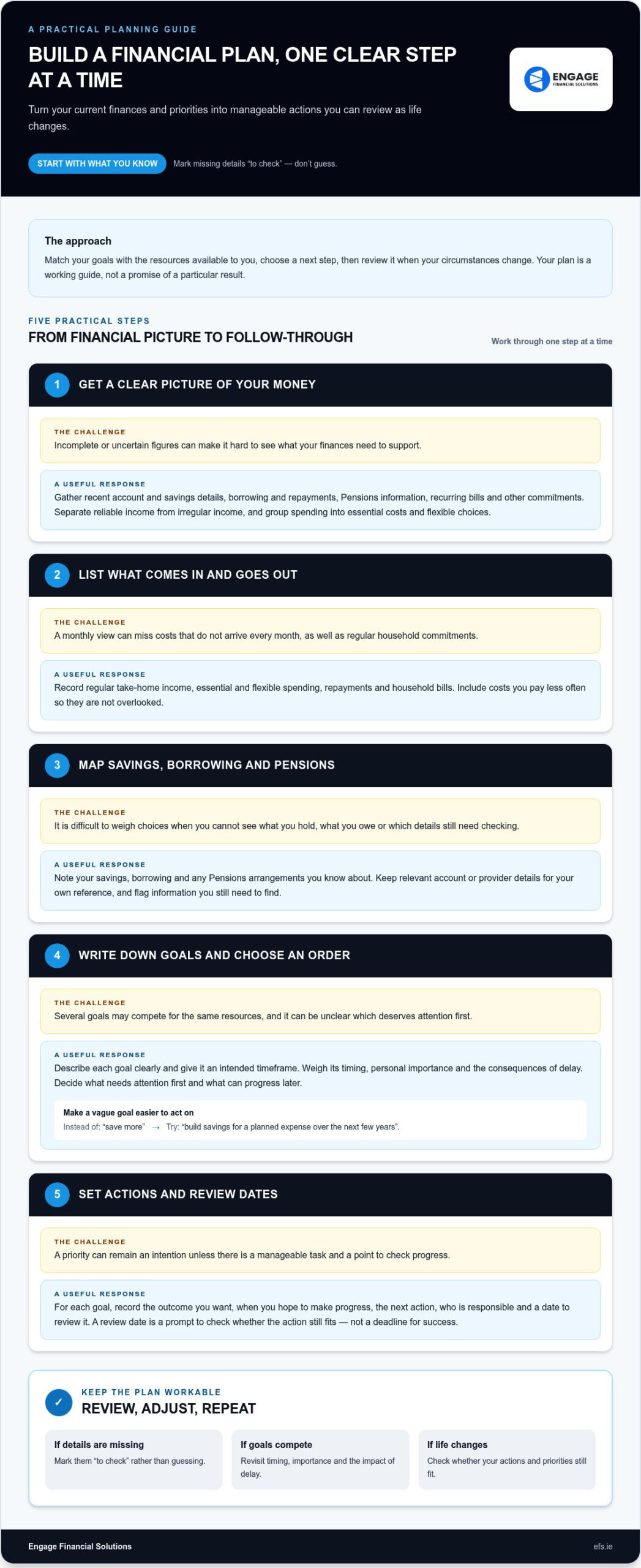
Once you know what you want your finances to support, turn that direction into a workable process. You don’t need perfect records or a complicated spreadsheet to begin. Gather the information you have, mark anything you’re unsure about, then set out actions you can revisit.
A financial plan is a practical process for matching your goals with your available resources, choosing next steps and reviewing them as circumstances change.
Gather a clear picture of your current finances
Collect recent account and savings information, details of borrowing and regular repayments, pension information, and records of recurring bills and other commitments. Separate reliable income from irregular income, then group spending into essential costs and more flexible choices. If a balance or figure is missing, write “to check” rather than guessing. An honest starting point is more useful than a tidy but inaccurate picture.
Use this sequence to turn your notes into a first draft:
- List what comes in and goes out. Record regular take-home income, essential spending and flexible spending. Include repayments, household bills and costs you pay less often, so your monthly view doesn’t overlook them.
- Map savings, borrowing and Pensions. Note what you currently hold, what you owe and any Pensions arrangements you know about. Include relevant account or provider details for your own reference, and flag information you still need to find.
- Write down your goals. Describe each goal in specific terms, with an intended timeframe. For instance, replace “save more” with “build savings for a planned expense over the next few years”. Choose wording that feels relevant and achievable enough to guide a next step.
- Choose an order for your priorities. Consider timing, personal importance and the consequences of delay. If several goals compete for the same resources, decide which needs attention first and which can progress later. Revisit the order as circumstances change.
- Set actions and review dates. Turn each priority into a manageable task, such as locating a Pensions statement or reviewing regular spending. Write down who will do it and when you’ll check progress, so intentions become practical follow-through.
Turn priorities into actions you can review
Keep the first version simple. For each goal, record the outcome you want, when you hope to make progress, the next action, who is responsible and a date to review it. If you share finances with someone, agree who will handle each task. A review date isn’t a deadline for success. It’s a prompt to check whether the action still fits your circumstances and priorities.
Creating a personal financial plan can feel more manageable when you focus on one useful next step instead of trying to solve every decision at once. If you’d value support connecting financial decisions to your circumstances, explore personalised financial planning.
How to prioritise financial goals without making your plan rigid
A plan isn’t a promise to follow one route whatever happens. It helps you make choices deliberately, with room to adjust when your income, family needs or other circumstances change. As you work through creating a personal financial plan, compare goals by when they matter, how much their timing can shift and what delaying them could mean. There’s no universal order that suits everyone.
Use the table as a prompt for weighing up goals, not as a recommendation about which one must come first. Add your own priorities and be honest about what you can postpone.
| Goal category | Timeframe | Flexibility to consider | Question to ask |
|---|---|---|---|
| Essential commitments | Ongoing or due soon | Often limited | What could happen if this is delayed? |
| Planned near-term goal | Closer in view | May depend on timing or circumstances | Could the date move without creating difficulty? |
| Longer-term ambition | Further ahead | May allow more room to adjust | What can I do now while keeping options open? |
Use your answers to identify potential trade-offs, not to judge yourself. A goal with a flexible date may be able to wait, while a commitment with consequences for delay may need earlier attention. Your responsibilities and priorities determine how these considerations fit together.
Balance immediate needs with longer-term goals
Separate pressing commitments from goals whose timing may be more adaptable. Consider the impact of waiting, whether a date is fixed and how a decision affects other parts of your finances. For example, in a hypothetical scenario, someone planning a home move might need to reassess the timing if their work or family circumstances change. They could adjust the goal’s timeframe and review related decisions rather than treating the original plan as unchangeable. Note what has changed, then reconsider each goal against your current circumstances.
Understand where professional guidance may add value
If your finances are straightforward, you may be comfortable tracking goals and reviewing your own decisions. Tailored guidance can be useful when several areas interact. Choices about Pensions, Investments, protection or borrowing may each affect how you approach other priorities. A financial planner can help connect those decisions with your circumstances and goals, making the overall picture easier to consider. This support doesn’t remove uncertainty or promise better results; it provides a structured way to explore options. If you’re unsure how one decision fits with another, write down your questions and the trade-offs you want to understand before deciding what to do next.
Put your financial plan into action and review it as life changes
A plan becomes useful through manageable actions, not by trying to change everything at once. Choose a few next steps that fit your current capacity, then make them easy to find and revisit. Aim for steady progress, with room to update your approach as your circumstances evolve.
Make the next steps practical and trackable
Keep the latest version of your plan and key information together in a secure, accessible place. This might be a digital document or a folder containing account details, Pensions information and notes about decisions. Record questions as they arise rather than relying on memory at your next review.
After drafting your plan, choose a small number of actions to focus on first. For each one, write down who will take it, when you intend to do it and what you need to find out. Keep a brief note of progress and decisions made. This makes it easier to see what has moved forward and what still needs attention, without turning your plan into another source of pressure.
- Choose a few immediate actions that feel realistic.
- Keep relevant records and the current plan together securely.
- Note progress, decisions and questions for your next review.
Review the plan when your circumstances change
Choose a review rhythm you can maintain, and bring the date forward if something significant changes. A new family responsibility, career shift or approaching retirement may affect your income, commitments and priorities. Revisit your assumptions as well as your goals: check what has changed, what still matters and whether your planned actions remain suitable.
Retirement goals connect with other decisions, including Pensions, savings and the commitments you expect to have later in life. Explore how they fit into your wider priorities through personalised financial planning. If your income or responsibilities change, consider whether income security still supports the needs you want your plan to address.
Tax and pension details relevant to people in this market can change. Before relying on a rule, threshold or other time-sensitive detail, check current information with appropriate official sources, such as Revenue for tax matters and gov.ie for public-service information. If a detail affects a decision and you’re uncertain how it applies to you, note the question and seek suitable guidance rather than building an assumption into your plan.
A review doesn’t mean starting again. It’s a chance to bring your goals, income and commitments back into alignment, then choose the next practical action. This regular habit helps keep your plan relevant as life moves on.
How personalised financial planning can help bring the pieces together
You can build a useful plan yourself, but individual decisions can be easier to assess when you see how they relate. A choice about retirement, for example, may sit alongside questions about protecting income, managing borrowing or supporting family. Personalised guidance can help you consider these connections in the context of your goals, resources and circumstances, without assuming every financial option is right for you.
When a joined-up view of finances may be useful
A broader view can help when a change or goal touches several areas of your finances. You might be thinking about retirement while also considering how your household would manage if your income changed. Or, if you have a mortgage, you may want to consider Mortgage Protection alongside other financial commitments. The right conversation depends on your objectives, responsibilities and current position, not a standard checklist.
To prepare, note the decisions you’re weighing up and how they might affect one another. For example, write down your retirement priorities, existing commitments and any questions about income security. This gives you a clear starting point for exploring the options and trade-offs that matter to you, with the focus on your own circumstances.
Take a considered next step with Engage Financial Solutions
Engage Financial Solutions provides personalised financial guidance for individuals and businesses. A planning discussion can bring your priorities into focus and help you consider relevant decisions across areas such as Pensions, protection, savings and Investments. The aim is to connect those areas to your objectives, rather than start with a product or assume one solution fits everyone.
This can be helpful if you’re unsure how different choices fit together, or if your circumstances have shifted since you last reviewed your plans. You don’t need to have every detail resolved before beginning. Bring your main goals, the commitments you’re managing and the questions you want to answer. Guidance can then be tailored to your situation, with space to account for changes over time and no promise of a particular financial outcome.
Creating a personal financial plan is an ongoing process, and guidance can help you make sense of the decisions that support it. Whether you’re focused on retirement, protecting your family or balancing several priorities, a calm conversation can help clarify a suitable next step. Discuss your financial planning.
Give your financial plan room to grow
Your next step doesn’t need to be a major financial change. Choose one decision you’ve been putting off, note what you need to understand and set aside time to consider it. A small, deliberate action can help turn uncertainty into a question you can work through without having every part of your future mapped out.
Creating a personal financial plan is an ongoing way to respond thoughtfully as your priorities evolve. You might revisit it after a change in your work, family responsibilities or longer-term hopes. Rather than treating a revised plan as a setback, use it to make sure your next decisions still reflect what matters to you.
If you’d like support thinking through your priorities and the choices ahead, take a considered next step. Bring the questions that feel most pressing, even if you’re still working out what you want to achieve. A clear conversation can help you decide where to focus next, at a pace that feels manageable. Your plan can develop with you, one considered decision at a time.
Frequently Asked Questions
What should a personal financial plan include?
Include a snapshot of your finances, your priorities and the decisions you want to make next. Note irregular costs, such as annual bills or planned home repairs, so they don’t take you by surprise in a monthly budget. Record assumptions too, such as expected changes in work or household costs. That makes it easier to see which details may need updating later.
Can I create a personal financial plan on my own?
Yes. You can start independently, especially if your finances are straightforward and you’re comfortable tracking your income, spending and goals. A spreadsheet or written document can be enough to organise your thoughts. Creating a personal financial plan yourself can also help you spot gaps, such as an unclear Pensions record or an expense you haven’t accounted for. If several decisions affect one another, tailored guidance may help you examine the whole picture.
How often should I review my personal financial plan?
Choose a review schedule you can realistically maintain, then put a reminder in your calendar. At each check-in, compare your current position with your notes: have planned actions happened, have costs changed and do your goals still feel relevant? You don’t need to rewrite the plan if nothing material has shifted. A short review can keep it useful and flag questions to explore before they become urgent.
What happens if my income or goals change after I make a plan?
Update the plan rather than treating the change as a failure. If your income falls, for example, revisit regular commitments and decide whether the timing of a less urgent goal needs to move. If your income rises or a goal changes, consider how that affects other priorities before committing to a new course of action. Record what changed and why, so your next review has a clear point of reference.
Should I pay off debt or save first?
There isn’t one answer for everyone. Compare the cost and terms of your borrowing with the value of keeping accessible savings for unexpected expenses. High-cost debt may deserve prompt attention, but using all available savings to repay it could leave you with little flexibility if an urgent bill arises. List your repayment commitments and essential costs, then consider a balance that reflects your circumstances before deciding what to prioritise.
Do I need a financial adviser to make a personal financial plan?
No, an adviser isn’t essential for every plan. You may be comfortable handling a simple budget and a small number of clear goals yourself. Guidance can be useful if you’re weighing decisions about Pensions, protection, Investments or borrowing and want to understand how they connect. Before a discussion, write down what you want help deciding and any terms or options you find unclear. That helps keep the conversation focused on your needs.
How do Pensions fit into a personal financial plan?
Pensions are one part of planning for income later in life, alongside other resources and commitments you may expect to have. Start by locating your current Pensions information and noting any questions about what it means for your retirement aims. If you’ve had more than one employer, check whether you have records for each arrangement. This gives you a clearer basis for considering retirement priorities without assuming a particular contribution or outcome is right for you.
Disclaimer
Engage Financial Services LTD T/A Engage Financial Solutions is regulated by the Central Bank of Ireland CRO 764570. Suite 2 First Floor, 14 -18 Main street, Blackrock, Co Dublin. A94 W0Y3