


Could the same pension contribution qualify for different tax relief depending on how you earn and where you pay it? The rules can feel confusing, especially when workplace deductions, a PRSA and self-employed contributions are treated differently. To understand pension contributions tax relief, start with three things: who pays, how much goes in and how relief is claimed.
In 2026, eligible personal pension contributions can receive income tax relief at your marginal rate, either 20% or 40%. The amount that may qualify is subject to limits linked to your age and earnings, so the maximum isn’t the same for everyone. This guide explains how the rules work and what relief can and can’t do.
You’ll learn how the rules may apply if you’re an employee, contribute to a Personal Pension outside payroll or are self-employed. You’ll also find out what information to gather before deciding how much to contribute, so you can weigh the tax rules alongside your wider retirement plans. Whether you’re reviewing an existing arrangement or planning ahead, a clear understanding can help you consider your next step with confidence.
Key Takeaways
- Understand how pension tax relief works and how it differs from investment growth within your pension.
- Check your age, earnings and contribution details before estimating how much of your personal contributions may qualify for relief.
- Identify whether you contribute through a workplace scheme, a PRSA or self-employment, as the way relief is handled can differ.
- Gather your pension arrangement details, contribution records, earnings information and the relevant tax year before reviewing a claim.
- Weigh potential tax relief against affordability, access restrictions, investment risk and your other financial priorities.
What pension contributions tax relief means in practice
When an eligible pension contribution receives tax relief, it can reduce the income tax you pay, subject to the rules for you and your pension arrangement. This can make contributing more affordable than paying the same amount into a pension without relief. It doesn’t remove the need to consider your budget or future plans.
In brief: pension contribution tax relief is tax treatment that may reduce the income tax due on eligible contributions, subject to applicable limits and your personal circumstances. It is separate from investment growth. Relief affects the tax calculation; growth depends on how your pension fund’s investments perform and can be positive or negative.
How pension contribution relief affects your tax
Eligible personal contributions generally receive relief at your marginal income tax rate, meaning the highest rate of income tax that applies to you. In 2026, the rates are 20% and 40%. As a simplified example, if a €100 contribution qualifies in full, the potential income tax relief could be €20 or €40, depending on your circumstances. Your actual position may differ, and limits apply.
This isn’t a €20 or €40 cash bonus paid to you, or a guaranteed return on your pension. It is tax relief linked to eligible contributions. Personal pension contributions reduce income for income tax purposes, but don’t reduce the income on which USC or PRSI are calculated. If you pay tax at more than one rate, your overall position and the rules for your arrangement can affect how relief works in practice.
Before estimating the benefit, note your taxable income, the amount and type of contributions you make, and whether any contributions are already deducted from your pay. Then check Revenue guidance for the relevant tax year. For 2026, verify the current contribution and earnings limits rather than relying on an older calculation.
What tax relief does not tell you about a pension
Tax treatment is only one part of the decision. It doesn’t tell you how a fund will perform, what charges may apply or what income you might receive later. Investment values can rise or fall, and future outcomes aren’t guaranteed. Review the fund’s investment approach and charges alongside any potential tax benefit.
Access is another consideration. Pension savings are generally subject to scheme and tax rules, so don’t assume you can withdraw contributions whenever you need them. Check current Revenue guidance and the terms of your pension arrangement before making a decision.
Weigh potential relief against your regular expenses, emergency savings and other financial priorities. A contribution that fits your long-term plan should also remain manageable today. Personalised Retirement Planning can help you understand how your pension arrangement and contributions fit into the bigger picture.
How pension tax relief rules apply to contributions
Tax relief isn’t automatic for every pension payment, and there isn’t one contribution allowance that suits everyone. Whether a contribution qualifies, how much may receive relief and how relief is applied depend on your pension arrangement, age, the earnings Revenue counts for pension relief and your tax circumstances. When checking the rules, separate your own contributions from employer payments, as they can be treated differently.
Your personal relief limit depends on your age and the earnings counted for pension relief. Check both before deciding how much to contribute.
Which limits can affect eligible contributions?
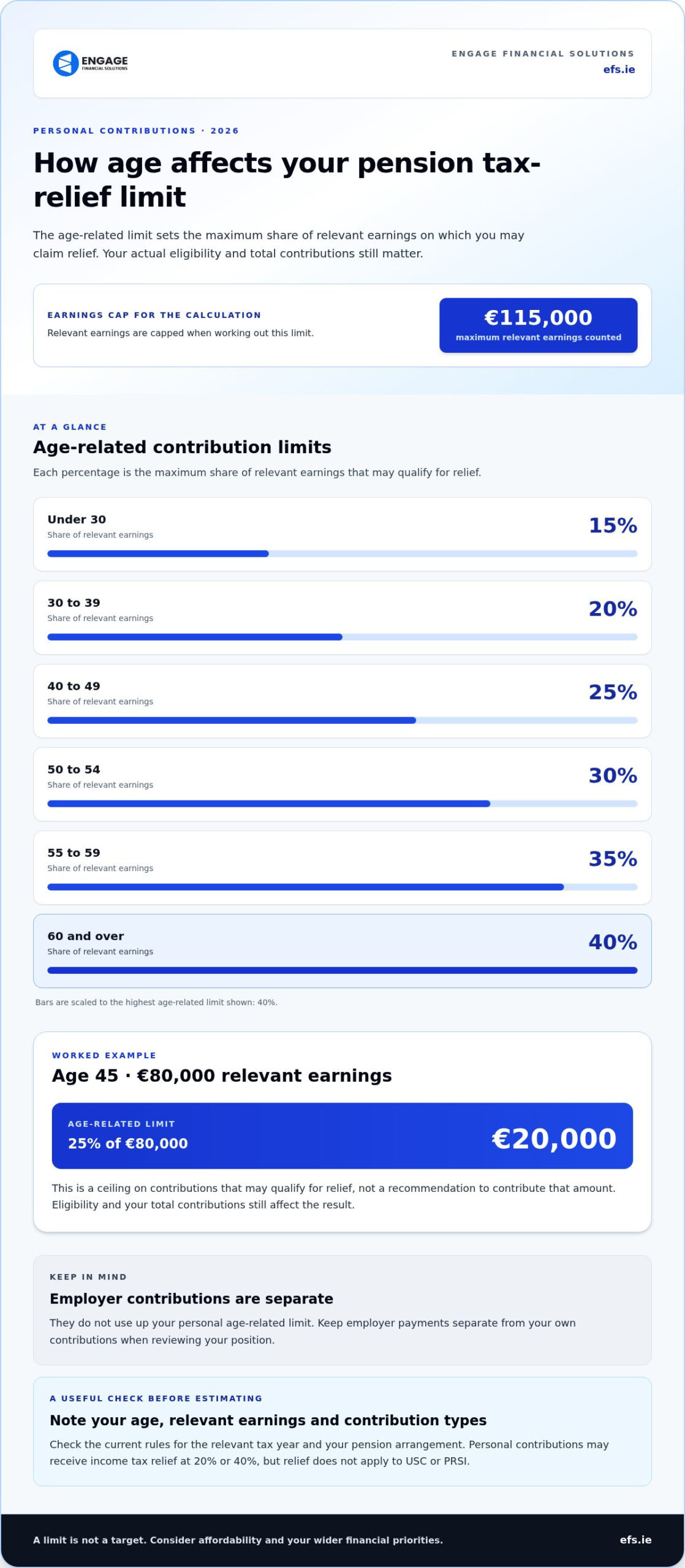
For personal contributions, the age-related limit sets the maximum share of relevant earnings on which you can claim relief. Relevant earnings are the earnings Revenue uses to calculate this limit. The 2026 limits are:
- Under 30: 15%
- 30 to 39: 20%
- 40 to 49: 25%
- 50 to 54: 30%
- 55 to 59: 35%
- 60 and over: 40%
These percentages apply to relevant earnings, capped at €115,000 for the calculation in 2026. For example, if you’re 45 and have €80,000 of relevant earnings, your age-related limit is 25% of those earnings, or €20,000. This is a ceiling on contributions that may qualify for relief, not a recommendation to contribute that amount. Your eligibility and total contributions still matter.
Employer contributions are treated separately from your personal contributions and don’t use up your personal age-related limit. If you have a workplace pension as well as a PRSA or Personal Pension, keep each contribution type clear when reviewing your position. The applicable rules can depend on your arrangement, so don’t assume the same calculation applies to every payment.
Tax relief and your personal tax position
Relief on eligible personal contributions applies to income tax, not USC or PRSI. USC is the Universal Social Charge, and PRSI is Pay Related Social Insurance. The practical value depends on your taxable income, the income tax rate that applies to you and whether you’re within the relevant limits. Relief isn’t a flat payment, and qualifying for it doesn’t mean every contribution will receive relief in full.
Keep eligibility separate from the claim process. First establish whether a contribution falls within the rules and limits, then identify how relief is applied for your pension arrangement. Payroll deductions, personal payments outside payroll and self-employed contributions can involve different steps, which are covered in the next section.
For current rules and definitions, refer to official guidance on pension contribution tax relief and Revenue information for the relevant tax year. Note your age, earnings and contributions before checking, so you can compare the guidance with your own figures. If you’re considering how contributions fit alongside other retirement priorities, tailored Retirement Planning guidance can help you see the wider picture.
Employee, self-employed and employer pension contributions compared
The route a contribution takes can affect how tax relief is applied and what records you need to keep. A workplace deduction may be handled through payroll, while a personal payment made outside payroll can require you to claim relief yourself. Self-employed contributors also have a separate filing step. The comparison below is a starting point, not a recommendation that one arrangement suits everyone.
| Contribution route | Who pays? | How relief may be handled | What to review |
|---|---|---|---|
| Workplace pension | You contribute through payroll, and your employer may also contribute. | For an occupational scheme, relief on your payroll contributions is typically applied automatically. | Check payslips, scheme statements and whether the amounts shown are your contributions or your employer’s. |
| Personal pension or PRSA outside payroll | You pay contributions directly. | You generally need to claim eligible relief through Revenue’s myAccount service. | Keep contribution receipts, identify the relevant tax year and review your income and other pension contributions. |
| Self-employed personal contribution | You pay into your own pension arrangement. | Claim eligible relief through your annual Form 11 return using Revenue Online Service (ROS). | Gather contribution records, earnings details and information for the tax year being filed. |
| Employer contribution | Your employer pays into an occupational pension arrangement. | Employer contributions are generally not treated as a taxable benefit-in-kind for the employee, and don’t use up the employee’s personal age-related contribution limit. | Separate employer payments from your own contributions when reviewing scheme and payroll records. |
Personal and workplace contributions
If you’re an employee, first check whether your contribution is deducted from your salary into an occupational Company Pension or whether you’re paying separately into a PRSA or Personal Pension. The distinction matters: payroll contributions are typically dealt with automatically, while contributions outside payroll generally need a claim through myAccount. Compare your payslips with your pension statement, and note any direct payments you’ve made so they aren’t overlooked.
A workplace arrangement may also include an employer contribution. Record that separately from your own contribution when checking your records and personal relief position.
Self-employed and employer contributions
If you’re self-employed, you’re responsible for including your eligible personal pension contribution when filing your annual Form 11 through ROS. Keep evidence of payments and match each one to the correct tax year. If you also have employment income or more than one pension arrangement, review the full picture rather than considering a single payment in isolation.
Employer contributions follow different tax treatment from personal contributions, so don’t assume they are claimed in the same way or counted against the same limits. The right arrangement depends on your work, income pattern and retirement goals. To consider how a PRSA, Company Pension or Personal Pension may fit into your plans, explore Retirement Planning guidance.
How to check your pension contribution and claim relief
Before making an additional payment or assuming relief has been applied, trace the contribution from payment to pension record. Knowing the arrangement, who paid and which tax year the payment belongs to will make it easier to work out what to do next.
Before acting, identify your pension arrangement, separate your own payments from employer contributions, and match each amount to the relevant tax year.
Information to gather before checking relief
Collect documents showing what was paid and where it went. These may include pension statements, contribution receipts, payslips, annual earnings information and records of direct payments you made. If you changed jobs or pension arrangements, gather records from each relevant period so contributions aren’t missed or counted twice.
Then use this checklist:
- Name the arrangement. Note whether it’s an occupational workplace scheme, a PRSA or another Personal Pension arrangement.
- Identify the payer. Separate your own contributions from amounts paid by your employer. A payslip or scheme statement may help distinguish them.
- Match the tax year. Record when each contribution was made and the year for which you intend to claim relief. Don’t rely on the date you received a statement alone.
- Bring together your figures. Note your relevant earnings and contributions across the arrangements you held during that tax year.
- Check current instructions. Use Revenue guidance for the year and contribution type before submitting or amending a claim.
Ways to verify that relief has been handled correctly
If you’re an employee contributing to an occupational pension scheme through payroll, compare the contribution shown on your payslip with your pension statement. Relief is typically applied automatically to payroll contributions, but comparing both records can help you spot an amount that appears missing or different. Keep employer contributions separate from your own in this check.
For a personal contribution to a PRSA or other Personal Pension outside payroll, employees generally claim relief through Revenue’s myAccount service. If you’re self-employed, claim relief through your annual Form 11 tax return using Revenue Online Service (ROS). Follow the current Revenue instructions for your circumstances, and make sure the contribution amount and tax year match your supporting records.
If the records don’t agree, pause before making another claim or contribution. Check the payment date, amount, payer and tax year against the provider statement and payroll records. If the difference remains, use Revenue’s current guidance for the relevant claim route and keep copies of your documents and any explanation you receive. Don’t assume a mismatch means relief has been granted or refused until the records are reconciled.
Keeping these details together can make future reviews simpler, especially if you have more than one pension arrangement. If you’d like help seeing how your contributions fit into your wider retirement plan, explore tailored Retirement Planning guidance.
Make pension tax relief part of a considered retirement plan
Tax relief can be one factor in deciding how much to contribute, but it shouldn’t make the decision on its own. Consider what you can comfortably set aside now, how long you expect the money to remain invested and how your pension fits with your other plans. A contribution may support future retirement income, but pension savings are subject to access rules and investment values can rise or fall.
Before changing a regular payment or making an additional contribution, review your existing arrangements together. You may have a Company Pension through work, a PRSA from a previous role and a Personal Pension you fund yourself. Each can have different features and records. Review what you already contribute, who pays each amount and whether you’re within the current relief limits for your circumstances.
Questions to consider before changing contributions
Start with your household budget. Could you maintain the contribution alongside essential costs, debt repayments and emergency savings if your income changed? Then consider your retirement goals and time horizon: how far away is the point when you expect to draw on pension savings, and how might investment risk affect your comfort with the plan?
Before increasing payments, gather details of all your pensions and contributions, including employer payments. Check the relevant tax year and use current Revenue guidance to verify the limits that apply to your age, earnings and tax position. Relief may make a contribution more tax-efficient, but it doesn’t remove access restrictions or investment risk.
When tailored retirement planning can help
Different arrangements may suit different working patterns and stages of life. A Company Pension may be part of your current employment package, while a PRSA or Personal Pension may be relevant if you change jobs or make contributions separately. Your own arrangements matter, particularly if you have more than one pension or both employment and self-employed income.
Personalised guidance can bring these moving parts into one view: your current contributions, the tax-relief rules, your intended retirement date and the income you may need later. It can also help you weigh pension saving against other financial priorities without assuming that a larger contribution is automatically the right choice. Engage Financial Solutions provides Retirement Planning guidance tailored to individuals and businesses.
Write down your pension arrangements, contribution amounts, monthly commitments and retirement goals. With those details in hand, you can have a clearer discussion about how each contribution fits into your wider plan. Explore Retirement Planning support as you review your options and plan for the future.
Make your next pension decision with confidence
Your next step doesn’t have to be a major change. Set aside time to review your pension arrangements, current contribution level and future priorities, then consider whether they still work together. If your income, employment or family commitments have changed, it may be a good time to revisit the plan rather than relying on an old assumption.
Understanding pension contribution tax relief is useful, but the wider question is how your savings, investment choices and expected retirement income fit your life. Engage Financial Solutions provides Retirement Planning guidance and advises on Personal Pensions, PRSAs and Company Pensions, helping you consider your options in context without assuming one route suits everyone.
If you’d value a tailored discussion about how your pension contributions fit your longer-term plans, explore tailored Retirement Planning guidance. A clear plan can help you take your next step with greater confidence.
Frequently Asked Questions
Is pension contribution tax relief automatic?
Not always. For contributions deducted from pay into an occupational pension scheme, relief is typically applied through payroll. If you pay personally into a PRSA or another Personal Pension outside payroll, you generally need to claim through Revenue’s myAccount service. Compare your payslip with your pension statement, then check your Revenue record for the relevant year. If the amounts don’t match, review the contribution type and current Revenue instructions before taking action.
Can I claim tax relief on pension contributions if I am self-employed?
Yes, you may be able to claim relief on eligible personal contributions, subject to the rules and limits for your circumstances. Self-employed contributors claim through their annual Form 11 tax return using Revenue Online Service (ROS). Before filing, organise your contribution receipts and income records by tax year. If you also have a Company Pension or another Personal Pension arrangement, include those details when checking your overall position.
Does pension contribution tax relief reduce USC or PRSI?
No. Relief on eligible personal pension contributions applies to income tax, not USC or PRSI. For example, a payslip may show income tax, USC and PRSI as separate deductions, so a change in income tax treatment won’t necessarily change the other amounts. If you’re comparing payslips, check each deduction separately and use Revenue guidance for the specific contribution type and tax year.
What happens if I contribute more than the amount eligible for tax relief?
The amount above your applicable limit may not qualify for the same tax relief as the eligible portion. Don’t assume that the full payment will receive relief, or that an excess contribution is automatically returned. Before changing a regular payment, total your personal contributions across arrangements and check your age, relevant earnings and the tax year. Revenue guidance can help clarify how the rules apply to your figures.
Can I claim tax relief for pension contributions from an earlier tax year?
Possibly, but whether you can claim or correct relief for an earlier year depends on the relevant rules, dates and your circumstances. For instance, a contribution paid in one year may need to be considered against the rules for the year to which the claim relates. Gather dated receipts and your tax records, then follow Revenue’s current instructions for that year. Don’t assume a late claim will be accepted.
Can I access my pension as soon as I receive tax relief?
No. Receiving tax relief doesn’t make pension savings immediately available to withdraw. Access depends on the arrangement and rules that apply to it, so a PRSA and a workplace scheme may not have identical terms. Before contributing, read the documents for your specific pension and consider when you might need the money. If you’re unsure, clarify the access conditions before committing funds you may need sooner.
Do employer pension contributions count towards my personal contribution limit?
Generally, employer contributions to an occupational scheme don’t use up your personal age-related contribution limit and are not usually treated as a taxable benefit-in-kind for the employee. Keep employer payments distinct from your own when reviewing your records. If you have multiple pension arrangements or an unusual employment situation, check the scheme information and current Revenue guidance rather than assuming every limit is calculated in the same way.
Disclaimer
Engage Financial Services LTD T/A Engage Financial Solutions is regulated by the Central Bank of Ireland CRO 764570. Suite 2 First Floor, 14 -18 Main street, Blackrock, Co Dublin. A94 W0Y3