

Could tax relief make an AVC more affordable without making it the right choice for you? If you’re asking, “Should I pay into an AVC?”, the answer depends on more than the potential tax saving. Charges, investment risk and access at retirement all matter. AVC schemes may charge fees, including management fees, which can reduce returns over time.
Qualifying contributions may receive Income Tax relief at 20% or 40%, subject to limits. For every €100 contributed, the effective cost can be €80 or €60 respectively, depending on the rate of relief you qualify for. So, when you ask, “Should I pay into an AVC?”, weigh that potential saving against how your contributions will be invested and the charges that apply.
This guide explains how tax relief and AVC charges work, and what to consider about investment performance and access to your savings at retirement. Use these points to decide whether extra contributions fit your wider retirement plans.
Key Takeaways
- Factor existing pension contributions into your annual tax-relief calculation, as Revenue Commissioners set a limit based on remuneration.
- Look beyond potential investment growth: management fees, currency movements and changing fund values can affect your eventual outcome.
- Explore how your AVC might be accessed at retirement, including whether a lump sum, an Approved Retirement Fund or an annuity could suit your plans.
- If you’re in a public-sector or defined benefit scheme, understand how its rules shape your options for making extra contributions.
- Consider AVCs alongside your wider retirement income needs, rather than judging them on tax relief alone.
Tax relief on AVC contributions
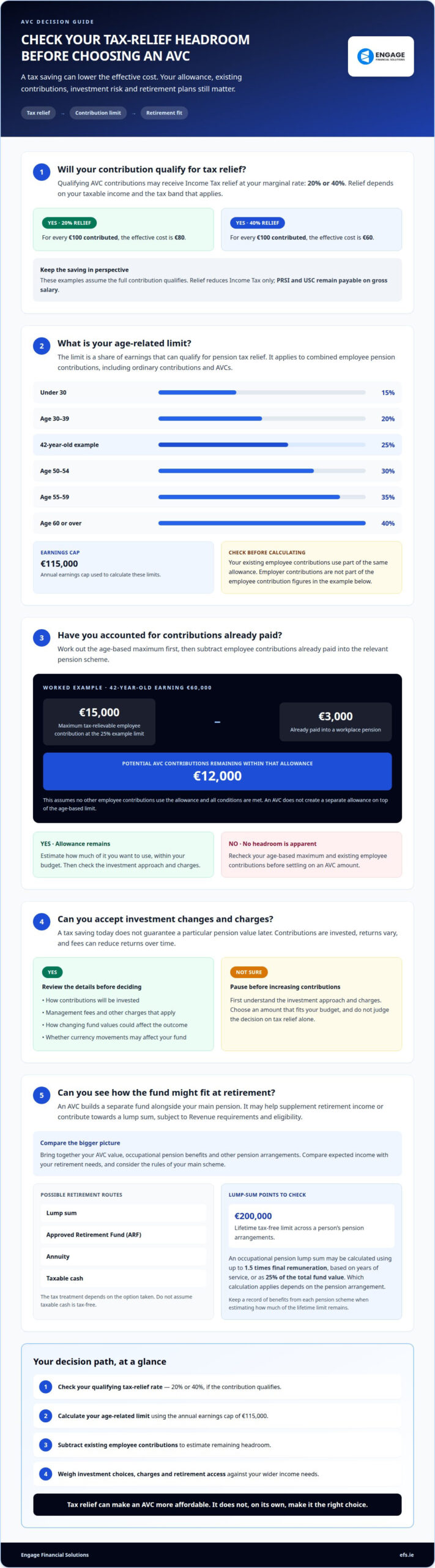
Tax relief can reduce the effective cost of an AVC, but it applies within limits. Qualifying contributions receive Income Tax relief at your marginal rate, either 20% or 40%. The rate depends on your taxable income and the tax band applying to that income. Relief reduces Income Tax, not PRSI or USC, which remain payable on gross salary. So, a €100 contribution costs €80 after 20% relief, or €60 after 40% relief. These examples assume the full contribution qualifies for relief.
Age-related limits cap the share of earnings that can qualify for pension tax relief. The limits apply to combined employee pension contributions, including ordinary contributions and AVCs. Under 30, the limit is 15% of earnings; from age 30 to 39, it is 20%. A 42-year-old example uses a 25% limit. For ages 50 to 54, the limit is 30%; ages 55 to 59, 35%; and age 60 or over, 40%. The annual earnings cap used to calculate these limits is €115,000.
Revenue Commissioners state that the aggregate amount of contributions allowed to be deducted shall not exceed 15 per cent of remuneration annually. This applies to contributions paid for the office or employment concerned. Your age-related limit and existing contributions also affect how much relief remains available. Calculate the age-based maximum first, then subtract employee contributions already paid into the relevant pension scheme. Employer contributions are not part of the employee contribution figures in the examples provided.
For instance, a 42-year-old earning €60,000 has a maximum tax-relievable employee contribution of €15,000 under the example’s 25% limit. If that person has already paid €3,000 into a workplace pension, €12,000 of potential AVC contributions remains within that allowance. This assumes no other employee contributions use the allowance and all conditions are met. The figures show why checking existing contributions matters before choosing an AVC amount. Adding an AVC does not create a separate allowance on top of the age-based limit.
Tax relief can make a larger contribution more affordable, but it does not determine your eventual pension value. Contributions are invested, and returns affect how the fund may grow before retirement. Because returns vary, a tax saving today does not guarantee a particular outcome later. Before increasing contributions, work out your remaining tax-relief entitlement and choose an amount that fits your budget. Then consider the investment approach and charges, which also affect the value available at retirement.
Accessing AVCs at retirement
Yes. AVCs can supplement an occupational pension or help fund a retirement lump sum, subject to Revenue requirements and your eligibility. The options you choose affect how the money can support you in retirement.
Supplementing retirement income
An AVC is an additional pension contribution that builds a separate fund alongside your main pension scheme. At retirement, this fund can help bridge the gap between your expected income and the income you want. For example, it could add to the resources available alongside your occupational pension.
An AVC may be worth considering if your main scheme is unlikely to provide the retirement income you have planned for. Compare your expected pension benefits with your other income and expenses, then decide what role an AVC fund could play. Its final value depends on contributions and investment performance, so consider it as part of your wider retirement plan.
Taxation of retirement benefits
Retirement benefits may include a tax-free lump sum, an Approved Retirement Fund (ARF), an Annuity or taxable cash. The tax treatment depends on the option you take. Do not assume that a cash payment described as taxable will be tax-free.
There is a lifetime tax-free limit of €200,000 across a person’s pension arrangements. This means the lump sum available from an AVC needs to be considered alongside lump sums from other pensions. Keep a record of benefits from each pension scheme when estimating how much of the lifetime limit remains available.
An occupational pension lump sum may be calculated using up to 1.5 times final remuneration, based on years of service, or as 25% of the total fund value. Which calculation applies depends on the pension arrangement. These methods can produce different outcomes, so the AVC’s potential lump sum should be assessed alongside the rules for your main scheme.
After considering a lump sum, an ARF may provide another way to manage retirement funds. An Annuity is also an option, while taxable cash offers a different form of access. Each choice affects how your pension savings support you, so weigh the need for money upfront against the role of funds intended to provide retirement income.
Before deciding, bring together your AVC value, occupational pension benefits and any other pension arrangements. This gives you a clearer view of the combined lump sums and retirement income available. Retirement planning can help place those choices in the context of your wider financial plans.
AVCs for public-sector and defined benefit scheme members
If your pension scheme limits extra contributions, a separate AVC arrangement may offer another route. The right option depends on your existing benefits, remaining tax-relief capacity and retirement savings goals.
Assessing whether AVCs are worthwhile
Assess an AVC by comparing the extra retirement benefits it could provide with what your current scheme already offers. This is particularly important with a defined benefit scheme, where your pension is based on scheme rules rather than solely on an individual investment fund.
First, understand the pension income your scheme is expected to provide, then identify any gap between that and your retirement income needs. Consider whether an AVC could help address the gap or support a lump sum, within your available tax-relief limit. Public-sector AVC contributions are typically made from pre-tax income, reducing Income Tax. Your salary and existing employee contributions affect your remaining relief entitlement, so include both when assessing a possible contribution.
There is no single contribution level that suits every scheme member. Weigh the potential additional benefit against the effect on your take-home pay, investment choices and charges. Do not treat the maximum contribution allowed for tax relief as a target. Instead, consider what you can sustain and how the extra pension savings would support your retirement plans.
Managing AVC complexity
Managing AVCs means coordinating an additional pension arrangement with your main scheme, its rules and your retirement plans. Contribution limits and access options may depend on how the AVC is structured.
Where occupational-scheme AVCs are limited or not permitted, an employer must make a nominated PRSA, or Personal Retirement Savings Account, available. This can provide a route for extra contributions outside the occupational scheme. Consider it alongside your main pension, not in isolation.
Keep your scheme benefits, employee contributions, AVC contributions and intended retirement options together. This makes it easier to see how the arrangements fit and whether your contributions remain within your available relief limit. If your scheme rules affect your options, consider how a PRSA might fit before choosing a contribution amount.
Public-sector members should consider how AVC savings could complement their scheme benefits, rather than assuming the additional fund will replace them. For example, an AVC could build a separate pool of retirement savings for a particular income or lump-sum goal. Investment returns and charges affect its eventual value, so the contribution alone does not establish what it will provide.
For a clearer view of how your scheme, AVC and retirement goals work together, retirement planning can help structure the decision. Focus on the benefits you need, the contribution level you can maintain and the rules governing your chosen arrangement.
Are AVCs a good investment?
An AVC combines extra pension contributions with investment risk, so its eventual value can rise or fall. Consider the available fund choices, charges and access rules alongside your retirement savings goals.
Investment choices and risk
Your AVC contributions are invested, and the available choices depend on the scheme. Each choice has a different balance of potential growth and risk. Consider how much fluctuation you could accept and when you expect to use the money.
An investment’s value can go down as well as up. Currency exchange-rate changes may also affect its value, and past performance is not a reliable guide to future performance. A fund that performed well previously may not do so again. Treat projected growth as uncertain, and compare investment choices with your time horizon and tolerance for losses.
Access rules matter too. Early access to occupational pension and AVC funds may be possible from age 50 if you leave service or take early retirement, subject to employer and scheme trustee approval. This is not the same as unrestricted access. If you are considering an AVC through a PRSA, or Personal Retirement Savings Account, include its retirement access arrangements in your decision.
Investment charges
AVC schemes may charge fees, including management fees, which reduce investment returns over time. Charges can accumulate as they are deducted from the fund, leaving less invested for potential growth.
Compare charges alongside the investment approach, rather than judging an option by performance figures alone. A fund’s return before charges does not show what remains after costs. Review the charge structure for the AVC options available to you and consider how ongoing deductions could affect the fund by retirement.
Payroll arrangements also affect how contributions are handled. Group AVC contributions are collected at source through payroll, so members do not need to set up bank direct debits or claim tax relief through Revenue. This can simplify payments, but it does not remove investment risk or charges.
To assess whether an AVC suits you, consider three things together: whether the investment choices match your risk tolerance, what charges may reduce returns, and when you can access the fund. Do not assume growth is guaranteed. A regulated pension arrangement is still exposed to market movements, so choose based on your retirement timeframe and overall financial plans.
What charges apply to my AVC?
AVCs build a pension pot, but charges and access rules affect what you may eventually receive. Check both before deciding whether an AVC fits your retirement plans. Charges reduce the money left invested, while access conditions determine when you can use it. These are separate considerations: convenient payment arrangements do not remove investment costs or withdrawal restrictions.
AVC schemes may have fees and charges, including management fees. These can reduce investment returns over time, so consider their effect while your savings remain invested. There is no single charge or fee structure for every scheme. Identify which charges apply to your arrangement and how they affect the fund. Focus on the amount deducted and the service or investment management it covers.
Access depends on the pension arrangement, your circumstances and the scheme’s conditions. Early access to an occupational pension and AVCs may be possible from age 50 if you leave service or take early retirement, subject to employer and scheme trustee approval. This is not an automatic right to withdraw funds at that age. Whether you work in the public or private sector, the relevant scheme conditions remain important.
At retirement, an AVC may support options such as a lump sum, an Approved Retirement Fund (ARF), taxable cash or an Annuity, subject to Revenue requirements and your eligibility. Each serves a different purpose. A lump sum provides money upfront, while an ARF keeps funds invested for retirement. Taxable cash is treated differently from a tax-free lump sum, so consider how your choice could affect your overall retirement income.
Before choosing your contributions, consider when you may need access to the money and what you want the pension pot to provide. For example, if you expect to rely on an ARF for income, consider how a withdrawal could affect the fund left invested. Keep your AVC details with your main pension information, including the scheme rules, charges and retirement options. This gives you a clearer picture of how your additional savings may fit together.
Revenue requirements and scheme conditions can affect how benefits are taken, so don’t assume every access route applies to every AVC. Review the terms for your specific arrangement and weigh its charges against the role the fund is intended to play. To consider how an ARF could fit your retirement plans, explore the option as part of your wider pension picture.
Engage Financial Solutions
Engage Financial Solutions provides retirement planning and can help you consider an AVC alongside your wider financial plans. This may be useful if you’re weighing potential tax relief against investment risk, charges and access at retirement. A broader view can help you assess how extra pension savings fit with your expected income and other priorities, rather than making the decision on tax relief alone.
Before deciding, bring together your existing pension benefits, current contributions and retirement goals. This gives you a practical starting point for discussing whether additional contributions could support the future you have in mind. If you’d like to talk through your options, contact Engage Financial Solutions.
Make your next retirement decision with clarity
If you’re still asking, “Should I pay into an AVC?”, start with what you want your retirement savings to make possible. Consider how an extra contribution fits with your current commitments and future priorities, such as flexibility or a regular income. This keeps the decision connected to the life you want, rather than focusing on one feature in isolation.
“Should I pay into an AVC?” is a question you can explore without settling every detail at once. A considered conversation can help you see how your pension choices fit your wider financial plans and what to consider before acting. Discuss your pension options with Engage Financial Solutions and take a confident next step towards the future you’re planning for.
Frequently Asked Questions
What happens with my AVC when I retire?
At retirement, your AVC fund may support a lump sum, an Approved Retirement Fund, an Annuity or taxable cash, subject to Revenue requirements and eligibility. The option you choose affects whether money is available upfront or remains invested to support retirement income. For example, someone seeking a regular income may weigh an annuity against keeping funds invested in an ARF. Consider your other pension benefits alongside the AVC.
Are AVCs worth it?
An AVC may be worthwhile if extra pension savings support a clear retirement goal and fit your finances now. Weigh potential tax relief against investment risk, charges and the time until you expect to use the fund. For example, someone with a defined benefit pension might use an AVC to build an additional fund for a lump sum. Whether it makes sense depends on your circumstances, not tax relief alone.
Can I cash in my AVCs?
You generally access AVC benefits through retirement options, rather than treating the fund like an ordinary savings account. These may include a lump sum, an ARF, an Annuity or taxable cash, subject to eligibility and Revenue requirements. Early access to occupational AVCs may be possible from age 50 after leaving service or taking early retirement, with employer and scheme trustee approval. Check which conditions apply to your arrangement.
Can I change my AVC contributions?
You may be able to change your contribution, but the process depends on how your AVC is arranged. If you contribute through payroll, an adjustment may take up to two months to affect your salary. Plan changes around your monthly budget, particularly if you’re reducing contributions to manage other expenses. Review the amount when your income or retirement priorities change.
Can I transfer my AVC pension fund if I change jobs?
Changing jobs does not by itself determine whether you can transfer your AVC. Your options depend on the type of arrangement and its scheme rules. Before deciding, establish whether the fund can remain in place or a transfer is available, then compare the investment choices, charges and access conditions. Keep the AVC details with your pension records while considering your new employer’s scheme.
Can I vary my AVC contributions?
You may be able to change your contributions, but the terms depend on your scheme or AVC arrangement. If payments are taken through payroll, a change may take up to two months to show in your salary. Decide whether you want to increase, reduce or pause contributions, then consider the effect on your budget and remaining tax-relief allowance. Changing the amount does not remove investment risk or charges.
What is an AVC pension and how does it work?
An AVC, or additional voluntary contribution, is an extra payment into a pension arrangement to build retirement savings alongside your main pension. Contributions are invested, so the eventual fund value can change with investment performance and charges. For example, a workplace pension member may contribute through payroll, while another arrangement may use a PRSA. Tax relief is subject to age-related limits and existing contributions.
What tax relief is available on AVC contributions, and what are the age-related limits?
Qualifying AVC contributions may receive Income Tax relief at 20% or 40%, depending on your marginal rate and applicable limits. The age-related limits are 15% of earnings under 30, 20% from 30 to 39, 30% from 50 to 54, 35% from 55 to 59, and 40% from 60. A provided example uses 25% for a 42-year-old. The earnings cap is €115,000, and existing employee contributions count towards the limit.
Disclaimer
Engage Financial Services LTD T/A Engage Financial Solutions is regulated by the Central Bank of Ireland CRO 764570. Suite 2 First Floor, 14 -18 Main street, Blackrock, Co Dublin. A94 W0Y3