

The more flexible pension isn’t automatically the better fit. The PRSA vs Personal Pension decision often comes down to how you work and whether employer contributions matter: employers can contribute to a PRSA, while a Personal Pension is generally for self-employed people or those in non-pensionable employment. Both can qualify for income tax relief, with the maximum percentage of earnings depending on your age.
It’s understandable to focus on tax relief first, but the contribution rules and pension structure also shape how well an option fits your circumstances. In this guide, you’ll compare who can use each arrangement, how contributions work and what relief may apply. Pension contributions receive relief at your marginal income tax rate, according to Revenue, subject to age-related limits and an earnings cap of €115,000. We’ll also explain the practical differences to consider, so you can weigh the options against your employment situation and retirement plans.
Key Takeaways
- Compare how your employment situation affects access to a PRSA or Personal Pension before choosing an arrangement.
- Use your age and earnings to understand the limits on tax-relievable contributions, and how relief is applied.
- Consider whether employer contributions and the flexibility to adjust payments matter for your circumstances.
- Before adding a PRSA to an existing pension, look at how the arrangements work together and how contributions are treated.
- Compare investment choices and charges as well as tax relief to see which option better supports your retirement plans.
How much can I contribute and what pension tax relief can I claim?
Contribution rules depend on your age, earnings and employment arrangements. Compare the tax-relief limits with the flexibility and employer support you need.
Employer Contributions and Occupational Pension Access
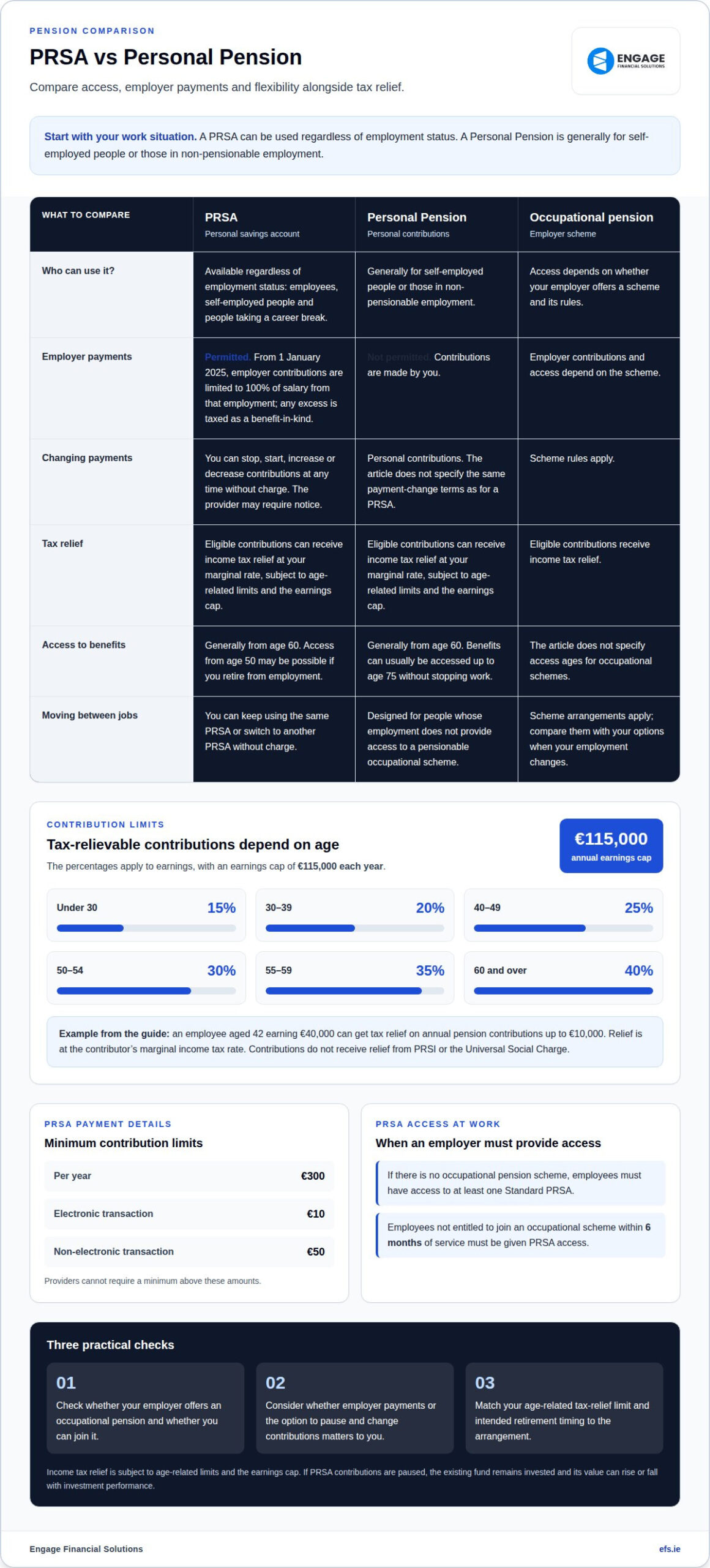
An employer can contribute to a PRSA, but cannot contribute to a Personal Pension. If your employer has no occupational pension scheme, employees must have access to at least one Standard PRSA; employees not entitled to join an occupational scheme within 6 months of service must be given PRSA access.
From 1 January 2025, employer PRSA contributions are limited to 100% of salary from that employment; any excess is taxed as a benefit-in-kind. Private pension benefits build retirement savings alongside any State Pension entitlement. Contributions qualify for income tax relief, but not relief from PRSI or the Universal Social Charge.
PRSA Contribution Flexibility and Minimums
A PRSA lets you stop, start, increase or decrease contributions at any time without charge, although the provider may require notice. Providers cannot require a minimum contribution above €300 a year, €10 for each electronic transaction or €50 for each non-electronic transaction.
Employers can contribute to a PRSA, while Personal Pension contributions are made by you. If you pause payments, your existing fund remains invested, so its value can rise or fall with investment performance. Consider whether this flexibility suits variable income and how changes to your contributions fit your savings plan.
Contribution Limits and Income Tax Relief
Tax-relievable contributions are limited by age-related percentages of earnings and an earnings cap of €115,000 each year. The limits are 15% under age 30, 20% from 30 to 39, 25% from 40 to 49, 30% from 50 to 54, 35% from 55 to 59, and 40% from age 60.
An employee aged 42 earning €40,000 can get tax relief on annual pension contributions up to €10,000, according to Revenue. Revenue also says relief applies at the contributor’s marginal, or highest, income tax rate. Eligible contributions reduce income tax due, but do not receive relief from PRSI or the Universal Social Charge.
| Option | Employer payments | Contribution flexibility | Tax-relief basis |
|---|---|---|---|
| PRSA | Permitted within the salary limit | Payments can be changed or paused | Age-related earnings limit and earnings cap |
| Personal Pension | Employer payments are not permitted | Personal contributions | Age-related earnings limit and earnings cap |
| Occupational pension | Access depends on the employer’s scheme | Scheme rules apply | Eligible contributions receive income tax relief |
You can transfer from one PRSA to another without a transfer penalty, and a Personal Pension can be transferred into a PRSA. Conditions may apply, depending on the transfer. Weigh employer support, payment flexibility and your available tax-relief limit when choosing.
Choosing a pension based on employment and retirement needs
Employment status shapes which personal retirement savings arrangements are open to you. PRSA and Personal Pension benefits are generally accessible from age 60; a PRSA may allow access from age 50 if you retire from employment, while a Personal Pension holder can usually access benefits from age 60 up to age 75 without stopping work.
Pension Choices by Employment Status
You can take out a PRSA regardless of your employment status, so it can suit employees, self-employed people and those taking a career break. A Personal Pension is generally available to self-employed people or those in non-pensionable employment. Your work arrangements are therefore an important first distinction.
If you change jobs, you can keep using the same PRSA or switch to another PRSA without charge. This portability can help you maintain personal retirement savings as your employer or working circumstances change. A Personal Pension, by contrast, is designed for people whose employment does not provide access to a pensionable occupational scheme.
Accessing Benefits at Retirement
For a PRSA or Personal Pension, access generally begins from age 60, with earlier access possible in some cases. A PRSA may allow access from age 50 if you retire from employment; a Personal Pension holder can access benefits between age 60 and age 75 without retiring or stopping work.
These differences matter if you plan to keep working while drawing pension benefits or hope to retire earlier. Distinguish when you can access your private pension from your plans for the State Pension. Before choosing, compare your intended retirement date with the access conditions for each arrangement.
Employer access rules also affect your options. If an employer has no occupational pension scheme, employees must be given access to at least one Standard PRSA. Employees who are not entitled to join an occupational pension scheme within 6 months of service must also be given access to a PRSA.
This employer access rule provides a route to retirement savings, but it does not make a PRSA an occupational pension scheme. A PRSA is an individual retirement savings account that remains yours when your employment changes. The Pensions Authority maintains a register of PRSA products and providers, which can help you understand the registered options.
To make a practical choice, first identify whether your current role offers an occupational pension and whether you can join it. Then consider whether you need an arrangement that can continue through job changes or career breaks. Finally, match the access rules to your retirement plans, including whether you expect to keep working after drawing benefits.
Financial advice can help you assess how a pension fits your employment, existing savings and retirement income plans. If you are weighing these decisions alongside broader retirement planning, consider how each arrangement supports the future you want.
Differences between a PRSA and a Personal Pension
A PRSA and a Personal Pension both build retirement savings, but their structures and investment choices differ. The right fit depends on your employment, the investment choice you want and whether capped charges matter to you.
A PRSA is an individual defined contribution arrangement: your contributions are invested, and the eventual fund depends on investment performance and charges. A Personal Pension, also called a Personal Pension Plan or Retirement Annuity Contract, is generally used by self-employed people or those in non-pensionable employment. Both are designed for personal retirement saving, rather than providing a fixed retirement income in advance.
There are two main PRSA types. A Standard PRSA invests in pooled funds, where investment risk is spread across a range of investments. Its charges are capped at 5% on contributions and an annual fund management fee of 1%. A Non-Standard PRSA has no statutory charge cap and may allow investment in funds beyond pooled funds. Personal Pension Plans may also offer a wider choice of funds than Standard PRSAs.
These differences matter when comparing a PRSA with a Personal Pension. A Standard PRSA offers capped charges and a pooled-fund structure. Non-Standard PRSAs and Personal Pension Plans can offer broader investment choices, with different charges and investment risks. Read the fund information and charge details together, rather than judging an arrangement by its product label alone.
To choose and set one up, first identify whether your employment makes a Personal Pension appropriate, then compare PRSA types, investment options and charges. You can obtain a PRSA directly from a registered provider or through a financial adviser. People opening a PRSA or Personal Pension will usually need a financial broker. The Pensions Authority maintains a register of PRSA products and providers.
A Personal Investment Account (PIA) serves a different purpose. A flat 1% tax rate applies to the account’s value above €50,000. Unlike a PRSA, a PIA allows access to money before retirement age, so it may suit additional long-term investing where access matters.
For retirement saving, compare pension arrangements with your work status and appetite for investment choice. For money you may need before retirement, consider how a PIA’s access differs from a pension’s purpose. Revenue’s rules on pension tax relief also matter, so assess tax treatment alongside fund selection and charges.
Whether to get a PRSA alongside an existing pension
A second pension can help you save beyond an existing arrangement, but it does not automatically create a separate tax-relief allowance. Before opening a PRSA, map your current contributions, employer payments and retirement goals. Then consider whether a separate account adds flexibility or duplicates an arrangement you already have.
If you’re employed in an occupational scheme, a PRSA can provide an individual pension alongside it. This may be useful if you want to continue saving when changing jobs or taking a career break. However, compare the investment options, charges and access rules across both arrangements before deciding where future contributions should go.
Tax relief remains a key part of the calculation. Contributions to both products are subject to an earnings cap, and your age-related limit still matters. An additional PRSA is not a way to bypass those limits. Estimate your eligible contributions across your pension arrangements before setting a payment level.
Employer payments can also change the picture. Since January 2025, employer contributions to an employee’s PRSA do not count against that employee’s age-related tax-relief limits and do not trigger a benefit-in-kind charge. This differs from personal contributions, so separate the two when reviewing the funding of an existing occupational scheme and any PRSA.
Next, compare what you already hold. A PRSA gives you an individual account, while an occupational scheme follows its own rules. You can make ongoing contributions to a PRSA; a Personal Retirement Bond, by contrast, does not accept ongoing personal or employer contributions. This distinction matters if you want to keep adding savings rather than preserve benefits from an earlier scheme.
Charges and investment risk deserve a side-by-side review. Standard PRSA charges are capped, including a maximum 5% charge on contributions and a 1% annual fund management fee. A Non-Standard PRSA has no statutory charge cap. Compare the actual investment approach and charges with your existing pension, not just the product name.
Also consider how multiple arrangements affect retirement choices. An eligible PRSA or Personal Pension may provide a lump sum of up to 25% of its fund, subject to a lifetime limit of €200,000. That lifetime limit makes it sensible to consider any other pension benefits when planning how to take retirement funds.
Use a simple decision sequence: list each pension and its contributions, compare investment choices and charges, then estimate the tax-relievable contributions available to you. If a PRSA fills a clear gap, such as continued saving outside an occupational scheme, it may complement rather than replace existing benefits.
What a PRSA is and how it compares with other personal pensions
A PRSA is one type of personal pension, but the term also includes Personal Pension Plans. Eligibility, investment structures and charges differ, so compare the arrangements themselves before choosing.
Understanding a PRSA
A Personal Retirement Savings Account is an individually owned, defined contribution pension. Contributions are invested, and the eventual value depends on investment returns, fees and charges, and the cost of buying retirement benefits. You can keep the same PRSA when changing jobs or taking a career break, rather than relying on one employer’s occupational pension.
Standard PRSAs invest in pooled funds, spreading investment risk across a variety and number of investments. Their charges are capped: the maximum charge on contributions is 5%, and the annual fund management fee is capped at 1%. Non-Standard PRSAs have no statutory charge cap and may invest beyond pooled funds. That makes the specific fund and charge details important when comparing providers.
PRSA holders should receive an investment performance report and a statement of account every 6 months. The account statement shows contributions and the PRSA’s transfer value. A statement of reasonable projection arrives every year, estimating retirement benefits using assumptions. These reports give you practical information to review how savings and investment performance are progressing.
Understanding a Personal Pension
A Personal Pension Plan, also called a Retirement Annuity Contract, is generally available to self-employed people or those in non-pensionable employment. It is an individual defined contribution arrangement: contributions are invested for retirement, and the resulting benefits depend on fund performance and relevant charges.
Unlike a PRSA, a Personal Pension is generally not available to everyone, regardless of employment status. It may offer a wider choice of investment funds than a Standard PRSA, but charges and investment options depend on the particular plan. Compare the fund selection and applicable charges rather than assuming greater choice means a better fit.
A PRSA can receive employer contributions, while a Personal Pension cannot. Both are personal retirement savings options, but a PRSA’s portability can be useful if your employment changes. A Personal Pension may better suit self-employment or non-pensionable work. The key distinction is not simply the name: assess eligibility, investment risk, charges and how you can make contributions.
For either arrangement, the value of benefits depends on contributions, investment returns after fees and charges, and the cost of buying benefits. Ask a financial adviser to compare those elements with your employment and retirement plans. For support aligning a pension choice with your wider goals, explore tailored financial planning.
Engage Financial Solutions: PRSA (Personal Retirement Savings Account)
Engage Financial Solutions can help you assess whether a PRSA fits your employment, contribution plans and retirement goals. If you’re comparing it with a Personal Pension or considering an additional pension alongside an existing scheme, look at how the arrangement fits your wider financial plans, including your expected retirement income.
Before deciding, bring together details of your current pension arrangements, planned contributions and preferred retirement timing. This gives you a clearer basis for discussing whether a PRSA supports your savings needs and how it may sit alongside other provisions, such as Income Protection.
For guidance on your pension options, contact Engage Financial Solutions.
Make your next financial decision with confidence
Your PRSA-versus-Personal Pension decision is one part of a wider plan for financial security. Consider how retirement savings fit alongside your other priorities, whether you’re preparing for a first home, managing a rental property or reviewing an existing mortgage. A clear view of your goals can help you make decisions that work together rather than in isolation.
Engage Financial Solutions can also help with switching mortgages, first-time buyer mortgages and buy-to-let mortgages. If your plans involve both pension choices and property finance, consider how each decision affects your longer-term financial direction. Focus on the outcome you want, then take the next step with relevant guidance.
Speak with Engage Financial Solutions about your financial plans and move forward with greater clarity.
Frequently Asked Questions
How do charges and investments compare?
Compare the charge taken from each contribution separately from the annual fund management charge. A Standard PRSA caps these at 5% on contributions and 1% annually on fund management; Non-Standard PRSAs and Personal Pension Plans may have different charges and investment choices. Look at the actual funds available, their risks and all applicable charges together. A wider fund range does not, by itself, show that an arrangement suits your needs.
What do PRSAs and Personal Pensions have in common?
Both are individual, defined contribution arrangements designed to build retirement savings. Your eventual fund depends on contributions and investment performance, rather than a guaranteed pension amount set in advance. Both can qualify for income tax relief within the applicable limits. As a practical step, list each arrangement’s contributions, investments and projected benefits together. This helps you assess your overall retirement provision rather than viewing one account in isolation.
What should I do before choosing a pension?
Start by noting your employment status, existing pension arrangements and intended retirement timing. Then compare eligibility, investment options, charges and how contributions can be made. For example, an employee in an occupational scheme may weigh a PRSA differently from a self-employed person without one. Check how each option fits your wider retirement income plan, and consider financial advice to understand the trade-offs before committing to contributions.
Why choose a Personal Retirement Savings Account?
A PRSA can suit you if you want a pension that remains yours through job changes or a career break. It is available regardless of employment status, and employers can contribute to it. For example, if you move from employment to self-employment, a PRSA can continue as your personal retirement arrangement. Compare the PRSA type, its funds and charges before deciding whether it complements your existing savings.
Can an employer contribute to a Personal Pension?
No. An employer can contribute to a PRSA, but cannot contribute to a Personal Pension. From 1 January 2025, employer PRSA contributions are limited to 100% of salary from that employment; an excess is taxed as a benefit-in-kind. Employer payments within that limit do not count against the employee’s own age-related tax-relief limits. Keep employer contributions distinct from your personal payments when reviewing pension funding.
Can you keep making contributions?
Yes. You can continue contributing to a PRSA while building retirement savings, and you can stop, start, increase or reduce PRSA payments without charge. A provider may require notice when you change payments. Personal Pension contributions are also made by the individual, rather than the employer. Before setting or changing payments, consider your budget and how total pension contributions fit within your available tax-relief limits.
What are the main differences between a PRSA and a Personal Pension?
A PRSA is available regardless of employment status and can receive employer contributions. A Personal Pension is generally for self-employed people or those in non-pensionable employment, and employers cannot contribute to it. Investment choices and charges also differ by arrangement and product type. To narrow your choice, start with your employment situation, then compare the specific funds and charges rather than relying on the product name alone.
What are the current PRSA and Personal Pension contribution tax-relief limits?
For the 2026 tax year, tax-relievable contributions are capped by age-related percentages of earnings, with an earnings cap of €115,000. The limits are 15% under age 30, 20% at 30 to 39, 25% at 40 to 49, 30% at 50 to 54, 35% at 55 to 59, and 40% from age 60. Revenue says relief is at your marginal income tax rate, not for Pay Related Social Insurance contributions or the Universal Social Charge.
Disclaimer
Engage Financial Services LTD T/A Engage Financial Solutions is regulated by the Central Bank of Ireland CRO 764570. Suite 2 First Floor, 14 -18 Main street, Blackrock, Co Dublin. A94 W0Y3