


What if the most significant gift you leave your family isn’t a physical asset, but the quiet certainty that they’ll always be looked after? Securing the right life insurance Ireland policy is about more than just a monthly premium; it’s about building a bespoke financial architecture that protects your loved ones whilst remaining flexible enough to evolve with your life. You might feel a bit of hesitation when faced with jargon like ‘assurance’ versus ‘insurance’, or perhaps you’re concerned about how a medical exam might affect your eligibility. These are common worries, but they shouldn’t stand in the way of your family’s future security.
We’ve designed this expert-led guide to help you master the process of choosing the perfect cover for your specific life stage. You’ll gain a clear understanding of the policy types available in 2026, alongside a straightforward framework to calculate exactly how much protection you need. By the time you finish reading, you’ll have the confidence to begin your application, knowing you’re making an informed decision for your long-term stability. We’ll walk through everything from the impact of the latest Consumer Protection Code to the nuances of inheritance tax planning, ensuring your journey to peace of mind is as seamless as possible.
Key Takeaways
- Distinguish between fixed-term insurance and whole-of-life assurance to select the most appropriate protection for your family’s unique requirements.
- Approach the life insurance Ireland market with a methodical framework designed to simplify the application process and eliminate uncertainty.
- Utilise the income replacement method to calculate a precise level of cover that accounts for both daily living costs and any outstanding debts.
- Understand how full medical disclosure and professional guidance can streamline your application whilst helping you secure the best possible terms.
- Identify why an independent broker provides a more flexible and personalised path to financial security than the limited options offered by high-street banks.
Understanding Life Insurance in Ireland: Safeguarding Your Family’s Future
At its core, life insurance is a straightforward financial contract. You agree to pay a regular premium, and in return, the insurer provides a tax-free lump sum to your beneficiaries if you pass away. This payment acts as a vital safety net, ensuring your family isn’t left with a financial burden during an already difficult time. Understanding Life Insurance involves recognising that it isn’t just about a eventual payout; it’s about the immediate security it buys for those you love most. In the context of life insurance Ireland providers are strictly regulated by the Central Bank of Ireland. This regulation is essential for your protection, particularly with the new Consumer Protection Code coming into effect on March 24, 2026, which ensures clearer information and fairer treatment for all policyholders.
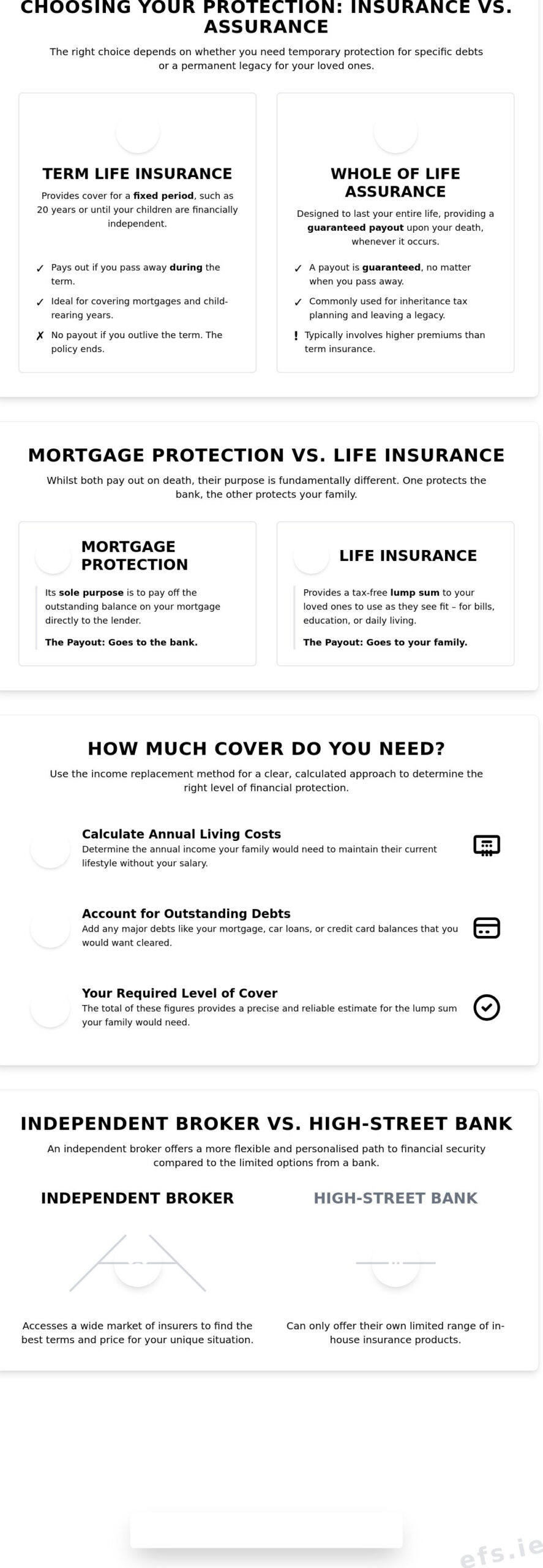
Many people feel confused by the terms ‘insurance’ and ‘assurance’, yet the difference is quite simple. Life insurance usually refers to ‘term’ cover, which lasts for a specific period, such as twenty years or until your children finish university. If you don’t pass away during that term, the policy simply ends. Life assurance, on the other hand, is generally ‘whole of life’ cover. It’s designed to last until you pass away, whenever that may be, making it a guaranteed payout. This distinction is crucial amongst the shifting economic landscapes of 2026, as your choice will depend on whether you need temporary protection for specific debts or a permanent legacy for inheritance tax planning.
Life Insurance vs Mortgage Protection
It’s a common misconception that mortgage protection and life insurance are the same thing. Whilst they both provide a payout upon death, their purposes are distinct. Mortgage protection is usually compulsory when you take out a loan; its sole job is to pay off the bank so your family can stay in the home. It doesn’t provide any extra cash for daily living costs. By contrast, life insurance Ireland policies are a voluntary choice that provides a lump sum directly to your family. This money can be used for anything from groceries and utilities to future education costs. For a more detailed look at the specifics of home-related cover, you can explore our Mortgage Protection Ireland guide.
The Emotional and Financial Peace of Mind
Choosing a policy provides an immediate sense of relief. It acts as the cornerstone of a wider financial strategy, ensuring that your long-term goals remain on track even in your absence. Whether you’re worried about your spouse’s ability to maintain their lifestyle or your children’s future university fees, this cover bridges the gap between uncertainty and stability. This level of protection fits seamlessly with other areas of your life, such as retirement planning in Ireland, creating a holistic shield for your financial health. By taking this step, you’re not just buying a product; you’re securing a legacy of care and responsibility.
Navigating the Different Types of Life Cover in Ireland
Choosing the right policy requires a clear understanding of how different products align with your long-term goals. The Competition and Consumer Protection Commission (CCPC) provides impartial guidance on these options, helping you identify which structure best serves your family’s needs. Whether you’re looking for a temporary safety net or a permanent legacy, the Irish market offers several distinct paths. Selecting the most appropriate form of life insurance Ireland depends largely on your current life stage and your future financial aspirations.
Term Life Insurance is perhaps the most flexible option for growing families. It provides cover for a specific duration, such as until your youngest child finishes university or until your retirement age. If you pass away during this period, the policy pays out; if you outlive the term, the cover simply ends. For those who want more versatility, many providers offer a ‘conversion option’. This allows you to extend your cover or switch to a whole-of-life policy at the end of your term without undergoing a new medical examination. This is particularly valuable if your health changes over the years, as it guarantees you won’t be left without protection when you need it most.
Whole of Life Assurance, by contrast, is designed to remain in place until you pass away. Because a payout is guaranteed, premiums are typically higher than term policies, but the benefits are significant for estate planning. With Capital Acquisitions Tax (CAT) currently set at 33% for inheritances above specific thresholds, such as the €400,000 limit for children, a whole-of-life policy can be used to cover potential tax bills. This ensures your heirs don’t have to sell family assets just to settle a Revenue debt.
Pension Term Insurance: The Tax-Efficient Choice
If you’re self-employed or in a job that doesn’t offer a company pension, Pension Term Insurance is often the most cost-effective way to organise your cover. The Revenue Commissioners allow you to claim tax relief on your premiums at your marginal rate, which could be as high as 40%. This unique benefit means that a significant portion of your protection costs is essentially funded by the state. It’s a highly efficient way to safeguard your dependents whilst simultaneously managing your tax liabilities.
Whole of Life vs Term Life: Which Fits You?
Deciding between these options involves weighing the “guaranteed payout” of assurance against the lower cost of a “protection period” offered by term life. Young families often favour term life because it provides high levels of cover for a lower monthly outlay during their most vulnerable years. If you’re currently climbing the property ladder, an expert mortgage broker can help you align these insurance choices with your home ownership journey. To ensure your plan remains robust as your life evolves, you might consider speaking with an advisor who can tailor a strategy to your specific circumstances.
How to Calculate the Right Level of Cover for Your Lifestyle
Determining the correct amount of protection is one of the most critical steps in securing your family’s future. It’s not about picking a random figure or using a “black box” calculator; it’s about building a realistic financial buffer based on your unique circumstances. When considering life insurance Ireland experts often recommend the “Income Replacement” method as a starting point. This approach suggests aiming for a lump sum between 10 and 15 times your annual gross salary. If you earn €50,000, a policy of €500,000 to €750,000 provides a robust foundation, allowing your dependents to maintain their standard of living whilst they adjust to a new reality.
Beyond replacing your income, you must account for immediate and future liabilities that could place a strain on your loved ones. A comprehensive calculation should include:
- Existing Debts: Clear all personal loans, car finance, and credit card balances to prevent them from becoming a burden.
- Future Education Costs: Factor in the rising costs of childcare and university fees for each child.
- Final Expenses: Ensure there is enough liquidity to cover funeral costs and any immediate household bills that arise.
- Daily Living Expenses: Consider the ongoing costs of groceries, utilities, and health insurance for your dependents.
The Debt and Dependents Framework
The DIME method, which stands for Debt, Income, Mortgage, and Education, serves as the gold standard for calculating your total protection needs. As children grow older and financial liabilities like car loans are cleared, you can work with an advisor to adjust your cover downwards, ensuring your premiums remain efficient. It’s also vital to recognise that relying solely on “Death in Service” benefits from an employer is often insufficient. These benefits are usually capped at four times your salary and, crucially, they vanish the moment you leave the company, leaving you potentially uninsurable if your health has declined in the meantime.
Reviewing Your Cover: When to Organise an Update
Life doesn’t stand still, and your insurance shouldn’t either. Major life events such as marriage, the birth of a child, or switching your mortgage are natural trigger points for a professional review. In the inflationary environment of 2026, the real-world value of a policy taken out a decade ago may have diminished significantly. For homeowners who are actively managing their finances, understanding your mortgage overpayment savings in Ireland can also influence how much life cover you ultimately need, as reducing your outstanding balance lowers the debt your family would face. By regularly assessing your requirements, you avoid the risk of under-insurance and ensure your policy remains fit for purpose. This proactive approach guarantees that your life insurance Ireland plan stays aligned with your long-term aspirations and the evolving needs of your family.
The Application Process: From Quote to Policy Activation
Moving from the research phase to actually securing your cover is a significant milestone. The process of obtaining life insurance Ireland policies is designed to be methodical and transparent, ensuring that both you and the insurer have total clarity. It begins with an initial consultation where your specific needs are defined. Rather than approaching a single bank, working with a broker allows you to gather quotes from a broad panel of Irish insurers. This ensures you’re not just getting a standard product, but one that is tailored to your financial goals and lifestyle. Once you’ve selected the most appropriate quote, you’ll complete an application form. This document serves as the foundation of your contract, detailing your personal information and medical history.
The Importance of Full Disclosure
Honesty is the most critical element of your application. Being entirely transparent about your health and lifestyle, such as whether you smoke or have pre-existing conditions, is vital for ensuring a valid claim in the future. If an insurer discovers “non-disclosure” during a claim assessment, they may refuse to pay out the lump sum, leaving your family without the protection you intended. A broker helps you present your case to insurers in the best possible light, navigating any potential red flags to find the most favourable terms available. This stewardship ensures that your policy is robust and that your family’s future is truly safeguarded.
What to Expect During Underwriting
Underwriting is the stage where the insurer evaluates the risk and sets your final premiums. This process can sometimes feel intrusive, but it’s a standard part of financial stewardship. Depending on the level of cover and your health, the insurer might request a GP report or a simple nurse visit. There are generally three outcomes from this assessment: you’re offered standard rates, you’re given “rated” premiums due to higher risk, or specific exclusions are added to the policy. Throughout this phase, a professional advisor provides the calm competence needed to manage any requests for further information, keeping the process moving forward without unnecessary stress.
After the underwriting is complete, your policy is issued. You’ll then enter a 30-day “cooling-off” period. This gives you time to review the final documents and ensure every detail aligns with your expectations before the cover becomes permanent. It’s a final safety net that guarantees you’re completely comfortable with your choice. To begin this journey with a steady guide by your side, you can start your application with expert guidance today to ensure your family’s stability is never left to chance.
Securing Your Legacy with Expert Financial Guidance
Building a financial safety net is a profound act of stewardship, yet the complexities of the market can often feel overwhelming. Whilst the technical details of policies are important, the most significant factor in your long-term success is the quality of the guidance you receive. Choosing life insurance Ireland isn’t a task you should face alone; it’s a collaborative process that benefits from the steady hand of a professional who understands your specific aspirations. By seeking expert advice, you move away from generic products and towards a bespoke financial architecture designed to withstand the test of time.
One of the most common mistakes is going directly to a single bank for cover. Banks are usually “tied agents,” meaning they can only offer products from one specific provider. This severely limits your choices and may leave you with a policy that isn’t the best fit for your budget or your family’s needs. By contrast, an independent broker acts as your advocate, scanning the entire market to find the most competitive terms and the most robust protection. This independence ensures that your interests always come first, providing a level of transparency that a single-provider bank simply cannot match.
The Advantage of a Multi-Provider Search
A broker provides access to a broad panel of the country’s leading insurers, ensuring you get the best possible value whilst maintaining the highest quality of cover. Rather than being restricted to one set of rules, you benefit from a comprehensive search across all major Irish insurance providers. Beyond the initial application, a professional advisor offers ongoing support throughout the life of your policy. Whether you need to adjust your cover as your family grows or simply have a question about your premiums, having a dedicated partner ensures your plan remains agile and effective as your circumstances evolve. A truly holistic financial plan also considers how your savings and investments in Ireland work alongside your protection strategy to build lasting wealth.
Take the Stress Out of Financial Planning
At Engage Financial Solutions, we adopt a “future-back” perspective. We start by identifying your ultimate goal, such as total financial security for your loved ones, and then work backward to create a seamless path to achieving it. Our goal is to ensure that navigating life insurance Ireland becomes a straightforward, positive experience that aligns with your overall lifestyle and long-term aspirations. We act as the buffer between you and the complexities of the financial world, ensuring every detail is meticulously handled with calm competence.
The transition from uncertainty to peace of mind should be straightforward and optimistic. By choosing a partner who prioritises your individual needs, you’re not just buying a policy; you’re building a relationship based on reliability and proactive care. If you’re ready to take the next step in protecting your family’s future, contact Engage Financial Solutions today for a tailored life insurance review and start your journey towards lifelong financial health.
Step Into a Secure Future with Confidence
Mastering the process of securing your family’s financial future is a journey that starts with clarity and ends with peace of mind. You now understand how to distinguish between the flexibility of term cover and the permanence of whole-of-life assurance, ensuring your policy aligns with your specific life stage. By applying methodical calculation techniques and accounting for all liabilities, you can move forward with the certainty that your dependents are fully protected against the unexpected.
Navigating the life insurance Ireland landscape doesn’t have to be a source of stress or confusion. As a firm regulated by the Central Bank of Ireland, we offer personalised guidance from experienced financial consultants who have access to all major Irish insurance providers. We’re here to remove the friction from the application process, providing the calm competence you need to safeguard your legacy and maintain long-term stability.
Secure your family’s future with a tailored life insurance quote from Engage Financial Solutions. Taking this step is one of the most responsible decisions you’ll ever make, and we’re here to ensure the transition is seamless and optimistic.
Frequently Asked Questions
How much life insurance do I really need in Ireland?
You generally need enough to replace your income for ten to fifteen years whilst clearing all outstanding debts. Whether you’re protecting a young family or securing a business, this calculation ensures your dependents can maintain their lifestyle. It’s also vital to factor in future costs like university fees for each child, ensuring the lump sum provides long-term stability rather than just immediate relief.
Is life insurance payout tax-free for my family?
Life insurance payouts are typically paid as a tax-free lump sum to the policyholder’s estate or named beneficiaries. However, the recipient may be liable for Capital Acquisitions Tax (CAT) if the amount exceeds their specific tax-free threshold. For 2026, the Group A threshold for children is €400,000; any inheritance above this figure is taxed at 33% unless the policy is specifically structured to cover this liability.
Can I have more than one life insurance policy in Ireland?
You can certainly hold multiple policies to cover different financial goals or life stages. For example, you might maintain a mortgage protection policy specifically for your home loan whilst holding a separate life insurance Ireland policy for family protection. This layered approach allows you to tailor your cover precisely, ensuring each policy serves a distinct purpose in your wider financial architecture.
Do I need a medical exam to get life insurance?
A medical exam isn’t always required; many applications are accepted based solely on a digital health questionnaire. Whether an exam is needed depends on your age, the amount of cover requested, and your medical history. If an insurer requires more detail, they may arrange a nurse visit or request a report from your GP to ensure the underwriting process is thorough and fair.
What is the difference between life insurance and life assurance?
The main difference lies in the duration and certainty of the payout. Life insurance is usually “term” cover, meaning it provides protection for a specific period, such as twenty years. Life assurance is “whole of life” cover, which is designed to last until you pass away. Whilst insurance covers a possibility, assurance covers a certainty, making it a key tool for long-term inheritance tax planning.
How long does the application process take from start to finish?
The timeline for life insurance Ireland applications typically ranges from two to four weeks, though straightforward cases can often be approved within days. If the insurer requires a GP report or a medical exam, the process may take slightly longer whilst they wait for external documentation. Working with a proactive broker helps to streamline these stages, ensuring a seamless transition from your initial quote to active protection.
Can I get life insurance if I have a pre-existing medical condition?
You can often secure cover even with a pre-existing condition, though the insurer may apply specific terms. Depending on the severity of the condition, they might offer standard rates, apply a “rating” to the premium, or include a specific exclusion. Full disclosure is essential here, as it allows your advisor to navigate the market and find the provider most sympathetic to your health profile.
Does life insurance cover terminal illness?
Most modern policies include terminal illness cover as a standard feature. This allows for an early payout of the death benefit if you’re diagnosed with an illness that is expected to lead to death within twelve months. This provides immediate financial support during a difficult time, ensuring you can focus on your family’s needs without the added stress of financial pressure.
Disclaimer
Engage Financial Services LTD T/A Engage Financial Solutions is regulated by the Central Bank of Ireland CRO 764570. Director David Moore. Suite 2 First Floor, 14 -18 Main street, Blackrock, Co Dublin A94 W0Y3