

You don’t need a mountain of cash to pick up the keys to your first home in 2026. While property prices rose by 6.2% over the last year, getting a mortgage with a low deposit is a practical reality for many buyers who use the right strategy. It’s completely natural to feel a sense of unease when looking at the cost of living whilst wondering how you will ever bridge the gap between your savings and a 10% deposit. You might even fear that lenders will reject your application for a FIRST-TIME BUYER MORTGAGE if your financial profile doesn’t look perfect on paper.
We understand these concerns and are here to provide a clear, professional roadmap to help you buy sooner rather than later. This guide will explore how to layer the HELP TO BUY tax rebate with the FIRST HOME SCHEME to reduce your upfront costs and ensure a seamless transition from tenant to owner. By the end, you will understand how to use Central Bank rules and various lender incentives to create a stable, secure future in a home of your own.
Key Takeaways
- Learn why a 90% Loan-to-Value ratio is the benchmark for a FIRST-TIME BUYER MORTGAGE and how Central Bank regulations safeguard your financial future.
- Discover how to layer the HELP TO BUY scheme and FIRST HOME SCHEME to make getting a mortgage with low deposit a straightforward reality for new-build homes.
- Evaluate the benefits of a CASHBACK MORTGAGE to help manage the upfront costs of solicitors and furniture whilst maintaining long-term security.
- Master the art of preparing your financial ‘shop window’ to secure APPROVAL IN PRINCIPLE before you begin your property search.
- Understand the value of an independent guide who can navigate multiple lender options to find a solution tailored to your unique lifestyle.
Understanding the 10% Deposit Rule for a FIRST-TIME BUYER MORTGAGE
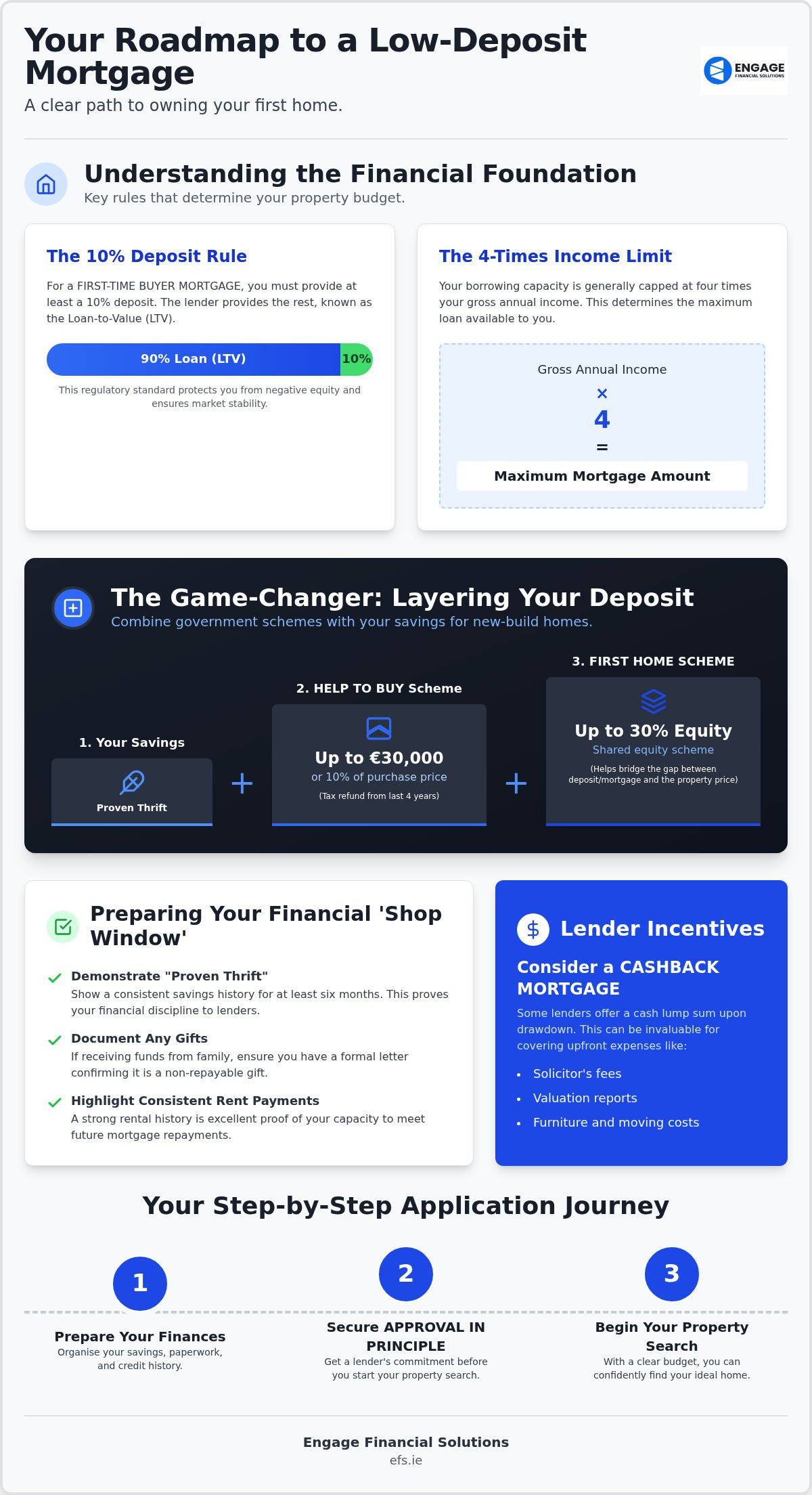
You’ve likely heard that a 10% deposit is the “magic number” for buying your first home. In the current market, this isn’t just a recommendation; it’s a regulatory standard that provides a foundation for your financial journey. When you apply for a FIRST-TIME BUYER MORTGAGE, lenders look closely at your Loan-to-Value (LTV) ratio. This term describes the percentage of the property’s price that the bank is willing to lend you. Currently, the maximum LTV is 90%, meaning you must provide the remaining 10% from your own resources or through supported government schemes.
The days of 100% loans are a thing of the past. These strict requirements were established to ensure long-term stability for both homeowners and the wider economy. By following the Central Bank mortgage rules, lenders maintain a protective buffer. This safeguards you from falling into negative equity if property prices fluctuate. Whilst saving that initial 10% can feel daunting amidst a high cost of living, it’s the essential key that unlocks the door to homeownership.
Choosing the path of getting a mortgage with low deposit means your loan amount will be higher. This naturally leads to slightly higher monthly repayments compared to someone with a 20% or 30% deposit. However, with the average interest rate for new agreements sitting around 3.48% as of July 2026, many find that the cost of borrowing is manageable when compared to the rising costs of the rental market. It’s about finding the right balance between buying now and the long-term cost of credit.
What Counts as a Deposit?
Lenders don’t just want to see a lump sum; they want to see “proven thrift.” This means showing a consistent ability to save over at least a six-month period. Your bank statements act as your financial shop window, reflecting your discipline and readiness. Whether you’re using personal savings or receiving “gifted” funds from family, you’ll need clear documentation. If you’re receiving a gift, a formal letter confirming the money doesn’t need to be repaid is required. Interestingly, if you’ve been paying rent consistently, lenders often view this as proof of your capacity to meet future mortgage instalments, making the transition from tenant to owner much smoother.
The 4-Times Income Limit
Your deposit is only one half of the puzzle. The other half is your borrowing capacity, which is currently capped at 4 times your gross annual income. For example, a couple with a combined income of €90,000 can typically borrow up to €360,000. When you add your 10% deposit to this figure, you arrive at your maximum property purchase price. Some lenders offer flexibility or “exemptions” for high earners or specific professions, but for most, this 4-times limit remains the steady guide for budgeting. Understanding how your income and deposit interact allows you to set a realistic target for your new home.
Leveraging Government Support: HELP TO BUY and the FIRST HOME SCHEME
Securing your first home often feels like a race against rising prices, but you don’t have to run it alone. While saving a full 10% deposit is the standard goal, the most successful buyers today use a layered approach. By combining different supports, you can bridge the gap between your current savings and the purchase price of a modern, energy-efficient home. This strategy is a game-changer if you have a stable income but find that the high cost of living makes it difficult to build a massive cash pot. Choosing a new-build property is often the most effective way to unlock these benefits, as it allows you to access multiple incentives simultaneously.
Many people view these supports as separate options, but they’re designed to work in harmony. Using them together simplifies the process of getting a mortgage with low deposit, turning what once felt impossible into a straightforward plan. It’s about looking at your future from the end goal backwards. When you see the security of owning your own front door, the steps to get there become much clearer.
Maximising the HELP TO BUY Incentive
The HELP TO BUY scheme is essentially a refund of the income tax and Deposit Interest Retention Tax (DIRT) you’ve paid over the last four years. You can check your eligibility and the exact amount you’re owed through the Revenue online portal. Once approved, this grant is paid directly to your developer, acting as a significant portion of your deposit. As of 2026, the maximum grant available for qualifying applicants is €30,000 or 10% of the purchase price, whichever is lower. This Help to Buy incentive remains a cornerstone of the local property market for those purchasing new or self-build homes valued up to €500,000.
The FIRST HOME SCHEME Equity Bridge
If the HELP TO BUY grant and your mortgage still leave you short of the purchase price, the FIRST HOME SCHEME can step in. This is a shared equity model where the state takes a percentage stake in your home. It’s not a loan in the traditional sense; there are no monthly interest payments for the first five years. You can choose to buy out the state’s stake later as your finances improve, or leave it in place until you sell the property. This scheme provides up to 30% of the property’s value, or 20% if you’re also using the HELP TO BUY incentive. Regional price caps apply, so it’s vital to check the ceilings for your specific local authority area. If you’re feeling overwhelmed by these calculations, speaking with a professional at efs.ie can help you map out exactly how these numbers fit your budget.
Comparing Lender Incentives and CASHBACK MORTGAGE Options
Once you’ve secured your 10% deposit, the next challenge is managing the “hidden” costs of homeownership. Between solicitor fees, structural surveys, and the inevitable trip to the furniture shop, your remaining savings can disappear quickly. This is where choosing the right lender becomes a strategic decision. Many banks now offer incentives designed specifically for those getting a mortgage with low deposit Ireland, providing a much-needed cash injection at a critical time. These perks can alleviate the immediate stress of moving, but they require a careful look at the long-term numbers.
The role of an independent consultant is to act as a buffer between you and these tempting offers, ensuring you understand the “true cost” of your loan. Whilst a lump sum of cash on moving day feels like a win, it’s essential to calculate how that choice affects your interest over the first five years of your term. We focus on a “future-back” perspective, making sure the decisions you make today support your long-term financial health.
Is Cashback Right for You?
CASHBACK MORTGAGE offers are currently a major feature of the local lending landscape. Certain high-street lenders provide 2% of the mortgage value back in cash at drawdown, with some even offering additional percentages on monthly repayments for account holders. Other institutions offer up to 3% in total incentives. For a €300,000 loan, a 2% payment puts €6,000 directly into your bank account on moving day. This liquidity is incredibly valuable if you’ve exhausted your savings to reach your deposit threshold.
However, you must weigh this upfront cash against the interest rate. Often, loans with the most generous cashback offers carry slightly higher rates than “clean” products. A small difference in your rate can add up to thousands of euros over the life of the loan. Whether you prioritise immediate cash for renovations or a lower monthly payment depends on your specific lifestyle and savings goals.
The Value of GREEN MORTGAGE Rates
If you’re purchasing a new-build home, as discussed in our look at the HELP TO BUY scheme, you likely qualify for a GREEN MORTGAGE. These products are reserved for homes with a high energy efficiency rating, typically a BER rating of A3 or better. Because these properties are cheaper to run and hold their value, lenders offer their most competitive interest rates to these buyers.
The synergy here is clear. You use government supports to bridge the gap when getting a mortgage with low deposit Ireland for a new home, which then unlocks a GREEN MORTGAGE rate that is often the lowest in the market. This double-benefit reduces your monthly outgoings whilst protecting your future. It’s a proactive way to manage a loan, ensuring your home remains an affordable asset rather than a financial burden.
Step-by-Step Guide to a Seamless Application Process
The path to homeownership is often portrayed as a stressful ordeal, but it doesn’t have to be. We believe in removing the friction from the process, acting as the buffer between you and the technical complexities of banking. Whether you’re currently renting or living at home to save, the secret to getting a mortgage with low deposit is meticulous preparation. By organising your finances well in advance, you can move forward with the confidence that your application is robust and ready for scrutiny. This proactive approach ensures a smooth transition from your initial enquiry to the day you receive your keys.
Securing an APPROVAL IN PRINCIPLE is your first major milestone. This document is essentially a statement from a lender indicating how much they’re willing to lend you based on a preliminary review of your finances. It’s a vital tool because it allows you to understand your true budget before you begin viewing properties. In a competitive market, having this in hand shows sellers and estate agents that you’re a serious, prepared buyer who is ready to act when the right home appears.
Preparing Your Documentation
Lenders need to see a clear, consistent “shop window” of your financial behaviour over at least the last six months. This means you should avoid taking out new debt, such as car finance or large credit card purchases, during this period. You’ll need to gather your P60s, three months of recent payslips, and six months of bank and savings statements. If you’ve had a career break or are self-employed, don’t worry. We can help you explain these scenarios to lenders by providing the right context and documentation to prove your long-term stability. Consistency is more important than perfection, and showing a steady ability to save whilst meeting your current rent payments is incredibly persuasive.
From Approval to Keys
Once you’ve found a property and gone ‘Sale Agreed’, the process moves into a more technical phase. You’ll work closely with your solicitor and broker to coordinate a professional valuation and a structural survey. At this stage, you must also arrange MORTGAGE PROTECTION insurance. This is a mandatory requirement that ensures your loan will be cleared if the worst should happen, providing essential peace of mind for your future. For a deeper look at the stages involved, our First Time Buyer Mortgage Guide offers a granular breakdown of what to expect.
The final step is the ‘Letter of Offer’, which is the formal contract from your lender. It will outline the specific conditions of your loan, such as your interest rate and the term length. Once your solicitor has reviewed the title deeds and all conditions are met, the funds are drawn down and the house is yours. If you’re ready to take that first step, start your journey with us today to ensure every detail is handled with care.
Why Expert Guidance is Essential for Low Deposit Buyers
Purchasing your first home is one of life’s most significant financial transitions. It’s a moment filled with optimism, but it also requires meticulous attention to detail to ensure long-term stability. When you’re focused on getting a mortgage with low deposit, the margin for error is slim. An independent consultant acts as your steady guide, navigating the intricate requirements of various lenders to find a solution that fits your unique lifestyle. Instead of facing the complexities of the banking world alone, you have a partner who understands how to safeguard your interests from the initial enquiry to the final drawdown.
The value of professional stewardship becomes clear when you consider the sheer variety of options available. Whilst a single high-street bank can only offer its own products, a broker provides access to a wide panel of lenders. This perspective is vital for those with a 10% deposit, as different institutions have varying appetites for low-deposit applications. We look at your financial health from a “future-back” perspective, ensuring that the loan you take today remains an affordable and secure foundation for the years ahead.
The Broker Advantage
One of the greatest benefits of expert guidance is the removal of friction from your daily life. Your consultant serves as a single point of contact, handling the constant stream of queries and documentation requests from lenders. This saves you significant time and alleviates the inherent stress of the process. Beyond simple admin, a broker knows how to “package” your application to highlight your strengths as a borrower, such as your consistent savings history or stable career path. If you’re curious about the broader benefits of this partnership, you can explore Why Use a Mortgage Broker to see how professional advice transforms the experience.
Securing Your Long-Term Future
A FIRST-TIME BUYER MORTGAGE shouldn’t be viewed in isolation. It’s a single, albeit large, piece of your overall financial puzzle. We help you integrate your new home into a holistic plan that includes safeguarding your income and planning for retirement. This includes tailoring essential covers like INCOME PROTECTION and ensuring you have a robust MORTGAGE PROTECTION policy in place. This comprehensive approach ensures that your family and your home are protected against any unforeseen changes in circumstances. To start building a tailored plan that prioritises your peace of mind, book a consultation with Engage Financial Solutions today. We’re here to ensure your transition to homeownership is as seamless and straightforward as possible.
Your Path to a New Home Starts Today
Taking the first step towards homeownership is a bold and optimistic move for your future. By understanding the 10% deposit requirement and strategically layering supports like the HELP TO BUY scheme, the goal of getting a mortgage with low deposit Ireland becomes a practical reality rather than a distant dream. Whether you’re looking for the energy efficiency of a new build or the immediate benefit of a CASHBACK MORTGAGE, the right strategy ensures you move forward with confidence and clarity.
At Engage Financial Solutions, we act as your steady guide, navigating every technical hurdle to ensure your experience is as straightforward as possible. As a firm regulated by the Central Bank, we offer specialist expertise in FIRST-TIME BUYER MORTGAGES and bespoke financial planning to safeguard your long-term security. We take a “future-back” approach, ensuring your new home fits seamlessly into your overall lifestyle and aspirations. Start your seamless journey to homeownership with Engage Financial Solutions and let us help you turn your vision of a secure future into a key in your hand. You have the plan; now it’s time to take the first step.
Frequently Asked Questions
Can I get a mortgage with only a 5% deposit?
No, you cannot currently secure a FIRST-TIME BUYER MORTGAGE with only a 5% deposit. Local regulatory rules require a minimum 10% deposit, which equates to a 90% Loan-to-Value ratio. This requirement is designed to provide a financial buffer and ensure long-term stability for both the homeowner and the lender. Whilst saving this amount can feel challenging, various government supports are available to help you reach this threshold.
Is it possible to use the HELP TO BUY grant as my full 10% deposit?
Yes, the HELP TO BUY grant can often cover your entire 10% deposit when you are purchasing a new-build property. This incentive provides a tax rebate of up to €30,000 or 10% of the purchase price, whichever is lower. If you’re getting a mortgage with low deposit for a home valued at €300,000, for example, the grant could potentially meet your full deposit requirement without needing additional personal savings.
Do low deposit mortgages have higher interest rates than those with 20% down?
Generally, lenders offer slightly higher interest rates for loans with a higher Loan-to-Value ratio. Because a 10% deposit represents more risk to the bank than a 20% deposit, the interest rate may be a few fractions of a percent higher. However, you can often offset this by choosing an energy-efficient home that qualifies for a GREEN MORTGAGE, as these products offer lower rates regardless of your deposit size.
What happens if I have a low deposit but a very high salary?
A high salary increases your borrowing capacity, which is typically capped at 4 times your gross annual income, but it doesn’t change the deposit rules. Even if you can comfortably afford the monthly repayments on a large loan, you’ll still need to provide a 10% deposit. In this scenario, your high income allows you to qualify for a more expensive home, provided you can meet the corresponding 10% cash requirement through savings or grants.
Can I use a credit union loan to fund my mortgage deposit?
No, lenders almost never allow you to use another loan to fund your deposit. They want to see “proven thrift” through your own savings or a non-repayable gift from a family member. Borrowing your deposit creates an additional monthly debt that would negatively impact your repayment capacity assessment. Lenders will check your bank statements to ensure the deposit hasn’t been sourced from a recent personal loan.
How long does it take to get a mortgage approved with a minimal deposit?
The approval timeline is usually the same as any other application, typically taking between two and four weeks once you’ve submitted all your documents. Getting a mortgage with low deposit doesn’t necessarily slow down the process, provided your financial “shop window” is clean. Having your APPROVAL IN PRINCIPLE ready before you start house hunting is a proactive way to ensure a seamless transition when you find the right property.
Are there extra fees I should save for besides the 10% deposit?
You should budget for several additional costs, most notably Stamp Duty, which is 1% of the property value up to €1 million. You’ll also need to pay for a solicitor, a structural survey, and a professional valuation. As a steady guide, it’s wise to save an additional 2% to 3% of the purchase price to cover these legal and administrative fees comfortably without dipping into your main deposit.
Disclaimer
Engage Financial Services LTD T/A Engage Financial Solutions is regulated by the Central Bank of Ireland CRO 764570. Director David Moore. Suite 2 First Floor, 14 -18 Main street, Blackrock, Co Dublin A94 W0Y3