


For employers and employees comparing a company pension scheme ireland, the key question is how the arrangement fits an employee’s future plans and an employer’s responsibilities. With MyFutureFund beginning in January 2026, it’s also important to understand how workplace pension options differ and what each means for you.
You may be wondering who chooses the arrangement, who contributes and how much administration it involves. A workplace pension should be understandable for employees and practical for employers to manage, while supporting retirement goals over the long term.
This guide explains the main company pension arrangements, including occupational schemes and Personal Retirement Savings Accounts (PRSAs), and outlines the roles employers and employees may have. You’ll also find practical questions to consider about contributions, flexibility, portability and how a workplace pension fits into broader retirement planning. Whether you’re setting up a scheme or deciding how to engage with one, understanding its terms can help you make a considered choice.
Key Takeaways
- Understand how employer and employee contributions can support long-term retirement saving, subject to the arrangement’s rules.
- Compare a Company Pension with a Company PRSA by looking at structure, administration, flexibility and member experience.
- Start with your retirement goals, current pension provision and workplace circumstances to assess what may suit you.
- Review the scheme’s terms and consider how it fits alongside other retirement options and your wider financial plans.
What is a company pension scheme, and what does it do?
A Company Pension is a workplace arrangement that helps employees save for retirement, usually through contributions from the employee, the employer or both. The money is held in a pension arrangement for later life, rather than in an ordinary savings account that you can generally access whenever you choose.
In plain English, it’s a way for an employer and employees to build retirement savings through work, under the rules of a pension arrangement. The contribution terms, investment options and benefits depend on the scheme. A workplace arrangement is linked to employment; an individual pension account, such as a PRSA, is a personal contract with a pension provider. Both can support retirement planning, but their structures and rules differ.
How a workplace pension builds retirement savings
Contributions are payments made into the pension over time. The scheme rules set out how they are arranged, including whether the employer contributes and how employee payments are handled. Check the scheme documents for the terms that apply to you rather than assuming every workplace arrangement works in the same way.
Contributions may be invested in funds, with the aim of growing the pension over the years. Investment growth isn’t guaranteed: the value can rise or fall depending on how the chosen funds perform. Keep these three elements distinct:
- Contributions: the payments made into the pension.
- Investment value: what those contributions are worth as investments at a given time.
- Retirement benefits: the options available under the arrangement when you can access your pension.
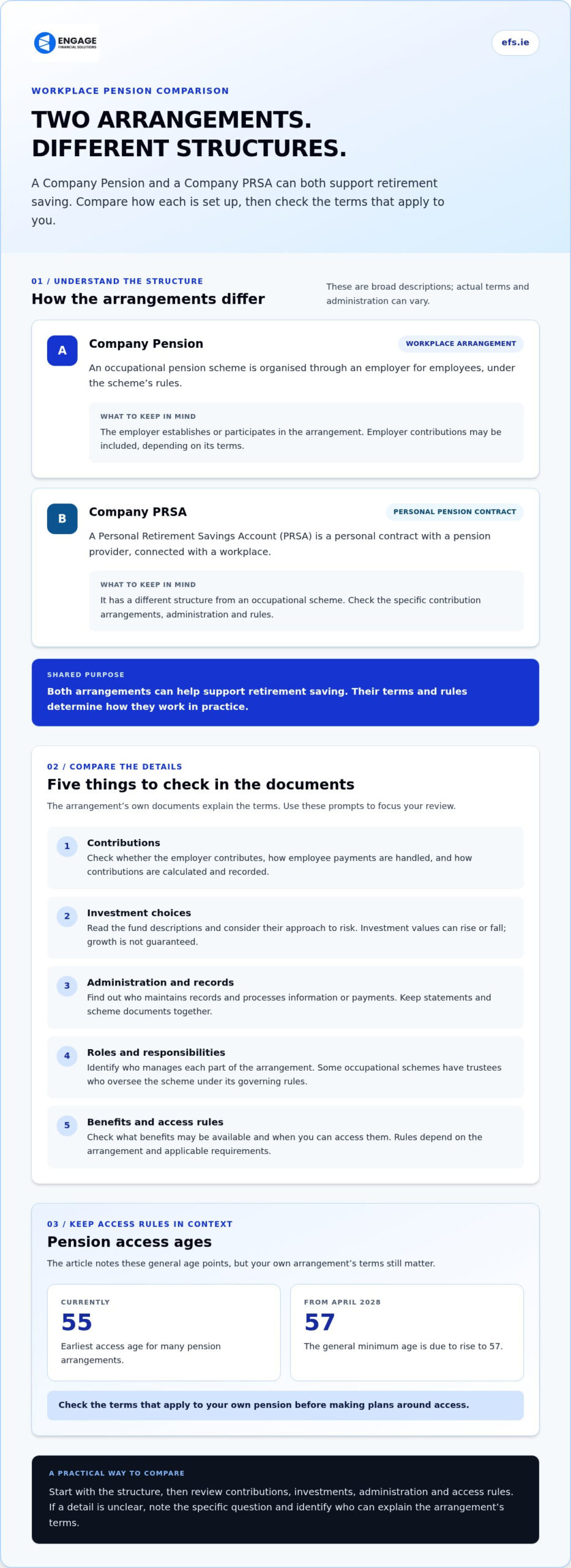
Pension savings are generally intended for later life, and access depends on the arrangement and applicable rules. The earliest access age is currently 55 for many pension arrangements, with the general minimum due to rise to 57 from April 2028. Check the terms that apply to your own pension before making plans around access. For broader context on workplace and personal arrangements, see this overview of the pension system.
Who is involved in a company pension scheme?
The employer establishes or participates in the workplace arrangement and may contribute under its terms. Employees who join make contributions where the scheme provides for them, and should review the information explaining their options and benefits. Scheme administrators handle practical tasks such as maintaining records and processing information or payments, according to the arrangement.
Some occupational schemes have trustees, who oversee the scheme in line with its governing rules. The structure varies, so don’t assume every workplace pension has identical roles or administration. If you’re an employer, identify who manages each part of the arrangement. If you’re an employee, find the scheme documents and note who can explain its terms. These steps give you a clearer picture of how the pension supports your wider retirement plans.
How company pension schemes are structured and managed
A workplace pension has several moving parts, from how payments are collected to how savings are invested and eventually used to provide retirement benefits. The details depend on the arrangement, so two employers may offer pensions that work differently even if both are designed to support long-term saving.
A scheme brings together contribution arrangements, investment choices, administration and rules for accessing benefits. Understanding how these parts connect helps employers assess whether an arrangement is manageable and helps employees see how their pension is progressing.
Contributions, investments and pension administration
Employer and employee contributions are paid into the arrangement according to its terms. The scheme documents explain how payments are set, collected and recorded. If you’re an employee, check how your contributions are calculated and where to find a record of payments. If you’re an employer, understand the administration involved in applying the contribution arrangements consistently.
The contributions are then invested in line with the scheme’s investment options. Members may be able to choose between funds with different approaches to risk and potential returns. Investment values can rise or fall, so returns aren’t guaranteed. Before selecting an option, read its description and consider how its investment approach fits your time horizon and comfort with changes in value.
Administration keeps the arrangement operating and helps members understand their position. Records and scheme communications can show contributions, investment information and important terms. Keep statements and scheme documents together, and note how to access them. If something is unclear, write down the specific point, such as how contributions are calculated or which investment options are available, before seeking an explanation.
Occupational schemes and Company PRSAs
An occupational pension scheme is established through an employer for employees under the scheme’s rules. A Company PRSA is a Personal Retirement Savings Account connected with a workplace. Both can support retirement saving, but they are different arrangements, and their administration and terms may vary. A Company PRSA is a personal pension contract, while an occupational scheme is organised through the employer.
These broad descriptions don’t determine which arrangement is right for a particular business or employee. Legal, tax and scheme rules matter, and shouldn’t be assumed to be identical. For current information about pensions and relevant requirements, consult The Pensions Authority. When comparing arrangements, focus on the actual terms, the responsibilities involved and how clearly members can understand their pension.
For employers, consider how the arrangement’s design and administration fit the workplace. For employees, review whether the contribution terms, investment options and member information make sense alongside other retirement savings. Personalised retirement planning guidance can help connect a Company Pension or PRSA with your wider financial plans, rather than viewing the workplace arrangement in isolation.
Company pension scheme or Company PRSA: what should you compare?
An occupational Company Pension and a Company PRSA can both support retirement saving through the workplace, but they are structured differently. Rather than assuming one is automatically simpler or better, compare how each arrangement would work for your business and its employees. The table provides a starting point; the scheme’s own terms determine the details.
| What to compare | Occupational Company Pension | Company PRSA |
|---|---|---|
| Structure | An occupational arrangement established through an employer, with its own governing rules. | A Personal Retirement Savings Account connected with a workplace, held as a personal pension contract. |
| Administration | Administration follows the scheme’s structure and may involve additional governance and record-keeping responsibilities. | Administration follows the PRSA arrangement and its terms. The practical tasks for the employer depend on current rules and how it is set up. |
| Flexibility | Contribution arrangements and investment choices are set out under the scheme’s rules. | Contribution arrangements and investment choices depend on the PRSA terms and applicable rules. |
| Member experience | Employees use the scheme information and processes provided for that occupational arrangement. | Employees use the information and processes associated with their PRSA contract. |
This is a broad comparison, not a substitute for reviewing specific terms. Tax treatment and employer obligations can depend on the arrangement and current requirements, so avoid relying on general assumptions. Check authoritative, up-to-date guidance before making a decision, particularly if the business is changing an existing arrangement.
For employers, consider the people and resources involved. Think about the needs of your workforce, who will oversee the arrangement and whether the business can manage its administration and record keeping. An arrangement with more administrative demands isn’t automatically unsuitable, but you should understand those demands and have a clear process for handling them. Clear employee communications also matter: staff need accessible explanations of the arrangement, their choices and where to find relevant information.
For employees, read beyond the headline contribution terms. Review how contributions are described, what investment approach is available and which documents explain the arrangement. If you change jobs, the pension pot may need attention, but the options depend on its type and rules. Keep your pension records and scheme documents accessible so you can understand what you have and which choices apply to you.
To compare arrangements in practice, write down the questions that matter most: how will administration work, what will employees need to understand, and how does the arrangement fit the business’s circumstances? Then use the governing documents and current guidance to assess each point. This keeps the decision grounded in real needs rather than a broad claim that one structure suits every employer or member.
How to assess whether a company pension fits your circumstances
Start with the outcome you want, not the name of a pension arrangement. An employer considering a workplace benefit and an employee deciding whether it supports their future both need to weigh current provision, workplace circumstances and longer-term goals. Use this practical review to identify what matters before reaching a decision.
- Set out your retirement goals. Think about the lifestyle you hope to support later in life and when you may want to access your savings. You don’t need a precise forecast at this stage. A broad picture helps you judge whether the arrangement is part of a wider plan or the only pension provision you currently have.
- Take stock of existing provision. List any workplace and personal pensions you already have, along with the information you can find about them. This gives you a clearer view of how a new or existing arrangement may fit alongside your other savings.
- Review the scheme information. Read the documents that explain contributions, investment choices, administration and member options. If a term is unfamiliar, note it and get a plain-English explanation before deciding. Don’t rely on assumptions about how a feature works; the terms of the arrangement matter.
- Consider your workplace circumstances. Employers should think about workforce needs, existing benefits, available administrative support and how scheme information will be communicated. Employees can consider whether the arrangement’s terms and information are clear enough to make informed decisions.
- Identify questions that need tailored guidance. Tax treatment, governance, access and the handling of pension savings when employment changes can depend on current rules and individual circumstances. Write down the points that affect you, then seek an appropriate, up-to-date explanation before acting.
A focused review for employers and employees
For employers, map the workforce’s needs and existing benefits before considering how a pension arrangement could fit. Decide who will oversee administration, keep records and share clear information with staff. Flag legal, tax and governance questions for current professional review rather than relying on general assumptions.
For employees, look closely at the scheme information, contribution terms and investment choices. Consider how the workplace pension connects with other retirement savings, and write down any questions about access, transfers or leaving employment. Individual terms can differ, so use your own scheme documents as the starting point for answers.
A workplace pension is one part of your financial future, not a decision in isolation. Consider how your retirement goals, pension arrangements and other financial choices fit together to support the future you want.
If you’d like support connecting a workplace pension with your wider goals, explore personalised retirement planning guidance.
Plan your next steps with company pension guidance
A useful next step is to understand what your workplace arrangement provides, review its terms and consider how it fits with your wider plans. Whether you’re looking at staff benefits as an employer or reviewing your own pension as an employee, focus on the details that affect your decisions: the arrangement’s rules, available choices and how it connects with your retirement goals.
Pension language can feel unfamiliar, particularly when you’re weighing up different arrangements or trying to understand what happens as circumstances change. Personalised retirement planning guidance can help clarify the options and bring the key considerations into one conversation. It can support a considered decision without promising a particular investment outcome, tax advantage or level of retirement income.
When tailored pension guidance may help
Some decisions are easier to review with support. You might be starting a business and considering staff benefits, reviewing an existing workplace arrangement, or changing employment and wondering how to think about pension savings you’ve built up. Gather the relevant scheme documents and note the questions you need answered. An adviser can help explain unfamiliar terms and make the available options easier to assess in light of your circumstances.
For employers, that may mean getting a clearer view of how a Company Pension fits the business and its workforce. For employees, it may mean understanding what the scheme information says and which points need individual attention. The aim is clarity, so you can make decisions with a better grasp of the trade-offs rather than relying on assumptions.
Connect workplace saving with wider retirement planning
A Company Pension is one part of a longer-term financial picture. Depending on your circumstances and the relevant rules, your plans may also involve a PRSA, an ARF or an Annuity. These options serve different purposes, so consider how each relates to your goals rather than treating a workplace pension as a complete retirement plan on its own.
Looking at your savings, expected needs and future choices together can help you see where the workplace arrangement fits. The retirement planning guide offers broader context for connecting pension decisions with your wider financial plans.
Engage Financial Solutions provides personalised retirement planning guidance, helping you consider Company Pensions alongside other retirement options in a joined-up way. If you’re ready to review how your pension arrangements fit your future goals, discuss your retirement planning.
Take a considered step towards your retirement goals
Your workplace pension decision can be a useful moment to take a fresh look at the future you want to build. Whether you’re reviewing staff benefits or checking your own arrangements, note what you understand, where you need clarity and how your pension fits with your wider plans. A clear list of questions gives you a practical starting point for assessing a company pension arrangement.
Choosing a workplace pension isn’t simply about selecting an arrangement; it’s about understanding how it supports your longer-term priorities. Personalised guidance can help you weigh up the relevant questions and make your next step more manageable.
Discuss your retirement planning with Engage Financial Solutions and take a considered step towards the future you have in mind.
Frequently Asked Questions
What is a company pension scheme?
It’s a workplace pension arrangement that helps employees build savings for retirement under specific scheme rules. A guide to company pension scheme ireland options can help you understand how workplace arrangements fit into the local pension system. For example, an employee may see pension contributions recorded separately from salary and ordinary savings. If you’re reviewing a scheme, look for its member guide or latest statement to see which terms apply.
Is a company pension scheme the same as a Company PRSA?
No. An occupational Company Pension is organised through an employer, whilst a Company PRSA is a Personal Retirement Savings Account linked to a workplace. The two arrangements have different structures, and their terms shouldn’t be assumed to match. If you’re comparing them, check who holds the pension contract, how the arrangement is administered and what the member documents say about contributions and options.
Can an employee join a company pension scheme if they have other pension savings?
Having other pension savings doesn’t automatically determine whether you can join a workplace arrangement. Membership depends on the scheme’s eligibility and joining rules, so check the employee information or scheme documents. Also gather details of your existing pensions before making decisions about additional saving. A complete view can help you understand how the arrangements sit alongside one another and what questions may need individual financial guidance.
How does a company pension scheme work when an employee changes jobs?
A pension from a previous job doesn’t simply disappear when you move to a new employer. Its future treatment depends on the original arrangement’s rules and the options available to you. Keep your latest statement and the scheme’s contact details, then review the information about your choices before deciding what to do. Don’t assume a new employer’s pension automatically combines with an earlier one.
What happens to a company pension if an employee leaves the business?
The pension remains subject to its scheme rules after employment ends, and the available options depend on the arrangement. Employee contributions are owned by the employee, while employer contributions may be subject to vesting terms, which set out when those contributions become fully the employee’s. Before leaving, read the scheme’s leaving-service information and keep any statement explaining the value and status of your benefits.
Do employers have to provide a company pension scheme?
Whether an employer needs to provide or facilitate pension saving depends on current rules and the employee’s circumstances. MyFutureFund began on 1 January 2026, and eligible employees without a pension plan may be automatically enrolled. This is not the same as saying every employer must establish an occupational Company Pension. Employers should check current official guidance to understand which requirements apply to their workforce and arrangements.
How does MyFutureFund relate to a company pension scheme?
MyFutureFund is a separate, government-run auto-enrolment pension scheme that began on 1 January 2026. If you’re comparing a company pension scheme ireland employers offer with MyFutureFund, don’t assume how one affects eligibility for the other. Employees aged 23 to 60, earning at least €20,000 a year and not currently in a pension plan are within the stated eligibility criteria. Check current official guidance for your circumstances.
Disclaimer
Engage Financial Services LTD T/A Engage Financial Solutions is regulated by the Central Bank of Ireland CRO 764570. Suite 2 First Floor, 14 -18 Main street, Blackrock, Co Dublin. A94 W0Y3