


If you’re searching for “PRSA pension Ireland”, the widest investment choice isn’t automatically the right one. Look beyond the investment menu and compare charges, contributions, employer involvement and how each option fits your retirement plans.
It’s understandable if the differences between a PRSA, a workplace pension and a personal pension feel unclear. The terminology can be unfamiliar, and charges or tax-relief rules may seem difficult to compare. A PRSA is held in your name rather than being tied to one specific job, which may make it easier to consider alongside other arrangements if your work changes.
This guide explains how a PRSA works within the Irish pensions market. You’ll learn what to compare between Standard and Non-Standard PRSAs, what to ask about fees, investment choices and contributions, and how to check current tax-relief rules with Revenue. Whether you’re starting to save, reviewing an existing pension or planning for retirement, you’ll have a clearer basis for assessing whether a PRSA could fit into your wider financial plans.
Key Takeaways
- See how a PRSA can help you build retirement savings while accommodating changes in your working life.
- Understand the different roles contributions, tax relief and investment performance may play in building your pension fund.
- Compare Standard and Non-Standard PRSAs by checking charges, investment choices and provider information.
- Use a pre-application checklist to review existing pensions, gather provider documents and connect your choice to your retirement goals.
- Explore the retirement options a PRSA may offer, and learn which questions to ask when seeking personalised guidance.
What is a PRSA pension, and who might find one useful?
If you want to build retirement savings that can adapt as your working life changes, a Personal Retirement Savings Account (PRSA) may be worth understanding. A PRSA is a personal pension arrangement held in your name, rather than being tied to one specific job. You can read a neutral overview of the Personal Retirement Savings Account (PRSA) to familiarise yourself with the term, then check current rules and provider details before making a decision.
A PRSA is an investment-based pension for retirement, not a bank savings account: its value can rise or fall, and growth isn’t guaranteed. Contributions are invested, so the eventual fund depends on how much is paid in, investment performance and charges. Portability may help you keep an arrangement as your circumstances change, but it does not remove investment risk.
How does a PRSA differ from a workplace pension?
A PRSA is personally held and isn’t linked to one particular employer. An occupational, or workplace, pension is arranged through an employer and operates under that scheme’s rules. Depending on the arrangement, the employer may contribute to it.
Neither option is automatically better. Before opening another pension, ask your current scheme or provider for its benefits, charges and the options available if you leave your job. Compare those details with the PRSA documents, including whether employer contributions are available, so you can judge how a new arrangement would fit alongside what you already have.
Could a PRSA suit your working situation?
Your circumstances can help shape the questions to ask, but they don’t determine the answer on their own:
- If you’re an employee, check whether your employer offers a workplace pension, whether employer contributions are available and how the scheme compares with a PRSA.
- If you’re changing jobs, a personally held PRSA may offer continuity, but review your existing pension options before deciding what to do with a workplace plan.
- If you’re self-employed, consider whether a personal pension arrangement suits your income pattern, retirement goals and wider financial commitments.
In each case, suitability depends on your existing arrangements, goals and personal circumstances. Confirm current eligibility and employer-access rules with official guidance, and ask a provider to clarify anything that affects your situation. If you’re comparing several pensions, personalised retirement-planning guidance can help you assess them as part of your wider plan.
How do PRSA contributions, tax relief and investment growth work?
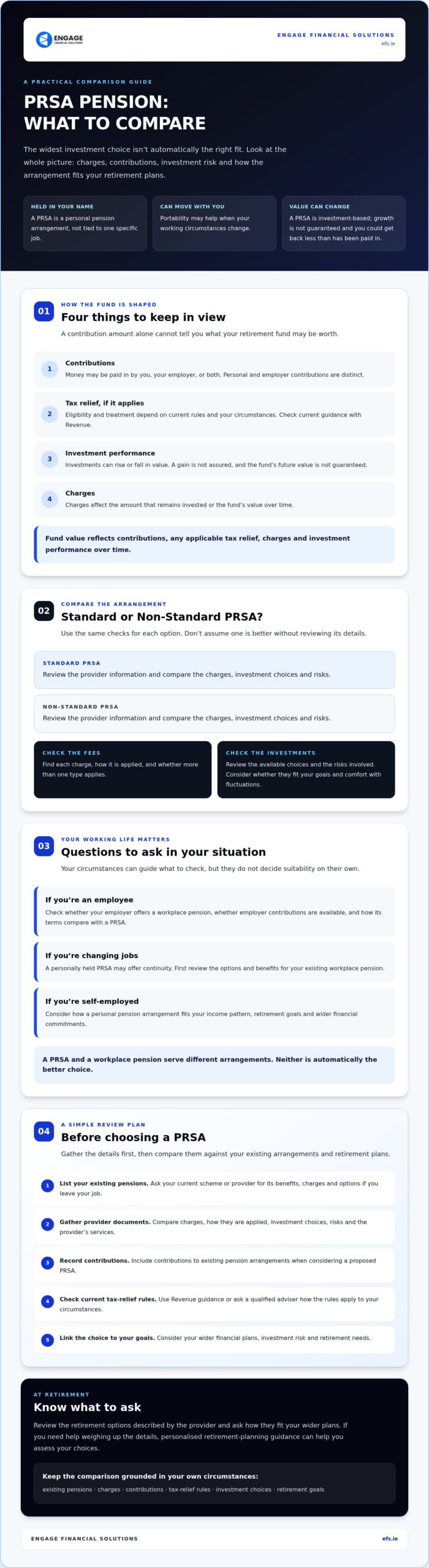
To understand how a PRSA fund builds, separate four things: what goes in, any tax relief that applies, what happens to the investments, and the fund’s value at a given time. Contributions may be paid by you, your employer or both. Tax relief is a tax treatment that may apply to eligible personal contributions under current rules. Investment growth means an increase in the value of investments, but their value can also fall.
A PRSA fund reflects contributions, any applicable tax relief, charges and investment performance over time, so its future value isn’t guaranteed. This is why the contribution amount alone can’t tell you what your retirement fund will be worth.
What should you know about PRSA contributions and tax relief?
Your personal contributions and employer contributions are distinct. Tax treatment depends on current rules and your individual circumstances, so don’t assume the same conditions apply to both or that you’ll receive a particular tax benefit. Your age, income and other pension arrangements may be relevant to your position.
Before setting a contribution amount, check current guidance from Revenue or ask a qualified adviser to confirm how the rules apply to you. Keep a record of contributions to existing pension arrangements and ask how these should be considered alongside a proposed PRSA. That gives you a more complete picture when deciding what to contribute.
How do investment choices and charges affect a PRSA?
PRSA contributions are invested, and investments can rise or fall in value. A gain isn’t assured, and you could get back less than has been paid in. Risk depends partly on the investment choices available and selected, so consider whether they align with your goals and how comfortable you are with fluctuations.
Charges also affect the amount that remains invested or the fund’s value over time. Before choosing a provider, read its documents and look for:
- each charge, how it is applied and whether more than one type applies;
- the available investment choices and the risks they involve;
- clear information about the provider’s services and the terms of the PRSA.
The Pensions Authority PRSA guide is a useful place to review PRSA information. Check current details rather than relying on an old illustration or assuming past investment performance will continue. If you’d like help considering contributions, charges and investment choices alongside your wider retirement plans, you can explore PRSA and retirement-planning guidance.
Standard PRSA or Non-Standard PRSA: what should you compare?
Choosing between a Standard and Non-Standard PRSA isn’t simply a matter of finding the plan with the most investment options or the lowest-looking charge. The categories differ in how charges are regulated and what investments may be available. Check current details against official guidance, such as the Pensions Authority’s PRSA information, and the provider’s own documents.
What is the difference between Standard and Non-Standard PRSAs?
In broad terms, Standard PRSAs have regulated limits on charges and a more restricted range of investment choices. Non-Standard PRSAs don’t have the same charge caps and may provide a wider choice. A wider menu isn’t automatically an advantage: consider whether you understand the options and need that additional choice.
| What to compare | Standard PRSA | Non-Standard PRSA |
|---|---|---|
| Charges | Charges are subject to category limits. Ask how each charge is applied. | Charges aren’t subject to the same caps. Request a full breakdown and check how costs could affect your fund. |
| Investment options | Typically offers a more limited selection. Does it provide options that match your needs? | May offer a wider selection. Do you need the extra choice, and are you comfortable assessing it? |
| Provider information | For either type, check the provider’s documents, investment risks, services and terms. Confirm current category features with official guidance. | |
These are general category differences, not a recommendation. Compare the full terms rather than deciding on a single headline feature. For example, a broad investment range may matter less than charges you can understand and investment choices you can assess confidently.
How does a PRSA compare with other pension arrangements?
A PRSA is personally held, while an occupational pension is arranged through an employer and follows that scheme’s rules. A personal pension is also an individual arrangement, but its terms and features can differ from a PRSA. The names alone won’t tell you which arrangement is more suitable.
Before deciding, check whether your employer contributes to an existing scheme, what benefits you could lose or retain if you leave, the charges, and how portable each arrangement is if your work changes. Ask providers for current scheme documents and compare the same details across each option. To place the decision in the context of your wider retirement plans, read this retirement planning guide.
How can you assess a PRSA before applying?
A little preparation can make conversations with providers more useful and help you assess a PRSA against your existing pension arrangements, rather than considering it in isolation. Gather the relevant documents first, then use this checklist to guide your questions.
- List your existing pensions. Note each arrangement, its provider and any benefits or terms that may apply if you change jobs or transfer funds.
- Check employer contributions. Review your workplace scheme documents and ask your employer or provider to explain any contributions and benefits available through the scheme.
- Set out your circumstances. Note whether your income is regular or varies, how much you intend to contribute and whether an employer may contribute.
- Define your retirement timeframe. Consider when you hope to access your pension and what role you expect it to play alongside your other retirement resources.
- Collect provider documents. Request the PRSA’s terms, charge details, investment information and service documents. Ask where each charge is explained and how it is applied.
- Compare the practical details. Ask what investment choices are available, what risks they involve, what ongoing information you’ll receive, how contributions can be changed and what happens if your employment changes.
Before speaking with a provider, bring details of your current pensions, employer contributions, income pattern and retirement timeframe. Ask for written information on charges, investments and service terms.
Check transfers and tax questions before acting
If you’re thinking about transferring an existing pension, don’t assume that moving it is straightforward or automatically beneficial. The terms, possible effects and tax treatment can depend on your circumstances and the arrangements involved. Gather the relevant scheme documents and ask a qualified adviser to explain any transfer or tax question using current information before you make a decision.
For a PRSA pension decision, clear answers matter as much as the headline features. If a provider’s explanation is unclear, ask them to point to the relevant section in the documents and explain what it means for you. You can also discuss PRSA and retirement planning as part of your wider financial picture.
What happens to a PRSA at retirement, and where can you get guidance?
As retirement approaches, the question shifts from how to build your PRSA fund to how it could support your income. The options available, when you can access benefits and how they’re taxed depend on current rules and your individual circumstances. Check the latest guidance from Revenue and the Pensions Authority before making plans, rather than relying on old provider documents or assumptions.
Depending on the rules and your circumstances, options may include taking a retirement lump sum and arranging an income from some or all of the remaining fund. An Annuity is a product that provides an income for life in return for using some pension savings to buy it. An Approved Retirement Fund (ARF) keeps money invested, with withdrawals taken from the fund. A vested PRSA is a PRSA from which benefits have been accessed while funds remain invested. “Drawdown” simply means taking money out of an invested retirement fund. Each option has different implications, so check the current terms and tax treatment that apply to you.
What should you consider before taking PRSA benefits?
Look at the whole picture, not just the value of one pension. List any other pensions or expected retirement income, then consider your regular outgoings, financial commitments and how much flexibility you may need. For example, an income that can vary may suit one person’s plans, while another may prefer to explore an income designed to continue for life. Neither example determines the right choice on its own.
Taking benefits can have tax consequences, and some decisions may be difficult to change later. Confirm the current access, age, lump-sum and post-retirement withdrawal rules with official sources. Check Revenue guidance on tax, and speak with a qualified adviser before deciding how or when to take benefits.
When can personalised PRSA guidance help?
Guidance can help you assess a PRSA alongside workplace pensions, other retirement arrangements and your plans for future income. Engage Financial Solutions offers PRSA and retirement-planning guidance, alongside support with ARFs and Annuities. A discussion can help clarify the questions to ask and the information to verify, without guaranteeing a particular investment result or tax outcome.
Review your PRSA in the context of your wider financial plans, whether retirement is approaching or still some way off. If you’d like to explore your options, explore financial planning support.
Make your next pension decision with confidence
A PRSA can offer flexibility, but the right choice depends on how it fits with your existing pensions, work situation and retirement plans. Compare the full terms of Standard and Non-Standard PRSAs, including charges, investment options and provider information, rather than focusing on one feature. Remember that investment values can fall as well as rise, and check current tax rules and retirement options before acting.
A useful next step is to gather your pension documents, note any employer contributions and list the questions you still need answered. This gives you a clearer basis for considering a PRSA alongside other arrangements. Engage Financial Solutions provides PRSA and retirement-planning guidance, with support across Company Pensions, ARFs and Annuities.
If you’d like to review your options in the context of your wider plans, explore personalised PRSA and retirement-planning guidance. Contact Engage Financial Solutions to discuss your PRSA and retirement-planning options.
Frequently Asked Questions
What is a PRSA pension?
A PRSA pension is a Personal Retirement Savings Account, a personal pension arrangement held in your name and not tied to one specific job. Contributions are invested to build a fund for retirement, so its value can rise or fall and isn’t guaranteed. Before choosing one, read the provider’s documents to understand its charges, investment options and terms, and check current official guidance on tax treatment.
Can I have a PRSA if I already have a workplace pension?
You may be able to have both, but whether that makes sense depends on your circumstances and the terms of each arrangement. First, check what your workplace pension provides, including any employer contributions, benefits and charges. Then compare these with the PRSA’s terms. A qualified adviser can help you understand how the arrangements fit together and check which current rules apply to your situation.
Is a PRSA suitable for self-employed people?
A PRSA may suit a self-employed person who wants to build retirement savings, but it isn’t automatically the right choice. Consider whether its contribution arrangements work with your income pattern, and compare charges, investment options and your retirement timeframe. Before deciding how much to contribute, check current tax-relief rules with Revenue or ask a qualified adviser how they apply to your circumstances.
What is the difference between a Standard PRSA and a Non-Standard PRSA?
The categories differ in their charges and available investment choices. Standard PRSAs have capped charges and a more restricted range of investment types; Non-Standard PRSAs aren’t subject to the same charge caps and may offer broader choices. These are general distinctions, not a recommendation. Check current Pensions Authority guidance and provider documents, comparing the full terms rather than choosing based on one feature.
Can my employer contribute to my PRSA?
An employer may be able to contribute to your PRSA, but the rules and tax treatment depend on current requirements and your circumstances. Ask your employer and PRSA provider how contributions are arranged and recorded. Check current Revenue guidance for any applicable limits before relying on figures you’ve seen online, as rules may change and your individual position can affect how contributions are treated.
How are PRSA contributions treated for tax?
Tax relief may apply to eligible personal PRSA contributions, subject to current rules and your circumstances. Don’t assume every contribution receives the same treatment, as the relevant rules can depend on factors such as your situation and the type of contribution. Check Revenue’s current guidance, and speak with a qualified adviser if you’re unsure how it applies to you before setting or changing contributions.
What happens to a PRSA when I change jobs?
A PRSA is held personally, so changing jobs doesn’t necessarily mean you need a new account. Check your provider’s terms and find out what pension arrangements or contribution options your new employer offers. If you’re considering transferring funds or changing contributions, review the relevant documents first and get current, personalised guidance so you understand how the decision may affect your existing arrangements.
When can I access money in a PRSA?
Access depends on current rules, the terms of your PRSA and your personal circumstances, so don’t assume you can withdraw money whenever you need it. Taking benefits may involve tax and other conditions. If retirement is approaching or you’re considering a withdrawal, check the latest Revenue guidance and your provider’s documents, then seek qualified advice before deciding when or how to access your fund.
Disclaimer
Engage Financial Services LTD T/A Engage Financial Solutions is regulated by the Central Bank of Ireland CRO 764570. Suite 2 First Floor, 14 -18 Main street, Blackrock, Co Dublin. A94 W0Y3