


If you’re searching for “set up company pension Ireland”, the first step is to work out what you need a workplace pension to do for your business and employees. The right arrangement isn’t necessarily the one with the most features. It’s the one that fits your workforce and can be managed clearly over time.
MyFutureFund has been in effect since January 2026, adding a new consideration for employers. A workplace pension can support employees’ longer-term retirement planning, but the details matter: your choice should reflect your business, your people and current requirements.
This guide compares occupational pension schemes and PRSAs, and outlines the stages involved in setting up a plan. It also covers contributions, tax and administration, so you can build a practical implementation plan rather than choosing a scheme on name alone.
Key Takeaways
- Decide what you want a workplace pension to achieve, then gather information about your workforce and existing benefits.
- Compare an occupational pension scheme with a PRSA, considering employer involvement, employee flexibility and administration.
- Break setup into clear stages, from defining your aims to putting the arrangement in place and explaining it to employees.
- Plan for ongoing tasks, including keeping records, managing contributions and responding to employee questions.
- Check current requirements and consider how tailored pension guidance can help align your choice with your business and employees’ retirement plans.
Set up company pension Ireland: start with your business needs
Before comparing arrangements, write down what you want the pension to achieve, who it needs to serve and who will manage it. This gives you a practical basis for comparing options and keeps decisions connected to your business and employees, rather than the scheme name alone.
What a Company Pension Can Do for Your Business and Employees
A Company Pension is a workplace arrangement that helps employees save towards retirement over time. Depending on its structure, the employer may set up or facilitate access to it, and contributions may come from the employer, employee or both. Contributions are not the same as guaranteed growth or a guaranteed retirement income because the money is invested.
A workplace arrangement gives you a way to include retirement saving in your employee benefits, alongside salary and, where offered, protection benefits. It may strengthen your overall benefits package and support employees’ financial wellbeing, although it can’t guarantee improved recruitment or retention. The right fit depends on your business, workforce and current requirements.
How a workplace pension fits into employee benefits
A workplace pension is one part of the wider employment package. Your role may include choosing an arrangement, facilitating contributions and helping employees understand how it works. For example, a growing business might review its benefits as it takes on new staff, then consider whether a workplace pension can sit alongside pay and Group Protection. Start by listing the benefits you already provide and the needs of your team, rather than choosing a scheme in isolation.
Company Pension terminology employers should understand
An occupational pension scheme is an arrangement established through an employer for employees. A PRSA, or Personal Retirement Savings Account, is a personal pension arrangement that can also be relevant in a workplace context. Read a general explanation of the Personal Retirement Savings Account (PRSA). The structures differ in how they’re arranged and administered, so compare their features with your workforce’s needs and current obligations before deciding.
Contributions are payments made into a pension arrangement. They help build retirement savings but don’t promise a particular investment return or retirement outcome. Investment values can rise or fall, and the eventual benefits depend on factors such as contributions, investment performance and the arrangement’s terms.
Before setting up a Company Pension, write down what you want the benefit to achieve, who it needs to serve and how it will fit into your existing package. Tailored pension guidance can help you assess the options as part of broader financial planning, taking account of both business priorities and employees’ longer-term retirement needs.
Compare Company Pension Options Before Choosing a Scheme
Once you know what you want a workplace pension to achieve, compare the structures available. An occupational pension scheme is generally arranged by an employer for employees, while a Personal Retirement Savings Account (PRSA) is an individual pension account that may also be used in a workplace context. The labels alone won’t show which is the better fit. Consider how each arrangement works, current rules and the needs of your workforce.
Occupational pension scheme or PRSA: what should employers weigh?
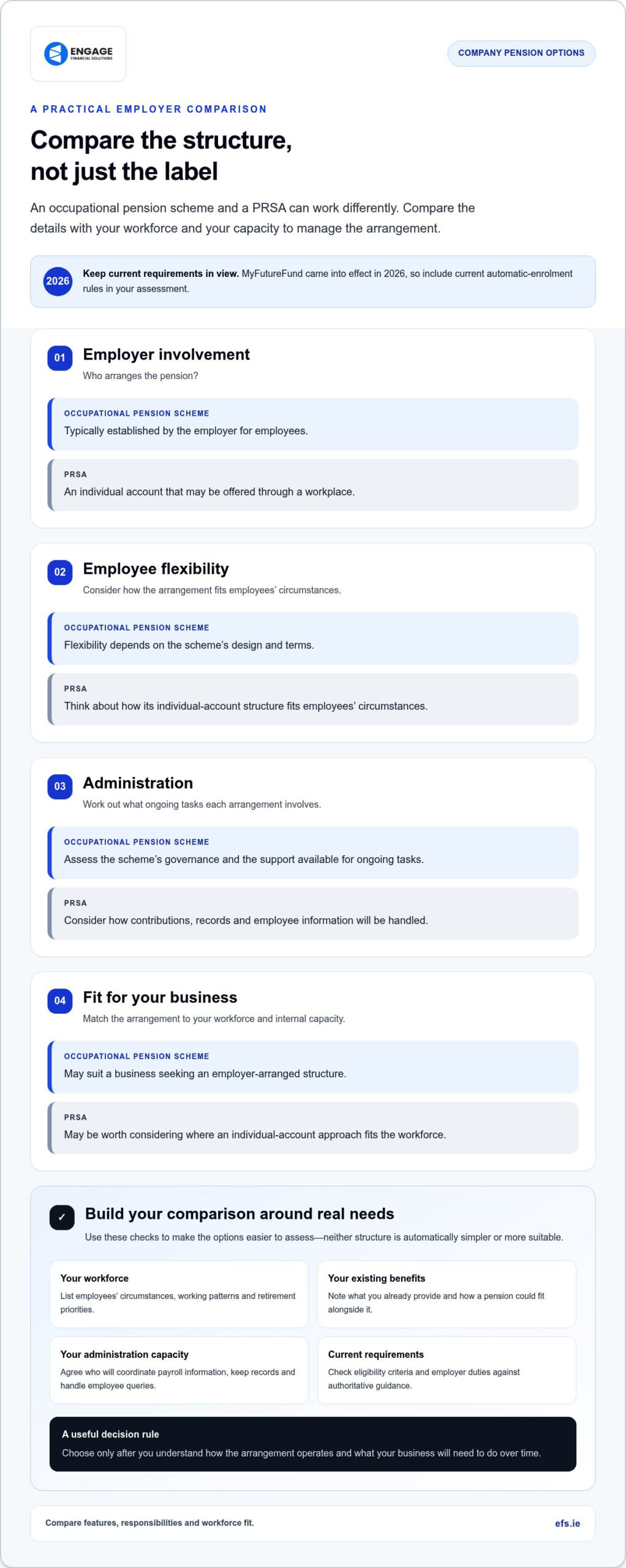
Look beyond the product name and consider how each arrangement would work in your business. This table is a starting point, not a legal ruling: features and responsibilities depend on the arrangement and current requirements. Since MyFutureFund came into effect in 2026, include current automatic-enrolment rules in your assessment. The Pensions Authority employer hub provides employer information.
| Consideration | Occupational pension scheme | PRSA |
|---|---|---|
| Employer involvement | Typically established by the employer for employees. | An individual account that may be offered through a workplace. |
| Employee flexibility | Depends on the scheme’s design and terms. | Consider how its individual-account structure fits employees’ circumstances. |
| Administration | Assess the scheme’s governance and the support available for ongoing tasks. | Consider how contributions, records and employee information will be handled. |
| Suitability | May suit a business seeking an employer-arranged structure. | May be worth considering where an individual-account approach fits the workforce. |
Use the comparison to frame your decision, not to assume either structure is automatically simpler or more suitable. Check current eligibility criteria and employer duties against authoritative guidance. Make sure you understand how the arrangement operates and what your business will need to do before proceeding.
Match pension arrangements to workforce needs
Consider who the arrangement needs to serve. A closely grouped workforce may have different communication needs from a team with varied working patterns, roles or retirement priorities. Think through how employees will receive information, raise questions and understand the choices available to them.
Then assess your capacity to manage the arrangement over time. Who will coordinate payroll information, keep records and handle employee queries? If responsibilities are shared, agree ownership early. List your workforce’s main circumstances, existing benefits and internal administration capacity, then compare each structure against that list.
Professional Company Pension guidance can help you weigh the available options against your business and employees’ longer-term retirement needs. Explore tailored pension guidance as part of your assessment, so your decision is grounded in your circumstances rather than the scheme label alone.
Plan the Company Pension Setup in Clear Stages
A clear process turns a pension decision into a workable arrangement. Before you begin, gather information about your workforce, agree who will make decisions and check which current requirements apply. Use the steps below as a practical framework. The timeline and documents will depend on the arrangement selected and its provider.
Prepare the business and workforce information
Start with a concise picture of your business and the employees the arrangement is intended to support. This gives you a sound basis for comparing options and keeps decisions connected to your objectives.
- Define your aims. Decide what you want the pension to support, such as making retirement saving part of your employee benefits package.
- Map your workforce. Gather relevant information about roles, working patterns and existing pension arrangements, handling employee information carefully.
- Review current benefits. Note existing pay and benefits to see how a pension might fit alongside them.
- Assign responsibility. Identify who will approve the arrangement and who will coordinate practical administration, including payroll processes and employee communications.
Prepare questions about contributions, governance, administration and ongoing support. Keep a record of decisions and outstanding points. That makes it easier to compare options on the same basis and reduces the risk of relying on assumptions during implementation.
Move from scheme decision to employee launch
After choosing a structure, follow the provider’s onboarding process for the documentation and information needed to establish it. Allow time for internal review, payroll coordination and any required approvals. Arrangements can have different processes and timetables.
Before committing, check current legal, regulatory and tax requirements. In particular, consider how the current MyFutureFund rules may affect your workforce and interact with the pension arrangement. Requirements can depend on individual circumstances, so verify them using authoritative guidance and a suitably qualified adviser before implementation.
Plan employee communications before launch. Explain in straightforward language how the arrangement works, how participation and contributions are handled, and where employees can find information or raise questions. Share updates if key details change, and give the person coordinating the scheme a clear process for managing queries.
Agree a target launch period once the provider has outlined its steps and you’ve assessed internal readiness. Tailored Company Pension guidance can help bring your workforce information, business objectives and current requirements together in an implementation plan.
Understand Contributions, Administration and Ongoing Responsibilities
Putting a pension arrangement in place is only the start. To keep it working smoothly, establish clear processes for contributions, employee information and regular reviews. Agree who owns each task internally and how they’ll coordinate with the scheme administrator and other relevant professionals.
Employer contributions and tax treatment
Depending on the arrangement, contributions may come from the employer, the employee or both. Set out how payments will be calculated, processed and recorded, and make sure everyone involved understands their role. Contributions are payments into the pension arrangement, not a promise of investment growth or a particular retirement outcome.
Tax treatment depends on the arrangement and the circumstances of the business and employee. Before setting contribution terms, check current Revenue guidance and seek advice on how the rules apply to your situation. General information can help frame the decision, but it isn’t a substitute for advice about your business’s position.
Keep pension administration understandable and consistent
Routine administration is easier to manage when responsibilities and handovers are clear. Create a schedule for recurring tasks and record completed actions, outstanding queries and key scheme communications. Your process may include:
- Coordinating payroll information and pension payments with the scheme administrator.
- Keeping relevant records up to date and handling employee information appropriately.
- Explaining scheme features and contributions clearly to employees, including where to direct questions.
- Passing specialist questions to the appropriate scheme or financial professional and tracking follow-up.
Use plain language in employee communications. If someone asks how a contribution is handled or where to find scheme information, a consistent response process helps them get a clear answer.
Review the arrangement at planned intervals and when a significant business or workforce change prompts you to reassess its fit. Consider whether administration remains manageable, employee needs have shifted or current requirements have changed. Record what’s working, what needs attention and who will follow up.
As you set up a Company Pension, tailored guidance can help you consider contribution arrangements and ongoing responsibilities in the context of your wider business and employees’ retirement planning. Explore tailored pension guidance to support informed decisions and a considered approach to managing the arrangement.
Choose Your Next Steps for a Company Pension
You don’t need to resolve every detail at once. Bring your business aims, employee needs and practical responsibilities together, then use that information to assess suitable pension structures. This keeps the decision focused on how the arrangement will work for your workforce, not just on its name.
A practical checklist before proceeding
Before moving towards implementation, gather the key information and note any decisions that still need attention:
- Clarify your objectives. Set out what you want the pension arrangement to achieve and which employee needs it should support.
- Review existing benefits. Record current pension and other employee benefits to understand how a new arrangement might fit.
- Compare structures. Consider how each option could work for your workforce, including its administration and communication needs.
- Assign internal roles. Identify who will make decisions, coordinate administration and respond to employee questions.
- Check current requirements. Verify relevant pension, regulatory and tax considerations against up-to-date authoritative guidance before finalising your choice.
Keep this information together. It provides a useful working brief and makes it easier to explain the reasoning behind your decision to colleagues and employees.
Get tailored guidance for the business
An adviser can help you weigh pension options against your business circumstances and your employees’ needs. That means considering the arrangement alongside administration, communication and how the pension supports employees’ longer-term retirement planning. Advice can also help identify questions that need attention before you commit to a structure.
Company Pension decisions sit within a wider financial picture. For a broader view of planning towards future financial security, read this retirement planning guide.
With a clear brief and informed guidance, you can take the next steps at a considered pace. Discuss Company Pension planning to explore how the options may fit your business and employees.
Take the Next Step Towards a Suitable Workplace Pension
A considered pension decision starts with your business and employees, not a one-size-fits-all scheme. Clarify what you want the arrangement to achieve, compare suitable structures and check current responsibilities before moving ahead. Then plan how contributions, administration and employee communications will work in practice.
Setting up a Company Pension is one way to support employees’ longer-term retirement planning. The right approach depends on your workforce, business priorities and capacity to manage the arrangement over time, so tailored guidance can help you assess the options.
Engage Financial Solutions provides Company Pension and retirement planning guidance, with advice tailored to businesses and individuals. Discuss tailored Company Pension guidance to explore your circumstances and consider a practical way forward.
A clear plan can make the decisions ahead feel more manageable and help you take steady steps towards a suitable workplace pension for your team.
Frequently Asked Questions
How do I set up a Company Pension for my employees?
Start by defining what you want the arrangement to achieve and gathering information about your workforce, existing benefits and internal administration capacity. Compare suitable structures, check current requirements and tax considerations, then agree who will manage decisions and ongoing tasks. Once you select an arrangement, follow its onboarding process and prepare clear employee communications. Timelines and documentation vary, so build your implementation plan around the chosen arrangement and provider.
What is the difference between an occupational pension scheme and a PRSA?
An occupational pension scheme is arranged by an employer for employees, while a Personal Retirement Savings Account (PRSA) is an individual pension account that can also be used in a workplace context. Administration, governance and flexibility can differ depending on the arrangement. Neither label alone determines suitability. Compare how each option fits your workforce and business processes, and check current rules and employer responsibilities before deciding.
Does a company have to provide a pension to employees?
Employers should check current workplace pension requirements rather than assume that no action is needed. Under the rules in effect from 2026, eligible employees who aren’t already in a qualifying pension arrangement are automatically enrolled in MyFutureFund. Employers without an occupational pension scheme must provide access to a PRSA. Eligibility and duties can depend on circumstances, so verify your position using current authoritative guidance.
Can a small business set up a Company Pension?
Yes, a small business can consider setting up a Company Pension. Choose an arrangement that fits the business’s workforce, objectives and capacity for ongoing administration, rather than assuming a particular structure is suitable because the team is small. Start by listing employee needs, current benefits and who will manage payroll coordination, records and queries. Tailored pension guidance can help you assess the options and plan the next steps.
Are employer pension contributions tax deductible?
The tax treatment of employer contributions depends on the pension arrangement and the business’s circumstances, so there isn’t one answer that applies to every employer. Don’t assume a contribution receives a particular tax treatment based on the scheme name alone. Before setting contribution terms or budgeting for the arrangement, check current Revenue guidance and obtain advice relevant to your business. This helps you make decisions using the rules that apply to your situation.
What information does an employer need to set up a workplace pension?
Prepare an overview of your workforce, including relevant employment patterns and existing pension or benefit arrangements. Record what you want the pension to support, who will approve decisions and who will coordinate administration. It’s also useful to list questions about contributions, employee communications, governance and ongoing support. The precise information and documents required depend on the arrangement and provider, so use the onboarding process to build a complete implementation plan.
What is changing for workplace pensions in 2026?
MyFutureFund, the automatic enrolment system, came into effect on 1 January 2026. Employees aged 23 to 60 earning over €20,000 annually are automatically enrolled if they aren’t already in a qualifying pension scheme; people outside those criteria can opt in. For 2026 to 2028, the employee and employer each contribute 1.5% of gross salary, with a 0.5% State contribution. Check current official guidance for eligibility, rates and employer processes before acting.
Disclaimer
Engage Financial Services LTD T/A Engage Financial Solutions is regulated by the Central Bank of Ireland CRO 764570. Suite 2 First Floor, 14 -18 Main street, Blackrock, Co Dublin. A94 W0Y3