


When comparing family income benefit insurance Ireland options, consider whether your family would need a lump sum straight away or regular payments to help manage household costs over time. If you died during the policy term, Family Income Benefit could provide scheduled payments to eligible beneficiaries, subject to the policy terms. Understanding the payment pattern is just as important as choosing a benefit amount.
It’s useful to compare this option with Life Insurance, which may pay a lump sum, and Income Protection, which is designed to support you if illness or injury affects your ability to work. Each addresses a different financial risk. The right fit depends on your family’s needs, existing cover and longer-term plans.
This guide explains how Family Income Benefit works, who may receive payments and what to check in the policy wording. It also covers how to weigh regular payments against a lump sum, choose a benefit and term to suit your needs, and review household income, debts and existing protection. Personalised financial guidance can help you assess how protection options fit together and make a more informed decision for your family.
Key Takeaways
- Family Income Benefit is designed to provide regular payments to eligible beneficiaries if the insured person dies during the policy term. The policy wording explains how the cover works.
- Compare regular payments with a potential lump-sum payout from Life Insurance, and consider which payment pattern better matches your family’s needs.
- Map the benefit amount and policy term against your dependants’ needs and household commitments when comparing family income benefit insurance Ireland options.
- Review existing protection, income and debts to identify the financial gap your family may need to manage.
- Personalised financial guidance can help you weigh protection choices against your household needs and longer-term plans.
What Is Family Income Benefit and Who Is It For?
Think about how your household would manage everyday costs if your income were no longer there. Family Income Benefit is one way to plan for that possibility. It is designed to provide regular payments to eligible beneficiaries if the insured person dies during the policy term. The policy wording sets out the conditions and arrangements, so check the details rather than relying on the product name alone.
How does Family Income Benefit work?
Family Income Benefit is term-based life cover designed to pay an agreed regular benefit to named beneficiaries if the insured person dies during the policy term, subject to the policy’s conditions. A claim must meet the policy requirements before payments can begin. The wording explains the benefit amount, how long payments may continue, who may receive them and what circumstances qualify.
Unlike Life Insurance that pays a single lump sum, Family Income Benefit is structured around regular payments. Those payments may help with ongoing household costs, while a lump sum gives beneficiaries different choices about how to use the money. Family Income Benefit is a type of Term life insurance, meaning the cover applies for a specified period. Check how the payment period is calculated and what happens if a claim arises near the end of the term.
As you compare family protection options, write down the questions you need answered: when would payments start, how often would they be made, and when would they stop? The answers depend on the individual policy, not a universal formula.
Which family needs might it help address?
Regular payments may be relevant if your dependants would need ongoing support with food, utilities, childcare, education-related costs or other family commitments. Couples can consider how a surviving partner’s income and responsibilities might change. For a single parent who is the main source of financial support for children, continuity of household income may be a particular concern.
Needs can change as children grow, a mortgage balance reduces, or caring responsibilities begin or end. Existing Life Insurance, workplace benefits, savings and other household resources may also affect how much additional cover is appropriate. Family Income Benefit won’t suit every situation, and it cannot guarantee that every future cost will be met.
As a practical first step, list the people and regular expenses you want to protect, then note any cover or resources already in place. This gives you a clearer starting point for comparing Family Income Benefit with other protection options. The sections below explain the policy details to consider without assuming one type of cover is right for every family.
How Family Income Benefit Payments, Terms and Cover Amounts Work
The payment pattern depends on the benefit selected and the cover period. If a valid claim is made, these determine the potential support available to beneficiaries. The policy documents set out the conditions, payment arrangements and claim requirements, so read them carefully rather than relying on a general description of Family Income Benefit.
What determines how long payments may continue?
The policy term is the period during which the cover applies. If the insured person dies and a claim meets the policy conditions, the time remaining in the term may affect how long payments can continue. The policy wording specifies the payment frequency and when payments end.
Hypothetical timeline: A policy begins, time passes, and a valid claim arises before the policy term ends. Payments may then be made to the eligible beneficiary according to the contract, for the period specified by its terms. A claim later in the term could leave less time for potential payments than one arising earlier. This illustrates the relationship between the remaining term and the payment pattern. It is not a guaranteed duration or a feature that works identically across policies.
Check whether the benefit stays level or can increase over time, how often it is paid, and how beneficiaries are designated. Inflation protection or escalation, meaning an increase in the benefit over time, is not automatic. The policy also sets out who may receive payments and the qualifying circumstances. The CCPC guide to life insurance types offers useful background on how life cover options differ.
How should you think about the benefit amount?
Start with the support your household might need rather than choosing a figure simply because it sounds substantial. List regular commitments and consider which costs would continue, such as household bills, childcare and other ongoing family responsibilities. Then consider how long your dependants may need support, taking the policy term into account.
Next, review other household income and existing protection, including Life Insurance and workplace cover. These resources may affect the gap you want to address, but avoid assuming they will remain unchanged. A partner’s income, savings or employment benefits could change over time. Make your assumptions clear and revisit them as circumstances shift.
A considered benefit amount reflects the needs you’ve identified, the support already available and the period your dependants may need help. There’s no universal figure that suits every household. Write down your expected commitments, existing cover and key assumptions before comparing options. Personalised financial protection guidance can help you relate those details to your wider plans.
Family Income Benefit vs Life Insurance, Income Protection and Mortgage Protection
Start by identifying the financial risk you want to address. Family Income Benefit is designed to provide regular support to beneficiaries after an insured death during the policy term. Other protection may focus on a mortgage liability or lost earnings if illness or injury affects your ability to work. The policy wording determines the exact benefits and conditions.
| Cover | Purpose | Potential payout form | Key consideration |
|---|---|---|---|
| Family Income Benefit | Provide support to beneficiaries following an insured death during the term. | Regular payments, subject to policy terms. | Review the benefit, payment period and beneficiary arrangements. |
| Life Insurance | Provide financial support to beneficiaries after an insured death. | May pay a lump sum, depending on the policy. | Consider whether a single payment suits the family’s needs. |
| Mortgage Protection | Address a mortgage liability following an insured death. | Depends on the policy and mortgage-related arrangements. | Consider how it relates to the mortgage and other family costs. |
| Income Protection | Help replace earnings if illness or injury prevents you from working, subject to the policy. | Payments according to the policy terms. | It addresses loss of earnings, not a death benefit. |
| Critical Illness Cover | Provide protection in relation to specified serious illnesses. | Depends on the policy terms. | It is distinct from cover designed to pay on death. |
When might regular payments differ from a lump sum?
Regular payments may help a family plan for recurring costs, such as household bills or childcare, over a defined period. A lump sum may give beneficiaries flexibility to address varied needs, which could include paying down debt or setting money aside. Neither payment approach is universally better. Compare the structure with the financial responsibility you want the cover to address.
The Competition and Consumer Protection Commission’s guide to Life Insurance provides background on life cover types. Use it alongside the specific policy documents, which explain benefits, conditions and exclusions.
How do other protection products fit alongside it?
These products address different risks and may be considered together. Mortgage Protection is generally linked to a mortgage liability, while Family Income Benefit is structured around payments to beneficiaries. Income Protection relates to your ability to earn if illness or injury prevents you from working. Reviewing Family Income Benefit alongside these options can help clarify how each may fit your household’s priorities. You can also read more about Income Protection guidance.
For a practical comparison, note the need each policy is intended to address, then check its benefit and conditions. This can help you identify potential gaps or overlaps before considering how the options fit into your wider financial plans.
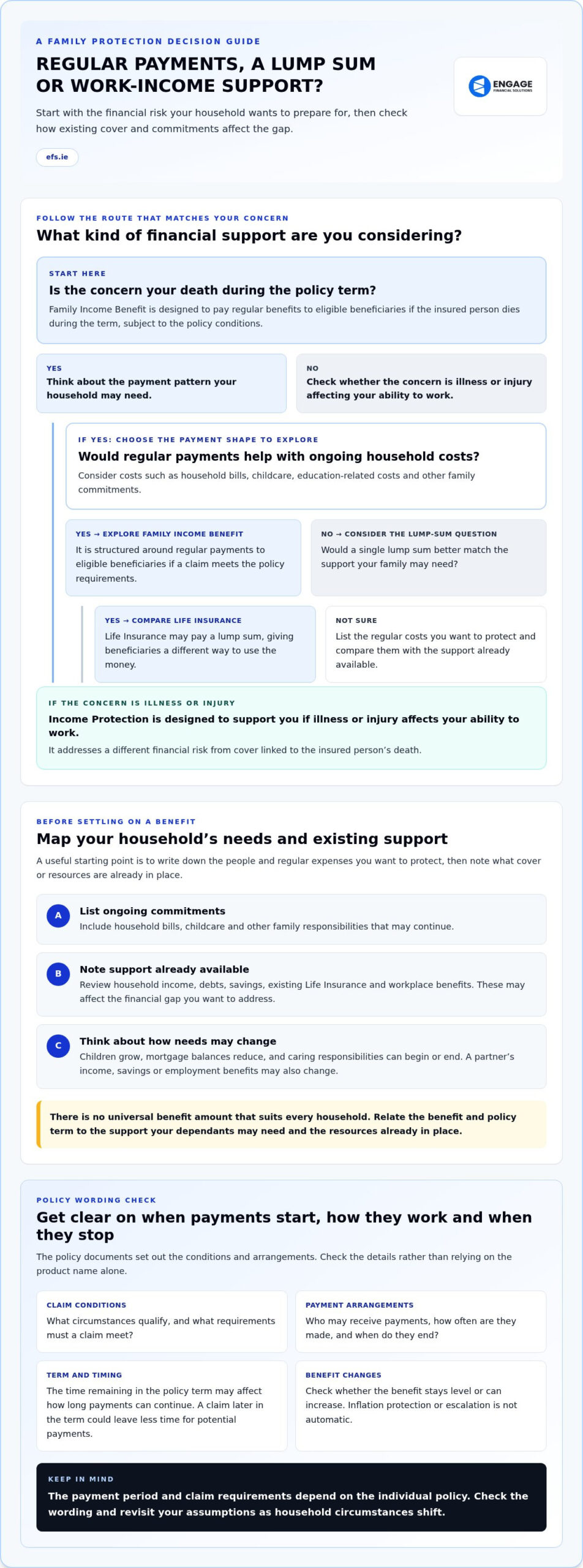
How to Assess Family Income Benefit for Your Household
Start with the people who rely on you and the financial responsibilities you want to protect. A clear picture of your household finances can help you decide whether Family Income Benefit may have a role and how it could sit alongside your existing arrangements. Work through these steps before comparing cover.
- List your dependants and responsibilities. Note who relies on your income, including children or other family members you support. Write down the commitments you want to safeguard, such as household bills, childcare, education-related costs or mortgage payments.
- Gather details about your household finances. Record regular income, essential outgoings, savings and debts. Consider how these might change if your circumstances changed, rather than assuming a partner’s income or other resources would stay the same.
- Review existing protection. Collect the policy documents for any Life Insurance, Mortgage Protection, Income Protection or workplace cover. Note what each is designed to address, who may benefit and when cover applies. This helps you spot possible overlaps or gaps without treating each policy in isolation.
- Think about the support period. Consider how long dependants may need financial help. Their needs could change as children grow, debts reduce or family responsibilities shift, so there’s no standard term that suits every household.
- Compare policy details and affordability. Set the benefit amount, policy term, payment structure, exclusions and claim conditions side by side. Exclusions are circumstances a policy doesn’t cover; the wording explains what applies. Review the cost in the context of your regular budget, without assuming eligibility or a particular premium.
Keep a simple summary of your findings: the needs you want to address, the cover already in place and any questions raised by the policy documents. This makes it easier to assess whether a proposed benefit matches its intended purpose. If a term is unfamiliar, use the policy wording for its exact meaning rather than relying on a general description.
As part of your review, look closely at Mortgage Protection and how it relates to your mortgage liability. Check what the policy is intended to cover and how that differs from support for other household costs. Revisit the details if your family, income, debts or existing protection changes.
For a tailored view of how protection choices relate to your dependants, current cover and longer-term plans, explore personal financial guidance.
Choosing Family Income Benefit With Personal Financial Guidance
Choosing cover is less about finding a single “right” figure and more about matching protection to the people and responsibilities you want to safeguard. Personalised guidance can help connect your dependants’ needs with your existing protection and longer-term plans, so you can compare options in context rather than in isolation.
What should a considered review include?
Begin by stating the financial need you want to address. Who would you want to receive support? Which household responsibilities should it help with, and for how long might that support be needed? Then consider whether regular payments or a potential lump sum better reflects the intended purpose. The benefit structure and policy term should make sense alongside those priorities.
Next, review the policy wording. Pay particular attention to exclusions, which describe circumstances the policy doesn’t cover, and claim conditions, which set out what must apply for a claim to be considered. Check how the cover may sit alongside existing Life Insurance, Mortgage Protection, Income Protection or workplace benefits. This can help identify where protection may overlap or where a separate need remains. For wider context, explore Life Insurance guidance as you compare related options.
A useful review can follow a few clear stages: clarify your priorities, compare relevant protection approaches, understand the terms and conditions, then consider a suitable way forward. If a policy term or phrase is unclear, refer to the wording and ask for it to be explained in plain language before making a decision.
What is a sensible next step if you are comparing cover?
Before a tailored discussion, gather a short summary of your household priorities and the policies already in place. Include who depends on your income, the commitments you want to protect and any changes you expect, such as a mortgage reducing or children becoming less financially dependent. Bring your policy documents so the benefits and conditions can be considered together.
This preparation gives you a practical starting point for assessing family income benefit cover alongside other protection options. It helps keep the discussion focused on your circumstances, the purpose of the cover and how it may fit your wider financial plans.
If you’d like to explore your options with Engage Financial Solutions, discuss your protection needs in a straightforward, low-pressure conversation.
Make Your Family’s Protection Plan Work for You
Family Income Benefit is designed to provide regular payments to beneficiaries after an insured death during the policy term, while Life Insurance may provide a lump sum. The right approach depends on how your household would need support, the responsibilities you want to protect and the terms of each policy.
Before deciding, review your dependants’ needs, existing protection and household commitments. Compare the benefit amount and term, and read the policy wording for payment arrangements, exclusions and claim conditions. Consider how Family Income Benefit could fit alongside Life Insurance, Mortgage Protection or Income Protection rather than viewing each policy in isolation.
Engage Financial Solutions is regulated by the Central Bank and provides personalised guidance on Life Insurance and related protection for individuals and businesses. A considered discussion can help you relate cover choices to your family’s circumstances and longer-term plans, without assuming one option suits everyone.
Ready to explore what may fit your household? Discuss your protection needs with Engage Financial Solutions and take a confident next step towards planning for your family’s future.
Frequently Asked Questions
What is Family Income Benefit insurance?
Family Income Benefit is life cover designed to provide regular payments to beneficiaries if the insured person dies during the policy term, subject to the policy’s conditions. It differs from cover that pays a single lump sum. The policy documents explain the benefit amount, payment period, eligible beneficiaries and qualifying circumstances. Read these details carefully, as arrangements can vary between policies and affect how the cover may support your family.
How does Family Income Benefit pay my family?
If the insured person dies during the policy term and the claim meets the policy conditions, payments may be made to eligible beneficiaries. The policy sets the payment amount, frequency and duration, along with how beneficiaries are designated. Check how much of the term could remain when a claim occurs and when payments would stop. The policy wording explains the precise process.
Is Family Income Benefit different from Life Insurance?
Yes. Family Income Benefit is designed around regular payments to beneficiaries, while Life Insurance may provide a lump sum, depending on the policy. Regular payments may help with ongoing costs, whereas a lump sum can give beneficiaries flexibility to address different needs. Neither structure is automatically better. Consider the financial responsibilities you want to protect, then compare the payment terms, conditions and exclusions in the relevant policy documents.
Can Family Income Benefit work alongside Mortgage Protection?
Family Income Benefit and Mortgage Protection address different potential needs, so they may be considered together. Family Income Benefit is intended to provide regular support for beneficiaries after an insured death, while Mortgage Protection is generally linked to a mortgage liability. Exact arrangements depend on each policy. Review both documents to understand the benefits, claim conditions and any overlap, then consider whether other household commitments would still need financial support.
How much Family Income Benefit cover might my family need?
There’s no single benefit amount that suits every family. Start by listing your dependants, regular household costs, debts and responsibilities you want to protect. Then review existing Life Insurance, workplace benefits, savings and other household income to understand what support may already be available. Consider how long your family might need help, and compare that need with the proposed benefit and policy term. Personalised guidance can help you assess the figures in context.
What happens if my circumstances change during the policy term?
Changes such as a new child, a different income, a reducing mortgage balance or a change in dependants may affect the protection your household needs. Review your policy documents and overall cover when circumstances shift. The documents explain whether and how the policy can be adjusted, along with any relevant conditions. Don’t assume a change happens automatically. A review can help you understand whether your current arrangements still reflect your priorities.
Does Family Income Benefit pay out in every circumstance?
No. A payment depends on the policy’s qualifying circumstances and the claim meeting its terms. Cover generally relates to the insured person’s death during the policy term, but exclusions, conditions and other details can affect whether a claim is payable. Read the policy wording, especially the sections explaining what is covered and how to make a claim. If a term is unclear, seek a plain-language explanation before relying on the cover.
Disclaimer
Engage Financial Services LTD T/A Engage Financial Solutions is regulated by the Central Bank of Ireland CRO 764570. Suite 2 First Floor, 14 -18 Main street, Blackrock, Co Dublin. A94 W0Y3