


The greatest risk in residential letting isn’t finding reliable tenants; it’s entering the market without an aligned financing and regulatory structure. Whether you’re acquiring your first investment property or repurposing a private residence, the domestic market demands meticulous commercial preparation. You likely already feel the pressure of tightening statutory standards, complex lender criteria, and confusing tax rules that can quickly erode gross rental yields. That’s why having a structured roadmap is essential. This definitive becoming a landlord in Ireland guide is designed to help you master compliance, structure the optimal Buy-to-Let mortgage Product, and launch your rental venture seamlessly.
Ahead, you’ll discover a practical, step-by-step roadmap covering every critical milestone, from assessing deposit requirements and lender borrowing criteria to statutory tenancy registration and allowable expense deductions. By approaching your property venture with structured clarity and steady financial stewardship, you can safeguard your hard-earned capital, eliminate regulatory friction, and build enduring long-term wealth with complete peace of mind.
Key Takeaways
- Master statutory tenancy registration deadlines and annual compliance rules to protect your investment from costly administrative penalties.
- Use this comprehensive becoming a landlord in Ireland guide to navigate lender underwriting criteria and secure the ideal Buy-to-Let mortgage Product.
- Ensure your rental property meets mandatory physical safety standards and holds a valid Building Energy Rating before marketing to tenants.
- Safeguard your net yields by learning how to properly claim allowable deductions, from mortgage interest relief to wear and tear capital allowances.
- Integrate your property assets with tailored Mortgage Protection and long-term financial planning to preserve wealth with lasting peace of mind.
Understanding Landlord Obligations: Tenancy Regulations and Legal Registration
Launching a rental property requires more than simply securing a tenant and collecting rent. Under domestic law, residential letting is governed by strict statutory duties designed to balance security of tenure with clear property rights. Whether you’re letting an inherited home or purchasing a new unit, consulting a comprehensive becoming a landlord in Ireland guide helps ensure you remain fully compliant from day one, protecting both your cash flow and your legal standing.
Mandatory Tenancy Registration and Regulatory Compliance
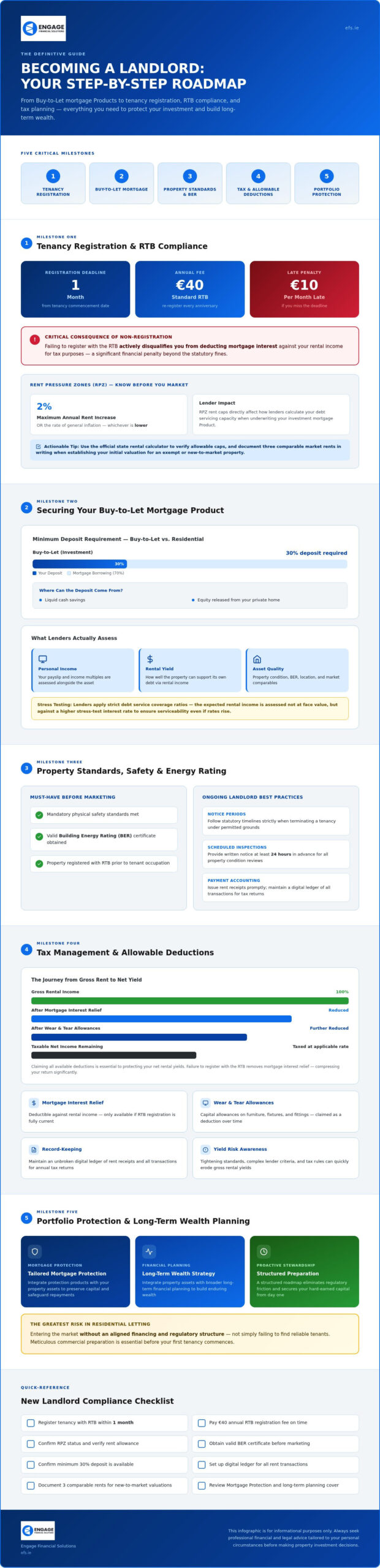
Every landlord must register a tenancy with the Residential Tenancies Board (RTB) within one month of its commencement date, and re-register annually on that anniversary. The standard annual registration fee is €40, while a late fee of €10 per month applies if you miss the deadline. Beyond statutory fines, non-compliance carries severe financial repercussions: failing to register actively disqualifies you from deducting mortgage interest against your rental income for tax purposes. Familiarising yourself with the wider landlord-tenant law framework reinforces the necessity of meticulous record-keeping for deposits, safety checks, and communications to ensure seamless dispute resolution if issues ever arise before the board.
Navigating Rent Setting Rules and Rent Pressure Zones
Before marketing your property or calculating your loan serviceability, you must verify whether the home sits within a designated Rent Pressure Zone (RPZ). In these restricted areas, annual rent increases cannot exceed the rate of general inflation or 2% per year, whichever is lower. Crucially, these caps directly impact how lenders calculate your debt servicing capacity when underwriting your investment mortgage Product. To protect your returns, use the official state rental calculator to verify allowable caps, and always document three comparable market rents in writing when establishing your initial valuation for an exempt or new-to-market property.
Rights and Responsibilities for Tenant Relationships
Professional property stewardship relies on clear communication, structured documentation, and total respect for tenant privacy. Day-to-day best practices include:
- Lawful Notice Periods: Follow statutory notice timelines strictly if terminating a tenancy under permitted grounds, such as requiring the property for personal use or conducting substantial refurbishments.
- Scheduled Inspections: Provide written notice at least 24 hours in advance to arrange property condition reviews, keeping inspections to reasonable intervals without breaching peaceful occupation rights.
- Payment Accounting: Issue prompt rent receipts and maintain an unbroken digital ledger of all incoming transactions to ensure full transparency during annual tax returns.
Approaching these legal duties proactively establishes a calm, professional partnership with your occupants, delivering stability for your tenancy and enduring security for your balance sheet.
Securing the Ideal Buy-to-Let Mortgage Product for Maximum Returns
Securing the right financing represents the bedrock of any successful residential property venture. While residential mortgages focus predominantly on personal income multiples, an investment loan requires an entirely distinct underwriting assessment. Any reliable becoming a landlord in Ireland guide will highlight that lenders evaluate not just your personal payslip, but how effectively the target asset can support its own debt.
Lender Requirements and Deposit Thresholds
Expect higher down-payment hurdles when financing a residential tenancy asset. Domestic lenders generally require a minimum deposit of 30% for a dedicated investment borrowing facility, reflecting the commercial risk profile. If you already own your private home, you might release accumulated equity to fund this upfront deposit rather than relying solely on liquid cash savings. For those holding underperforming existing loan terms on other assets, reviewing our comprehensive switching guide can unlock valuable capital to fuel your next purchase.
Rental Yield Stress Testing and Affordability
Underwriting criteria hinge on strict debt service coverage ratios (DSCR). Lenders do not merely look at current market rents. They apply simulated interest rate stress tests to ensure the property maintains a financial buffer against market shifts, as detailed in the official Guide to Landlord Responsibilities. Key elements lenders assess include:
- Rental Coverage: Net rental income typically needs to exceed 120% to 145% of the stressed monthly mortgage payment.
- Personal Income Floor: Most institutions enforce minimum annual earnings thresholds outside of rental receipts.
- Local Rent Caps: Statutory limits inside rent zones are factored into long-term cash flow projections, limiting artificial rent inflation models.
Fixed Versus Variable Rates for Rental Portfolios
Your choice of interest rate structure dictates day-to-day profit margins and peace of mind. A fixed-rate loan Product provides absolute budgeting certainty, safeguarding your monthly cash flow against broader monetary policy fluctuations. In contrast, a variable-rate mortgage Product allows for flexible early capital repayments and penalty-free switching if borrowing conditions improve. Because commercial rates vary considerably between high-street banks and non-bank lenders, securing tailored debt structuring is paramount. You can partner with Engage Financial Solutions to compare leading lenders and identify the optimal investment structure tailored to your long-term wealth objectives.
Preparing Your Property: Safety Standards, Repairs, and Energy Ratings
Bringing a rental property to market involves rigorous physical preparation before handing over keys. Local authorities actively inspect private rentals to enforce statutory standards, meaning basic cosmetic updates aren’t enough. As this becoming a landlord in Ireland guide illustrates, aligning your building’s health, safety, and energy efficiency early avoids costly improvement notices and helps attract reliable long-term occupants.
Minimum Physical Standards and Safety Measures
Domestic legislation sets explicit baseline criteria for habitable rental housing. Properties must remain structurally sound, weather-proof, and entirely free from dampness. Before letting, ensure your property meets these non-negotiable safety standards:
- Fire Safety: Fit functional, mains-wired or sealed 10-year battery smoke alarms on each level, an optical heat alarm in the kitchen, and a dedicated fire blanket.
- Carbon Monoxide Alarms: Install certified detection devices in any room containing a fuel-burning appliance or flue.
- Ventilation and Heating: Each habitable room requires adequate natural light, adjustable wall vents or opening windows, and an independently controllable heating installation capable of maintaining 20°C comfortably.
- Sanitary and Cooking Facilities: Maintain dedicated food preparation equipment, including a four-ring hob, oven, fridge-freezer, microwave, and plumbed washing machine.
Building Energy Rating (BER) Requirements
Securing a valid Building Energy Rating (BER) certificate is a legal requirement before advertising any domestic property for lease. The current simplified rating scale runs from A0 down to G, and the specific energy label must appear in all online listings and print advertisements. While the private rental sector has no statutory minimum rating threshold at present, high-efficiency ratings deliver tangible commercial benefits. Better-insulated properties lower day-to-day running bills for tenants, encourage longer tenancies, and unlock discounted green borrowing rates when sourcing a competitive mortgage Product. Landlords can also access SEAI grant assistance alongside a dedicated €10,000 tax deduction for qualifying retrofitting projects.
Furnished Versus Unfurnished Letting Decisions
Deciding between furnished and unfurnished accommodation depends on local demand. City apartments typically achieve quicker occupancy when fully furnished, whereas long-term family suburban homes often let well unfurnished. If furnishing, select commercial-grade, durable items that withstand daily wear. Compile a detailed photographic inventory log signed by both parties at check-in. This transparent documentation establishes clear mutual expectations, safeguarding your furnishings and removing friction when reconciling deposits at the conclusion of the tenancy.
Managing Rental Finances: Taxation, Allowable Deductions, and Accounting
Maintaining a profitable rental portfolio requires disciplined financial management. Many first-time investors focus entirely on gross rental yields, only to experience an unwelcome surprise when their annual tax assessment arrives. As this practical becoming a landlord in Ireland guide underscores, mastering domestic tax mechanics and claiming every legitimate deduction ensures your venture delivers authentic net profitability rather than unexpected overheads.
Understanding Taxable Rental Profits
Rental income is not taxed in isolation. Revenue calculates your liability by adding net rental profits directly to your overall personal earnings. This means your profits face income tax at either the 20% standard rate or the 40% higher marginal rate, alongside the Universal Social Charge (USC) ranging from 0.5% to 8%. Pay Related Social Insurance (PRSI) also applies at 4.20%, rising to 4.35% from October 1, 2026. A sensible strategy is ring-fencing roughly 45% to 50% of your net monthly rental profit into a separate savings reserve. Doing this prevents cash shortfalls when settling your preliminary and final tax bills each autumn.
Maximising Allowable Revenue Expenses
Lowering your taxable exposure lawfully depends on distinguishing between operational revenue expenses and capital improvements. Under current Revenue guidelines, key allowable deductions include:
- Mortgage Interest: Claim 100% of the interest charged on your investment mortgage Product, provided your tenancy holds active RTB registration.
- General Revenue Expenses: Fully deduct RTB annual registration fees, property insurance premiums, estate agent management fees, accountancy fees, and direct maintenance costs like plumbing call-outs.
- Wear and Tear Allowances: Depreciate eligible furniture, white goods, and fixtures at a rate of 12.5% per year across an eight-year schedule.
- Special Targeted Reliefs: Utilise the Residential Premises Rental Income Relief (providing up to a €1,000 tax credit through a €5,000 deduction on qualifying income), pre-letting expenses up to €10,000 for prolonged vacancies, or up to €10,000 in retrofitting deductions backed by SEAI grants. Note that Local Property Tax remains strictly non-deductible.
Bookkeeping Best Practices for First-Time Landlords
Meticulous administrative habits shield you from costly accounting reconciliation errors. Open a dedicated business or sub-current account exclusively for rental deposits, monthly rent, and contractor payments. Never mix private personal groceries or fuel receipts with property outlays. Scan every invoice, maintenance receipt, and utility bill into organised cloud folders, preserving these records for the statutory six-year retention timeframe. To structure your lending, debt service, and cash flow with absolute precision, schedule a financial consultation with Engage Financial Solutions today.
Safeguarding Your Portfolio: Strategic Protection and Long-Term Wealth Planning
Building a successful property portfolio involves far more than merely collecting rent and managing leases. For investors seeking professional investment advisory and management support, check out MaddisonV Properties to explore specialist strategies. True financial stability also requires shielding your hard-earned assets against sudden life events, market shocks, and operational hazards. While many introductory articles stop at basic tenancy rules, this strategic becoming a landlord in Ireland guide focuses on the broader horizon, connecting individual property acquisitions directly to your lifelong wealth goals.
Essential Property and Liability Insurance
Standard domestic homeowner policies are void the moment you welcome paying tenants. Lenders insist on dedicated landlord insurance before loan drawdown, but your coverage must go beyond basic bricks and mortar. Essential policy layers include:
- Specialist Buildings and Contents: Safeguards against fire, storm damage, burst pipes, and accidental damage to landlord-owned furnishings.
- Public Liability Cover: Protects your personal assets if a tenant or visitor sustains an accidental injury on the property grounds.
- Loss of Rent Provisions: Covers lost monthly earnings if an insured event, such as a major flood, renders the home temporarily uninhabitable.
Whether you are assessing specialist risks for wider property interests or looking for bespoke cover online, you can discover Just Quote Me to explore comprehensive landlord and business insurance solutions tailored to protect your rental investments.
Personal Protection and Mortgage Safeguards
Securing property borrowing introduces a substantial personal financial commitment. If illness or injury prevents you from earning your primary salary, rental receipts alone might not bridge the cash-flow shortfall during extended tenant vacancy. Shielding your investment commitments by evaluating an appropriate income protection Product ensures your personal and investment finances remain completely independent. Similarly, you can protect your family by exploring a tailored mortgage protection Product designed to clear outstanding investment debt upon death. This guarantees your property assets become a legacy of financial freedom for your dependents rather than a complicated borrowing liability.
Integrating Property into Comprehensive Retirement Plans
Bricks and mortar should form a cohesive part of your overall financial future, operating hand-in-hand with pensions and liquid savings. Discover holistic wealth structures through professional retirement planning guidance to understand how net rental yields interact with future personal taxation, capital gains thresholds, and eventual inheritance transfers. Aligning every asset with a clear, forward-looking roadmap delivers true financial independence. Take the next step toward confident, friction-free ownership: schedule a comprehensive consultation with Engage Financial Solutions today to structure your borrowing, protect your balance sheet, and build lasting family security.
Building Your Long-Term Rental Success With Confidence
Stepping into property investment provides a dependable route to long-term financial security when supported by rigorous commercial planning. Sustainable profitability depends on maintaining prompt tenancy registrations, claiming every allowable tax deduction to preserve net yields, and aligning day-to-day operations with your personal wealth goals. As outlined throughout this becoming a landlord in Ireland guide, treating your rental venture as an integrated financial asset removes operational friction and protects your capital.
Navigating borrowing criteria and choosing the appropriate debt structure doesn’t need to be stressful. Engage Financial Solutions is regulated by the Central Bank, offering direct access to premier national mortgage lenders alongside full-spectrum wealth management and personal protection guidance. Speak with a qualified advisor at Engage Financial Solutions to secure the ideal Buy-to-Let mortgage Product for your investment and take your next step forward with lasting peace of mind.
Frequently Asked Questions
Can I rent out my property without registering with the tenancy board?
No, statutory law strictly requires every residential tenancy to be registered with the Residential Tenancies Board within one month of starting. Failing to complete annual registration exposes you to recurring financial penalties and civil enforcement action. Crucially, as highlighted in this becoming a landlord in Ireland guide, an unregistered tenancy legally prevents you from deducting mortgage interest expenses on your annual tax return.
How much deposit do lenders require for a Buy-to-Let mortgage Product?
Lenders generally require a minimum cash deposit of 30% to secure an investment borrowing facility. This substantial down payment mitigates commercial lending risk across the domestic market. Investors often fund this equity hurdle using accumulated personal savings or by releasing available equity built up within their primary private residence through structured refinancing.
Is mortgage interest fully deductible against rental income?
Yes, landlords can deduct 100% of the loan interest paid on an investment mortgage Product against gross rental receipts. However, full deductibility remains strictly contingent on keeping your annual RTB tenancy registration active and up to date. You cannot offset the capital repayment portion of monthly loan instalments, which remains non-deductible.
What happens if my rental property is located in a Rent Pressure Zone?
Operating inside a Rent Pressure Zone means statutory caps limit your annual rent increases to the rate of general inflation or 2% per year, whichever is lower. Lenders actively factor these statutory limits into debt service coverage calculations. When setting an initial market rate for an exempt home, you must document three written comparable market properties to validate your figure.
Do I need a Building Energy Rating certificate before advertising a rental home?
Yes, securing a valid Building Energy Rating certificate is a mandatory legal obligation before publishing any public marketing listing. The simplified rating letter must appear in all print and digital adverts. While private rental properties currently face no statutory minimum energy score, achieving higher ratings attracts conscientious tenants and unlocks favourable green borrowing terms.
Can I switch my current residential mortgage into a Buy-to-Let loan?
Yes, you can re-mortgage an existing private home into an investment borrowing facility if your life plans change. Lenders will re-underwrite the facility under commercial criteria, assessing property equity, stress-tested rental yield coverage, and your independent personal earnings. Working with an advisor ensures you transition smoothly without breaching original loan covenants.
What insurance coverage does a residential landlord legally require?
While basic public liability isn’t technically mandated by civil statutes, commercial mortgage lenders legally require comprehensive specialist landlord insurance before releasing funds. Standard homeowner policies become invalid once paying occupants move in. This essential protection safeguards your building fabric, landlord-owned fixtures, loss of rental income, and substantial third-party occupier liability claims.
Disclaimer
Engage Financial Services LTD T/A Engage Financial Solutions is regulated by the Central Bank of Ireland CRO 764570. Suite 2 First Floor, 14 -18 Main street, Blackrock, Co Dublin. A94 W0Y3