


A blueprint is only as strong as the finance that supports it. While the prospect of creating a home tailored to your exact needs is exhilarating, the path to securing a SELF-BUILD MORTGAGE often feels cluttered with obstacles. Whether you are worried about the complexities of stage payments or the impact of rising material costs, it’s understandable to seek a sense of stability before you begin. You need a partner who understands that meeting the specific self build mortgage requirements for 2026 isn’t just a box-ticking exercise; it’s about safeguarding your long-term security.
We’ve designed this guide to demystify the application process, providing the clarity you need to navigate Central Bank regulations, such as the four-times income limit for first-time buyers. You’ll discover exactly how much deposit is required, how lenders assess your construction costs, and what documentation is essential for a seamless approval. By the end of this article, you will have a practical roadmap and the confidence to ensure your project remains financially viable from the initial planning permission to the final lick of paint.
Key Takeaways
- Understand why a SELF-BUILD MORTGAGE is released in distinct increments rather than a single lump sum to align with your specific construction milestones.
- Discover the current self build mortgage requirements Ireland lenders apply to Loan-to-Value ratios and how your existing site value can contribute towards your deposit.
- Prepare a robust application pack by ensuring your “Grant of Planning Permission” and professional costings are finalised before seeking a formal offer.
- Master the rhythm of the stage payment process, from the initial foundation stage to the final retention release once your home is fully complete.
- Safeguard your financial stability throughout the build by arranging essential MORTGAGE PROTECTION and INCOME PROTECTION to cover any unforeseen circumstances.
Understanding the SELF-BUILD MORTGAGE Framework
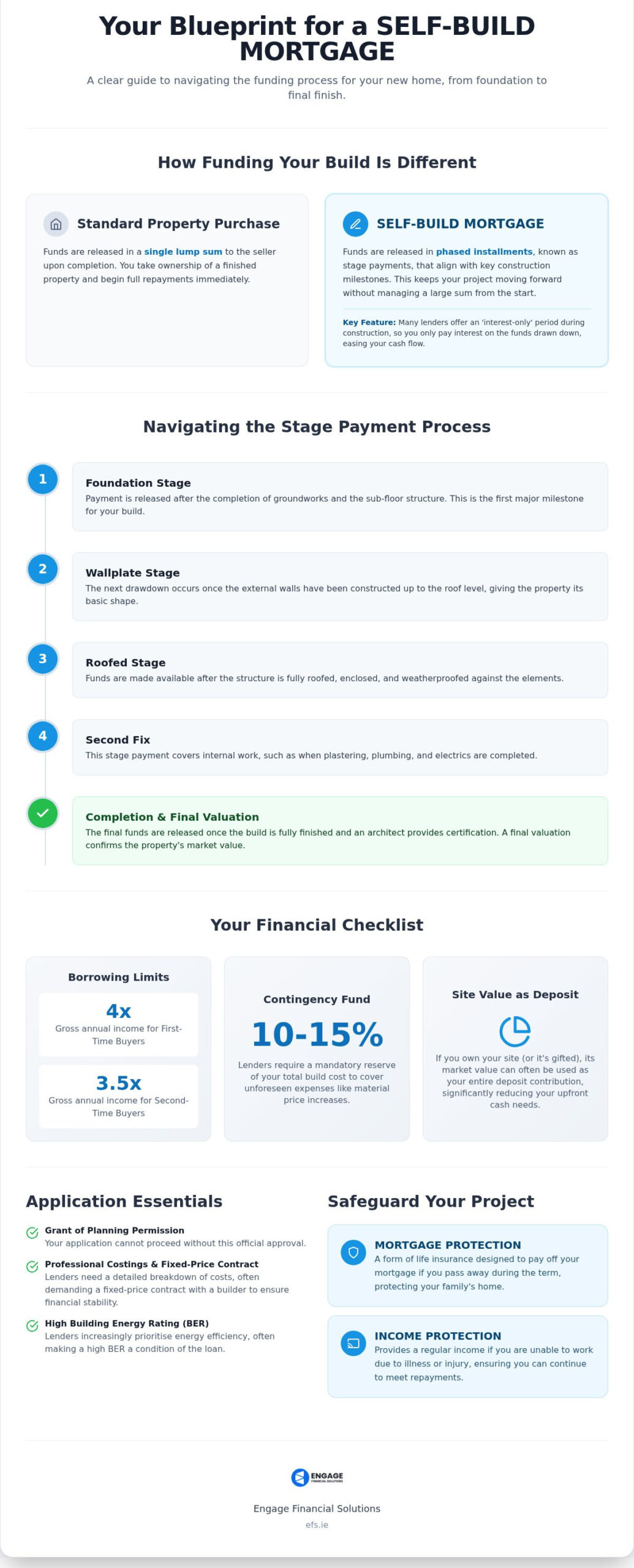
Building your own home is a deeply personal journey, quite different from purchasing a “turnkey” property where you simply collect the keys to a finished house. In a standard purchase, the lender releases the full loan amount in one single transaction at the point of sale. However, a SELF-BUILD MORTGAGE operates on a fundamentally different logic. It’s a specialised financial tool where funds are released in increments, or “stage payments,” as your construction progresses. This ensures that the capital is available exactly when you need it to pay contractors and suppliers, keeping your project moving forward without the burden of managing a massive lump sum from day one.
One of the most critical self build mortgage requirements is the presence of a “fixed-price contract.” In the current economic climate, lenders prioritising stability will often insist on a formal agreement with a builder that locks in costs. This protects you from the anxiety of sudden price hikes in materials. Additionally, many lenders offer “interest-only” periods during the construction phase. This means you only pay the interest on the funds you’ve actually drawn down, which helps keep your monthly outgoings manageable whilst you might still be paying rent or a mortgage on your current residence.
The Core Logic of Staged Funding
Lenders don’t release money based on trust; they release it based on verified progress. Funds are typically paid out only after specific milestones are reached and certified. These stages often include:
- Foundation stage: Completion of the groundworks and sub-floor.
- Wallplate stage: External walls are built to the roof level.
- Roofed stage: The structure is fully weathered and enclosed.
- Second fix: Internal plastering and plumbing are completed.
An architect or engineer must certify each stage before the bank issues the next payment. This structure acts as a safeguard, ensuring the loan-to-value ratio remains healthy. A final valuation is conducted once the build is finished to confirm the property’s market worth matches the initial projections. This methodical approach provides peace of mind, ensuring the project remains financially viable for both you and the institution.
Lender Expectations for 2026
As we look toward the requirements for 2026, there’s a significant shift towards sustainability and professional oversight. Lenders are increasingly focused on energy efficiency, often requiring a high Building Energy Rating (BER) as a condition of the loan. There’s also more rigorous vetting of building contractors to ensure they have the necessary experience and insurance. Working with a professional consultant, such as those at Engage Financial Solutions, can help you organise your application pack to meet these modern standards. We act as a buffer, translating complex criteria into a straightforward plan that secures your future home.
Financial Thresholds and Deposit Criteria
Understanding the financial landscape is the first step toward turning a green field into a family home. When assessing self build mortgage requirements Ireland lenders strictly adhere to macroprudential rules set by the Central Bank. For most first-time buyers, this means you can generally borrow up to four times your gross annual income. If you’re a second-time buyer, this limit typically shifts to 3.5 times your income. These ratios ensure that your dream doesn’t become a financial burden, providing a foundation of long-term stability for your future.
The Loan-to-Value (LTV) limit is equally significant. Whilst a standard residential purchase requires a 10% deposit, a construction project allows for more flexibility if you already own the site. If a family member gifts you a plot of land, its market value can often serve as your entire deposit contribution. This equity is a powerful tool, potentially reducing the amount of cash you need to have on hand. However, lenders also insist on a contingency fund, which is a mandatory reserve of 10% to 15% of your total estimated build costs. This buffer safeguards the project against unforeseen price hikes in materials or unexpected ground conditions.
Calculating Your True Borrowing Power
Lenders will meticulously examine your ability to service a loan whilst you’re potentially paying rent elsewhere during the construction phase. They’ll conduct a “stress test” on your finances to ensure you can manage repayments even if interest rates rise. Whether you have existing car loans or credit card balances, these commitments will impact your total SELF-BUILD MORTGAGE capacity. It’s essential to demonstrate a clean savings history for at least six months, proving that you possess the financial discipline required for a project of this scale. If you aren’t sure how these ratios apply to your specific income, reaching out to a consultant at Engage Financial Solutions can clarify your position.
Site Ownership and Equity
Using a site you already own as collateral is a straightforward process, but it requires a professional valuation before any funds are released. Lenders need to be certain that the site is free from legal encumbrances. Issues such as a “right of way” for a neighbour or “wayleave” agreements for utility companies can sometimes complicate an application. Ensuring these details are resolved early in the planning stage prevents friction during the mortgage process. By addressing these self build mortgage requirements Ireland lenders expect, you’re positioning your project for a seamless transition from a vacant plot to a completed home.
Essential Documentation and Professional Requirements
While securing an initial indication of borrowing power is a positive first step, the full application for a SELF-BUILD MORTGAGE is significantly more detailed than a standard home loan. Lenders require a robust “Application Pack” that proves your project is both legal and technically sound. Meeting the self build mortgage requirements Ireland banks mandate involves coordinating with various professionals to ensure every document is precise and verified. This meticulous preparation is what transforms a conceptual design into a funded reality.
The cornerstone of your application is the “Grant of Planning Permission.” Lenders will not issue a formal mortgage offer without seeing the final, unappealed decision from the local planning authority. Alongside this, you must provide a detailed “Costings Document.” This isn’t just a rough estimate; it must be a comprehensive breakdown of every expense, from groundworks to internal finishes, signed off by a qualified professional. This transparency ensures that the loan amount covers the entire build, preventing the stress of a mid-project funding gap.
The Role of the Supervising Professional
Your lender will insist that a qualified Architect, Building Surveyor, or Chartered Engineer oversees the construction. This professional isn’t just there for design; they carry the responsibility of signing off on “stage certificates.” These certificates are the triggers for your fund releases, confirming that the work completed matches the quality and specifications agreed upon. Crucially, your supervisor must hold valid Professional Indemnity Insurance. This provides an essential layer of security for you and the bank, ensuring that any professional errors or omissions are covered, thus safeguarding the integrity of your investment.
Administrative Must-Haves
Beyond the technical build details, your personal financial history must be transparent. You’ll need to provide a comprehensive set of documents to verify your long-term repayment ability:
- Proof of Identity and Address: Current passports and recent utility bills.
- Financial History: At least six months of detailed bank statements for all accounts, including savings and current accounts.
- Employment Verification: Recent payslips and a signed salary certificate from your employer.
- Site Documentation: Detailed site maps and specifications for the lender’s valuer to review.
By gathering these components early, you create a seamless path toward approval. If the volume of paperwork feels overwhelming, remember that a dedicated advisor can help you organise these requirements into a professional submission that speaks the lender’s language.
Navigating the Stage Payment Process
The transition from planning to construction requires a shift in how you manage your finances. A SELF-BUILD MORTGAGE is not a static product; it’s a dynamic agreement where funds are released in tandem with your progress. Navigating the stage payment process effectively is one of the most vital self build mortgage requirements Ireland lenders look for in a well-managed project. By understanding the rhythm of these drawdowns, you can maintain a steady momentum on-site without the stress of liquidity issues.
Lenders typically structure these releases across 5 to 7 key stages. However, a significant detail often overlooked is the “retention” policy. Most financial institutions will hold back the final 10% of your total loan until the property is fully finished and a final valuation is performed. This means you must plan your final fit-out costs with this temporary shortfall in mind, ensuring you have the personal savings to bridge the gap until the final release. Managing your cash flow is the lifeblood of the build, especially since there’s often a delay of 5 to 10 working days between your professional signing a certificate and the bank actually depositing the funds into your account.
From Foundations to Finish
The build typically moves through three broad phases of funding. Phase 1 covers the initial site purchase and the groundworks, including the sub-floor and drainage. Once the structure begins to rise, you enter Phase 2, which focuses on reaching the floor level and completing the wall plates. Phase 3 is the most intensive period, involving the roofing and internal plastering. Each of these milestones must be verified before the next tranche of money is released, ensuring that the loan-to-value ratio remains stable as the building’s worth increases.
Managing the Drawdown Timeline
Coordination with your builder is essential to keep the project on schedule. You’ll need to ensure that certificates are submitted the moment a stage is reached to avoid work stoppages. If you encounter unforeseen delays or cost overruns, the 10% to 15% contingency fund we discussed previously becomes your primary safeguard. Once the “Final Completion Certificate” is issued, the lender will move you from the construction-phase interest rates to a standard rate. At this point, many homeowners evaluate their options, often looking for a SWITCHING MORTGAGE structure to lock in better long-term savings as they settle into their new home. If you’re ready to map out your drawdown schedule, contact our advisory team for a personalised consultation.
Safeguarding Your Project with INCOME PROTECTION and LIFE INSURANCE
Whilst you focus on the physical structure of your new home, it’s equally vital to construct a digital safety net around your finances. A SELF-BUILD MORTGAGE is a significant, long-term commitment, and protecting your ability to service that debt is a cornerstone of responsible planning. In fact, MORTGAGE PROTECTION is a legal requirement for almost every home loan. This specific type of insurance ensures that the outstanding balance is cleared if you pass away, preventing the financial burden from falling on your loved ones during an already difficult time.
However, a truly robust plan looks beyond the worst-case scenario. INCOME PROTECTION plays a critical role in your build journey. If an illness or injury prevents you from working, this cover provides a replacement income, ensuring you can meet your stage payments and keep the project on track. When you consider the specific self build mortgage requirements lenders enforce, demonstrating that you have a plan for every eventuality adds a layer of stability to your application. It shows you’re not just building a house; you’re securing a future.
Beyond the Basic Bank Requirements
Standard bank-offered policies often lack the flexibility that a self-builder requires. These generic products might not account for the unique risks associated with a multi-stage construction project or your specific lifestyle needs. By opting for a tailored LIFE INSURANCE policy, you can ensure that your family is protected whilst the project is in progress and long after the final brick is laid. A professional broker can help you navigate these options, tailoring products to fit your specific build timeline and budget, rather than simply ticking a box for the lender.
The Next Steps in Your Journey
Taking the first step toward your dream home should be an exciting milestone, not a source of anxiety. We recommend beginning with a comprehensive consultation to assess your eligibility and understand the current lending landscape. Organising an initial “Discovery Meeting” allows you to map out your financial goals and identify any potential friction points before they arise. Our role is to act as your steady guide, providing the calm competence needed to manage your application pack from start to finish. You can take the stress out of the process by contacting our expert team today for a seamless experience that prioritises your long-term security.
Building Your Future on a Solid Foundation
Building a home from the ground up is one of the most rewarding financial journeys you’ll ever undertake. Success lies in mastering the details, from the initial site valuation to the final stage payment release. By aligning your project with the current self build mortgage requirements Ireland lenders demand, you turn a complex process into a manageable roadmap. You’ve seen how essential it is to coordinate with supervising professionals and safeguard your family’s future with robust INCOME PROTECTION and LIFE INSURANCE.
At Engage Financial Solutions, we act as your steady guide through every phase of this transition. As specialists in complex mortgage applications, we provide a personalised financial consultancy that simplifies the application pack and manages lender expectations on your behalf. We’re regulated by the Central Bank, offering you the peace of mind that comes from professional stewardship. Whether you’re just starting to clear the site or you’re ready to submit your costings, we’re here to ensure your project remains on a stable path.
For business owners who wish to extend this level of professional stewardship to their commercial premises, we recommend you visit The CFS Group to discover comprehensive facilities management solutions that ensure your business operates as seamlessly as your new home.
Secure your future and start your build journey with expert guidance. We look forward to helping you turn your vision into a completed home and providing the security you need for the years ahead.
Frequently Asked Questions
Can I get a SELF-BUILD MORTGAGE if I am self-employed?
Yes, you can certainly secure a SELF-BUILD MORTGAGE while self-employed. Lenders typically require two years of certified accounts and Revenue balancing statements to verify your income stability. They look for a consistent track record of earnings to ensure your project remains financially viable over the long term, providing you with the same opportunities as salaried applicants.
How much deposit do I really need for a construction project?
You generally need a minimum deposit of 10% of the combined value of the site and the total construction costs. If you already own the site or it has been gifted to you, the equity in that land often satisfies the self build mortgage requirements Ireland lenders set. This can potentially reduce the amount of physical cash you need to contribute at the start.
What happens if my build costs increase after the mortgage is approved?
If your build costs increase, you should first utilise the mandatory 10% to 15% contingency fund built into your initial loan. If costs exceed this buffer, you will likely need to fund the difference from personal savings. Lenders rarely increase the loan amount once the mortgage has been formally drawn down, making careful initial costings essential for your peace of mind.
Do I have to pay stamp duty on a self-build project?
Stamp duty is typically only payable on the purchase price of the site rather than the value of the finished house. For residential land, the rate is usually 1% on the first €1 million. This provides a significant cost saving compared to purchasing a finished property where duty applies to the total price of the completed building.
Can I live in my current home whilst building my new one?
You can stay in your current residence, but the lender will “stress test” your finances to ensure you can afford both sets of costs. They will verify that your income comfortably covers your existing rent or mortgage payments whilst also servicing the interest on your new construction loan during the building phase. This ensures your financial stability remains intact throughout the build.
Are there any government grants available for self-builders in 2026?
Several supports remain available for eligible builders, including the HELP TO BUY scheme and the FIRST HOME SCHEME. These initiatives are designed to bolster your deposit or bridge a funding gap for first-time builders. It’s wise to consult with a professional to see how these specific supports can be integrated into your overall financial plan for 2026.
How long does it typically take to get full mortgage approval for a build?
Full mortgage approval typically takes between eight and twelve weeks once a complete application pack is submitted. This timeline depends on how quickly you can provide your “Grant of Planning Permission” and finalised professional costings. Having a dedicated advisor manage your paperwork can often streamline this process, leading to a much more straightforward experience.
Disclaimer
Engage Financial Services LTD T/A Engage Financial Solutions is regulated by the Central Bank of Ireland CRO 764570. Director David Moore. Suite 2 First Floor, 14 -18 Main street, Blackrock, Co Dublin A94 W0Y3