


What if you could remove every ounce of market anxiety from your retirement strategy with a single, permanent decision? You’ve spent decades carefully building your pension pot, so it’s only natural to feel protective of it. The fear of market volatility eroding your savings just as you plan to step back is a common worry for those exploring an annuity Ireland wide. It’s a significant transition, and you want to ensure your hard work translates into a stable future.
In this guide, we’ll show you how to secure a guaranteed income for life and navigate the complexities of the Irish market with professional ease. Whether you’re aiming for a simple level income or looking to protect a partner, we’ll demystify the 2026 annuity rates, which currently sit between 5% and 5.7% for a 65-year-old. We’ll also clarify how to maximise your €200,000 tax-free lump sum while safeguarding your future. By the end, you’ll have a clear roadmap for a seamless transition from saving to spending, giving you the peace of mind you deserve.
Key Takeaways
- Discover how a lifetime annuity provides a fixed, reliable income that removes the stress of market volatility from your retirement years.
- Learn the vital steps to accessing your 25% tax-free lump sum and why shopping around for an annuity Ireland wide is crucial for your financial future.
- Evaluate the differences between annuities and Approved Retirement Funds (ARFs) to see which structure aligns with your lifestyle and legacy goals.
- Explore customisation options like joint-life cover and escalation to safeguard your partner’s security and protect your income against future inflation.
- Understand how ‘Enhanced Annuities’ could significantly boost your monthly payments based on your specific health and lifestyle factors.
What is an Annuity and How Does it Secure Your Retirement in Ireland?
After years of diligent saving, the transition to retirement can feel like a daunting shift. An annuity acts as a bridge, turning your accumulated pension pot into a reliable, predictable stream of money. When you explore an annuity Ireland wide, you’re essentially entering a financial contract with a Life Assurance company. In exchange for your pension fund, they take on the risk of the markets and the uncertainty of how long you might live, providing you with a “salary” for the rest of your life. For a foundational look at the mechanics, you can read more about What is an Annuity? and how these structures operate globally. These companies are professional risk managers, and their core promise is that your income will never run out, even if you live to be 100 or beyond.
This process is strictly overseen by the Central Bank of Ireland. This robust regulatory framework ensures that providers maintain sufficient capital to meet their long-term promises, giving you a layer of consumer protection that’s vital during your later years. It removes the friction of worrying about a provider’s stability. When you set up an annuity Ireland based, you can feel confident that your future is in safe, professional hands, allowing you to focus on the things that matter most in your retirement.
The Role of Annuities in the Irish Pension Landscape
In the current Irish system, the State Pension (Contributory) provides a foundational income of €15,564 per year as of 2026. While this is a welcome baseline, many retirees find it isn’t enough to maintain their desired lifestyle. An annuity functions as the “gold standard” for bridging this gap because it offers absolute certainty. It marks the vital shift from the “saving” phase to “decumulation,” ensuring your basic costs are covered regardless of market volatility or economic shifts.
Who Should Consider an Annuity in 2026?
An annuity is often the ideal choice for the risk-averse retiree who prioritises stability over growth. If you don’t have a Defined Benefit pension from an employer, an annuity might be your only source of guaranteed income beyond the State Pension. Your health status also plays a unique role. Through “Enhanced Annuities,” certain medical conditions can result in a higher income rate. This provides a tailored, straightforward path to long-term security that reflects your personal circumstances.
The Mechanics of Purchasing an Annuity: From Pension Pot to Monthly Payment
The transition from saving to drawing an income begins with a significant financial milestone: the tax-free lump sum. In Ireland, you can typically take 25% of your pension fund as a tax-free payment, up to a maximum of €200,000. This provides an immediate injection of capital before you commit the remaining 75% to an annuity Ireland provider. It’s a moment of progress, turning years of contributions into tangible security for your next chapter. For a deeper look at how these structures are governed, you can consult the official guide to personal pensions.
One of the most important rights you hold is the ‘Open Market Option’. You aren’t restricted to the company that managed your pension during your working life. Just as switching mortgage Ireland wide allows homeowners to find more favourable terms, shopping around for annuity rates ensures you receive the highest possible monthly payment for your fund. Rates are calculated based on your age, current interest rates, and your health status. A 65-year-old in 2026 can generally expect rates between 5% and 5.7%, though this varies depending on the specific options you choose.
It’s vital to understand the finality of this decision. Once you purchase an annuity, the contract is permanent. You cannot “cash it in” or change the structure later. This structural certainty is exactly what allows the insurance company to guarantee your income for life, but it requires careful planning at the outset. You’re effectively trading the flexibility of a fund for the stability of a guaranteed cheque, so getting the details right from the start is essential.
Step-by-Step: The Transition Process
The journey starts by evaluating your total pension landscape, including PRSAs and company schemes. You’ll need to request a ‘Statement of Options’ from your current provider, which outlines their offer. Comparing this against the wider market is where you find the true value of your pot. If you’re feeling overwhelmed by the paperwork, reaching out for a professional review of your Annuities options can make the entire process feel straightforward and manageable.
Taxation and the USC on Annuity Income
Once your monthly payments begin, they’re treated as earned income under the PAYE system. This means your income is subject to Income Tax and the Universal Social Charge (USC). The Revenue Commissioners apply your specific tax credits to these payments, much like they did with your salary. Understanding these deductions early helps you plan your actual take-home budget with precision, ensuring there are no surprises as you settle into your new financial routine.
Annuity vs ARF: Which Retirement Path Fits Your Lifestyle?
The decision between a lifetime income and a managed fund is often the most pivotal choice you’ll make at the point of retirement. An annuity Ireland wide offers a structural promise: a fixed payment that arrives every month for as long as you live. In contrast, an Approved Retirement Fund (ARF) keeps your money invested in the markets. Whilst an ARF offers the potential for growth, it also carries the risk that a market downturn could deplete your fund faster than anticipated. If you value the peace of mind that comes from knowing exactly what’s landing in your bank account, the stability of an annuity is hard to beat.
Longevity risk is a factor many retirees underestimate. If you live to be 100, an annuity continues to pay out at the same rate, effectively rewarding you for your long life. With an ARF, you’re required by law to withdraw a minimum amount each year. These mandatory withdrawals start at 4% from age 61 and increase to 5% from age 71. If the underlying investments don’t perform well, these “imputed distributions” can gradually exhaust the capital. An annuity removes this friction entirely; the insurance company takes on the risk of you outliving your savings, acting as a buffer between you and the uncertainties of the future. For a comprehensive overview of how these imputed distribution rules work and how to manage them effectively, our guide to the approved retirement fund Ireland landscape in 2026 covers the full picture.
Inheritance is another area where the two paths diverge. With an ARF, any remaining fund can be passed on to your heirs, though this is subject to specific tax rules. For instance, children over 21 face a flat 30% income tax on inherited ARF assets, whilst a spouse can often transfer the fund to their own ARF tax-free. An annuity is generally designed to provide maximum income during your lifetime. Once the contract begins, the capital is no longer yours to pass on, unless you’ve specifically tailored the product with a guarantee period or joint-life option.
When an Annuity is the Superior Choice
For those with a low tolerance for market volatility, an annuity is often the superior choice. It offers a “set and forget” lifestyle, removing the need for ongoing investment reviews or the stress of watching global indices. This straightforward approach is particularly favoured for smaller pension pots where the priority is securing a reliable baseline of income rather than chasing investment returns. It ensures your fundamental needs are met without fail.
The Hybrid Approach: Can You Have Both?
You don’t always have to choose one or the other. Many retirees opt for a hybrid strategy by splitting their pension pot. You might use a portion to purchase an annuity Ireland based to cover your essential living costs, whilst placing the remainder into an ARF. This balanced method provides the security of a guaranteed floor with the flexibility to benefit from future market growth. Professional guidance is key to finding the right split that aligns with your unique aspirations.
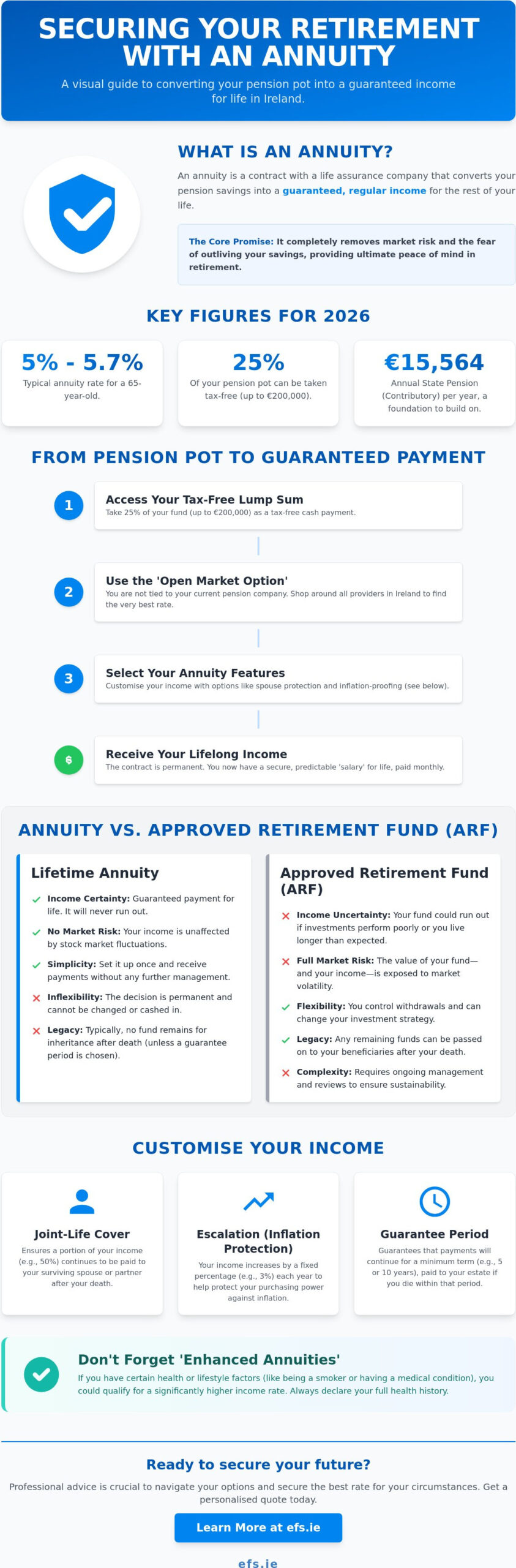
Customising Your Income: Understanding Joint Life, Escalation, and Guarantee Periods
An annuity is more than just a monthly payment; it’s a flexible tool you can shape to fit your personal circumstances. When choosing an annuity Ireland wide, you’ll need to decide between a Single Life and a Joint Life structure. A Single Life policy provides the highest possible starting income because it stops when you pass away. However, for those with a spouse or civil partner, a Joint Life annuity ensures that a portion of the income, often 50% or 100%, continues to the survivor for the rest of their life. This decision is one of stewardship, ensuring your partner remains looked after and financially secure even when you’re no longer there to manage the household budget.
To address the common anxiety about what happens to your fund if you die shortly after retiring, you can add a Guarantee Period of 5 or 10 years. This ensures payments continue to your estate for that set term, regardless of when you pass away. Alternatively, ‘Value Protection’ acts as a robust safety net. This feature returns the balance of your original fund to your beneficiaries, minus any income already paid out. These options remove the friction of the “all or nothing” perception of annuities, making the transition from saving to spending feel much safer for you and your family.
Joint Life Annuities and the ‘Overlap’ Feature
A frequent point of confusion is the difference between ‘Overlap’ and ‘Non-Overlap’ in joint life policies. If you choose a 10-year guarantee with ‘Overlap’ and you pass away in year two, your spouse receives the full income for the remaining eight years of the guarantee while simultaneously receiving their survivor’s pension. In a ‘Non-Overlap’ scenario, the survivor’s pension only begins after the guarantee period ends. Understanding these nuances is vital for long-term security, as it prevents a sudden, unexpected drop in household income during a difficult life transition.
Inflation Protection: Is Escalation Worth the Cost?
Inflation is a subtle but persistent thief of purchasing power. A ‘Level’ annuity offers a higher initial payment, but that fixed amount buys less every year. For example, 3% annual inflation over a 20-year retirement can significantly erode your standard of living. An ‘Escalating’ annuity increases your payment by a fixed percentage each year, such as 3% or 5%. Whilst it starts lower than a level plan, it provides a reliable buffer against rising costs. Choosing between them depends on your other assets and whether you prioritise immediate cash flow or future stability. If you’re ready to build a tailored plan that protects your purchasing power, you can request a personalised quote to see how these features impact your specific monthly income.
Navigating the Market: How to Secure the Best Annuity Rates in Ireland
Your current pension provider will likely send you a ‘Statement of Options’ as you approach your retirement date. Whilst it’s convenient to simply stay where you are, doing so could be a costly oversight. Securing a competitive annuity Ireland wide requires looking beyond your existing insurer. Different life offices have different appetites for risk and vary their rates accordingly. By exercising your right to the Open Market Option, you ensure that your hard-earned fund works as hard as possible for you during your retirement years.
A surprising way to boost your monthly income is through an ‘Enhanced Annuity’. If you have certain health conditions or lifestyle factors, such as high blood pressure, diabetes, or a history of smoking, providers may offer a higher rate. They calculate that your life expectancy might be slightly shorter, which allows them to increase your monthly payments. It’s a pragmatic, professional assessment that turns personal health challenges into a tangible financial advantage, providing you with more capital to enjoy your lifestyle.
Working with an independent broker removes the administrative friction of comparing these complex offers yourself. We act as your steady guide, navigating the fine print across the entire Irish market to find the best fit. We take a ‘future-back’ approach, starting with your desired end-state of security and working backward to the present action. Our meticulous attention to detail ensures that every feature is tailored specifically to your family’s needs, from protecting a spouse to safeguarding your purchasing power.
The Broker Advantage: Seamless and Stress-Free
Dealing with multiple life offices can be overwhelming and time-consuming. We take on that burden, providing a single point of contact for all your retirement needs. At Engage Financial Solutions, our commitment is to provide tailored guidance that integrates your long-term goals into your product choice. We simplify the technical jargon, framing every option through its practical benefit to you, so you can make decisions with calm competence and total clarity.
Next Steps: Moving Towards Your Retirement Goal
To ensure a seamless transition, you should start the review process at least six months before your planned retirement date. This gives you ample time to gather your pension statements and health information without feeling rushed. You can book a comprehensive retirement review with our team to explore your Annuities and ARF options in depth. Achieving the long-term stability and peace of mind you deserve after years of hard work is our priority, and we’re here to make that journey as straightforward as possible.
Securing Your Financial Future with Confidence
Retirement is a significant milestone that marks the beginning of a hard-earned new chapter. By understanding the mechanics of an annuity Ireland wide, you’ve taken the first step toward replacing market uncertainty with a guaranteed, life-long income. We’ve explored how to tailor your payments through joint-life options and inflation protection, ensuring your strategy aligns perfectly with your family’s aspirations. Whether you’re prioritising the stability of a level income or the flexibility of a hybrid approach, the key is making a decision rooted in clarity and professional insight.
As a firm regulated by the Central Bank of Ireland, we provide meticulous, client-centric planning that simplifies these complex transitions. Our expertise spans all major Irish life assurance providers, allowing us to navigate the open market on your behalf to secure the most favourable rates. You don’t have to manage these decisions alone. To ensure your transition from saving to spending is as seamless as possible, book a comprehensive retirement consultation with our expert advisors today. We’re here to help you move forward with optimism and the peace of mind you deserve.
Frequently Asked Questions
Can I change my annuity once it has started?
No, you cannot change or cancel an annuity once the contract has begun and the initial cooling-off period has passed. Because the insurance company provides a lifelong income guarantee, they require the capital to be committed permanently. This finality is why it is essential to meticulously tailor your options, such as joint-life cover or inflation protection, before you sign the final agreement.
What happens to my annuity if I die shortly after retiring?
What happens depends entirely on the features you selected at the outset. If you chose a Single Life annuity with no guarantee, payments stop immediately upon your death. However, if you included a guarantee period, such as 10 years, or opted for Value Protection, the remaining value or payments will be directed to your estate or beneficiaries. This ensures your hard-earned fund provides security for your loved ones even in unforeseen circumstances.
Is the income from an annuity taxable in Ireland?
Yes, annuity income is treated as earned income and is subject to Income Tax and the Universal Social Charge (USC) under the PAYE system. Your provider will deduct these taxes before the payment reaches your bank account, based on the tax credits and cut-off points issued by the Revenue Commissioners. It is a straightforward process that mirrors how your salary was handled during your working life.
What is an ‘Enhanced Annuity’ and do I qualify?
An Enhanced Annuity provides a higher monthly income based on your specific health or lifestyle factors. If you have medical conditions like heart disease or diabetes, or if you are a smoker, you may qualify for a better rate because your life expectancy is statistically shorter. When shopping for an annuity Ireland wide, disclosing these details can significantly boost your retirement income without any extra cost to you.
Can I use my pension pot to buy an annuity for my spouse?
You can use your pension fund to provide for your spouse by choosing a Joint Life annuity. This structure ensures that if you pass away first, a pre-determined percentage of your income, often 50% or 100%, continues to be paid to your spouse or civil partner for the rest of their life. It is a popular choice for those who want to ensure their partner enjoys a seamless transition and long-term financial stability.
How do current interest rates in 2026 affect annuity payments?
Annuity rates are closely linked to the yields on government bonds, which are influenced by broader interest rates. In 2026, as interest rates have stabilised, retirees are seeing gross annual incomes of approximately €37,500 to €42,750 from a €750,000 fund. Higher interest rates allow insurance companies to generate better returns on the capital they hold, which they pass on to you in the form of higher monthly payments.
Is there a minimum fund size required to buy an annuity in Ireland?
There is no legal minimum fund size, but most life assurance providers in Ireland have their own internal thresholds, often starting around €10,000 to €20,000. For very small pots, the administrative costs might make an annuity less efficient. However, for most people with a standard PRSA or company pension, an annuity Ireland based remains a viable and secure way to manage the decumulation of their savings.
What is the difference between a ‘Level’ and an ‘Escalating’ annuity?
A Level annuity pays the same fixed amount every month for life, providing a higher starting income but no protection against rising prices. An Escalating annuity starts at a lower rate but increases by a fixed percentage each year, such as 3% or 5%. This choice allows you to decide whether you need more cash immediately or if you prefer to safeguard your future purchasing power against the long-term effects of inflation.
Disclaimer
Engage Financial Services LTD T/A Engage Financial Solutions is regulated by the Central Bank of Ireland CRO 764570. Director David Moore. Suite 2 First Floor, 14 -18 Main street, Blackrock, Co Dublin A94 W0Y3