


Could your child’s cover be less comprehensive than you assume, even when it sits within your own policy? Critical illness cover for children is commonly included as a feature of an adult policy, but conditions, limits and claim rules can differ. Check the policy wording rather than assuming what is covered.
If you’re unsure whether cover is already included, or how a child’s claim might be assessed, you’re not alone. Policy language can be difficult to compare, especially when you’re weighing potential protection against your household budget and other financial priorities.
This guide explains how children’s cover may be structured alongside Critical Illness Insurance, and what to check before making a decision. You’ll learn how to compare covered conditions, benefit limits, age rules and claim requirements. To make the review more useful, gather your current policy documents and note what matters most to your household. That preparation can help you see how the terms fit your circumstances.
Key Takeaways
- Children’s cover may be linked to an adult Critical Illness Insurance policy, so check your existing documents to see how it is structured.
- A diagnosis alone may not qualify for a claim; the condition must meet the definition in the policy wording.
- Compare eligibility, exclusions, benefit limits and claim conditions, rather than relying on benefit labels alone.
- Consider your household’s existing protection, financial priorities and budget before deciding whether children’s cover suits your family.
- Bring your policy details and a short list of questions to a guidance conversation to make the terms easier to compare.
What Children’s Critical Illness Cover can mean for your family
If a child becomes seriously ill, parents may need to think about more than medical care. Could a claim benefit help with household bills, travel or time away from work? It depends on the policy. Cover is designed to provide financial support when a claim meets its terms, but payment isn’t guaranteed.
Children’s Critical Illness Cover is insurance protection that may pay a benefit if a child meets the policy’s definition of a covered condition and the claim satisfies its requirements. It is financial protection, not a medical service, and it can’t guarantee treatment, recovery or a particular outcome. For a general overview of how Critical illness insurance works, see the linked reference.
To judge whether a benefit could help your family, first establish how the child cover is arranged, who may qualify and what the benefit is intended to support. The policy wording, rather than the product label, sets the boundaries.
How children’s cover may sit within a parent’s policy
Children’s protection may be included as a feature of an adult’s Critical Illness Insurance policy. The benefit may be attached to a parent’s cover, and the policy explains how it applies. Don’t assume every insurer uses the same structure or that a child has a separate policy simply because a child benefit is mentioned.
Eligibility depends on the policy terms, including how a covered condition is defined and what is required to make a claim. Check which children the wording refers to, whether conditions or exclusions apply, and what evidence may be needed. If you already hold a policy, find the section on children’s benefits and note whether the cover is included or arranged separately. This helps you understand the protection in place instead of relying on a summary or verbal description.
What a claim benefit is intended to support
If an insurer accepts a claim, the policy may provide a lump sum, meaning a single payment rather than regular payments. The policyholder can then decide how to use it. For example, a family might put some of the money towards everyday expenses, travel connected with care, or time away from work. These are possible uses, not guaranteed outcomes, and the benefit may not meet every cost.
- Consider which household commitments could continue if a parent needed to reduce or pause work.
- List practical costs that could arise alongside a child’s care, without assuming insurance would cover them all.
- Check who receives any accepted benefit and how the payment is made.
Insurance can provide a measure of financial flexibility, but it doesn’t replace clinical advice or treatment. Picture the support your household would value, then compare that need with the benefit and conditions set out in the policy.
How children’s Critical Illness Cover works in practice
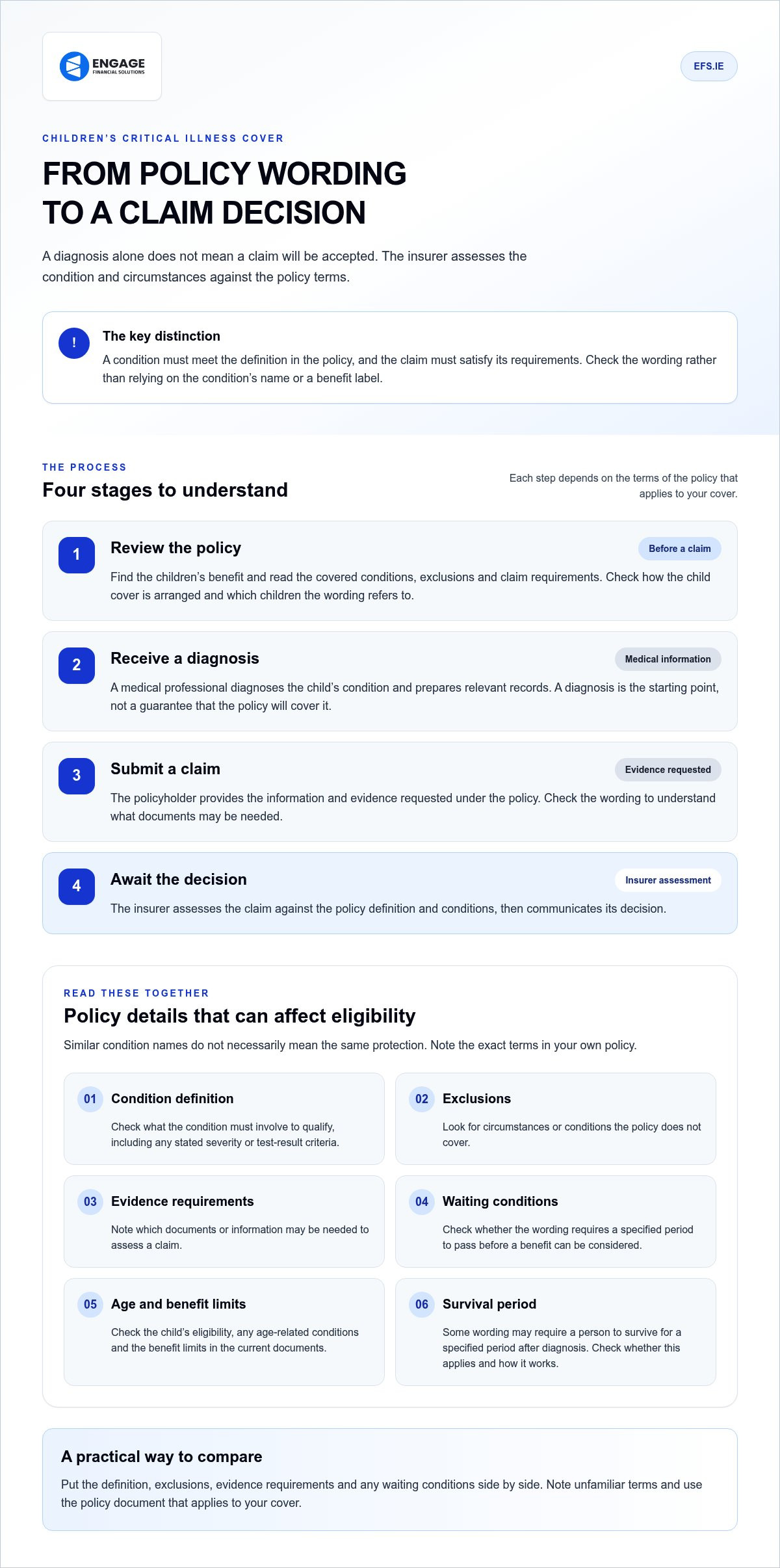
A diagnosis is an important starting point, but it doesn’t automatically mean a claim will be accepted. The insurer assesses the information against the policy terms and decides whether the condition and circumstances meet the requirements. Knowing this can help you interpret the wording and set realistic expectations.
In general, the process involves four steps:
- Review the policy: Find the children’s benefit, covered conditions, exclusions and claim requirements.
- Receive a diagnosis: A medical professional diagnoses the child’s condition and prepares relevant records.
- Submit a claim: The policyholder provides the information and evidence requested under the policy.
- Await the decision: The insurer assesses the claim against the policy definition and conditions, then communicates its decision.
The distinction between a diagnosis and a covered condition matters. A policy may set specific criteria, such as a required level of severity or particular test results. If those criteria aren’t met, the diagnosis may not qualify under that policy. Read the condition definition and claim requirements together rather than relying on the condition’s name alone.
Definitions, exclusions and claim requirements
A policy definition sets out what a condition must involve to qualify. Exclusions describe circumstances or conditions the policy doesn’t cover. Evidence requirements explain what documents may be needed to assess a claim. A waiting condition may require a specified period to pass before a benefit can be considered. As these details differ between policies, use the policy document that applies to your cover rather than assuming an example applies to you.
As you read, note unfamiliar terms and how each one affects eligibility. Record the exact definition, relevant exclusions, evidence requested and any waiting conditions. If you’re comparing policies, put these details side by side: similar labels don’t necessarily mean the same protection.
Child-specific terms worth understanding
Some policy wording may refer to a survival period, a specified period a person may need to survive after diagnosis for a claim to qualify. Whether this applies, and how it works, depends on the policy. Guaranteed insurability may also appear in some wording; use the terms that apply to your cover to understand what it means.
Age limits and benefit amounts can vary, too. Check the current documents for the child’s eligibility, any age-related conditions, benefit limits and claim rules. If you’re unsure how a term affects your cover, personalised Critical Illness Insurance guidance can help you interpret the wording in light of your family’s circumstances.
Compare children’s cover options using these policy criteria
Policy summaries can make different options sound alike, but the detail behind each benefit matters. For a useful comparison, use the current policy documents and look beyond feature names. Check who is eligible, how conditions are defined, what is excluded, and what limits or claim requirements apply.
Use a simple table to record the wording for each policy. Mark anything you can’t interpret clearly, rather than assuming the terms match.
| Compare | What to check | Why it matters |
|---|---|---|
| Eligibility | Which children qualify, and whether age or other conditions affect eligibility. | The benefit may not apply in the same way to every child or at every stage. |
| Definitions | The exact wording for each covered condition and any severity criteria. | A condition’s name alone may not show whether it meets the policy definition. |
| Exclusions | Conditions or circumstances the policy says it won’t cover. | Exclusions can limit when a benefit is payable. |
| Limits | Any maximum benefit, age-related limit or restriction on how a benefit applies. | A benefit label doesn’t tell you the amount or extent of protection. |
| Claim conditions | Evidence required, how a claim is assessed and any waiting or survival conditions. | These terms affect what must happen before a claim can be considered. |
Compare policy wording, not just feature names
Compare the same details across each option, using the documents that apply to the policy rather than a headline summary. Two policies might use a similar name for a child benefit, yet define the covered condition differently, request different evidence or apply different exclusions. Those differences can affect whether a claim meets the terms. Note the exact wording, then consider what it means in practice for your family.
Extra benefits may sound reassuring, but they’re useful only if their terms fit your circumstances and priorities. Check what triggers each benefit, who can qualify and whether separate limits or conditions apply. This helps you focus on relevant protection rather than choosing a policy simply because its feature list appears longer.
Understand how Critical Illness Cover differs from Income Protection
Critical Illness Cover may pay a lump sum if a claim meets the policy definition and conditions. Income Protection guidance relates to a different purpose: Income Protection is designed to replace some income when an insured person can’t work because of illness or injury, subject to its terms. One doesn’t automatically replace the other. Consider which financial need each type of protection is intended to address in your household plan.
Before deciding, compare like with like: eligibility, definitions, exclusions, limits and claim conditions. A side-by-side review makes differences easier to spot and gives you a clearer basis for deciding what may fit your family.
Decide whether children’s cover fits your family’s needs
Whether this cover is worth considering depends on your family’s priorities, current arrangements and budget. Start by considering the practical impact a serious illness could have on your household. Then review what protection you already have and whether there may be a gap. There’s no single answer that suits every family.
Use this step-by-step assessment to organise your thinking:
- Review existing protection. Read current policy documents and check for child-related benefits. If you have cover through work, review the benefit information available to you, but don’t assume it includes protection for a child.
- Identify your priorities. Consider which household commitments would continue if a parent needed time away from work or extra flexibility to support a child. Note the practical pressures you’d most want financial protection to help address.
- Compare the terms. Use the current policy wording to compare eligibility, covered-condition definitions, exclusions, limits and claim requirements. Focus on what each term means in practice for your family.
- Consider affordability. Think about whether the cost of cover fits comfortably within your household budget alongside essential spending, savings and other protection needs. Avoid choosing an amount that would put pressure on day-to-day finances.
A practical checklist before comparing policies
Gather your existing policy documents and any workplace benefit information. Note whether child-related cover is described and how it applies. Write down the costs or practical pressures you’d want a benefit to help with, such as regular household commitments or time away from work. Then list questions about definitions, exclusions and benefit limits. Keeping these notes together makes it easier to compare terms and discuss what matters most.
Don’t treat a benefit as suitable just because it appears in a policy summary. Consider how it would work alongside your existing arrangements and whether its conditions match the support you’re seeking. If you have several policies or workplace benefits, it may take a closer review to understand how they fit together. Tailored financial guidance can help clarify the details.
Balance cover choices with wider family protection
Children’s cover is one part of a broader household protection plan, not a solution to every financial pressure. Consider it alongside your existing Critical Illness Insurance, without assuming one feature can meet all your family’s needs. Reviewing current arrangements can clarify what you value most, such as support with immediate household commitments or greater flexibility if circumstances change.
If you’d like help considering the policy wording alongside your family’s wider priorities, explore personalised financial guidance. A clear picture of your existing cover, questions and budget can support a considered discussion and help you decide on a manageable next step.
Get tailored guidance on children’s Critical Illness Cover
Policy wording can be difficult to interpret, especially when you’re trying to understand how a child-related benefit fits with your family’s wider protection. A financial adviser can help you work through the terms, identify questions and consider how the cover relates to your priorities. The aim is to make the choices clearer, not to rush you towards a decision.
Engage Financial Solutions provides personalised financial guidance on Critical Illness Insurance. A discussion can help you distinguish what your existing policy says from what you hope the cover might provide, and consider the wording alongside your household commitments. Bring the documents that apply to your current arrangements so the conversation can focus on your circumstances.
Prepare for a useful advice conversation
Before meeting an adviser, write down what matters to your family and what you’ve already arranged. Note any child-related benefit you’ve found in your policy documents, along with any workplace protection information you can access. You don’t need to interpret every clause in advance; a short list of questions can keep the discussion focused and practical.
- Summarise the household priorities you want protection to support.
- Bring current policy details and mark any wording about children’s benefits.
- List questions about condition definitions, exclusions, limits and claim requirements.
- Note any terms you’d like explained in plain language, including how a benefit could apply.
This preparation gives you a useful starting point. Ask the adviser to explain how the wording works in practice, and take time to consider the answers. If something remains unclear, make a note of it rather than feeling you need to decide straight away.
Move forward with clarity and confidence
Suitable cover depends on your family’s circumstances and the specific policy terms. A benefit that appears relevant in a summary may have conditions or limits that affect how it applies, so understand those details before making a choice. Reviewing your existing protection may also show which arrangements to take into account when deciding what, if anything, to change.
There’s no need to make the decision in one sitting. Use the discussion to clarify what the policy does, where its limits are and how it fits with your priorities and budget. Personalised guidance can make complex wording easier to compare, while giving you space to weigh the options at your own pace.
If you’re ready to talk through your circumstances and questions, discuss your protection needs.
Take a thoughtful next step for your family
Deciding whether children’s cover suits your family depends on your priorities, existing arrangements and budget. Take time to consider what matters most to your household; you don’t need to reach a decision straight away.
A conversation about your protection needs can help you explore Critical Illness Insurance in the context of your circumstances. Bring any policy details you have and note the questions you’d like answered. You can then weigh the information at your own pace and decide what feels right for your household.
Engage Financial Solutions offers tailored financial guidance to help make that conversation clear and considered. Talk through your family’s protection needs and take your next step with greater confidence.
Frequently Asked Questions
Can a child have more than one claim under Critical Illness Cover?
It depends on the policy’s claim rules and the type of benefit involved. Some policies may restrict repeat claims, while others may treat different conditions or partial benefits separately. An earlier payment could also affect what remains available, depending on the terms. Read the sections on multiple claims, repeat conditions and remaining cover. If the wording doesn’t explain how a later diagnosis would be handled, ask your adviser to help interpret it.
Can a childhood diagnosis affect a child’s ability to get cover as an adult?
It may affect an application, but the outcome depends on the insurer’s assessment and the cover being applied for. An adult application may ask about medical history, and a past diagnosis could influence the terms offered or whether cover is available. Keep relevant medical information accurate and complete if an application asks for it. Don’t assume a child benefit automatically converts into adult cover; check the policy wording and any separate application requirements.
Are congenital conditions covered by children’s Critical Illness Cover?
There isn’t a universal answer. A congenital condition, meaning one present from birth, may be treated differently depending on the policy’s definitions, exclusions and any terms relating to conditions known before cover began. The specific diagnosis and wording matter. Look for relevant exclusions in the policy document and get guidance on how they apply to the circumstances in question. A general list of covered illnesses doesn’t confirm that a particular claim would qualify.
Does children’s cover continue when a child reaches adulthood?
Not necessarily. A child benefit may end when the child reaches the age or other eligibility point specified in the policy. Continuing protection as an adult may require a separate policy or application, and the terms may differ from the child benefit. Check the policy’s age provisions and what happens when eligibility ends. If that point is approaching, review the wording early so you understand the next steps.
Can parents change children’s cover if their family circumstances change?
Possibly, but what can be changed depends on how the child benefit is arranged and the terms of the parent’s policy. A change to the adult policy may affect related benefits, and increasing or altering cover could involve an application or assessment. Review the policy’s amendment rules before making changes. Note what has changed in your household, then clarify how a proposed adjustment would affect the existing cover and its conditions.
Does a child need a medical assessment for Critical Illness Cover?
That depends on the policy and how the child’s benefit is arranged. If cover is linked to a parent’s policy, the application process may focus on the policyholder, but an insurer could still request information about a child under its terms. Don’t assume either that an assessment is always needed or that none will be. Read the application questions carefully and answer them accurately; the policy documents explain any relevant requirements.
Can children’s Critical Illness Cover be arranged without a parent’s policy?
Children’s serious illness benefits are generally offered as part of an adult’s policy rather than as standalone cover, but arrangements can vary. Check whether the benefit is built into the parent’s policy, separately selected within it, or subject to particular eligibility rules. Look for the policyholder requirements and how the child benefit operates. The wording will show whether the protection depends on the adult policy remaining in force.
Disclaimer
Engage Financial Services LTD T/A Engage Financial Solutions is regulated by the Central Bank of Ireland CRO 764570. Suite 2 First Floor, 14 -18 Main street, Blackrock, Co Dublin. A94 W0Y3