


What if two illness-cover policies use different names but offer different protection? It’s understandable that Specified Illness Cover vs Critical Illness Cover can be confusing. The terms are often used for the same broad type of insurance, but a policy name alone doesn’t tell you which conditions are covered or when a benefit may be paid. The wording matters.
This guide explains how the names relate and what to compare, including covered conditions, claim definitions and benefit structure. It also shows how to think about a potential payment in practical terms, such as whether it could help with household bills, debts or other financial commitments during a difficult time.
As you compare options, focus on the policy details and how they fit with protection you already have. Similar names don’t mean identical cover. A structured review can help you understand the differences and consider illness cover in the context of your wider finances.
Key Takeaways
- Compare covered conditions, exclusions and claim requirements in the policy documents, rather than relying on a product name.
- For specified illness cover vs critical illness cover, focus on how each policy defines an illness and the circumstances in which it may pay.
- Review how the benefit is structured and consider which household commitments a potential payment might help with.
- Set out your savings, existing protection and the people who depend on you before assessing what cover may fit your needs.
- A personalised review can help you understand the wording and consider Critical Illness Insurance as part of your wider financial plans.
Specified Illness Cover vs Critical Illness Cover: Why the Names Cause Confusion
Two policies can use different names for a similar type of protection, while policies with the same name can still differ in what they cover. In the financial services market, Specified Illness Cover, Critical Illness Cover and Serious Illness Cover are commonly used terms for illness-related insurance. None of these names guarantees identical cover or sets a universal standard for how a policy works.
Illness cover is a policy benefit that may pay if you experience an insured condition and meet the requirements in the contract. The general idea is straightforward, as outlined in this Critical illness insurance overview, but the details that affect a claim are specific to the policy you hold.
An illness-cover label is only a signpost. The policy schedule and definitions determine which diagnosis may qualify, what claim conditions apply and what benefit may be payable. The schedule summarises your cover. Read it alongside the full policy wording, which explains the terms, exclusions and limitations behind that summary.
What does Specified Illness Cover mean?
Specified Illness Cover refers to cover for illnesses listed in the policy. The list is only a starting point. A condition appearing by name doesn’t automatically mean that every diagnosis or stage qualifies. A claim may depend on specific medical details and other conditions described in the wording.
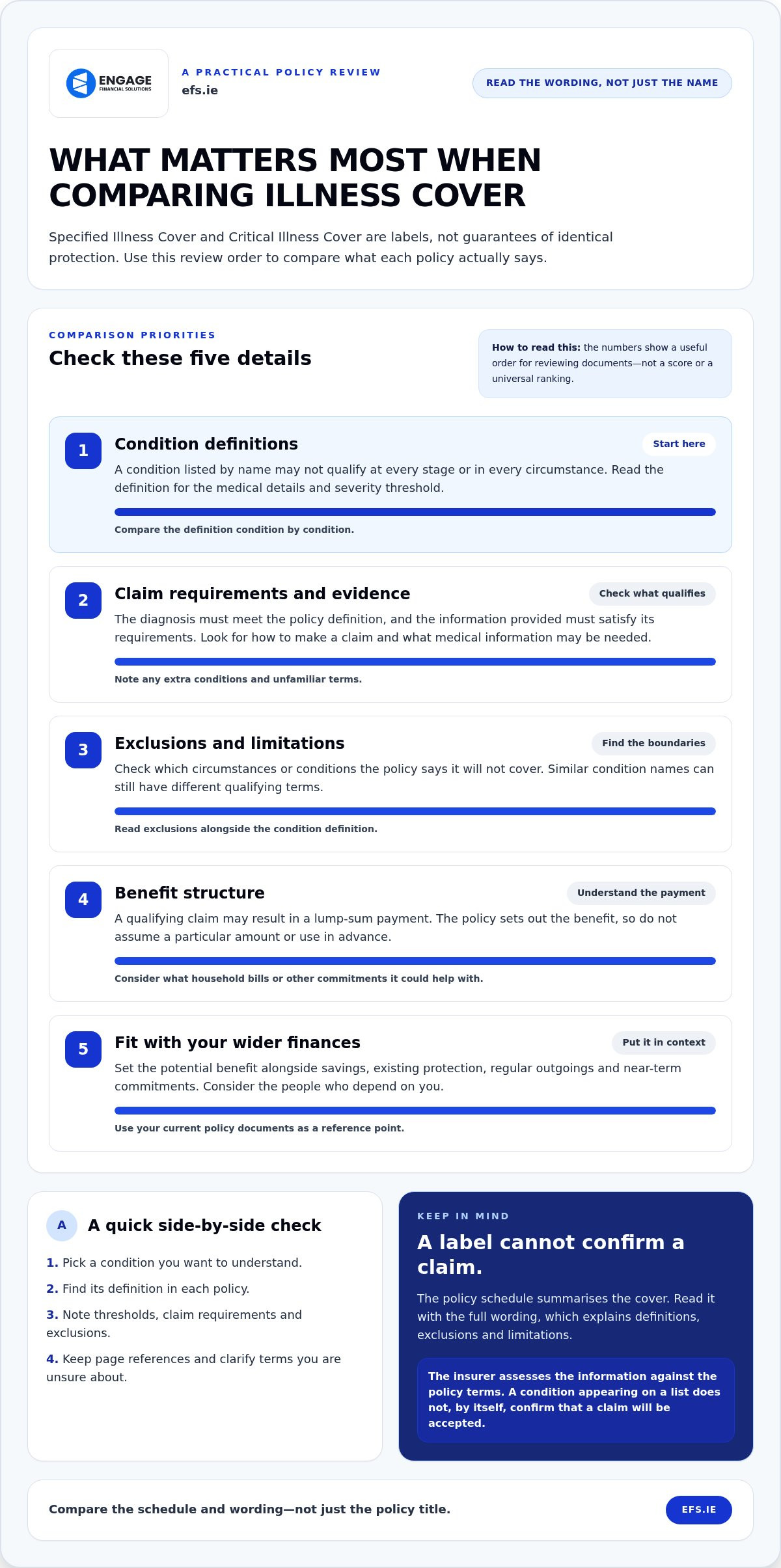
For a useful first check, find a condition in the policy list, then read its definition and claim requirements. Note details such as how the condition must be diagnosed or how severe it must be. If the policy uses medical or technical terms, write them down and look at how they are explained in the wording. This helps you compare what the policy actually says, rather than relying on the illness name alone.
What does Critical Illness Cover mean?
Critical Illness Cover is another commonly used label for illness-related cover. The name alone doesn’t show whether a policy covers more conditions, fewer conditions or different circumstances than a policy called Specified Illness Cover. Any distinction is in the policy terms, not the title.
Look for the list of covered conditions, the definitions attached to them and any exclusions or claim requirements. Exclusions are circumstances or conditions the policy says it won’t cover. Reading these details helps you understand the boundaries of the protection before comparing it with another policy.
So, in Specified Illness Cover vs Critical Illness Cover, the practical question isn’t which label sounds more comprehensive. Compare the policy schedule and wording condition by condition, and note where definitions or claim requirements differ. If you already have cover, use its documents as a reference point. That gives you a clearer basis for considering how another policy might fit with your existing protection and wider financial needs.
How Illness Cover Works: Conditions, Definitions and Possible Payouts
A listed illness is only the first part of the picture. If you make a claim, the insurer assesses the information provided against the policy terms and decides whether the event meets the requirements for a benefit. The diagnosis, the policy definition and any other claim conditions all matter. A condition appearing in a list does not, by itself, confirm that a claim will be accepted.
Claim eligibility depends on whether the diagnosis meets the policy’s definition and whether the evidence provided satisfies its requirements. This matters when comparing policies: two documents may name the same condition but set different thresholds or require different supporting information. A product label or summary list won’t show every detail.
In practice, a claim may involve notifying the insurer, providing medical information and allowing the claim to be assessed. The precise steps depend on the policy. As you read your documents, look for how to make a claim, what evidence may be needed and whether additional conditions apply. If a term is unfamiliar, note it so you can clarify its meaning before relying on your interpretation.
How do condition lists and definitions affect a claim?
A definition may describe the severity of a condition, the symptoms that must be present or the medical evidence required. For example, a policy could set a threshold that a diagnosis must meet before it qualifies. Similar condition names in two policies don’t guarantee that these details match, so compare the full wording rather than only the summary list.
Try this practical check: choose a condition you want to understand, find its definition in each policy and note the requirements side by side. Include any exclusions or qualifying terms, then consider whether the wording is clear to you. Keep the relevant page references with your notes. This makes differences easier to spot and gives you specific points to raise during a review.
What does a lump-sum benefit do?
If a claim meets the policy conditions, the benefit may be paid as a lump sum. This is a one-off payment intended to help with financial needs after an eligible claim. Depending on your circumstances, it could contribute towards household bills, give you room to adapt your plans or ease pressure on other commitments. The policy sets out the benefit, so don’t assume a particular amount or use in advance.
To put the benefit in context, consider what your household might need if illness affected your usual routine or finances. Think about regular outgoings and near-term commitments, alongside savings and other protection you already have. You can then compare the policy terms with your situation, rather than treating a potential payout as a guaranteed solution to every expense.
Understanding both the claim criteria and the role a payment could play puts Specified Illness Cover vs Critical Illness Cover into practical context. A personalised review can help you work through policy wording alongside your existing protection and wider financial plans. Explore personalised financial guidance as you consider how Critical Illness Insurance may fit your circumstances.
Compare Specified Illness Cover and Critical Illness Cover Side by Side
A useful comparison starts with the policy documents, not the product titles. Two differently named policies deserve just as close a review as two policies with the same name. Use the table as a checklist and fill it in from each policy schedule and full wording. If a detail isn’t stated, don’t assume it applies.
| Detail to compare | Specified Illness Cover | Critical Illness Cover |
|---|---|---|
| Policy name | Record the exact name shown in the documents. | Record the exact name shown in the documents. |
| Covered conditions | Note each condition listed in the policy. | Note each condition listed in the policy. |
| Definitions | Summarise the requirements attached to each condition. | Summarise the requirements attached to each condition. |
| Exclusions | Record any relevant exclusions stated in the wording. | Record any relevant exclusions stated in the wording. |
| Benefit structure | Check how the benefit is described and when it may be payable. | Check how the benefit is described and when it may be payable. |
| Claim requirements | Note the evidence and other conditions specified. | Note the evidence and other conditions specified. |
Compare the terms that determine a claim, not the product names alone. A title won’t tell you whether a condition’s definition, an exclusion or a claim requirement differs. The table isn’t a verdict on which policy is better. It helps you identify what to examine and where you may need a clearer explanation.
Which policy details deserve a close comparison?
Start with the conditions that matter to your comparison, then read each full definition rather than matching condition names alone. Check exclusions, any waiting periods and other restrictions where they appear in the documents. Finally, note how the benefit is described and what evidence the insurer requires. Keep page references beside your notes so you can return to the exact wording instead of relying on memory.
How does illness cover differ from Income Protection?
Income Protection has a different purpose from an illness-cover benefit. It relates to income support if you’re unable to work, subject to that policy’s own terms and claim requirements. Illness cover, by contrast, concerns a benefit linked to an eligible diagnosis under its wording. Neither should be treated as a substitute for the other without considering your circumstances and existing protection.
For a practical comparison, write down the financial need each policy is intended to address, then review its trigger, benefit structure and conditions. If you’re also considering Income Protection, read the Income Protection guide alongside your policy documents. This can help you see how different forms of protection may fit into your wider financial picture.
How to Decide Which Illness Cover Fits Your Financial Situation
A useful review starts with your household, not a product label. Before comparing policies, gather the information that shows what you may need to protect and what cover or savings you already have. This won’t predict whether you’ll ever make a claim. It gives you a clearer basis for weighing policy terms against your current priorities.
- Map your household commitments. List regular outgoings and financial responsibilities, such as housing costs, childcare, debts and essential bills. Note who depends on your income and what support they might need if your circumstances changed.
- Record your existing protection. Gather documents for life cover, Mortgage Protection, illness cover and Income Protection. Note the benefit, policy term and any conditions that could affect how each policy responds. This can help you spot potential overlaps without assuming one policy replaces another.
- Review savings and household income. Consider what savings could be used for and how your household budget might look if your income or routine changed. This context can help you think about the level and type of protection you’re seeking, without treating savings as a substitute for cover.
- Compare policy definitions with your priorities. Use the full wording to examine relevant conditions, exclusions and claim requirements. Mark terms you don’t understand and compare them directly across documents. Avoid assuming that a particular diagnosis would lead to a claim. The insurer assesses each claim under the policy terms.
- Revisit your review after a life change. A new family responsibility, change in employment, mortgage change or health circumstance may affect your financial priorities. Keep your policy documents together and review them when your circumstances shift, so your understanding of your protection stays current.
What should you assess before comparing cover?
Alongside regular commitments, consider how many people rely on your income and whether another household income could help meet expenses. Note existing protection and savings in the same place, then identify any needs you feel are not addressed. This simple summary makes a policy comparison more personal and keeps the focus on your financial situation rather than a headline benefit.
How does illness cover sit alongside Mortgage Protection?
Mortgage Protection and illness cover relate to different financial concerns. Mortgage Protection is associated with a mortgage, while illness cover may provide a benefit if a claim meets its policy conditions. Don’t assume that one automatically includes or replaces the other. Read both sets of documents and note what each is intended to address, its terms and any restrictions. A review can help you understand how they fit alongside other protection and household commitments.
If you’d like help relating policy wording to your commitments and existing protection, explore personalised financial guidance from Engage Financial Solutions.
Get Personal Guidance on Comparing Illness Cover
The most useful comparison is based on what each policy says and how its terms fit your circumstances, not on whether it is called Specified Illness Cover or Critical Illness Cover. If the wording feels difficult to interpret, a personalised review can help you focus on the details that matter to your household and wider financial plans.
Engage Financial Solutions provides personalised financial guidance and arranges Critical Illness Insurance. A review can consider illness cover alongside protection you already have, your financial commitments and the priorities you want to safeguard. It won’t assume one option is right for everyone. Instead, it can help you understand the available information and decide what questions you want answered before making a decision.
What can a personalised cover review clarify?
A review can help you identify which policy terms deserve closer attention and frame clear questions about how they relate to your circumstances. That might mean looking at the wording alongside existing protection or discussing how illness cover connects with other financial priorities. Keeping the conversation grounded in your needs and the policy documents helps you make an informed comparison without relying on a label or a general assumption.
What to prepare for a conversation about cover
A little preparation can make it easier to focus on the details that matter. Gather your current policy schedules and benefit summaries, then note your financial commitments, dependants and protection priorities. You don’t need to arrive with a preferred product or a complete assessment. A clear picture of your questions and circumstances is a useful starting point.
- Bring the documents for any existing illness or other protection cover.
- Write down the household commitments you would want to take into account.
- Note who depends on you and which financial priorities feel most important.
- Mark any policy wording or claim terms you’d like help understanding.
This preparation gives you a practical basis for discussing how cover may fit within your broader financial picture. It can also help distinguish between what a policy says and what you still need to understand, without assuming that a specific benefit or level of cover is suitable.
If you’re weighing up specified illness cover vs critical illness cover, you can discuss your protection needs with Engage Financial Solutions. A tailored conversation can help you review the wording, consider your existing protection and explore your priorities in a calm, straightforward way.
Make Your Next Protection Decision with Confidence
Choosing cover doesn’t have to mean finding a label that sounds reassuring. Use your comparison as a starting point for a conversation about what you want your financial plan to support, which policy terms need more attention and how different types of protection may work together. The right questions can make the next step clearer, whether you’re reviewing existing cover or considering a change.
The key to specified illness cover vs critical illness cover is to focus on the wording and how it fits your priorities, rather than making assumptions based on the name. Personalised financial guidance can help you consider Critical Illness Insurance and Income Protection in the context of your wider financial picture, without presuming one approach suits everyone.
When you’re ready to explore your options, discuss your protection needs with Engage Financial Solutions. A thoughtful review can help you move forward with greater clarity and confidence in the choices you make.
Frequently Asked Questions
Are Specified Illness Cover and Critical Illness Cover the same?
They can describe the same broad type of insurance, but the names don’t prove that two policies offer identical protection. In the specified illness cover vs critical illness cover comparison, treat the title as a starting point, not a decision. Put the policy schedules and full wording side by side. Note differences in conditions, restrictions and claim requirements before considering what the terms mean for you.
Can you claim if your diagnosis is not listed in the policy?
A diagnosis that isn’t listed may not meet the stated trigger for an illness-cover benefit, but the policy wording determines the answer. Don’t rely on a similar-sounding condition or an online summary to reach a conclusion. Find the relevant condition list and claim terms in your current documents, then get guidance on how they apply to your circumstances before making financial plans around a possible claim.
Does a diagnosis automatically qualify for an illness-cover payout?
No, a diagnosis alone doesn’t necessarily qualify. The insurer assesses the information against the policy’s requirements, which may include medical evidence or other stated criteria. Before relying on a policy, locate the wording for the diagnosis you’re concerned about and note what evidence it refers to. Only an assessment of the particular claim can establish whether the policy conditions are met.
Can you have illness cover and Income Protection at the same time?
Yes, you can have both, although each has its own terms and purpose. Income Protection relates to income support, while illness cover may pay a benefit for an eligible condition. If you hold or are considering both, make a note of the financial need each is intended to address and the relevant claim conditions. This can help you understand how the policies may complement one another without assuming either will respond in every situation.
What happens if your policy wording differs from another provider’s?
The difference may affect how a condition is defined or what evidence is needed to assess a claim. Compare matching sections in both documents rather than relying on product summaries. Check that you’re looking at the wording for the policies you actually hold or are considering, and write down any clauses you can’t interpret. Having specific questions ready makes it easier to understand the practical significance of a difference.
When should you review your illness cover?
Review your cover when your financial responsibilities or personal circumstances change, such as when you have a new dependant, different household commitments or a change to other protection. It’s also sensible to revisit the documents when weighing up cover against your current priorities. Keep a note of when you reviewed them and any questions still to answer, so you have a clear starting point when your circumstances shift again.
Disclaimer
Engage Financial Services LTD T/A Engage Financial Solutions is regulated by the Central Bank of Ireland CRO 764570. Suite 2 First Floor, 14 -18 Main street, Blackrock, Co Dublin. A94 W0Y3