


If you’re searching for “what happens if I can’t work due to illness Ireland”, start by separating the possible sources of support. When illness stops you working, your usual income may change, and it can be difficult to know whether employer sick pay applies, whether you qualify for State support or how either might cover household commitments. The answer depends on your circumstances, so check each source rather than assuming you’ll qualify for a particular payment.
This guide explains how workplace sick pay and State supports such as Illness Benefit may fit into your plans, and how Income Protection could provide another option if illness or injury affects your ability to earn. You’ll learn how Income Protection differs from Critical Illness Cover, what information to gather and where to find application steps and eligibility rules. Start by reviewing your employer’s sick-pay policy and noting your income, essential outgoings and PRSI details. These simple steps can help you plan your next move with greater clarity.
Key Takeaways
- Illness can create a gap between your usual earnings and available support. Identify the main parts of your income picture.
- Check your workplace sick-pay terms and current State support requirements instead of assuming what applies to you.
- Understand how Income Protection differs from Critical Illness Cover, including the policy conditions that can affect a claim.
- Gather employment, earnings, PRSI and policy information to make your next steps more straightforward.
- Compare your household commitments with existing support to identify where an income disruption could leave a gap.
When illness stops you working, what happens to your income?
Illness can affect your health, earnings and household routine at the same time. Alongside getting the care you need, you may be wondering how rent or mortgage payments, bills and other regular commitments will be managed. The main financial concern is often a gap between your usual earnings and the support available while you’re unable to work.
There isn’t one outcome that applies to everyone. It depends on your employment arrangements, whether you meet the eligibility rules for State support and the terms of any insurance policy you hold. Employer sick pay, social welfare payments and personal Income Protection are separate sources, each with its own purpose and conditions. Don’t assume a payment will start automatically or replace your full income.
Reviewing workplace sick pay, State supports and any Income Protection together gives you a clearer picture of what income may be available and when it could change.
What changes first when you cannot work?
Start with the immediate absence, while allowing for the possibility that a short period away from work may become longer. Follow your employer’s process for reporting illness and recording your absence. Find out what information or medical certification is required, and keep a record of what you submit.
Next, note when your pay or other payments might change. Record your usual pay date, any period covered by employer sick pay and when you may need to apply for support. You don’t need to predict how long recovery will take. A simple timeline can help you identify which questions need attention now, such as when to notify your employer or submit an application.
Which sources of support may be relevant?
Start by distinguishing between these three sources:
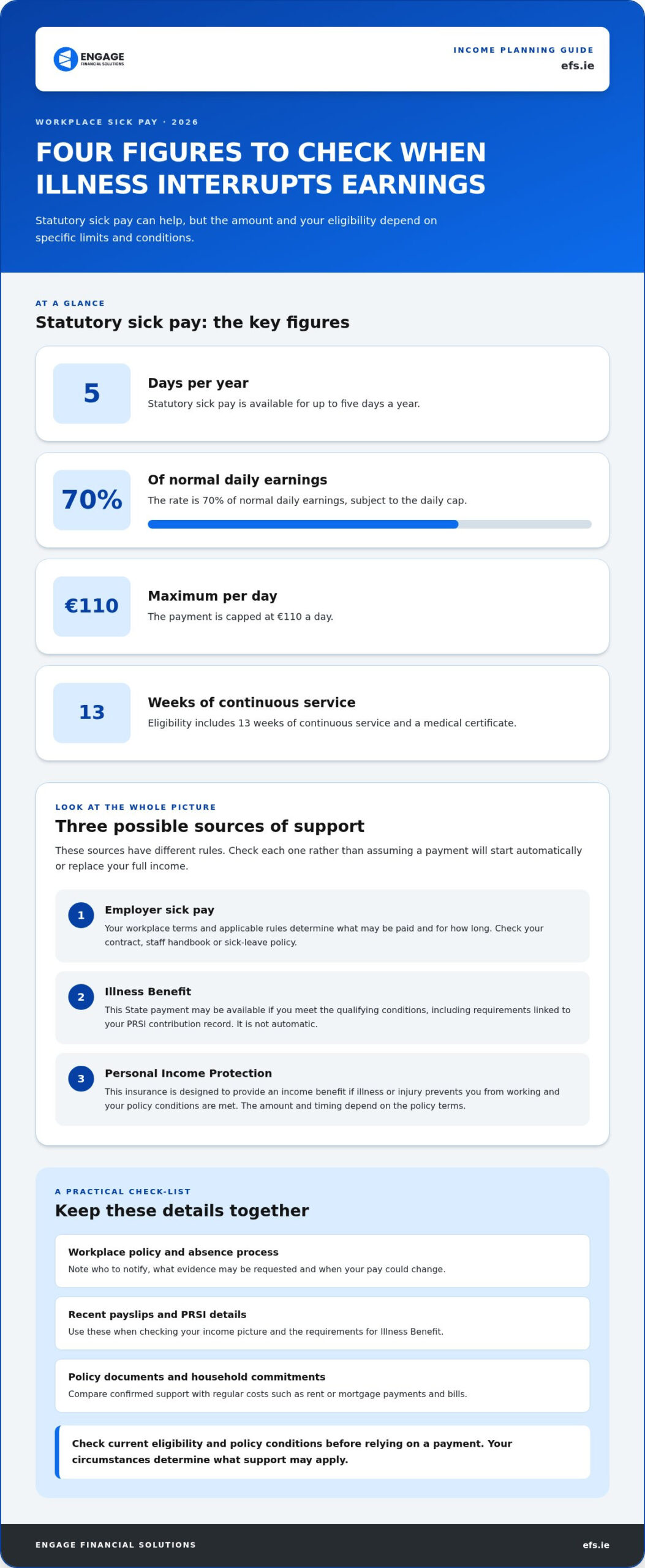
- Employer sick pay: Your entitlement may depend on workplace arrangements and applicable rules. For 2026, statutory sick pay is up to five days a year at 70% of normal daily earnings, capped at €110 a day. Eligibility includes 13 weeks of continuous service and a medical certificate.
- State support: Illness Benefit may be available if you meet the relevant conditions, including requirements linked to your PRSI contribution record. It isn’t automatic, so use official social welfare services to check eligibility and application steps.
- Personal Income Protection: This insurance is designed to provide an income benefit if illness or injury prevents you from working and the policy’s conditions are met. The amount and timing depend on the policy terms.
These supports can apply differently depending on whether you’re employed or self-employed, your contribution history and any cover you already have. Keep your employment details, recent payslips and policy documents together. These records give you a practical starting point for understanding how illness could affect your earnings and what support may be relevant.
How employer sick pay and State supports may work
Workplace sick pay and Illness Benefit are separate routes, so check both rather than assuming one replaces the other. Your employer’s arrangements are shaped by workplace terms and current rules. A State payment has its own eligibility and application requirements. What you may receive depends on your employment circumstances and whether you meet the relevant conditions.
PRSI means Pay Related Social Insurance, contributions linked to social insurance. Your contribution record may be relevant to Illness Benefit eligibility, but having paid PRSI doesn’t by itself guarantee a payment. Check the rules for your circumstances before relying on a particular source of support.
Employer sick pay follows workplace arrangements, while Illness Benefit is a separate State payment with its own qualifying conditions.
What should you check with your employer?
Review your employment contract, staff handbook or workplace sick-leave policy. These documents can explain how sick pay is handled in your role and the process to follow when you’re absent. If the details aren’t clear, ask the appropriate person at work, such as your manager or HR team.
Note who you need to notify, what evidence may be requested and how often you should provide updates. Check how your pay could change during an absence and when a change might take effect. Arrangements differ between workplaces, so don’t assume a particular amount or duration applies to you.
What is Illness Benefit and where can you check it?
Illness Benefit is a social welfare payment that may be available to eligible people who are unable to work because of illness. Qualifying conditions and application steps apply. Check current guidance from the Department of Social Protection rather than relying on assumptions or older information. Have your PRSI record details ready when reviewing the requirements.
MyWelfare provides an online route to relevant services, including information and application options where available. Follow the current instructions carefully and keep a record of details or documents requested. Submitting an application doesn’t guarantee an award, so plan around confirmed information rather than an assumed outcome.
To understand how potential State support could sit alongside personal cover, explore personalised financial guidance. This can help you consider your circumstances and any Income Protection policy terms as part of the wider picture.
State support, Income Protection and Critical Illness Cover: what differs?
These options address different parts of your financial picture. State support is assessed under social welfare rules, while Income Protection and Critical Illness Cover are insurance policies governed by their own terms. Compare their purpose, eligibility and payment conditions to understand what may apply to you. Don’t assume any one source will cover your usual income.
| Source | Purpose | Eligibility basis | Payment conditions | What to investigate |
|---|---|---|---|---|
| State support | Provides social welfare support for eligible people affected by illness. | Relevant rules may include qualifying conditions and your PRSI record. | Payment depends on meeting the requirements and completing the relevant application process. | Check current eligibility, application steps and how the support may fit your circumstances. |
| Income Protection | Designed to provide an income benefit if illness or injury prevents you from working. | Depends on the policy and its terms. | A claim must meet the policy conditions. Definitions, exclusions, waiting periods and benefit limits can vary. | Review what the policy covers, when a benefit may begin and how long it could be paid for. |
| Critical Illness Cover | Provides cover linked to specified serious conditions set out in the policy. | Depends on the condition and policy definitions. | A claim is assessed against the policy wording and its requirements. It isn’t automatically ongoing income replacement. | Check which conditions are covered and how the policy defines them. |
How does Income Protection differ from State support?
State support and an insurance benefit come from separate systems, with different qualifying rules and assessment processes. Income Protection is intended to provide an income benefit when the policy conditions are met, but it doesn’t guarantee that every claim will be accepted or replace all earnings. Read your policy schedule and wording, paying particular attention to definitions, exclusions, waiting periods and limits. If you have cover through work or an existing policy, review it before concluding you have none. For a fuller explanation, read this Income Protection guide.
When is Critical Illness Cover different?
Critical Illness Cover relates to specified conditions and the definitions in the policy. It isn’t designed as regular income replacement during an absence from work. A diagnosis alone doesn’t establish whether a claim meets the policy terms. Check the wording to understand which conditions are covered and what the claim requirements are. Keeping these distinctions clear can help you assess existing arrangements and decide what to explore next.
What to do if illness is affecting your ability to work
Take this one step at a time. Your health comes first, and you don’t need to resolve every financial question at once. A simple sequence can help you organise workplace communication, possible support applications and household planning while you focus on your wellbeing.
- Prioritise your health. Follow appropriate medical advice and seek urgent care if needed. Don’t postpone care to deal with paperwork.
- Notify your workplace. Follow the absence-reporting process in your employment documents and ask what information or updates are required.
- Check possible supports. Review your workplace sick-pay terms and check current State payment eligibility and application steps through official sources, including the Department of Social Protection and MyWelfare.
- Review any insurance. Find existing policy documents and workplace benefits. Read the terms and claim process rather than assuming a policy applies or that a claim will be paid.
- Map your finances. Compare confirmed income and payment dates with essential commitments. Revisit the plan as your health and income information change.
What information should you gather?
Keep relevant details in one secure place, digitally or on paper. Having them organised makes it easier to refer to accurate information when speaking with your employer or completing an application.
- Employment contract, staff handbook or sick-leave policy, along with absence notifications and related workplace messages.
- Recent payslips, your usual pay dates and a list of essential regular outgoings.
- PRSI record information, if available, and any relevant Income Protection or Critical Illness Cover documents.
- Copies of forms, correspondence and application updates, including the dates sent or received.
Use current official guidance to confirm eligibility, required evidence and application steps. Note anything you need to clarify, and avoid budgeting around a payment until you have reliable information about its status and timing.
How can you manage the financial transition?
List essential commitments such as housing, utilities and food, then compare them with income you know is available. If a payment delay may affect a commitment, contact the relevant organisation promptly to explain the situation and discuss possible options. Keep a record of the conversation and any agreed next steps.
Update your figures as circumstances change and review upcoming payment dates. If you’d like guidance on how Income Protection may fit alongside workplace benefits and State support, explore personalised financial guidance.
Plan ahead with a clearer view of income protection
Planning ahead can help you see how workplace benefits, possible State supports and existing policies might fit together if illness affects your earnings. The aim isn’t to predict exactly what will happen. It’s to understand where a shortfall could arise and what arrangements you already have in place.
Start by considering who relies on your income and which commitments would continue if it changed. Housing costs, household bills, childcare and other regular outgoings can all shape the support that may matter to you. Your priorities may shift over time, so include a protection review in your wider financial planning rather than treating it as a once-only decision.
What should a personal protection review consider?
Gather your workplace benefit information and any existing policy documents. Review what each arrangement is intended to cover, the definitions it uses, exclusions, claim conditions, waiting periods and benefit limits. If a term is unclear, seek an explanation in plain English before drawing conclusions. Then consider how a change in income could affect regular commitments and longer-term plans.
Income Protection is one option to consider for income disruption. It’s designed to provide an income benefit when policy conditions are met, but it isn’t a guaranteed solution, a promise that a claim will be paid or a substitute for every workplace or State support. The policy wording determines how the cover works, so compare it with your circumstances and existing arrangements.
Critical Illness Cover has a different purpose. It relates to specified conditions and policy definitions, so don’t assume it will provide ongoing income replacement. Reviewing both types of cover alongside your other financial resources can help you understand their distinct roles without treating them as interchangeable.
How can guidance help you make an informed decision?
Tailored financial guidance can help you consider cover options in the context of your earnings, dependants, commitments and wider plans. Engage Financial Solutions provides personalised guidance on Income Protection and Critical Illness Cover, helping you understand policy terms alongside workplace benefits and possible State supports. A review can clarify the questions to consider, while each policy’s conditions still determine how it applies.
There’s no need to make a rushed decision. Organise the information you already have, note any gaps or unfamiliar terms and revisit your plan as your circumstances change. If you’d like to explore how protection options could fit into your wider finances, explore personalised financial guidance at a pace that feels right for you.
Take the next step towards greater financial clarity
If illness affects your ability to work, the support available may depend on your workplace arrangements, State eligibility and the terms of any policy you hold. Check each source separately, gather your employment and earnings information, and list essential household commitments. These steps can help you see where a potential income gap may arise.
Planning ahead also gives you the chance to review existing cover and consider whether Income Protection could form part of your wider financial plan. It isn’t a guaranteed solution, so understanding the policy conditions matters. Engage Financial Solutions is regulated by the Central Bank and provides personalised guidance on Income Protection and Critical Illness Cover, tailored to your circumstances.
You don’t need to make every decision at once. Start with the information you have, identify what you still need to clarify and take the next step at a pace that feels right. Explore tailored financial guidance to build a clearer view of your options and support your long-term financial stability.
Frequently Asked Questions
What happens to my income if illness means I cannot work?
Your income may come from employer sick pay, State support or an Income Protection policy, depending on your circumstances and eligibility. These sources have separate rules and may not replace your full earnings. Check your workplace sick-pay arrangements, review current Illness Benefit requirements and locate any existing policy documents. Note when each payment might start or change, then compare confirmed income with essential household commitments.
Can I receive Illness Benefit if I am unable to work?
You may qualify for Illness Benefit if you meet the current conditions, including requirements relating to your PRSI contribution record. It isn’t automatic, and eligibility depends on your circumstances. The maximum personal rate in 2026 is €254 per week, but don’t assume you’ll receive this amount. Check the Department of Social Protection’s current guidance and application steps, and use MyWelfare to access relevant online services.
Does my employer have to pay me when I am off sick?
In 2026, statutory sick pay provides up to five days of paid sick leave per year for eligible employees. The rate is 70% of normal daily earnings, capped at €110 per day. Eligibility includes 13 weeks of continuous service and a medical certificate. Your workplace may also have its own sick-pay arrangements, so check your contract or staff policy for the details that apply to your employment.
How long can I receive support if illness keeps me off work?
The duration depends on the support and your eligibility. Statutory sick pay covers up to five days per year under the 2026 rules. Illness Benefit can be paid for a maximum of two years if you qualify, but payment isn’t guaranteed for that period. If your illness or disability continues, check official social welfare guidance for other payments and their conditions. Keep track of application updates and any review dates.
Can self-employed people get support if illness stops them working?
Self-employed people paying Class S PRSI aren’t eligible for Illness Benefit. This makes it particularly useful to review your finances and any existing Income Protection policy before illness affects your earnings. Check current official guidance for other supports that may fit your circumstances, as eligibility varies. If you already have cover, read the policy terms and claim requirements rather than assuming a particular benefit applies.
Is Income Protection the same as Critical Illness Cover?
No. Income Protection is designed to provide an income benefit if illness or injury prevents you from working and the policy conditions are met. Critical Illness Cover relates to specified conditions defined in the policy and isn’t automatically ongoing income replacement. Check the policy wording for covered conditions, definitions, exclusions and claim terms. If you hold either type of cover, reviewing the documents can help clarify what each is intended to do.
What should I do first if I become too ill to work?
Prioritise your health and seek appropriate medical care. Then notify your employer using the workplace absence procedure and ask what information they need. Gather your employment details, recent payslips, PRSI information and any insurance documents. Check current State support application steps through official services, and list essential outgoings against confirmed income. Keep copies of forms and messages, and update your plan as your health or payment details change.
Disclaimer
Engage Financial Services LTD T/A Engage Financial Solutions is regulated by the Central Bank of Ireland CRO 764570. Suite 2 First Floor, 14 -18 Main street, Blackrock, Co Dublin. A94 W0Y3