


The cheapest-looking mortgage switch may not be the cheapest move. If you’re weighing the cost of breaking a fixed-rate mortgage, the early repayment charge is only part of the decision. Your lender’s calculation may depend on your outstanding balance, the difference between your fixed rate and current market rates, and the time left in your fixed term.
It’s understandable to want a clear figure before deciding, especially when a charge could affect whether switching now makes sense. But the charge alone won’t show the full picture. Compare it with the interest you might pay by waiting, any costs involved in changing lender, and the terms of the alternative mortgage. Depending on the rates and your circumstances, acting now, waiting until the fixed period ends or exploring another option may each be worth considering.
This guide explains what can affect the charge, which figures to request from your lender and how to compare possible costs and savings. With the right information, you can assess your options calmly before making a change.
Key Takeaways
- The cost of breaking a fixed-rate mortgage depends on your lender’s terms, outstanding balance and time left in the fixed period. Request a written figure before making a decision.
- Compare staying, changing your rate with your current lender, switching lender and waiting. Assess the charge alongside repayment differences over the same timeframe.
- Gather your mortgage terms and separate confirmed lender figures from estimates so you can compare your options with greater confidence.
- Tailored Switching Mortgages guidance can help you understand the figures, terms and routes available, without assuming that changing will save you money.
What does it mean to break a fixed-rate mortgage early?
Breaking a fixed-rate mortgage means changing or repaying it before the agreed fixed period has ended. You might be considering this because you want to move, repay some or all of the loan, change your rate or switch to a different lender. The practical and financial consequences depend on your mortgage terms, so an early change won’t have the same result for every borrower.
A fixed rate keeps your interest rate unchanged for an agreed period, giving you more certainty about repayments during that time. You can read a general explanation of a fixed-rate mortgage, but your lender’s documents set out the terms of your agreement. Check the sections covering early repayment, changing rates, moving home and switching lender.
What is an early repayment charge?
Your lender may call an amount payable for ending or changing a fixed-rate arrangement early an early repayment charge, break fee or another similar name. It isn’t a standard fee that is identical across the market. Whether it applies, and how much it is, depends on your mortgage terms and the lender’s calculation for your circumstances.
Start with your mortgage offer and any later lender correspondence. Then request a current written figure for the change you’re considering, and check the date it applies to. A figure may relate to a particular repayment or switch date, so don’t assume an old estimate is still valid. If the wording or calculation isn’t clear, ask your lender to explain how it relates to your agreement.
Which changes might count as breaking the fixed period?
Different changes can affect your mortgage in different ways. Repaying the loan in full, switching to another lender and changing to a different rate with your current lender aren’t necessarily treated alike. Your lender’s terms determine whether a charge applies to the option you’re considering. Don’t assume that every change will trigger a charge, or that no charge will apply.
- Repaying the mortgage: If you sell your home or use funds to pay off the full balance, ask how your lender will handle repayment before the fixed period ends.
- Switching lender: A new mortgage may involve costs beyond any charge from your current lender, such as legal or valuation costs. These are separate items and may depend on the arrangements involved.
- Changing your rate with the same lender: Ask which rate options are available and whether changing within your current mortgage involves a charge or other conditions.
- Moving home: Your lender may have specific options or conditions for borrowers who move during a fixed term. Ask how the move would affect your existing mortgage and any proposed new borrowing.
Keep the lender’s written charge separate from other possible costs of switching, moving or arranging a new mortgage. This gives you a clearer starting point for comparing the full cost of each route.
What affects the cost of breaking a fixed-rate mortgage?
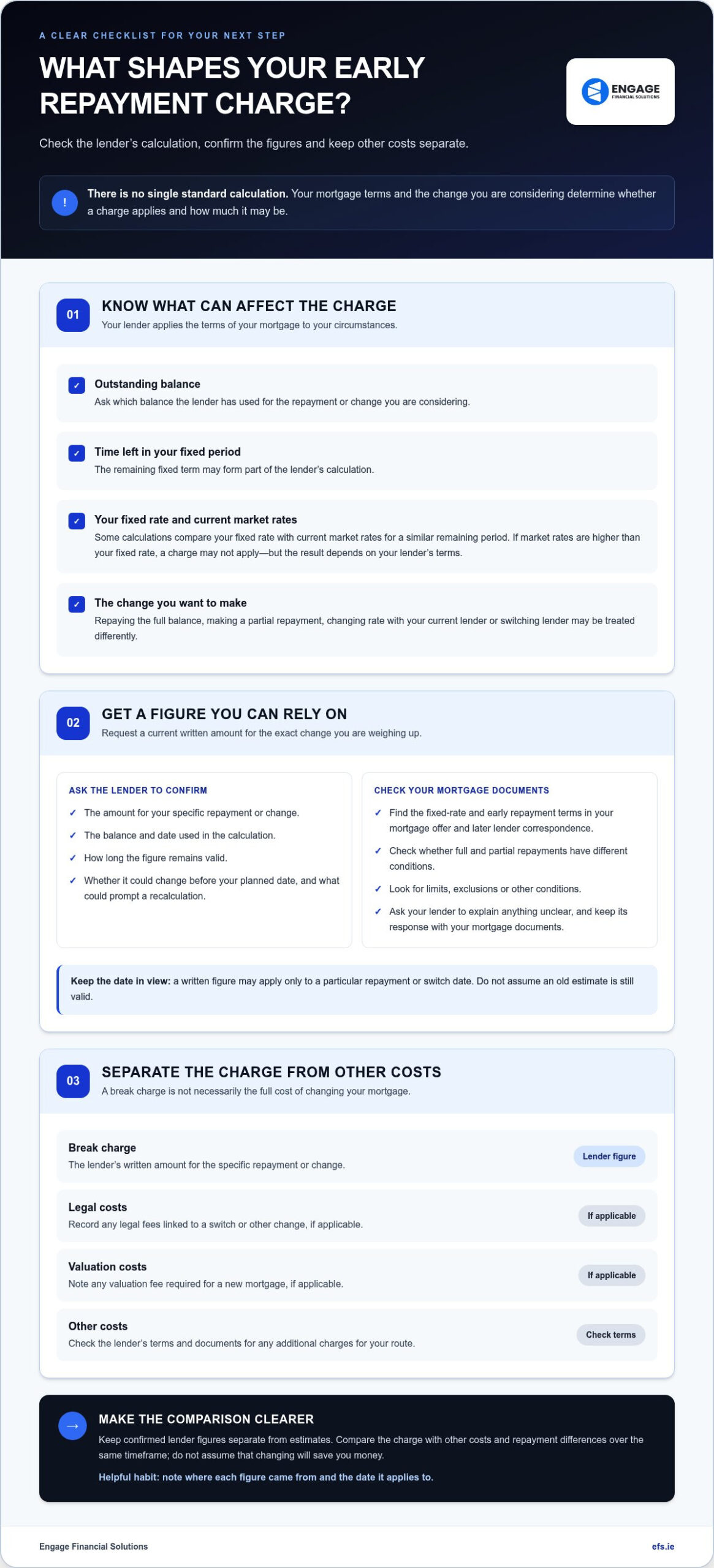
There isn’t one standard calculation you can use to work out your charge. Your lender applies the terms of your mortgage, and the figure may depend on the balance being repaid, how much of the fixed period remains and the lender’s calculation at the time. Some calculations compare your original fixed rate with current market rates for a similar remaining period. If market rates are higher than your fixed rate, a charge may not apply, but the outcome depends on your lender’s terms.
A general estimate can help you prepare questions, but it can’t replace a written figure from your lender. Ask for an amount based on the change you’re actually considering, whether that’s repaying the full balance or making a partial repayment.
How to get your lender’s figure
Request a current written redemption or break-charge figure. Check that it uses the correct outstanding balance and the date you expect to make the change. Ask how long the figure remains valid, whether it could change before that date and what might cause it to be recalculated. Keep the response with your mortgage documents so you can compare like with like.
Before relying on the figure, check what it covers. A break charge isn’t necessarily the total cost of changing your mortgage. List any other costs that apply to your circumstances separately, so you can see each item clearly rather than treating them as one fee.
- Break charge: The lender’s written amount for the specific repayment or change, including the date it applies to.
- Legal costs: Any legal fees associated with a switch or other change, if applicable.
- Valuation costs: Any valuation fee required for a new mortgage, if applicable.
- Other costs: Any additional charge stated in the lender’s terms or documents for the route you’re considering.
Don’t assume every item will apply. Record where each figure came from and whether it’s confirmed or still an estimate.
What to check in your mortgage documents
Look through your mortgage offer and later correspondence for the fixed-rate terms and wording about early repayment. Check whether the conditions distinguish between paying off the full balance and making a partial repayment. Note any limits, exclusions or other conditions, then ask your lender to explain wording you can’t interpret. This gives you a clearer basis for checking the written figure against your agreement.
For a useful comparison, make sure the lender’s figure, any other costs and the proposed change all relate to the same date and amount. Tailored mortgage advice can help you organise the figures and understand how the terms fit together, without assuming that one route is right for everyone.
Is breaking your fixed rate worth it? Compare the full outcome
A lower rate can look attractive, but it doesn’t show by itself whether changing your mortgage will leave you better off. The early charge, any verified transaction costs and the difference in repayments all matter. Compare each option using your actual balance, repayment details and lender figures, rather than relying on a headline rate or general estimate.
Choose one comparison period and use it for every route. For example, compare the total cost from now until the end of your current fixed term, or choose another period that reflects your plans. Include only costs you’ve verified, and make sure each repayment estimate is based on the same balance and timeframe.
Stay with your current rate: Record the repayments you expect to make over the comparison period. Include a charge or other cost only if it applies to this option.
Change rate with your current lender: Compare the lender’s new rate and repayment figures with staying put. Include any charge or conditions that apply to changing within your existing mortgage.
Switch lender: Set the expected repayments beside the written charge from your current lender and any verified legal, valuation or other switching costs. Use the new lender’s figures for the same period.
Wait until the fixed term ends: Compare repayments under your current arrangement while you wait, then consider the rate and costs available at the end of the term. Don’t assume today’s rates or offers will still apply later.
Compare the charge with potential savings
To assess whether a change may balance out financially, add the verified charge and other applicable costs, then compare that total with the repayment difference over the same period. If the new option’s projected repayments are lower, work out how long those differences would take to cover the costs. This is the break-even point: when the accumulated repayment difference equals the verified costs.
Use the lender’s written figures for the balance, repayments and relevant dates. If you don’t have enough information to calculate a reliable break-even point, treat the result as unknown rather than assuming the change will pay for itself. Check, too, whether your comparison includes all the costs you’ve confirmed.
When waiting may be worth considering
Waiting could be worth comparing if the fixed period is nearing its end, particularly if the current charge would add materially to the cost of changing now. Your plans matter as well. A move, a change in income or another financial priority may affect which route suits you, even if it doesn’t produce the lowest projected cost on paper.
For a wider view of the process and the decisions involved, see the Switching Mortgages guide. Use it alongside your lender’s figures, then review the options on a like-for-like basis before deciding.
What to do before your fixed-rate mortgage ends
A little preparation can make your next mortgage decision clearer, whether you’re considering a move, a new lender or a different rate with your current lender. These routes can have different terms, costs and timing, so don’t treat them as interchangeable. Work through the steps below and keep confirmed lender information separate from estimates.
Prepare a clear mortgage snapshot
Bring the key details together before comparing options. Note your current balance, regular repayment, fixed-rate end date and reason for considering a change. If you have a preferred timeframe, record that too. Keeping these details alongside your mortgage documents and lender correspondence makes it easier to discuss the same circumstances throughout.
- Gather your documents. Find your mortgage offer, any later changes to the terms and recent lender correspondence. Record your current balance, repayment amount and the date your fixed rate ends.
- Request current figures. Ask your lender for written information relevant to the route you’re considering, such as full repayment, a rate change or a switch. Check the balance and date used, how long each figure is valid, and whether it’s confirmed or an estimate.
- Compare the available routes. Set out staying with your current arrangement, changing rate with the same lender, switching lender and waiting until the fixed period ends. Moving home or refinancing may involve different lender terms, so make sure each figure applies to your actual plan.
- Review the decision before acting. Compare repayments and verified costs over the same timeframe, then consider how the choice fits your plans. If a figure is an estimate, label it clearly and don’t treat it as a final amount.
Compare your options with support
It can be difficult to keep lender terms, repayment figures and possible charges organised, particularly when more than one route is open to you. A mortgage adviser can help bring the information together, clarify what each figure relates to and compare the options against your priorities. This can support a more informed decision, but it doesn’t guarantee approval, a particular rate or savings.
If you’re weighing a full switch, the Switching Mortgages guide explains the wider process to consider alongside your lender’s terms. Once you’ve gathered your details, explore tailored mortgage advice to review the figures and consider your next steps with greater clarity.
How Engage Financial Solutions can help you decide what comes next
A decision about a fixed-rate mortgage is rarely just about one charge. Your plans, the terms of your current mortgage and the options available all matter. Engage Financial Solutions provides mortgage advice, including Switching Mortgages, to help you bring those details together and consider the wider decision calmly. You can explore your options before committing to a change.
A tailored view of your mortgage options
Your priorities shape what a suitable next step may look like. You might want to reduce repayments, move home, change your mortgage arrangements or understand what happens when your fixed period ends. Guidance can help you interpret lender figures and terms in the context of those goals, rather than treating a quoted rate or charge as the whole answer.
Break-charge analysis can also form part of the wider Switching Mortgages process. This means considering the lender’s figure alongside repayment information and other verified costs for each route. The aim is to help you understand what you’re comparing and which questions still need answers, not to assume that switching is automatically the right choice.
Move forward with a clearer comparison
A useful next step is to obtain a current figure from your lender, then compare complete options using the same timeframe. Bring together your mortgage terms, balance, repayment details and any written figures. If some information is only an estimate, keep it labelled as such. This gives you a more dependable basis for discussion and helps you avoid making a decision based on an incomplete picture of the costs.
You don’t need to commit to a change before seeking guidance. A conversation can help you make sense of the figures, understand how different routes relate to your circumstances and decide what to explore further. The final choice remains yours, informed by the terms and figures that apply to your mortgage.
Engage Financial Solutions is regulated by the Central Bank, and its website displays 64 Google reviews. This provides context as you consider who to speak with about your mortgage decision.
If you’re unsure how to weigh the charge against your wider options, explore tailored mortgage advice and take your next step with greater clarity.
Choose a next step that fits your plans
The right mortgage decision should support more than an immediate change in repayments. It should fit your plans for your home and finances, as well as the level of certainty you want in the years ahead. Take time to consider those priorities alongside your lender’s figures, then decide whether to act now, wait or explore another route.
If you’re still weighing the cost of breaking a fixed-rate mortgage, tailored mortgage guidance can help you make sense of the options in light of your circumstances. Engage Financial Solutions can help you consider how the decision fits your wider financial plans, without assuming that switching is automatically the right choice.
You don’t need to have every answer before taking a first step. Discuss your mortgage options with Engage Financial Solutions and move forward with greater confidence in the decision that suits you.
Frequently Asked Questions
Can I break a fixed-rate mortgage early?
In many cases, you can ask your lender about changing or repaying your mortgage before the fixed period ends. The options and any charge depend on your agreement and the change you have in mind. If you’re selling, ask for figures based on full repayment; if you’re considering a different rate, ask about that route specifically. Getting the relevant information before setting a sale or switch date can help you plan with more confidence.
How much does it cost to break a fixed-rate mortgage?
There isn’t one figure for the cost of breaking a fixed-rate mortgage, because each lender applies the terms of the individual agreement. Ask for a current written figure and check the balance and date it uses. A general online estimate can’t confirm your personal cost. If the lender’s calculation or assumptions aren’t clear, ask for an explanation before relying on the figure to plan a change.
What happens if I switch mortgage lenders before my fixed rate ends?
Your existing mortgage will need to be repaid as part of a switch, and your current lender may apply a charge under your agreement. The new lender will assess your application and affordability, so a lower advertised rate doesn’t confirm that you’ll qualify or that switching will suit you. Ask for the current lender’s repayment figure and compare it with the new offer and any costs that apply before deciding.
Can my lender waive an early repayment charge?
Possibly, but whether a charge is reduced, refunded or doesn’t apply depends on your lender’s terms and your circumstances. Don’t rely on another borrower’s experience as evidence that the same option applies to you. Ask your lender to explain any relevant conditions in writing, including the action or timing they relate to. Include an adjustment in your comparison only once your lender has confirmed it applies to your mortgage.
Can I make an overpayment while my mortgage is fixed?
You may be able to, but the amount allowed and any conditions depend on your mortgage agreement. Before making an extra payment, check whether the terms treat regular overpayments differently from a one-off lump sum. Ask how an overpayment would affect your balance and whether it could lead to a charge. This can help you weigh reducing the loan against keeping funds available for other planned expenses.
Should I wait until my fixed-rate period ends before switching?
Waiting may be worth considering if switching now could involve a charge, but the right timing depends on your plans and the figures available. Check when your current rate ends and whether a move or another financial change could affect your decision before then. Rates and lender options may change, so don’t assume today’s offer will remain available. Review your comparison again nearer the date you expect to decide.
Disclaimer
Engage Financial Services LTD T/A Engage Financial Solutions is regulated by the Central Bank of Ireland CRO 764570. Suite 2 First Floor, 14 -18 Main street, Blackrock, Co Dublin. A94 W0Y3