
Did you know that the Central Bank of Ireland estimates some homeowners could save up to €3,000 every year simply by moving their loan to a different lender? With the rising cost of living weighing heavily on household budgets, many people are asking: when should I switch my mortgage Ireland? It’s a question that carries more weight now than ever, especially following the ECB’s rate hike to 2.25% in June 2026. You might feel a sense of loyalty to your current bank, or perhaps you’re worried that the application process is too complex to navigate in the current climate.
We understand that the fear of hidden break fees or the stress of meeting strict new criteria can feel overwhelming. However, you deserve a financial plan that safeguards your future rather than one that adds unnecessary friction to your life. In this guide, we’ll show you how to spot the precise triggers that signal it’s time to move, helping you secure significant savings and long-term stability. We’ll explore the latest 2026 market shifts, including the new Consumer Protection Code rules, and explain how to leverage your home’s equity to achieve the lifestyle you’ve worked so hard for.
Key Takeaways
- Learn how the “0.5% rule” and your current Loan-to-Value (LTV) ratio act as precise indicators for when you can secure a more competitive interest rate.
- Understand why the “three-month warning” is essential for fixed-rate holders and finally answer the question: when should I switch my mortgage Ireland?
- Discover how 2026 market competition and updated Consumer Protection Code regulations have streamlined the process to make switching more transparent and straightforward.
- Identify the specific mortgage statement details and financial behaviours required to ensure a seamless transition to a lender offering better long-term security.
- Explore how a tailored, professional approach removes the friction from financial transitions, helping you achieve lower monthly repayments or a shorter mortgage term.
Is Now the Right Time to Switch Your Mortgage in Ireland?
Mortgage switching is essentially the process of moving your existing home loan from one lender to another to access more favourable terms. While many homeowners focus solely on the immediate monthly savings, the true objective is often to reduce the total interest you pay over the lifetime of your debt. If you’ve been asking yourself when should I switch my mortgage Ireland, the answer often lies in the balance between current market conditions and your specific financial milestones. Before diving into the details, it helps to remember what is a mortgage at its core: a long-term financial commitment that should be regularly reviewed to ensure it still serves your best interests. Beyond just the numbers, switching can offer increased flexibility, such as the ability to release equity for home improvements or adjust your repayment term to suit a change in your lifestyle.
The 2026 Irish Mortgage Landscape
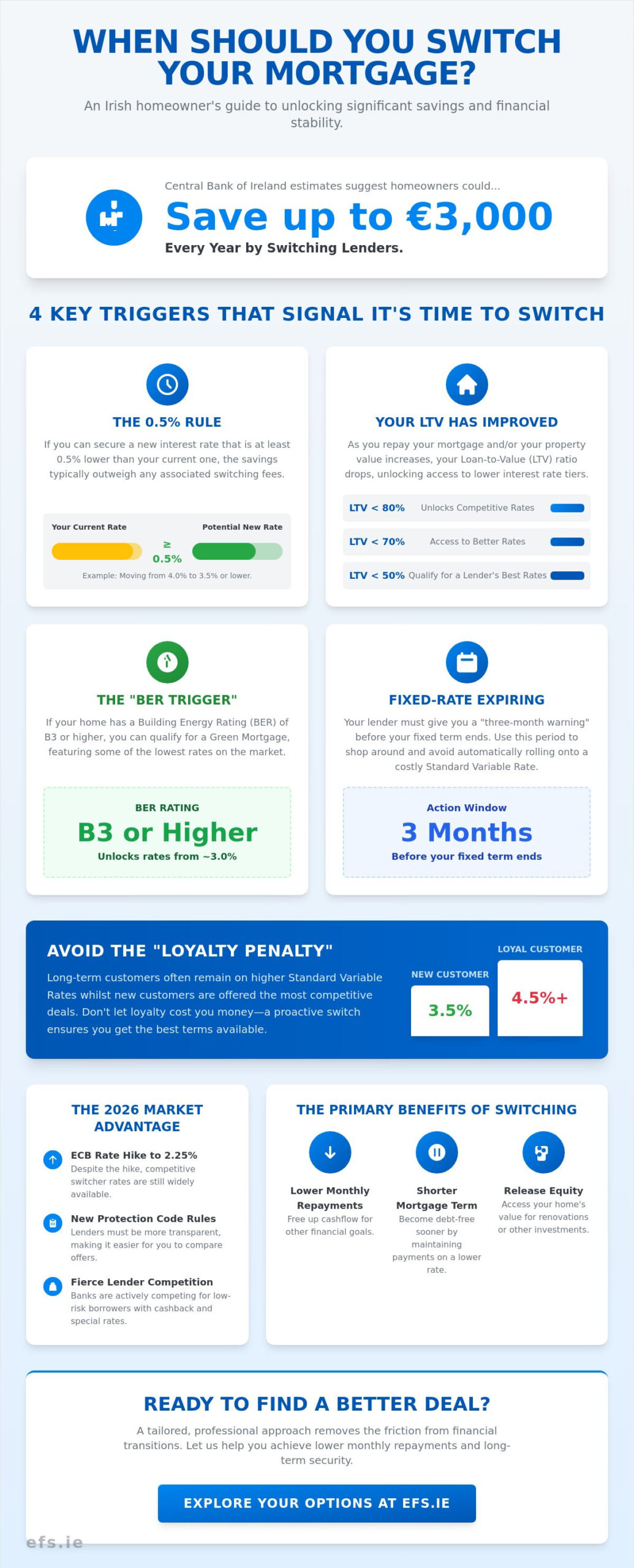
The financial environment in 2026 presents a unique window of opportunity for proactive homeowners. Even with the ECB deposit rate hike to 2.25% in June 2026, average new mortgage rates in Ireland remained at a competitive 3.50% as of April. New regulations under the Consumer Protection Code, which came into force in March 2026, have made it much easier for you to see the real value of different offers by requiring lenders to be more transparent about potential savings. Lenders are currently hungry for low-risk borrowers, often providing “switcher-only” incentives that aren’t available to their existing customers. The Switcher Market is a competitive arena where lenders vie for low-risk customers by offering reduced rates and significant cashback incentives.
The Emotional vs. Financial Case for Moving
Many Irish homeowners fall victim to the “loyalty penalty,” where long-term customers remain on higher standard variable rates whilst new customers enjoy the best deals. This isn’t just a financial drain; it can be an emotional one too. If you’ve ever wondered am I paying too much for my mortgage Ireland, you’re not alone — hundreds of thousands of homeowners are in the same position. Transitioning to a lender that values your business can provide a profound sense of security and optimism. Knowing your monthly outgoings are optimised allows you to plan for the future with confidence and stability. At Engage Financial Solutions, we view mortgage management as a partnership designed to safeguard your wealth. Once you understand the current landscape, the next step is identifying the specific financial triggers that make a move mathematically undeniable.
Key Financial Triggers: When the Numbers Demand a Switch
Identifying the right moment to move your loan involves more than just a gut feeling. Generally, the “0.5% Rule” serves as a reliable benchmark for Irish homeowners. If a new lender offers a rate at least half a percent lower than your current one, the potential savings usually outweigh the associated legal and valuation fees. Deciding when should I switch my mortgage Ireland becomes a matter of simple logic once you see these figures side-by-side. You aren’t just looking for a cheaper monthly payment; you’re aiming to reduce the total interest burden that accumulates over the decades.
Understanding Your LTV Thresholds
Your Loan-to-Value (LTV) ratio is a primary driver of the interest rate you’re offered. As property values in Ireland shift and you pay down your principal, you move into lower “risk tiers.” Lenders typically offer their most competitive rates at 80%, 70%, and 50% LTV thresholds. If your home’s value has risen since you first drew down your loan, an up-to-date valuation could instantly unlock a cheaper rate band. This reduces the lender’s risk and significantly improves your bargaining power during a switch.
The Green Mortgage Advantage
In 2026, the “BER Trigger” has become a powerful reason to review your provider. If your home has a Building Energy Rating (BER) of B3 or higher, you likely qualify for Green Mortgage rates, which currently start around 3.0%. These are amongst the lowest rates available in the Irish market today. If you’ve recently completed an energy upgrade or a home renovation, it’s the perfect time to review your mortgage options to ensure your interest rate reflects your home’s improved efficiency.
Timing also depends on your remaining balance. Switching is most effective whilst your outstanding balance is still substantial, as this is when interest compounding has the greatest impact on your wealth. This financial guide to mortgage switching provides a deeper look at how these financial variables interact to create a window of opportunity. By acting when your balance is high and your LTV is low, you proactively safeguard your financial future and move closer to being mortgage-free.
Fixed Rate Expiry and Variable Rate Traps
Many Irish homeowners find themselves at a crossroads as their initial fixed-term agreement nears its end. In the current 2026 market, the transition from a fixed rate to a Standard Variable Rate (SVR) is often where the “loyalty penalty” hits hardest. If you don’t take proactive steps, your lender will typically move you to their SVR by default. These rates can be significantly higher, with some reaching as high as 5.15% as of early 2026. Understanding when should I switch my mortgage Ireland requires a keen eye on your contract’s expiry date to avoid falling into this expensive trap.
Timing Your Move Near Fixed-Term End
We recommend a “Three-Month Warning” strategy. While the new Consumer Protection Code regulations effective from March 2026 require lenders to notify you of your options 60 days before your term expires, starting your search 90 days out provides a necessary buffer. This lead time allows you to organise your paperwork, secure a valuation, and complete the application process without the stress of a gap in coverage. By acting early, you ensure a seamless transition from your old rate to a new, more competitive offer, protecting your monthly budget from a sudden, sharp increase in repayments.
Calculating the Break Fee ROI
Sometimes, the numbers suggest it’s better to leave a fixed rate early, even if it means paying a penalty. To decide if this is right for you, ask your current lender for a formal “break fee” quote. You can then calculate the Return on Investment (ROI) by comparing the cost of that fee against the total interest you’ll save on a lower rate over the remaining term. In 2026, the competitive landscape is so intense that some lenders may offer cashback or subsidies to help cover these exit costs. It’s about looking at the big picture of your financial health rather than just the immediate hurdle of a fee.
Choosing between fixed and variable options in 2026 requires a balanced perspective. Following the ECB hike to 2.25% in June 2026, many switchers are opting for long-term fixed rates to lock in certainty. Our detailed fixed or variable mortgage Ireland comparison guide can help you weigh the pros and cons of each approach in the current market. Variable rates offer flexibility but leave you exposed to further market shifts. At Engage Financial Solutions, we help you weigh these options against your long-term aspirations. Whether you’re seeking the absolute lowest rate or the peace of mind that comes from a guaranteed monthly payment, the goal is to move you toward a more secure financial future.
The Switching Checklist: Evaluating Your Eligibility in 2026
Preparing for a switch requires more than just an interest in lower rates; it demands a clear-eyed look at your current financial health. Determining when should I switch my mortgage Ireland involves a meticulous review of your latest mortgage statement. You’ll need to confirm your exact outstanding balance, your current interest rate, and the remaining term of your loan. This foundation allows you to see exactly how a new offer compares to your existing commitment. Beyond the numbers, lenders in 2026 are looking for stability and predictable financial behaviour, making the months leading up to your application the most critical period for your success. A useful starting point is our 2026 homeowner’s checklist for identifying whether you are paying too much for your mortgage, which walks you through the key indicators that signal it’s time to act.
Preparing Your Financial Profile
Lenders typically require six months of “clean” bank statements to approve a switch. This means avoiding any missed payments, overdrawn accounts, or large, unexplained outgoings. It’s often wise to clear or significantly reduce credit card balances and avoid taking out new personal loans or car finance in the months before you apply. Consistency in your employment is equally vital, especially for those in hybrid roles or the self-employed sector, where lenders may require more detailed proof of sustainable income. By presenting a profile of stability, you remove friction from the approval process and position yourself as a low-risk candidate for the best available rates.
The Role of an Independent Broker
Consulting an independent broker is often the most efficient way to scan the entire Irish market. While a single bank can only offer its own products, a broker has the stewardship to compare various lenders, including non-bank entities that often provide the most competitive “switcher-only” deals. In fact, as of late 2025, 60% of mortgage switches in Ireland were facilitated by brokers, reflecting the value of professional guidance. A broker simplifies the transition by identifying the specific financial challenge you face and matching it with a tailored solution. For a deeper dive into the end-to-end process, our Switching Mortgage Ireland pillar guide provides a comprehensive roadmap for your journey.
Don’t forget to account for the practical costs of moving your loan. Whilst the savings can be substantial, it’s vital to factor in the legal fees for switching mortgage Ireland and valuation costs into your initial budget. Many lenders in 2026 offer cashback incentives specifically designed to cover these out-of-pocket expenses, ensuring your transition remains cost-effective from day one. If you’re ready to see how these numbers look for your specific situation, you can contact our team today for a personalised review of your eligibility.
Navigating Your Switch with Engage Financial Solutions
Transitioning to a new lender is a significant financial milestone that requires more than just a calculator; it requires a strategic partner. At Engage Financial Solutions, we act as your steady guide through the complexities of the 2026 Irish market, ensuring you don’t just find a better rate, but a better financial future. Our role is to act as the professional buffer between you and the administrative friction of the banking world. We manage the entire “seamless” process, from the moment of your initial consultation right through to the final drawdown. A critical part of this transition is reviewing your mortgage protection Ireland policies. Since your loan details, lender, or term may be changing, ensuring your family’s security remains robust and tailored to your new circumstances is an essential step in your switching journey.
A Tailored Approach to Your Finances
Every household has different priorities, whether you’re looking to release equity for a home extension or aiming to shorten your mortgage term to be debt-free sooner. We believe that every switch is unique, requiring a personalised strategy that respects your individual needs. We take a “future-back” perspective, asking what you want your finances to look like in ten or twenty years and working backwards to the present action. This holistic view ensures that your mortgage switch complements other vital areas of your life, such as retirement planning Ireland. By integrating these financial decisions, we help you build a foundation of security and optimism that lasts well beyond your next fixed-term expiry.
Take the First Step Toward Savings
The question of when should I switch my mortgage Ireland doesn’t have to be a source of stress or confusion. Taking the first step towards significant annual savings is as straightforward as having a conversation with an expert who understands the 2026 landscape. We invite you to a no-obligation consultation where we can assess your switching potential based on the latest market data and your specific LTV milestones. Our meticulous approach ensures that every detail of your application is handled with proactive care, allowing you to focus on the financial relief and stability that a successful switch provides. Book a consultation with Engage Financial Solutions today and let us help you navigate your way to a more secure and prosperous future.
Securing Your Financial Stability in 2026
Our expert team at Engage Financial Solutions brings a “calm competence” to every application, specialising in holistic financial security. As a firm regulated by the Central Bank of Ireland, we’re dedicated to safeguarding your long-term interests through meticulous stewardship and proactive support. Secure your financial future and start your seamless mortgage switch today with Engage Financial Solutions. You deserve the peace of mind that comes from a mortgage tailored to your life, and we’re here to help you achieve it with optimism and ease.
Frequently Asked Questions
How much can I typically save by switching my mortgage in Ireland?
You could save as much as €3,000 every year according to estimates from the Central Bank of Ireland. Recent analysis suggests that average annual savings of approximately €2,399 are common for typical switchers who move from a high variable rate to a competitive fixed offer. Whether you’re looking for lower monthly repayments or a shorter loan term, these savings can significantly improve your long-term financial security and household budget.
Will switching my mortgage affect my credit score?
Switching your mortgage won’t negatively impact your credit score if you’ve maintained a consistent repayment history. While a new lender will perform a credit check as part of their standard criteria, this is a routine part of the application process. Maintaining clean bank statements and avoiding new large debts in the months before you apply ensures your credit profile remains strong and your application proceeds without friction.
Do I need a new solicitor when I switch my mortgage?
You must engage a solicitor to manage the legal transfer of the title deeds between lenders. While you don’t necessarily need a “new” solicitor, you’ll need legal representation to ensure the process is handled correctly and the new charge is registered. Many lenders in 2026 provide cashback offers that can help cover these legal fees, making the transition much more straightforward and cost-effective for you.
Can I switch my mortgage if I am in negative equity?
Switching is generally not possible if you’re in negative equity, as lenders usually require a Loan-to-Value (LTV) ratio of 90% or less. However, with rising property values observed in 2026, you may find that your home’s current valuation has improved your position since you first drew down your loan. It’s always worth getting a professional valuation to confirm your eligibility before deciding when should I switch my mortgage Ireland.
How long does the mortgage switching process take in 2026?
The mortgage switching process typically takes between two and four months from your initial consultation to the final drawdown. This timeline includes gathering your documentation, securing a property valuation, and completing the necessary legal work. Starting your search approximately three months before a fixed-rate expiry ensures a seamless transition and protects your finances from defaulting to a lender’s higher standard variable rate.
What happens to my mortgage protection insurance if I switch lenders?
Your mortgage protection insurance will need to be formally reassigned to your new lender or updated to reflect any changes in your loan amount or term. This transition is an excellent time to review your coverage to ensure it still offers the stability and peace of mind your family needs. We help you navigate these updates so your protection remains robust and tailored to your new mortgage structure.
Is there a minimum mortgage balance required to be eligible for switching?
Most lenders in Ireland require a minimum outstanding balance of at least €40,000 to €50,000 to qualify for a switch. If your balance is below this threshold, the savings from a lower interest rate might not outweigh the legal and valuation costs associated with the move. We recommend reviewing your current mortgage statement to ensure the financial benefits of moving your loan remain substantial and worthwhile.
Are there any hidden costs I should be aware of when moving to a new lender?
The primary costs involve valuation fees, legal fees, and potential early repayment charges if you leave a fixed-rate contract early. Valuation fees are typically around €150 plus VAT, while legal fees can range from €1,000 to €1,500 plus VAT. Identifying these costs early allows you to plan your budget effectively and determine if a lender’s cashback offer will fully cover these out-of-pocket expenses.
Disclaimer
Engage Financial Services LTD T/A Engage Financial Solutions is regulated by the Central Bank of Ireland CRO 764570. Director David Moore. Suite 2 First Floor, 14 -18 Main street, Blackrock, Co Dublin A94 W0Y3