

What if the gap between your hard-earned savings and your future front door wasn’t a barrier, but an opportunity for a strategic partnership? It’s understandably stressful to find a property you love only to realise that market prices have outpaced the standard four times income lending limit. Whether you’re a first-time buyer or someone seeking a “fresh start” after a life change, the first home scheme offers a steady way to bridge that financial shortfall without the immediate pressure of traditional debt.
Our guide will help you manage the complexities of this equity support by comparing it against other options like the Help to Buy incentive or the Vacant Property Refurbishment Grant. You’ll gain a clear understanding of the updated 2026 regional price limits, such as the €475,000 cap in Dublin, and how the service charges evolve after your initial five-year interest-free period. We’ll provide the clarity you need to decide which path secures your long-term stability, ensuring a seamless transition from your application to finally turning the keys in the lock.
Key Takeaways
- Understand how the first home scheme acts as a shared equity partnership to bridge the gap between your mortgage capacity and current market prices.
- Discover the “Fresh Start” principle which ensures that those who have previously owned a home may still qualify for support following a life change.
- Learn how to strategically combine equity support with the Help to Buy rebate and how this interaction affects your maximum funding limits.
- Gain peace of mind by exploring the service charge structure, including the initial five-year window where no payments are required on the equity share.
- Identify the essential first steps in your application journey, from securing mortgage approval in principle to coordinating with participating lenders.
What is the First Home Scheme? Bridging the Irish Funding Gap
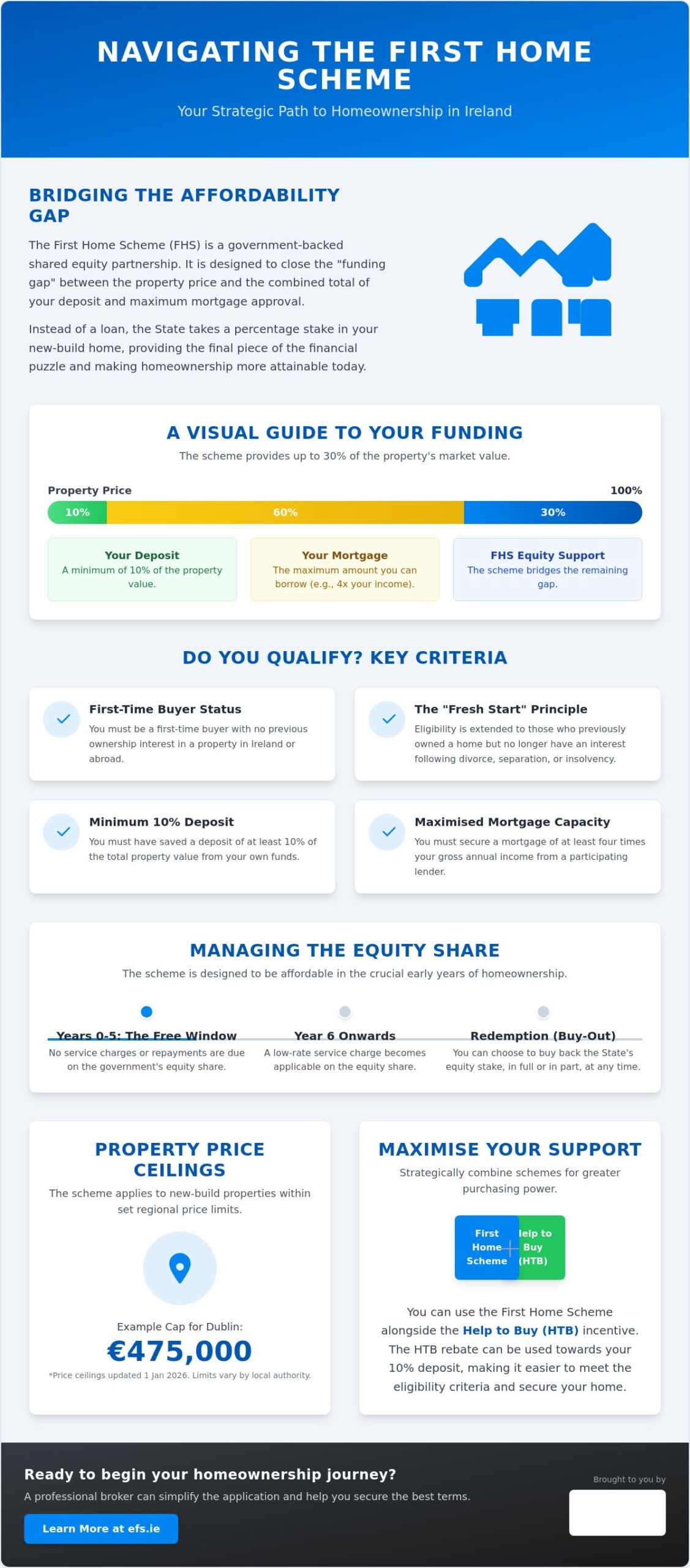
The First Home Scheme is a cornerstone of the Irish government’s 2026 “Housing for All” strategy, specifically designed to help buyers overcome the “funding gap.” This gap often appears when your 10% deposit and your maximum borrowing capacity—currently capped at four times your gross annual income by the Central Bank of Ireland—don’t quite meet the purchase price of a new-build property. Instead of forcing you to save for several more years whilst prices continue to climb, this initiative provides the necessary financial leverage to secure a home today.
By acting as a shared equity partnership between the State and participating lenders, the scheme provides the final piece of the financial puzzle. It isn’t just a temporary fix; it’s a long-term strategic tool aimed at increasing homeownership rates and providing stability in a high-demand market. This partnership ensures that the burden of high property prices doesn’t fall solely on the shoulders of individual buyers, making the transition to homeownership far more straightforward and attainable for those with steady incomes.
The Shared Equity Concept Explained
The core of the first home scheme is the shared equity model. In this arrangement, the State effectively buys a percentage stake in your new home. It’s important to distinguish this from a second mortgage or a traditional loan. Unlike a mortgage, there are no monthly interest or capital repayments required on the equity share for the first five years of ownership. This “free window” is designed to protect your cash flow during the expensive initial years of owning a home. You maintain full control over the property, whilst the State’s stake remains a silent partnership that you can choose to buy out at your own pace when your circumstances allow.
Who are the Participating Lenders?
To access this support, your primary mortgage must be with one of the major retail banks or non-bank lenders currently participating in the scheme. These institutions have integrated the equity support into their lending processes, ensuring a coordinated approach to your home purchase. Navigating the specific requirements of each lender can be complex, but aligning your application with the right provider is essential for a successful outcome. If you’re currently exploring your options, our guide on First Time Buyer Mortgage Ireland provides a detailed look at how to prepare your finances and choose a lender that supports these state initiatives. This integrated strategy ensures that your path from approval to keys is as seamless and stress-free as possible.
Eligibility Criteria: Do You Qualify for FHS Support?
Determining your eligibility for the first home scheme is the first step toward bridging your funding gap. At its core, the scheme is designed for first-time buyers who have no previous interest in a residential property, either in Ireland or abroad. You’ll need to have a minimum deposit of 10% of the property’s value and have maximised your borrowing capacity under the Central Bank’s lending rules. Currently, this means you must generally borrow four times your gross annual income before the equity support kicks in to cover the remaining balance.
The “Fresh Start” principle is a vital inclusion for those whose circumstances have changed. It ensures that individuals who previously owned a home but have since divorced, separated, or undergone insolvency are still eligible, provided they no longer hold an interest in their former residence. This compassionate approach recognises that life isn’t always linear. If you’re unsure how these rules apply to your specific situation, reviewing the detailed eligibility criteria can provide the legal clarity needed to move forward with confidence.
Property price ceilings also play a critical role. The home you intend to buy must fall within the regional price limits, which were updated on 1 January 2026 to reflect current market conditions. For instance, the cap in Dublin and certain surrounding areas currently stands at €475,000. These limits vary by Local Authority area, so it’s essential to check the specific ceiling for your preferred location to ensure your chosen property qualifies for support.
New Builds vs. Self-Builds
While most applicants use the support for new homes in private developments, the scheme also extends to those creating their own path. Self-builders can utilise the first home scheme to fund the construction of their primary residence on their own site. This is particularly beneficial in 2026 as construction costs remain a significant factor for many families. If you’re considering this route, our guide on The Ultimate Guide to Self-Build Mortgages in Ireland 2026 offers a deeper look at how to structure your financing for a successful build.
The Tenant Home Purchase Scheme
A significant development in 2026 is the increased focus on the Tenant Home Purchase option. This variant is specifically designed for tenants whose landlords have decided to sell the property they are currently renting. If you’ve received a notice of termination and wish to purchase the home, this scheme allows you to access equity support even though the property is not a “new build.” It provides a vital safety net, allowing you to stay in your community and transition from tenant to owner-occupier with minimal disruption. If you’re facing this transition, speaking with a mortgage advisor can help you navigate the “Right of First Refusal” and secure your future in your current home.
First Home Scheme vs. Help to Buy: A Strategic Comparison
Choosing between the available supports requires a clear understanding of how each mechanism impacts your long-term financial health. The primary difference lies in their structure: the Help to Buy scheme Ireland is a refund of the income tax and Deposit Interest Retention Tax (DIRT) you have paid in Ireland over the last four years, whilst the first home scheme is a shared equity partnership. One provides cash upfront to bolster your deposit; the other bridges the gap between your total funds and the property price by taking a stake in your home. Determining which to prioritise often depends on whether you need help reaching the 10% deposit requirement or if your main challenge is the four times income borrowing limit.
When you combine these supports, the rules for the equity share change. If you use the equity support alone, the State can provide up to 30% of the property’s value. However, if you also utilise the HTB incentive, the maximum equity share from the scheme is reduced to 20%. This interaction is designed to ensure a balanced level of state intervention in your purchase. By integrating these schemes, you effectively reduce the principal mortgage amount you need to borrow, which results in lower monthly repayments and makes higher-priced new builds more accessible within your current income.
Side-by-Side: FHS and HTB Features
The obligations attached to each scheme differ significantly. The HTB incentive is essentially a grant that you don’t repay, provided you live in the property as your main residence for five years. In contrast, the equity support involves a tiered service charge that begins after year five. You can find the most current rates and redemption rules on the Official First Home Scheme website. It’s also worth noting that while HTB applies to properties up to €500,000, the equity scheme is bound by regional price ceilings that may be lower depending on your location.
Maximising Your Buying Power
Consider a scenario where you are purchasing a new-build home in a regional area for €450,000. Without combined support, a couple earning €80,000 might find their €320,000 mortgage and €45,000 deposit leave an €85,000 shortfall. By utilising both schemes, the HTB could provide up to €30,000 toward the deposit, whilst the equity share covers the remaining gap. This reduces the immediate pressure on your personal savings, allowing you to allocate funds toward other essentials like closing costs for first time home buyers in Ireland. Whether you choose to buy back the equity early or manage the service charges over time, having a ten-year financial plan ensures you maintain control over your home’s future value. This strategic approach transforms a daunting purchase into a manageable, step-by-step journey toward full ownership.
Managing the Equity Share: Costs, Service Charges, and Redemption
Securing your home through the first home scheme is just the beginning of your journey. Once you’ve moved in, it’s vital to understand how the equity share functions over the long term. Unlike a traditional mortgage where you pay interest on a declining balance, this partnership involves a service charge based on the percentage of the home the State owns. This structure provides significant relief during your first few years of homeownership, allowing you to focus on your new life without the immediate burden of additional monthly costs.
The “Free Window” is a hallmark of the scheme. For the first five years, you won’t pay any service charges on the equity provided. This period ends on the sixth anniversary of your purchase. It’s a strategic breathing space that many buyers use to build up their savings or make improvements to their property. However, it’s prudent to have a plan for what happens next, as the charges are designed to encourage you to eventually buy back the State’s stake when your financial situation allows.
The Service Charge Timeline
From the start of year six, a tiered service charge applies. These rates are fixed but increase at specific milestones to reflect the duration of the partnership. Based on the 2026 guidelines, the charges are organised as follows:
- Years 6 to 15: 1.75% per annum.
- Years 16 to 29: 2.15% per annum.
- Years 30 and over: 2.85% per annum.
You can choose to pay this charge monthly or annually. Alternatively, you can let it accumulate, though this will increase the total amount you eventually owe. There are also mandatory redemption triggers to keep in mind. You must pay back the equity share if you sell the property, if it ceases to be your primary residence, or in the event of the owner’s death. Planning for these scenarios ensures that your home remains a source of security for your family rather than a source of stress.
Valuation and Market Fluctuations
The most important factor in buying back your equity is the property’s current market value. When you decide to redeem some or all of the State’s stake, the cost is calculated as a percentage of the home’s value at that specific time, not the original purchase price. This means that amongst high-demand areas where property prices are rising, the cost of “equity inflation” can be significant. If your home’s value increases by €50,000, the cost to buy back a 20% share increases by €10,000. It’s a direct reflection of the market’s performance.
To mitigate this, you can perform partial redemptions. The minimum repayment is €10,000, which allows you to slowly increase your own equity stake and reduce future service charges. This proactive approach helps you manage your long-term costs whilst your income grows. If you’re looking to restructure your finances or explore how your mortgage might change after the initial five-year period, talk to our experts about switching mortgages to find a solution that fits your evolving needs and protects your future stability.
Navigating the Application: How a Broker Simplifies the Journey
The path to homeownership often feels like a series of complex hurdles, but you don’t have to face them alone. Whilst the first home scheme offers a clear solution to the funding gap, the application process requires precise coordination between your lender, the scheme administrators, and your solicitor. A professional mortgage broker acts as your steady guide, managing the technical details so you can focus on the excitement of your new home. Securing a Mortgage Approval in Principle (AIP) is the essential first step; without it, you cannot progress with an equity support application. It’s the foundation that proves your borrowing capacity and shows you’re a serious buyer in a competitive market.
Common pitfalls often arise from simple documentation errors or a misunderstanding of how the equity share interacts with your primary loan. At Engage Financial Solutions, we coordinate directly with participating lenders to ensure your application is robust and compliant from the outset. We help you avoid the stress of back-and-forth queries by verifying your details before they reach the underwriter’s desk. This proactive management is what creates the “seamless” experience we promise, turning a potentially fragmented process into a logical, steady progression toward your keys.
Step-by-Step to FHS Approval
The journey begins with gathering your essential documentation. You’ll need your PPS number, proof of a 10% deposit, and a valid Mortgage Approval in Principle. Once these are ready, you can generate a Preliminary Certificate through the FHS portal, which outlines the maximum equity support available to you. Before you apply, it’s vital to have a clear picture of your financial boundaries. We work with you to calculate how much you can borrow as a first-time buyer, ensuring your expectations align with the current 2026 lending criteria. This clarity prevents the disappointment of falling short at the final hurdle.
Once your property is chosen and your offer is accepted, we ensure your mortgage protection in Ireland is tailored specifically to your new home’s value and your family’s needs. This isn’t just a regulatory requirement; it’s a layer of security that safeguards your future stability.
The Engage Financial Solutions Advantage
Whether you’re navigating the “Fresh Start” principle after a relationship breakdown or exploring the “Tenant Purchase” path, our approach is always personalised. We understand that every buyer’s journey is unique, and we take the time to meticulously review your scenario to find the most efficient path forward. Our commitment is to remove the friction from financial transitions, acting as the buffer between you and the complexities of the first home scheme. If you’re ready to move from anxiety to action, book a consultation with our team today to secure your financial future and take the first step toward your new front door.
Secure Your Future with Confidence
Taking the leap into homeownership in 2026 is a significant milestone, and having a clear strategy makes all the difference. By understanding how the first home scheme bridges the funding gap, you can move from feeling overwhelmed by market prices to feeling empowered by a structured equity partnership. You now have the clarity to decide which combination of supports fits your specific goals, ensuring you aren’t just buying a house, but securing a lasting home.
At Engage Financial Solutions, we specialise in first-time buyer mortgages and provide seamless application management to remove the friction from your journey. As a firm regulated by the Central Bank of Ireland, we offer the professional stewardship you need to navigate these complex state supports with ease. If you’re ready to turn your aspirations into a tangible reality, book a consultation with Engage Financial Solutions today. We are here to safeguard your interests and ensure the path to your new front door is as straightforward as possible.
Frequently Asked Questions
Is the First Home Scheme a loan that I have to pay back monthly?
No, the first home scheme isn’t a traditional loan requiring monthly capital or interest repayments. It is a shared equity arrangement where the State takes a percentage stake in your property. You won’t face any service charges for the first five years of ownership; this allows you to settle into your home without immediate financial pressure or added monthly costs.
Can I use the First Home Scheme for a second-hand house?
Standard applications are restricted to new-build properties or self-builds. However, the 2026 guidelines include a vital exception for the Tenant Home Purchase scheme. If your landlord is selling the property you currently rent, you may be eligible to use the support to purchase that specific second-hand home, provided you meet the other eligibility criteria.
What happens to the First Home Scheme if I decide to sell my house?
When you sell your property, you’re required to pay back the State’s equity share in full. The amount you repay is calculated as a percentage of the sale price or the current market value. If your home has increased in value since you bought it, the repayment amount will reflect that growth accordingly.
Does the government own my home if I use the First Home Scheme?
You remain the sole legal owner of the property and your name is on the title deeds. The government simply holds a financial interest in the form of an equity share. You’re responsible for all maintenance, insurance, and local property taxes, just as you would be with any traditional mortgage purchase.
How much can I borrow under the First Home Scheme in 2026?
The scheme can provide up to 30% of the property’s purchase price to help bridge your funding gap. If you’re also using the Help to Buy incentive, this maximum drops to 20%. The minimum contribution you can receive is 2.5% of the property value or €10,000, whichever happens to be higher.
Can I combine the First Home Scheme with the Help to Buy incentive?
Yes, you can combine both supports to maximise your buying power. This is a common strategy for many first-time buyers in 2026. Just remember that using both schemes together reduces the maximum equity share available from 30% to 20% to maintain a balanced level of state intervention in your purchase.
What are the service charges after year six?
From the beginning of year six, a tiered service charge applies to the equity share. The rate is 1.75% for years 6 to 15, rising to 2.15% for years 16 to 29. If the equity remains after 30 years, the rate increases to 2.85% to encourage the final redemption of the State’s stake.
Is there a limit on the price of the house I can buy?
Regional price ceilings are in place to ensure the support is targeted at starter homes. These limits were adjusted on 1 January 2026 to reflect current market changes. For example, the cap in Dublin and surrounding areas is €475,000, whilst other regions have lower limits based on local property data and affordability.
Disclaimer
Engage Financial Services LTD T/A Engage Financial Solutions is regulated by the Central Bank of Ireland CRO 764570. Director David Moore. Suite 2 First Floor, 14 -18 Main street, Blackrock, Co Dublin A94 W0Y3